
Sales QBR: Agenda and Template for Sales Teams

Sarah Johnson
Writes about field sales, meeting notes and voice-first workflows at ParrotNotes. Every article is reviewed by the ParrotNotes product team before it goes live.
Table of Contents
- 1.What is a sales QBR?
- 2.The sales QBR agenda: 90 minutes, timed
- 3.The rep's one-page sales QBR prep template
- 4.A filled-in example: one rep's QBR from a quarter of meeting records
- 5.How to run the sales QBR so it ends in decisions
- 6.The customer-facing QBR: how it differs
- 7.Build the sales QBR from the quarter's records, not memory
- 8.Run a sales QBR that ends in a forecast you believe
Slide 14 of 31. Jonah, a field rep with 40 accounts, is 25 minutes into his quarterly review. "Thornbury is close," he says. "I'd put it at 80% for next quarter."
His manager asks the only question that matters: "What did they say?" Jonah pauses. "They seemed keen." The quarter had 34 customer visits in it, and every one is now a feeling.
That's what a sales QBR turns into when it's built from memory: impressions dressed up as forecasts, and a manager who leaves the room knowing no more than when they walked in.
The fix isn't a longer deck. This guide gives you a timed 90-minute internal QBR agenda for a whole team, a one-page prep template each rep fills in beforehand, and a filled-in example built from a quarter of dated debriefs. There's also a section on the customer-facing QBR, because the term means two different meetings.
What is a sales QBR?
A sales QBR (quarterly business review) is a meeting held once a quarter in which each sales rep presents their territory's results, the deals that decided them, and their pipeline and forecast for the coming quarter to their manager and leadership. The same term is also used for the customer-facing QBR, where an account manager reviews the quarter with a client; that version is covered further down.
HubSpot's definition calls it "a presentation where sales reps and managers are given a forum to discuss their previous quarter's performance with higher-ups." The word to watch is "presentation." The best QBRs are conversations.
| Internal sales QBR | Customer QBR | |
|---|---|---|
| Who runs it | Sales manager | Account manager or customer success |
| Who presents | Each rep, in turn | The vendor, to the customer |
| Subject | Territory results, pipeline, forecast, what the rep needs | Value delivered, the customer's goals, joint plan |
| Length | 90 minutes for a team | 45 to 60 minutes per account |
| Ends with | Decisions and commitments per rep | A joint action plan sent in writing |
What a sales QBR is not
It isn't the weekly pipeline review or the monthly forecast meeting; our sales meeting agenda templates cover the stand-up, the weekly meeting, and the monthly review. The QBR sits on top of that cadence and asks a different question: not "where is this deal?" but "what did this quarter teach us, and what will we do differently?"
The five questions every rep's QBR answers
A rep's slot in a sales QBR answers five questions:
- What did I close against quota, and what decided it? The number, then the three deals (won, lost, slipped) that made it.
- What does my pipeline say about next quarter? Coverage against quota, and which deals have evidence behind their close dates.
- What did I learn? One pattern from the quarter's meetings, with dates.
- What will I do differently? One change, specific enough to check in 90 days.
- What do I need? One ask.
The agenda and template below get those five answers out of every rep in 12 minutes.
The sales QBR agenda: 90 minutes, timed
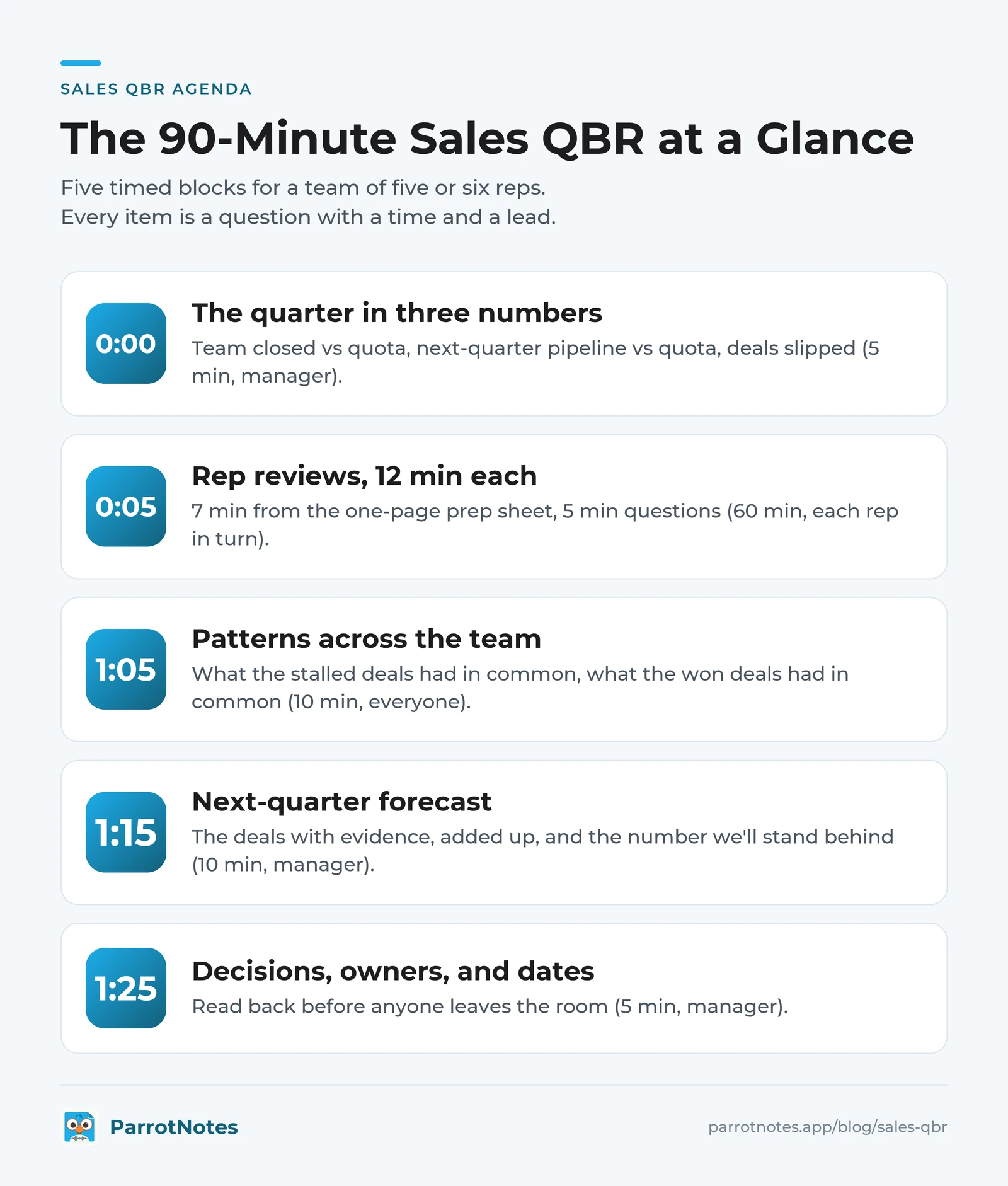
This agenda is for a manager with five or six field reps. Every item is a question with a time and a lead, so the record can follow the agenda. Send it a week ahead with the prep template.
SALES QBR (90 min)
Quarter under review:              Next quarter:              Date:
Goal: leave with a forecast we believe, one commitment per rep, and three team decisions

0:00  The quarter in three numbers: team closed vs quota, next-quarter pipeline vs quota, deals slipped (5 min, manager)
0:05  Rep reviews, 12 min each: 7 min from the one-page prep sheet, 5 min questions (60 min, each rep in turn)
        Rep 1  0:05   Rep 2  0:17   Rep 3  0:29   Rep 4  0:41   Rep 5  0:53
1:05  Patterns across the team: what the stalled deals had in common, what the won deals had in common (10 min, everyone)
1:15  Next-quarter forecast: the deals with evidence, added up, and the number we'll stand behind (10 min, manager)
1:25  Decisions, owners, and dates, read back (5 min, manager)
Twelve minutes is enough if the rep presents from the one-page sheet rather than a deck. Seven minutes covers five questions with one answer each; the other five is where the manager earns the meeting.
Bigger teams split, they don't squeeze. Eight reps at 12 minutes is 96 minutes of reviews alone. Run two sessions of four reps, with the patterns and forecast items in the second. Cutting slots to six minutes turns evidence back into impressions.
To get the whole 90 minutes on record without anyone typing, put a phone running ParrotNotes on the table. Try ParrotNotes free and the meeting gets a transcript, an AI summary, and its action items.
The rep's one-page sales QBR prep template
Send this to every rep with the agenda. It's one page on purpose: a rep who can fill it in understands their quarter, and one who can't finds that out a week early rather than in front of the room.
SALES QBR PREP SHEET: [Rep name], [Territory], [Quarter]
Send to your manager by [date, five working days before the QBR]

1. THE NUMBER
   Closed:  $          Quota:  $          Attainment:      %
   Visits this quarter:          Recorded debriefs:

2. THE THREE DEALS THAT DECIDED IT
   Won:      [Account, value] Why we won, in the customer's words (date):
   Lost:     [Account, value] Why we lost, in the customer's words (date):
   Slipped:  [Account, value] What changed, and when we found out (date):

3. NEXT-QUARTER PIPELINE
   Pipeline: $          Quota: $          Coverage:      x
   Deals with evidence (a customer action or their exact words, with a date):
     a. [Account, value, close date] Evidence:
     b. [Account, value, close date] Evidence:
     c. [Account, value, close date] Evidence:
   Deals without evidence yet (listed, not forecast):

4. THE PATTERN
   One thing that came up in three or more meetings this quarter, with dates:

5. ONE CHANGE
   What I'll do differently next quarter, and how we'll know by [date]:

6. ONE ASK
   What I need from my manager, the company, or another team, and by when:
The evidence rule is the whole template. In section 3, a deal only counts as forecast if the rep can write down a customer action (a purchase order requested, a signed pilot, a date in the buyer's calendar) or the customer's exact words, dated. "They're keen" doesn't qualify. "The GM said on August 28: we open November 3 and I need ovens commissioned by October 20" does.
That rule separates a forecast from a hope. A forecast built on dated debriefs can be checked; a forecast built on how the rep feels about the deal can only be argued with.
If your team runs a qualification method, section 3 is where it shows: a deal with a named economic buyer and a known paper process has evidence, and our MEDDPICC guide shows what each looks like on a real deal.
A filled-in example: one rep's QBR from a quarter of meeting records
The example below is invented to show the template working: the rep, the accounts, and the quotes don't exist, and the numbers are chosen to make the points, not to prove anything about real teams.
Tessa Okafor sells commercial kitchen equipment to hotels, restaurant groups, and caterers in a northern territory. She made 31 customer visits in the third quarter and dictated a debrief after every one, in the car, before the next stop. She built her prep sheet by searching those 31 debriefs rather than by trying to remember July.
SALES QBR PREP SHEET: Tessa Okafor, North, Q3 (Jul-Sep)

1. THE NUMBER
   Closed: $388,000   Quota: $420,000   Attainment: 92%
   Visits this quarter: 31   Recorded debriefs: 31

2. THE THREE DEALS THAT DECIDED IT
   Won: Harbor Lane Hotels, $96,000 (combi ovens, three kitchens)
     Why we won (Jul 22 debrief): the executive chef said "your engineer was the
     only one who asked what we cook on Sunday brunch."
   Lost: Cedar & Vine restaurant group, $54,000 (refrigeration, four sites)
     Why we lost (Sep 9 debrief): ops director said "we went with the supplier who
     put a four-hour service response in writing. Yours said 'usually same day'."
   Slipped: Meridian Catering, $71,000 (full kitchen fit-out)
     What changed (Aug 28 debrief): site opening moved from Sep 15 to Nov 3 after
     a building inspection. GM: "I still need ovens commissioned by October 20."

3. NEXT-QUARTER PIPELINE
   Pipeline: $1,080,000   Quota: $450,000   Coverage: 2.4x
   Deals with evidence:
     a. Meridian Catering, $71,000, close Oct 10. Evidence: Aug 28, GM's words above;
        deposit invoice requested Sep 19.
     b. Northgate Schools Trust, $120,000, close Oct 30. Evidence: tender document
        received Sep 12; decision date Oct 30 stated on page 2.
     c. Bluebird Bakeries, $38,000, close Oct 8. Evidence: Sep 24 debrief, owner said
        "send me the PO form, I'll sign it this week."
   Deals without evidence yet: Wren & Co ($210,000; no decision-maker met yet),
   Portside Hotel ($64,000; "reviewing budgets in Q4").

4. THE PATTERN
   Service response time came up in 6 of 31 debriefs (Jul 8, Jul 22, Aug 4,
   Aug 19, Sep 9, Sep 24). We won when the service engineer was in the room and
   lost when the promise was verbal.

5. ONE CHANGE
   Bring the service engineer to the second visit on every multi-site
   opportunity. Check on Dec 15: how many second visits had the engineer present?

6. ONE ASK
   A written 24-hour service-response commitment from operations for accounts
   over $50,000, by Oct 15, so it can go in the Wren & Co proposal.
The forecast is three named deals adding up to $229,000, each with a date and a source, plus two deals honestly listed as "not yet." The pattern isn't a feeling about service; it's six dated conversations. And the ask is specific enough that her manager can say yes or no in the room.
Tessa's 12 minutes went mostly on section 4. Two other reps had lost on the same thing, so the Cedar & Vine quote went into the team's patterns item, and the written service commitment became a team decision.
How to run the sales QBR so it ends in decisions
Picture a manager, Ravi Mehta, whose first QBRs were a four-hour slideshow: 30 slides per rep, most of them CRM screenshots, ending when the room's booking did. Nobody could say afterwards what had been decided, because nothing had. His second attempt used the agenda above, and the difference wasn't the length: every slot ended in a question he'd prepared.
Questions a manager asks in a sales QBR
Use the five minutes after each rep's seven for these, and skip the ones the sheet already answers:
- "What did the customer say, and when?" for any forecast deal without a quote or an action against it
- "What was the first sign?" for the lost deal: usually a remark from weeks before the loss
- "Who haven't you met yet?" for the largest deal without evidence
- "What would make this a no?" for the deal the rep is most confident about
- "What's the smallest version of your ask that I could say yes to today?"
The lost deal is where the QBR pays for itself as coaching. Salesforce's State of Sales statistics report that 75% of sales reps say they're more likely to hit their targets with a coach or mentor, and a QBR that finds the first sign of a loss in the rep's own records is a coaching conversation with the evidence already on the table. The follow-up belongs in a one-on-one; our guide to AI sales coaching has a 30-minute agenda for it built from meeting records.
Record it, and read the decisions back
The last five minutes are the read-back: every decision, owner, and date said aloud in one go. If the meeting is recorded, those minutes become a clean summary at the end of the transcript, and the action list exists before anyone leaves the room.
Say so before you press record, and ask. A line at the top of the agenda does it: "This QBR will be recorded for note-taking. Tell me if you'd rather it wasn't." Recording rules vary by state and country, and this isn't legal advice: ask everyone in the room, including reps on the phone, and pause for anything confidential.
The wording that turns "we'll look at service response" into an owner and a date is in our guide on how to never miss action items from sales calls.
The customer-facing QBR: how it differs
The other meeting called a sales QBR is the one an account manager runs with a customer every quarter, and it borrows little but the name. The internal QBR is an honest diagnosis, where the lost deal gets more time than the won one. The customer QBR is a partnership meeting: the agenda is the customer's goals, and it ends in a joint plan with owners on both sides.
Sybill's comparison of the two puts the internal version at "90 minutes to two hours" and the customer version at "45 to 60 minutes," and sums it up in one line: "an internal QBR is a meeting you run to prepare your team. A customer QBR is a meeting you run to serve your customer."
In 45 minutes, that means: the goals agreed last quarter, results against them in the customer's numbers, what got in the way on both sides, the customer's next 90 days in their words, and a joint plan of three actions with owners and dates.
Both meetings are only as good as the record of the quarter behind them. An account manager who dictated a note after every customer conversation can open with "in July you told us the night shift was the problem," which beats opening with a usage chart. The recap goes out the same day; our follow-up email templates include one for meetings with several stakeholders.
Build the sales QBR from the quarter's records, not memory
Every template above assumes the rep has a record of the quarter to build from. Most don't. Salesforce's statistics page reports that sales reps spend 60% of their time on non-selling tasks, and writing up 31 visits is the non-selling task that gets pushed to Saturday, then to never.
The fix is to make the record a by-product of the visit. Here's the workflow behind Tessa's sheet.
After every meeting, a two-minute spoken debrief. Before starting the car, open ParrotNotes, hit record, and talk: who was there, what they said that matters (in their words), what was decided, what was promised on each side, and where the deal stands. Recording continues with the screen locked, and two minutes of talking becomes a transcript, an AI summary, and the action items with owners.
Recorded the meeting itself? If everyone agreed to it, the transcript is the record, in the customer's exact words. On Pro, speaker identification labels who said what, and the sales frameworks (BANT, MEDDIC, SPIN) sort a discovery recording by qualification question, which is the evidence section 3 asks for.
At quarter end, search instead of remembering. Every debrief is searchable, so "service" brings up all six conversations where response time came up, with dates. On Pro, AI chat answers the prep sheet's questions directly: "What did Cedar & Vine say about why they chose another supplier?" returns the sentence from September 9.
In the QBR itself, one phone on the table. With permission from the room, the 90 minutes become a transcript, a summary, and the decisions list. Three weeks later, when a director asks what was decided about service, the manager asks the recording.
The free plan gives you 100 minutes of recording a month, up to 30 minutes per recording, with an AI summary on every recording and AI action items on five recordings a month. ParrotNotes Pro records up to 3 hours at a time, covering the full QBR, with 3,000 minutes a month, AI on every recording, speaker identification, frameworks, and AI chat, for $19.99 a month or $14.99 a month billed annually.
Recordings of customer conversations are sensitive, so read how ParrotNotes protects your data before the first debrief. For phone and video calls, don't try to record the call; dictate the debrief straight afterwards.
Want next quarter's QBR built from evidence? Download ParrotNotes free and have every rep start the two-minute debrief on Monday. By the QBR, the prep sheet fills itself in.
Run a sales QBR that ends in a forecast you believe
A sales QBR is worth 90 minutes of a whole team's time only if it ends in what the weekly and monthly meetings can't produce: a forecast built on evidence, one change per rep, and decisions with owners and dates.
Here's the short version:
- Give each rep a timed 12-minute slot: seven minutes from a one-page sheet, five of questions
- Apply the evidence rule: a deal is forecast only with a customer action or their exact words, dated
- Spend the questions on the lost deal and the largest deal without evidence
- Keep the customer QBR separate: the customer's goals, and a joint plan in writing
- Build the sheet from a record of the quarter, made two minutes at a time after each visit
Copy the agenda, send the prep sheet, and give your reps a way to keep the record. Download ParrotNotes free, and "they seemed keen" becomes a quote with a date on it.
Frequently Asked Questions
What is a sales QBR?
A sales QBR, or quarterly business review, is a meeting held once a quarter where each rep presents their territory's results against quota, the deals that decided them, their pipeline and forecast, and what they need, to their manager and leadership. The same name is used for the customer-facing QBR an account manager runs with a client.
How long should a sales QBR be?
Ninety minutes works for a team of five or six reps: five minutes of team numbers, 12 minutes per rep, 10 on patterns, 10 on the forecast, and five to read back decisions. Larger teams should split into two sessions rather than cut each rep's slot. A customer-facing QBR runs 45 to 60 minutes.
What should a rep present in a sales QBR?
Five things, from a one-page sheet rather than a deck: the number closed against quota and the three deals that decided it; next-quarter pipeline with evidence for each forecast deal; one pattern from the quarter's meetings; one change; and one ask. Evidence means a customer action or their exact words, with a date.
What is the difference between a sales QBR and a customer QBR?
An internal sales QBR is run by the sales manager, with each rep presenting their quarter, and ends in decisions for the team. A customer QBR is run by an account manager with a client, reviews the value delivered against the customer's goals, and ends in a joint action plan.
How do you prepare for a sales QBR?
Send the agenda and the one-page prep sheet a week ahead, and ask for completed sheets five working days before the meeting. Reps fill the sheet from their records of the quarter (call reports, debriefs, or recordings), not from memory. The manager reads every sheet in advance and prepares one question per rep.
Related Posts
How to Build a Sales Playbook From Your Team's Real Calls
Build a sales playbook from your team's real customer meetings: the sections it needs, a six-step method, a template, and one play built from three debriefs.

SaaS Sales: How It Works and How Reps Track Every Conversation
What is SaaS sales? Learn the subscription model, PLG vs sales-led, SDR/AE/CSM roles and the demo-to-renewal cycle, plus a deal log to track every call.
Otter.ai Alternatives for In-Person Meetings (7 Options Compared)
Looking for an Otter.ai alternative that works in a room, not on Zoom? Seven options scored on bots, minute caps and phone apps, prices checked Sept 2026.