
Sales Meeting Agenda: Templates for Weekly Team Meetings

Sarah Johnson
Writes about field sales, meeting notes and voice-first workflows at ParrotNotes. Every article is reviewed by the ParrotNotes product team before it goes live.

Table of Contents
- 1.What a sales meeting agenda needs that a general agenda doesn't
- 2.Which sales meeting agenda to use
- 3.Sales meeting agenda 1: the 15-minute pipeline stand-up
- 4.Sales meeting agenda 2: the 45-minute weekly sales team meeting
- 5.Sales meeting agenda 3: the 60-minute monthly field review
- 6.Sales meeting agenda 4: the 20-minute deal clinic
- 7.The rep prep card: three lines before every sales meeting
- 8.Run the sales meeting so the record writes itself
- 9.Send the sales meeting agenda on Friday, and read the recap on Monday
It's 8:00 on Monday morning. Nadia, who runs six commercial HVAC reps out of a branch office, has four of them in the room and two on speaker from their trucks. She opens the same way she has for two years: "Let's go round the room."
Forty minutes later, everyone has talked, the dashboard has been read aloud, and nobody has written anything down. By Wednesday, the one decision that mattered, who takes over the hospital account, has already been remembered two different ways.
Nadia's problem isn't discipline. It's that she's running a general staff meeting with a sales team. A sales meeting agenda has to do a different job: move deals, fix forecasts, coach people you rarely see in action, and end with owners and dates that survive the drive home.
This guide gives you four copy-ready agendas for a field team: a 15-minute pipeline stand-up, a 45-minute weekly sales team meeting, a 60-minute monthly field review and a 20-minute deal clinic. You also get a three-line prep card each rep sends beforehand, and a way to run the meeting so the record writes itself.
What a sales meeting agenda needs that a general agenda doesn't
Our guide to the meeting agenda template covers the general craft: write every item as a question, label it inform, input or decide, give it a time and a lead. Those rules still apply here. What changes is the raw material.
A sales meeting has four kinds of content, and a good sales meeting agenda gives each its own slot:
- Numbers. Where the team stands against quota this month, and which reps are ahead or behind
- Deals. The three to five opportunities that need a decision, a resource or a push this week
- Coaching. One skill, one objection or one call worth ten minutes of the whole team's time
- Territory. Route changes, account handovers, new accounts, competitor sightings
Most sales meetings fail because they try to do all four for every rep, every week. That turns into a status readout, and reps stop listening the moment their own turn is over.
The evidence says the readout habit is expensive. In Atlassian's Workplace Woes: Meetings Edition, a survey of 5,000 knowledge workers across four continents, respondents rated meetings ineffective 72% of the time, and 54% said they frequently leave without a clear idea of next steps. The same survey found 62% often attend meetings that didn't state a goal in the invite, and 79% said an agenda leads to a more productive meeting.
For a field team the stakes are higher still. Salesforce's State of Sales statistics put it plainly: sales reps spend 60% of their time on non-selling tasks. Your Monday meeting is one of them. If it costs six reps 45 minutes each, that's four and a half selling hours, so it had better change something.
Two rules follow from this, and every agenda below is built on them:
- One meeting, one purpose. The stand-up moves deals. The weekly meeting aligns the team. The monthly review looks at patterns. The deal clinic rescues one opportunity.
- Nothing leaves without an owner and a date. The last item on every agenda is a read-back of decisions, owners and due dates.
If you'd rather not be the person writing those down while also chairing, a phone running ParrotNotes on the table captures the whole meeting and pulls out the action items for you. You can try ParrotNotes free before your next Monday.
Which sales meeting agenda to use
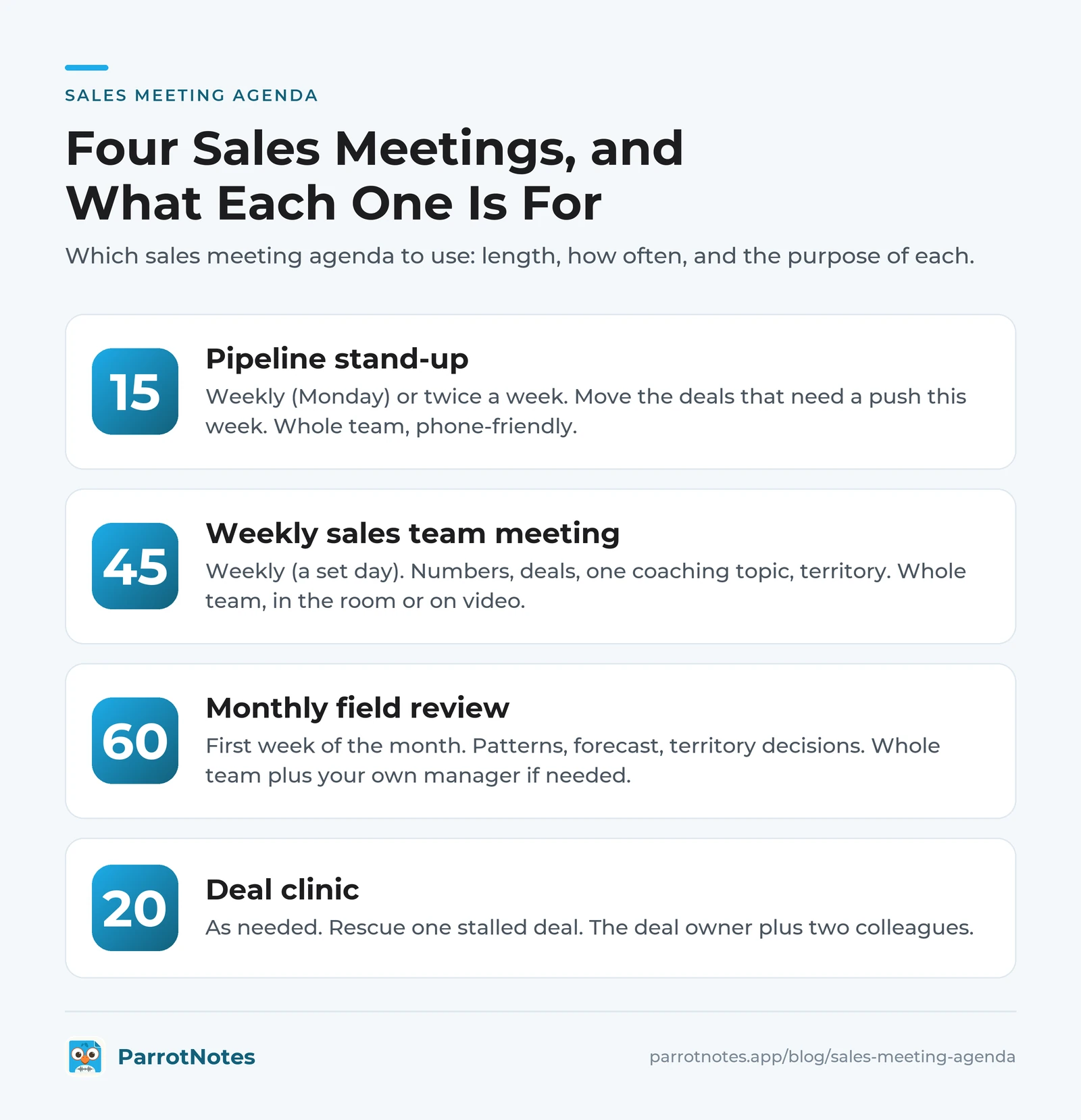
Pick the format by what the meeting has to produce, not by habit. Here's the cadence that works for a team of four to ten reps who spend most of their week on the road.
| Meeting | Length | How often | Purpose | Who |
|---|---|---|---|---|
| Pipeline stand-up | 15 min | Weekly (Monday) or twice a week | Move the deals that need a push this week | Whole team, phone-friendly |
| Weekly sales team meeting | 45 min | Weekly (a set day) | Numbers, deals, one coaching topic, territory | Whole team, in the room or on video |
| Monthly field review | 60 min | First week of the month | Patterns, forecast, territory decisions | Whole team plus your own manager if needed |
| Deal clinic | 20 min | As needed | Rescue one stalled deal | The deal owner plus two colleagues |
You'll notice the quarterly business review isn't on the list. A QBR is a different animal, with its own prep and its own template, and it deserves its own article. The four formats here are the meetings that run your week and your month.
Now the agendas. Each one is written as questions, because a question tells the rep what to prepare and tells everyone when the item is done. Roger Schwarz, whose advice on designing an effective meeting agenda first ran in Harvard Business Review in 2015, makes the same point: "office space reallocation" is a topic, but "under what conditions, if any, should we reallocate office space?" is an agenda item.
Sales meeting agenda 1: the 15-minute pipeline stand-up
Use this on Monday morning, or Monday and Thursday if your sales cycle is short. A sales stand-up works over the phone from a truck, which matters for a field team. Nobody presents. Each rep answers three questions about the deals that need a push this week, and you write down what you owe them.
PIPELINE STAND-UP (15 min)
Goal: every deal due to close this month has a next step by 8:15

0:00  Quick wins since last stand-up: what closed, what moved a stage? (2 min, everyone, one line each)
0:02  Deals due this month: for each, what's the next step, who owns it, and when? (8 min, deal owner)
      - Only deals with a close date in the next 30 days
      - Skip any deal that moved since last week and has a next step already
0:10  Stuck deals: which deal has had no customer activity for 14+ days, and what unblocks it? (3 min, deal owner)
0:13  What do you need from me this week? (2 min, everyone, one ask each)
0:15  Close: read back owners and dates (manager)
The 14-day rule is the useful part. A deal with no customer activity for two weeks isn't "in progress", whatever the CRM stage says. Asking the question out loud every Monday means stalled deals get named early, while there's still something to do about them.
Keep the stand-up at 15 minutes even when it's tempting to go longer. Any deal that needs more than 90 seconds gets a deal clinic (agenda 4) instead.
Sales meeting agenda 2: the 45-minute weekly sales team meeting
This is the meeting most people mean when they search for a weekly sales meeting agenda. It runs once a week on a fixed day, in the room or on video. A sales team meeting agenda that works covers all four kinds of content with a hard stop.
WEEKLY SALES TEAM MEETING (45 min)
Goal for this week (one sentence):

0:00  Last week's action items: done, not done, or dropped? (5 min, manager reads the list)
0:05  Wins and lessons: what closed, and what did the customer say that we can reuse? (5 min, everyone)
0:10  Numbers: where are we against quota this month, and which three deals decide whether we hit it? (5 min, manager)
0:15  Deal review: for the three deals named above, what has the customer done since last week, who's championing it on their side, and what could kill it? (10 min, deal owners)
0:25  Coaching segment: one skill, objection or call for the whole team. What worked, what didn't, what will we say next time? (10 min, rotating rep leads)
0:35  Territory and accounts: any route changes, handovers, new accounts or competitor sightings? (5 min, everyone)
0:40  Recap: decisions, owners and due dates, read aloud (5 min, manager)

Parking lot (topics that get their own meeting):
Three design choices make this work for a field team.
Last week's action items come first. If the list isn't reviewed, it dies quietly and reps learn that commitments made in this meeting don't count. Five minutes at the top fixes that. Our guide on how to never miss action items covers the owner-and-date habit in more detail.
Deal review is limited to three deals. Not every rep's whole pipeline. The three that decide whether the team hits the month. Everyone else's deals live in the stand-up.
The coaching segment has a rotating lead. Once a month, each rep brings one real conversation: a discovery call that went sideways, an objection they handled well, a price question they fumbled. Ten minutes of the whole team thinking about one moment is worth more than a generic training slide. If you've already got meeting recordings from the field, our piece on AI sales coaching shows how to pick the moment worth bringing.
A filled-in weekly sales meeting agenda
Here's what Nadia's Monday agenda looks like once it's built this way. She sends it on Friday afternoon, so reps can prepare over the weekend or in the truck on Monday morning.
| Time | Item | Lead |
|---|---|---|
| 8:00 | Last week's 7 action items: done, not done, dropped? | Nadia |
| 8:05 | Wins: Riverside Medical signed the two-building maintenance contract. What did the facilities director say about response time that we can reuse? | Theo |
| 8:10 | Numbers: 68% of quota with 9 selling days left. Three deals decide the month: Harbor Logistics, St. Anne's school district, Copper Ridge apartments | Nadia |
| 8:15 | Deal review: for those three, what has the customer done since last Monday, who's our champion, what could kill it? | Theo, Priya, Marcus |
| 8:25 | Coaching: the "we'll wait for the next budget cycle" objection. Marcus plays back what happened at Copper Ridge; what do we say next time? | Marcus |
| 8:35 | Territory: who takes the hospital account when Priya moves to the north route on October 1? | Everyone |
| 8:40 | Recap: decisions, owners, dates | Nadia |
| Parking lot | Truck stock levels for the new compressor line (own meeting with the warehouse, Thursday) |
Notice the hospital-account question. It's the decision that got remembered two different ways in the old meeting. Now it's a named item with a decision slot, and it will be read back at 8:40 with an owner and a date.
Sales meeting agenda 3: the 60-minute monthly field review
The weekly meeting looks at this week's deals. The monthly sales meeting agenda looks at the patterns those deals make: which stages deals stall in, which territories are thin, whether the forecast is built on evidence or on hope. It runs in the first week of the month, in person if you can manage it.
MONTHLY FIELD REVIEW (60 min)
Goal: leave with a forecast we believe and three territory decisions

0:00  Last month by the numbers: what did we close against quota, and what did each rep close? (10 min, manager)
0:10  Pipeline health: how much pipeline do we have for next month against target, and how much of it has customer activity in the last 30 days? (10 min, manager)
0:20  Where deals stall: which stage did last month's lost and stuck deals stall in, and what was the common reason? (10 min, everyone)
0:30  Forecast: for every deal forecast to close next month, what evidence supports the close date? (15 min, deal owners)
0:45  Territory decisions: which accounts, routes or handovers change next month, and who owns each change? (10 min, everyone)
0:55  Recap: forecast number, territory decisions, owners and dates (5 min, manager)
The forecast item is where a monthly review earns its hour. "What evidence supports the close date?" is a different question from "are you confident?". Evidence is a customer action: a signed pilot, a date in the buyer's calendar, a purchase order number requested. Confidence is a feeling.
A forecast built on the first is one you can take to your own manager.
The "where deals stall" item is also where coaching gets its evidence. If three deals stalled at the proposal stage in the same month, that's a coaching topic for the next four weekly meetings, not three separate rep problems. If you're considering tools to see those patterns across meetings you weren't in, our buying guide to sales coaching software has a scorecard built for field teams.
Picture Nadia's first monthly review run this way. The stall question surfaces something the weekly meetings never did: four deals in three months went quiet after the site survey, because the survey report took two weeks to reach the customer. That's not a rep problem, it's a process problem, and it becomes a territory-slot decision with the operations lead as owner and a two-week fix date.
Sales meeting agenda 4: the 20-minute deal clinic
A deal clinic is the pressure valve for the other three meetings. Whenever a deal needs more than 90 seconds in a stand-up, or would take over the weekly deal review, it gets its own 20 minutes with the deal owner and two colleagues who've sold into similar accounts. It can be run in a branch office, on a video call, or on the phone from a customer car park.
DEAL CLINIC (20 min)
Deal:                       Owner:                       Value:                  Close date:

0:00  The story so far: who have we met, what have they told us, what have they done? (5 min, deal owner, no slides)
0:05  Where it's stuck: what was supposed to happen, and what happened instead? (3 min, deal owner)
0:08  What we don't know: who's the economic buyer, what's their decision process, who else are they talking to? (5 min, colleagues ask, owner answers or says "don't know")
0:13  Three moves: what are the three actions most likely to restart this deal, and which one goes first? (5 min, everyone)
0:18  Commit: the one move, the owner, the date, and when we check back (2 min, deal owner)
The "what we don't know" item is the heart of it. Stalled deals are usually stalled because a question was never asked: who signs, what the paper process is, whether there's a competitor in the building. Two colleagues asking those questions cold will find the gap faster than the deal owner can alone. If your team runs a qualification method, the MEDDPICC note template gives you the eight questions to work through in that five minutes.
Here's how it played out for Luis, one of Nadia's reps, with a distributor deal that had sat at "proposal sent" for six weeks. In the clinic, Priya asked who at the distributor had read the proposal. Luis didn't know.
The one move was a call to the branch manager to ask for 15 minutes with the person who'd approve it. The deal restarted the following week, with a different contact and a revised close date that the forecast could believe.
Ready to keep every one of these meetings on record? Put a phone running ParrotNotes on the table and get a transcript, a summary and the action items without anyone typing. Download ParrotNotes free and try it at your next stand-up.
The rep prep card: three lines before every sales meeting
The best sales meeting agenda in the world stalls if reps arrive to think out loud. The fix is a prep card: three lines each rep sends you (by message, or as a 60-second voice note) by 5:00 PM the day before. It takes them two minutes, and it means you walk in already knowing where the meeting needs to go.
REP PREP CARD (send by 5:00 PM the day before)
1. My one deal that needs the team this week, and what's stuck:
2. My one ask (from the manager, from a colleague, from another department):
3. My one win or lesson worth 60 seconds of everyone's time:
Three things happen when you use it. The deal review writes itself: you pick the three deals from six cards instead of asking the room. The "what do you need from me" item stops being a surprise, so you can turn up with an answer. And quiet reps get the same airtime as loud ones, because you're choosing items from cards, not from whoever speaks first.
For reps on the road, a spoken card works better than a typed one. A rep can dictate three lines in the car park after the last visit of the day, and a voice note app turns it into text you can read at your desk. ParrotNotes does this on the free plan: every recording gets a transcript and an AI summary, with 100 minutes of recording a month and up to 30 minutes per recording.
If the rep is dictating a customer conversation from memory, the same recording can also produce a drafted follow-up email, so the prep card and the customer follow-up come from one 60-second note. Our library of follow-up email templates shows what that email should look like.
Run the sales meeting so the record writes itself
An agenda written as questions is the outline of the meeting's record. If the record fills in against the questions, the recap at the end is a formality and the action list exists the moment the meeting ends. That takes a few habits, and a recording.
Before you record, say so and ask. A line at the top of the agenda works: "This meeting will be recorded for note-taking. Tell me if you object." Recording rules vary by state and country, this isn't legal advice, and a confidential item can be taken with the recorder paused.
Reps joining by phone should hear the same line.
Then run the meeting so the recording can follow the agenda:
- Read each item aloud as you open it. "Item three: numbers. We're at 68% with nine selling days left." The transcript now has headings.
- Use names and deal names. "Theo, where's Harbor Logistics since last Monday?" tells the record who's speaking and which deal they mean.
- Say every decision as a sentence. "Decision: Marcus takes the hospital account from October 1, and Priya does the handover visit with him."
- Say the owner and the date together. "Marcus owns the introduction email, due Friday the 3rd."
- Park things out loud. "Truck stock is going to the parking lot for Thursday."
- Read the recap. The last five minutes become a clean summary of the whole meeting, in the last minutes of the recording.
With a phone running ParrotNotes in the middle of the table, the meeting becomes a transcript, an AI summary and a list of action items you can paste into the next week's first agenda item. Recording carries on with the screen off, so the phone can sit face down. Two reps on speaker from their trucks are part of the same recording.
On the free plan, ParrotNotes records up to 30 minutes at a time, which covers the stand-up and the deal clinic, with an AI summary on every recording and AI action items on five recordings a month. For the 45-minute weekly meeting and the hour-long monthly review, ParrotNotes Pro records up to 3 hours at a time, with 3,000 minutes a month and AI action items on every recording. Pro costs $19.99 a month, or $14.99 a month billed annually.
AI chat is the part a sales manager ends up using most. Three weeks after the monthly review, when Nadia's own manager asks what was decided about the north route, she asks the recording, "What did we decide about Priya's territory change?" and gets the decision, the owner and the date back in seconds. She doesn't have to trust that someone wrote it down, because the meeting itself is the record.
Send the sales meeting agenda on Friday, and read the recap on Monday
A sales meeting agenda that works for a field team does four things: separates the stand-up, the weekly meeting, the monthly review and the deal clinic; writes every item as a question with a time and a lead; asks reps for three lines before the meeting; and ends with owners and dates read aloud.
Here's the short version:
- Run a 15-minute pipeline stand-up for deals that need a push, and limit the weekly deal review to the three deals that decide the month
- Give coaching a 10-minute slot with a rotating rep lead, and let the monthly "where deals stall" item choose the topic
- Ask for a three-line prep card by 5:00 PM the day before, spoken or typed
- Say decisions, owners and dates aloud, and record the meeting so the action list exists before anyone leaves the room
Copy the weekly sales meeting agenda template above, fill in your own three deals for this month, and send it on Friday. Then put a phone on the table on Monday. Download ParrotNotes free and your next sales meeting agenda will come with its own record.
Frequently Asked Questions
What should a sales meeting agenda include?
A sales meeting agenda should include a review of last week's action items, wins and lessons, the team's numbers against quota, a review of the three to five deals that decide the month, one coaching topic, territory and account changes, and a five-minute recap of decisions, owners and due dates. Write each item as a question with a time and a lead.
How long should a weekly sales meeting be?
Forty-five minutes with a hard stop is enough for a team of four to ten reps if deal review is limited to three deals and everything else goes to a 15-minute stand-up or a 20-minute deal clinic. Meetings that run past an hour usually do so because every rep is reading out their whole pipeline.
How often should a sales team meet?
A field team does well with a 15-minute pipeline stand-up on Monday, one 45-minute team meeting a week, and a 60-minute review in the first week of each month. Add a 20-minute deal clinic whenever a single deal needs more time than a stand-up allows. Quarterly reviews sit on top of this cadence.
What is the difference between a sales meeting agenda and a pipeline review?
A pipeline review is one kind of sales meeting, focused only on deals: their stage, their next step and their close date. A weekly sales meeting agenda covers deals too, but also numbers, coaching and territory. Most teams run the pipeline review as a short stand-up and keep the weekly meeting for everything else.
Related Posts

Voice Notes on iPhone: Everything You Can Do With Them
Voice notes on iPhone can do more than record. Learn to capture, tidy, transcribe, sync, and share them, and which iPhone voice tool fits each job. Try it free.

Sandler Pain Funnel Questions (With a Note-Taking Template)
The 8 Sandler pain funnel questions as Sandler publishes them, what to write down at each one, a note-taking template and a worked call. Copy it free.
RFQ Template for Manufacturers and Distributors
Copy this RFQ template for manufacturers and distributors: a buyer-side request, a supplier quote response, and one worked example filled in on both sides.