
Follow-Up Email After a Sales Call: Templates That Get Replies

Sarah Johnson
Product Manager at ParrotNotes with 5+ years of experience in productivity tools and AI technology.
Table of Contents
- 1.What a follow-up email after a sales call has to do
- 2.How to write a follow-up email after a sales call: the five-line anatomy
- 3.The 60-second dictation that writes the email for you
- 4.8 follow-up email templates for field sales calls
- 5.Subject lines for a sales call follow-up email
- 6.When the follow-up email gets no reply
- 7.Let your phone write the first draft
- 8.Send it before you start the engine
It's 2:40 PM in a customer's car park. Marcus sells corrugated packaging across three counties, and he's finished his third stop of the day: 50 minutes with a food plant's purchasing manager and its operations lead.
They liked the sample. They asked for pricing on two tray sizes and a reference. His next visit starts in 45 minutes, and it's a 20-minute drive.
So the email waits. Tonight, maybe. More likely Saturday.
The follow-up email after sales calls like this one decides whether an expensive visit turns into a next step or fades into "we'll be in touch." You already know that. What's hard is writing it on a phone, between stops, while the detail is still in your head and not yet on paper.
This guide gives you a five-line anatomy for the email, a 60-second dictation script to run before you start the engine, eight templates written for in-person meetings, subject lines you can copy, and a plan for when nobody replies.
What a follow-up email after a sales call has to do
A follow-up email after a sales call is a short written record of the conversation, sent the same day. It confirms what the buyer told you, lists what each side promised and by when, and asks one question that moves the deal to its next step. Its job is to get a reply, not to pitch again.
Most advice on this topic assumes the "call" was a video meeting and the rep is at a desk. In field sales, a call is a visit, and that changes the email in four ways:
- Nobody else has a record. A video call leaves an invite and maybe a recording. A conversation on a loading dock leaves your memory and a notebook.
- More people were in the room than are on your thread. The operations lead who asked the hardest question might not be in your contacts yet.
- Things were physical. Samples got handled, a line got walked, a doorway got measured.
- You'll write it on a phone. That rules out long paragraphs.
So the email has three jobs. It proves you listened, it puts both sides' promises in writing, and it makes replying take 10 seconds.
The second job depends on catching every commitment first. Our guide on how to never miss action items from sales calls covers that step. This article is about the email itself.
If you'd rather talk than type, try ParrotNotes free. Dictate what happened, and it gives you a transcript, a summary, action items, and a drafted follow-up email to edit.
How to write a follow-up email after a sales call: the five-line anatomy
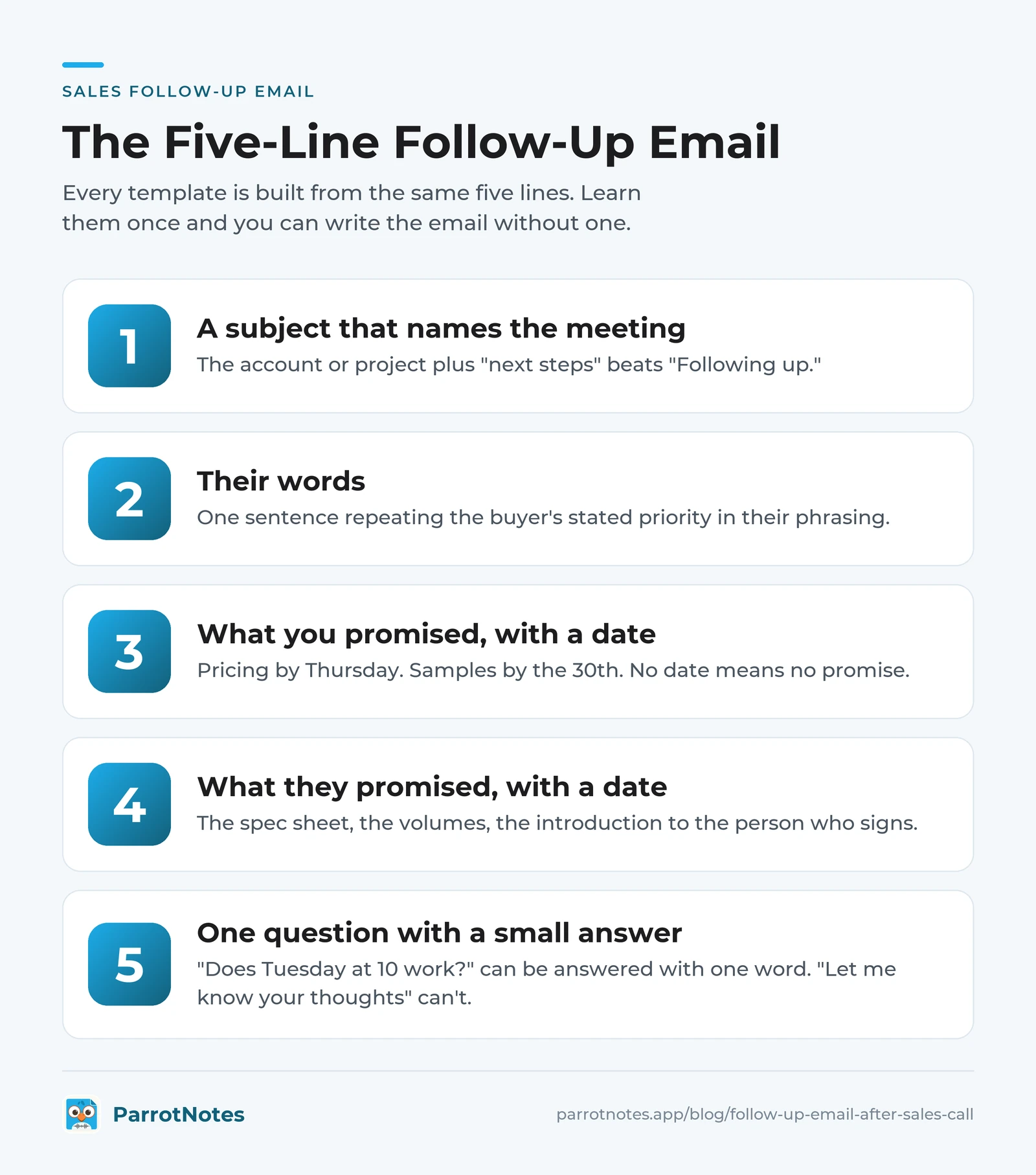
Every template below is built from the same five lines. Learn them once and you can write the email without a template.
The five lines
- A subject line that names the meeting. The account or project plus "next steps" beats "Following up."
- Their words. One sentence repeating the buyer's stated priority in their phrasing. "You said the crushed corners are the problem" lands harder than "Great discussing your packaging needs."
- What you promised, with a date. Pricing by Thursday. Samples by the 30th. No date means no promise.
- What they promised, with a date. The spec sheet, the volumes, the introduction to the person who signs.
- One question with a small answer. "Does Tuesday at 10 work?" can be answered with one word. "Let me know your thoughts" can't.
Keep it short enough to read on a phone
The best public data on replies is Boomerang's study of email response rates, drawn from more than 40 million emails its users had asked to be reminded about. It covers email in general, not sales alone, and it dates from 2016. The direction is still useful.
Boomerang found that emails of 50 to 125 words had response rates above 50%. Emails that asked one to three questions were 50% more likely to get a response than emails that asked none. Subject lines of three or four words got the most responses.
Plain writing won too. Emails at a third-grade reading level got a 53% response rate, against 39% for college-level writing.
The templates below run from 60 to 120 words once filled in. That's one phone screen, which is where your buyer will open it.
Send it before the next stop
Common advice is to send within 24 hours, and stricter guides say two. For a field rep, a simpler rule works better: send it before you walk into the next meeting. Your memory of who said what is sharpest in the first 10 minutes, and the buyer's interest peaks while your sample is still on their desk.
The obstacle is everything else you owe. Salesforce's State of Sales research reports that sales reps spend 60% of their time on non-selling tasks. A follow-up left for tonight competes with expenses, the CRM, and tomorrow's route. One sent from the car park competes with nothing.
The 60-second dictation that writes the email for you
You can't type five good lines with your thumbs while the detail fades. You can say them. Before you start the engine, record yourself answering five prompts, one for each line of the email.
Five prompts, five lines
- Who was in the room, and what does each person do?
- What did they say matters most? Use their words.
- What did I promise, and by when?
- What did they promise, and by when?
- What's the one question I need answered next?
That's a minute of talking. If you also owe a visit report, the two-minute debrief script in our field rep tool kit is the fuller version. This one only feeds the email.
Worked example: from car-park voice note to sent email
Most sales follow-up email examples start from a finished email. This one starts from what the rep said out loud. Marcus and his account are made up for illustration. Here's what he says into his phone at 2:41 PM on Monday, September 21:
"Bayview Foods. Met Dana Whitfield, purchasing manager, and Luis Ortega, operations lead. Dana said the big issue is crushed corners on the 12-count trays, about 3% of pallets rejected by their retail customer. Luis doesn't want to change the pallet pattern. I promised pricing on both tray sizes by Thursday and a reference from another food producer. Dana said she'd send the current spec sheet and annual volumes by Wednesday. The question: can Luis give us a 30-minute line trial slot the week of October 5?"
And here's the email those 85 words turn into:
Subject: Bayview trays: next steps
Hi Dana,
Thanks for the time today, and thanks to Luis for walking me through the line.
You said the priority is ending the crushed corners on the 12-count trays, which cost you about 3% of pallets, without changing the pallet pattern.
From me: pricing on both tray sizes by Thursday, September 24, plus a reference from another food producer.
From you: the current spec sheet and annual volumes by Wednesday, so the pricing rests on real numbers.
One question for Luis: could we have a 30-minute line trial slot in the week of October 5?
Marcus
That's under 100 words. Dana can answer it from her phone, and Luis has a reason to reply too.
Want the first draft written for you? Download ParrotNotes, dictate the five answers, and edit the drafted follow-up email before you pull out of the car park.
8 follow-up email templates for field sales calls
Each sales follow-up email template below follows the five-line anatomy. Swap the brackets for what was said in the room. If a bracket stays empty, cut the line.
1. After a first in-person meeting
Use this after a discovery visit, when you've learned the problem and agreed a next step.
Subject: [Company] and [topic]: next steps
Hi [name],
Thanks for meeting me at [location] today.
You said [priority in their words], and that [constraint: budget cycle, timeline, or who else decides].
From me: [what you promised] by [date].
From you: [what they offered] by [date], if that still works.
Would [day] at [time] suit for [next step]? A yes, or another time, is all I need.
[Your name]
Line two is where qualification shows up. If the visit surfaced budget, authority, need, or timeline, say so here. Our BANT qualification guide lists the questions that get those answers.
2. After a site walk or facility visit
A site walk produces numbers: dock heights, line speeds, square footage, part counts. Send them back for correction before they go into a quote.
Subject: [Site] walk: what I noted
Hi [name],
Thanks for the walk round [site] this morning. Here's what I wrote down, so you can correct anything I got wrong.
- [Measurement, spec, or condition]
- [Measurement, spec, or condition]
- [The concern they raised, in their words]
I said I'd send [samples, drawings, or a quote] by [date]. [Colleague's name] offered to send [item] by [date].
Does [the number that drives the price] match your records? If it does, I'll base the quote on it.
[Your name]
"Correct anything I got wrong" is the line that earns the reply. People answer a wrong number faster than they answer a sales question.
3. After a meeting with more than one stakeholder
Picture Priya, who sells building materials to contractors. Her Tuesday meeting had three people in it: an estimator, a project manager, and a site supervisor. Each asked for something different. Three separate emails would create three versions of the meeting, so she sends one, with a line for each person by name.
Subject: [Project]: who's doing what
Hi [name], [name], and [name],
Thank you all for the time today. One email, so everyone has the same record.
[Name 1], you raised [concern]. I'll send [item] by [date].
[Name 2], you asked about [question]. The short answer is [answer], and I'll confirm [detail] by [date].
[Name 3], you offered to [their action] by [date].
For [decision maker who wasn't there]: [two sentences covering the problem, the proposed fix, and the ask, written so they can be forwarded as they are].
Does [date] work for [next step] with the same group?
[Your name]
The forwardable paragraph matters most. Your contact will brief their boss with or without you, and this way they do it in your words. To work out who that absent person is, use our stakeholder mapping template.
4. After a lunch or coffee meeting
A lunch is informal, and the email should be too. It still needs a date and a question.
Subject: Good to catch up
Hi [name],
Thanks for lunch today. [One detail they mentioned, business or personal, in a sentence.]
You said [problem or plan] is coming up in [month]. I'll send [the one thing you promised] by [date].
Is it worth 20 minutes at your site in [week] to look at [specific thing] before then?
[Your name]
5. After a drop-in visit
You called in unannounced and got five minutes at the front counter. Keep the email as short as the visit.
Subject: Quick note from today
Hi [name],
Thanks for the five minutes today when I dropped in unannounced.
You mentioned [the one thing they said]. I've attached [a one-page item] that covers it.
I'm back in [area] on [date]. Could I book 20 minutes that day, at [time] or [time]?
[Your name]
Offering two times turns an open question into a choice, which is the point of line five.
6. After you send the quote
This one follows the visit by a few days. It ties the quote back to what the buyer told you in person, so it doesn't read like a price list from a stranger.
Subject: [Company] quote [number]
Hi [name],
The quote we discussed on [visit date] is attached. It's built on [the spec, volume, or measurement they confirmed].
Two things worth checking: [assumption 1] and [assumption 2]. If either is off, tell me and I'll rework it the same day.
You mentioned [approver] signs off on this. Would it help if I joined a 15-minute call with them on [day]?
[Your name]
7. When the meeting ended with "not now"
A timing objection isn't a no. Record the reason and earn the right to come back.
Subject: [Topic]: back in [month]
Hi [name],
Thanks for being straight with me today. You said [reason in their words: budget is set until Q1, the contract runs to March, another project comes first].
I won't chase you before then. I'll [one useful, low-effort thing: send the spec sheet, keep your volumes on file] so it's there when you need it.
Can I put a note in my calendar to call you in [month]? If a different month makes more sense, tell me which.
[Your name]
8. The no-reply nudge
Three working days have passed and the thread is quiet. Reply inside the same thread, and bring something new.
Subject: Re: [original subject]
Hi [name],
Following up on my note from [day]. [One new piece of information: the reference is confirmed, the sample has shipped, the price holds until a date.]
The open question was [repeat the one question]. A one-word answer is fine.
[Your name]
"Checking in" isn't new information. A confirmed reference is.
Subject lines for a sales call follow-up email
The rule behind every subject line above: name the account, project, or site, then say what the email is for. Boomerang's finding that three or four words draw the most responses is a good ceiling. On a phone, anything longer gets cut off anyway.
Nine you can adapt:
- Bayview trays: next steps
- Dock 4 walk: my notes
- Riverside project: who's doing what
- Thursday's pricing, as promised
- Quote 2217 attached
- Line trial: October 5?
- Good to catch up
- Back in touch in March
- Re: [your original subject], for every nudge
Skip "Following up," "Touching base," and "Checking in." They look like every other sales follow-up email in the inbox.
When the follow-up email gets no reply
A sales call follow-up email that gets no answer is more likely a busy buyer than a lost deal. Before you nudge, check the first email against four mistakes that stall replies:
- No question. The email recapped the meeting and stopped. There was nothing to answer.
- Too many questions. Four asks in one email get none answered. Pick one.
- A re-pitch. Three paragraphs of product benefits you already covered in person.
- Sent too late. Picture Tom, who sells industrial fasteners and batches his follow-ups on Saturday morning. His Tuesday visit gets its email five days later. By then the buyer has asked the incumbent supplier for a requote.
If the first email was sound, a light rhythm works for a field rep:
- Day 0: the follow-up email, sent before the next stop.
- Working day 3: the no-reply nudge (template 8), in the same thread, with one new piece of information.
- The following week: a phone call, or a drop-in the next time you're in that part of the territory. That's the field rep's advantage: you can show up.
- After that: park it. Put a date in your calendar, tell the buyer when you'll be back in touch, and spend the windshield time on accounts that are moving.
Let your phone write the first draft
The five-prompt dictation works with any voice recorder and your own typing afterwards. ParrotNotes removes the typing:
- Record the 60-second debrief in the car park. Recording carries on with the screen locked, so you can drop the phone in the cup holder and talk.
- Get the transcript and an AI summary of what you said, with action items pulled out: what you owe, what they owe, and the dates.
- Open the drafted follow-up email. You start from a draft, not a blank screen. Check the names and dates, tighten it to the five lines, and send it from your own email app.
The free plan includes 100 minutes of recording a month, with an AI summary on every recording. That's enough for five one-minute debriefs a day across a 20-day month. ParrotNotes Pro is $19.99 a month, or $14.99 a month billed annually, with 3,000 minutes a month and recordings of up to 3 hours.
One caution. A solo debrief in your own car involves nobody's voice but yours. If you record the meeting itself, ask everyone's permission first. Recording rules vary by state and country, and this isn't legal advice.
Send it before you start the engine
A follow-up email after a sales call doesn't need to be clever. It needs to be fast, short, and specific.
- Build it from five lines: subject, their words, your promise, their promise, one question
- Keep it between 60 and 120 words, in plain language
- Dictate the five answers in the car park before you drive off
- Pick the template that matches the meeting, and delete any line you can't fill
- Nudge once with new information, then call or drop in
Think back to Marcus at 2:40 PM. With a one-minute voice note and two minutes of editing, Dana has his email before he reaches the next customer.
Your next visit is already on the calendar. Download ParrotNotes free, run the five prompts as you leave, and get your follow-up email after a sales call sent before you start the engine.
Frequently Asked Questions
How soon should you send a follow-up email after a sales call?
Send it the same day, and before your next meeting if you can. Common guidance is within 24 hours, and stricter guides say two. For field reps, "before the next stop" is the practical version: your memory and the buyer's interest are both at their peak in the first hour.
What should a follow-up email after a sales call include?
Five things: a subject line naming the account or project, one sentence repeating the buyer's priority in their words, what you promised with a date, what they promised with a date, and one question with a small answer. Leave product detail for the proposal.
How long should a sales follow-up email be?
Aim for 60 to 120 words. Boomerang's email study found that messages of 50 to 125 words had response rates above 50%. That length also fits on one phone screen, which is where a buyer on the move will read it.
What's a good subject line for a follow-up email after a sales meeting?
Name the account, project, or site, then the purpose: "Bayview trays: next steps" or "Dock 4 walk: my notes." Keep it to about four words, which is also what fits on a phone screen. Avoid "Following up" and "Checking in," which say nothing about what's inside.
Related Posts
Sales Engineer: The Role and How to Document Technical Meetings
What a sales engineer does, what the role pays (BLS data), and a technical meeting record that keeps specs, units and promises intact. Copy the template.
Nurse Educator Guide: Record In-Services Staff Can Revisit
A working nurse educator's kit: what to record and what never to, a consent script, a session plan, and a one-page revisit sheet staff will use. Try it free.
Meeting Notes Template: Simple Formats That Work
Copy a meeting notes template that fits your meeting: six simple formats with filled-in examples, a shorthand key and a 10-minute routine for sending notes.