
What Does a Customer Success Manager Do?

Sarah Johnson
Writes about field sales, meeting notes and voice-first workflows at ParrotNotes. Every article is reviewed by the ParrotNotes product team before it goes live.

Table of Contents
- 1.What does a customer success manager do?
- 2.Customer success manager duties, from handoff to renewal
- 3.What 148 customer success manager job ads ask for
- 4.Who owns the renewal? Three versions of the job
- 5.The handoff from sales: where the job starts
- 6.How a customer success manager is measured
- 7.Customer success manager salary: why the numbers disagree
- 8.The customer success manager career path
- 9.The CSM job check: six questions to ask before you accept
- 10.Where the customer notes come from
- 11.The takeaway on the customer success manager role
Two companies were hiring a customer success manager on 5 November 2026. Ashby's ad says, "For renewal negotiation and upsell, we have a remarkable team of Contract Managers." LaunchDarkly's asks for "experience owning the renewal process and being held accountable to a retention quota."
Same title. Very different jobs.
If you're applying for this role, that gap decides your pay, your stress, and your week. If you work in sales, it decides who catches the customer after you close the deal.
We read 148 live customer success manager ads from 62 companies that day to see what the job involves. Below you'll get the definition, the duties, what the ads ask for, pay from named sources, the path into the role, and six questions that tell you which version you're being offered. And if you're the one running the customer calls, ParrotNotes turns each one into a summary and action items, so you're not typing while the customer talks.
What does a customer success manager do?
A customer success manager (CSM) is the person who makes sure a customer gets what they paid for after the sale. They take over from sales, get the customer live, keep usage growing, spot trouble early, and set up the renewal and any expansion. Many work at subscription companies, where the revenue depends on customers staying.
The role sits next to several others, and the lines move from company to company.
| Role | Starts from | Main job | Usually measured on |
|---|---|---|---|
| Account executive | A qualified deal | Win the customer | Revenue closed against quota |
| Customer success manager | A signed customer | Adoption and outcomes | Usage, health, retention |
| Account manager | A signed customer | Commercial growth | Renewals and expansion revenue |
| Customer support | A ticket | Fix the problem in front of them | Response and resolution time |
The short version: support reacts to a problem, and a customer success manager tries to get there first. Our guide to sales team structure shows how these seats fit together.
Customer success manager duties, from handoff to renewal
Strip out the company words and the job follows the customer's year.
- Take the handoff. Learn what was sold, what was promised, and what the customer expects to happen.
- Run onboarding. Hold the kickoff, build a success plan, and get people trained. At some companies a separate team does this.
- Drive adoption. Watch who's using the product and who isn't, then fix it with training and advice.
- Watch customer health. Track usage, support tickets, and sponsor changes, and step in before an account goes quiet.
- Run business reviews. Show the customer what they've gained against their goals. This is the customer-facing meeting, not the internal sales QBR that shares its name.
- Set up the renewal and growth. Flag risk early, spot expansion, and either run those talks or pass them to whoever does.
- Carry the customer's voice back. Tell product what customers keep asking for.
Most days are calls, follow-ups, and internal messages. A CSM with 40 accounts might have a kickoff at nine, a rescue call at eleven, and a product escalation after lunch. The hard part is rarely any one task. It's keeping 40 sets of goals and promises straight.
What 148 customer success manager job ads ask for
We pulled CSM ads from the public job boards of companies using Greenhouse, Lever, and Ashby, then counted what they mention. Here's what they said on 5 November 2026.
| What the ad mentions | Share of ads | Average company |
|---|---|---|
| Adoption | 86% | 90% |
| Upsell, cross-sell, or expansion | 76% | 83% |
| The word "sales" | 76% | 79% |
| Retention or churn | 61% | 71% |
| Renewals | 59% | 57% |
| A book or portfolio of accounts | 53% | 56% |
| Product feedback or roadmap | 51% | 57% |
| Onboarding | 47% | 52% |
| Customer health | 45% | 41% |
| Business reviews | 43% | 50% |
| Travel | 33% | 33% |
| Commission or OTE | 30% | 29% |
| Net or gross revenue retention | 16% | 20% |
| Quota | 5% | 3% |
| The handoff from sales | 5% | 5% |
"Average company" counts each company once, because four big employers made up 30% of the ads.
Three things stand out.
This is a commercial job more often than the title suggests. Three in four ads mention upsell or expansion. "Success" sounds like pure service, and at many companies it isn't.
Quota is rare, but money isn't. Only 7 ads use the word quota, yet 44 mention commission or on-target earnings (OTE: base plus variable pay at 100% of target).
Hardly anyone writes down the handoff. Only 8 ads, from three companies, mention taking customers over from sales. Every closed deal gets passed along somehow, so the low number probably means it's assumed, not absent. That makes it worth asking about.
How we did it, and the limits. We tried 468 company names. 280 boards answered, and 62 companies had a live ad with customer or client success manager in the title. We removed directors, team leads, engineers, and people managers. Language and regional variants count separately, and all countries are included.
The sample leans toward software, because those are the companies using these boards. A word test shows what an ad mentions, not how the week gets split. Treat it as a snapshot.
Who owns the renewal? Three versions of the job
This is the biggest difference between customer success manager jobs, and most guides skip it. In the ads, it comes in three versions. We're not giving you percentages here, because the wording is too loose to count fairly.
Version 1: You don't negotiate. Ashby's ads hand renewals and upsell to Contract Managers, and its strategic and mid-market ads add, "this role does not currently include variable pay." Its APAC ad warns off anyone who wants "exclusively commercial account management." You win by getting customers using the product.
Version 2: You support it. Someone else holds the commercial talk, and you supply the risk signal. Figma's Weave ad says to "collaborate with Account Executives on account reviews, expansion opportunities, and renewal risk mitigation." KnowBe4's mid-market role has the CSM "assisting the Renewal Specialist with the renewal process."
Version 3: You carry the number. LaunchDarkly calls its team "commercially oriented" and wants someone "comfortable owning a number and forecasting on a weekly basis." KnowBe4's SMB role says, "Meet and exceed bookings targets and quotas." Samsara lists "Experience working on a Renewal + Growth Quota" as a plus.
None of these is better. They suit different people.
Take Priya, who's weighing two CSM offers. Offer A pays a $95,000 salary with no variable pay, and a contracts team handles renewals. Offer B pays $120,000 OTE on an 80/20 split, so $96,000 in base and $24,000 tied to a retention quota. The base pay is almost the same, but B means forecasting every week and negotiating price with people she's also trying to help.
If she hates that, A is the better job. (Priya is an illustration, not a real person.)
The handoff from sales: where the job starts
Here's the view from the sales team. A deal closes, the account executive moves on, and everything said during the sale now belongs to someone who wasn't in the room.
Lena closes a $60,000 deal with a logistics firm. On a call in month two, she says the CRM sync will be live by go-live, and it never reaches the contract. Tom, the CSM, hears about it for the first time at kickoff, from an annoyed operations director. His first month goes to apologizing instead of onboarding. (Lena and Tom are illustrations too.)
The fix is small. Before kickoff, sales should pass over five things:
- Success criteria in the customer's own words, with the date they said them
- The go-live date, and who owns it on the customer's side
- Scope promises, especially anything said but not signed
- Who signed, and why now
- Expansion they mentioned: other sites, teams, or products
Our sales handover template has the full page, including a sales-to-customer-success version and a joint intro agenda. If you're the seller, record your own debrief. Talk through the deal for ten minutes and ParrotNotes gives you a transcript and summary to send across.
From the customer success side, the relationship runs both ways. Stripe's ad asks CSMs to "partner closely with account executives," and 1Password's wants a senior CSM to "lead joint account planning with your AE." A CSM may hear about a new budget or a new department before anyone in sales. On teams with key accounts, that tip is often where the next deal starts.
How a customer success manager is measured
Two numbers show up again and again.
Gross revenue retention (GRR) asks how much of last year's revenue you kept, ignoring growth. Net revenue retention (NRR) adds the growth back in. Say a CSM's accounts start the year at $1,000,000. Over the year they lose $60,000 to cancellations and $40,000 to downgrades, and they add $150,000 in expansion.
GRR = (1,000,000 - 60,000 - 40,000) / 1,000,000            = 90%
NRR = (1,000,000 - 60,000 - 40,000 + 150,000) / 1,000,000  = 105%
You can run your own figures in our churn rate calculator. Softer measures include adoption, health scores, and Net Promoter Score.
How many accounts you carry shapes the job as much as any metric. These ads stated it outright:
| Ad (5 November 2026) | Stated load |
|---|---|
| Amplitude, Senior CSM | 15-20 major enterprise accounts |
| Ashby, Strategic CSM | About 20 customers, over $2 million in total annual recurring revenue |
| Ashby, Mid-Market CSM | About 60 customers, over $1.5 million in total annual recurring revenue |
| Vanta, CSM Japan | Background with about 150-170 accounts |
| Samsara, CSM | 100-200 named accounts |
Those line up with Gainsight's 2022 analysis of its US enterprise customers: 22 accounts per CSM on high-touch contracts, 49 on mid-touch, and 144 on low-touch. It's an older figure from one vendor's customers, so read it as a rough shape.
Customer success manager salary: why the numbers disagree
Search for CSM pay and the top answer can be nearly double the bottom one. They aren't measuring the same thing.
| Source | Figure | What it measures |
|---|---|---|
| Robert Half 2027 Salary Guide, read 5 Nov 2026 | $68,500 to $90,250, midpoint $79,000 | National range on its US site, projected for 2027 |
| Indeed, quoted in Gainsight's guide | $86,436 | Average salary |
| Glassdoor, quoted in Zendesk's guide | About $91,000 | Average base |
| Glassdoor, quoted by Coursera, accessed 2 Oct 2026 | $149,000 | Median total pay, with bonus and commission |
| Our count: 54 US ads, 25 companies, 5 Nov 2026 | $135,000 | Median of each company's range midpoints, base and OTE mixed |
So the salary and base figures cluster around $79,000 to $91,000. The higher numbers add variable pay, and our ad count leans toward software companies, many in big cities. If you're at a regional distributor or a services firm, Robert Half is the fairer starting point.
Here's what individual employers stated on 5 November 2026.
| Ad | Stated range | How the ad labels it |
|---|---|---|
| Shopmonkey, CSM SMB (remote US) | $60,000-$75,000 | Base, plus bonus and equity |
| Datadog, Associate CSM (Boston) | $68,000-$90,000 | Yearly salary |
| Samsara, CSM (remote US) | $72,888-$98,000 | OTE |
| Veeva, CSM CRM Suite (Boston) | $75,000-$115,000 | Base |
| Datadog, Enterprise CSM (Boston, New York) | $90,000-$120,000 | Yearly salary |
| Wrike, Senior CSM (remote US) | $94,000-$118,000 | Total compensation |
| Harvey, Mid-Market CSM (New York) | $125,000-$145,000 | OTE |
| Harvey, Majors CSM (New York) | $180,000-$210,000 | OTE, 80/20 split |
| Intercom, Principal CSM (New York, San Francisco) | $222,300-$247,000 | OTE |
Each row is one ad, so don't read it as a ranking of employers. The practical point is the label. A $120,000 OTE and a $120,000 salary are different offers, so always ask for base and variable separately. Our guide to sales commission plans explains the structures.
The customer success manager career path
The titles in the ads sketch a clear ladder.
Support, account management, sales, or consulting
   ↓
Associate or junior CSM   (2 of 148 titles)
   ↓
Customer success manager
   ↓
Senior, enterprise, or strategic CSM   (42 titles say senior, principal, or staff)
   ↓
Principal CSM   or   manager of CSMs, then director or VP
Is it entry level? Mostly not. Of the 98 ads that state a number, the median asks for 5 years of experience, and 28 ask for 3 or fewer. Dashlane wants "3+ years of Customer Success or Account Management experience." Figma asks for "4+ years of experience in Customer Success, Customer Enablement, Account Management or a relevant customer-facing role."
Do you need a degree or certificate? Only 37 of the 148 ads mention a degree, and 18 mention a certification of any kind. Neither is what these ads lead with. Experience with customers does most of the work.
The easiest ways in are the jobs next door. A support agent already knows the product, and an account manager or sales rep already knows renewals. Coursera also lists account executive, product manager, and chief customer officer as later moves. If you want the closing side, read what an account executive does and compare the two.
The CSM job check: six questions to ask before you accept
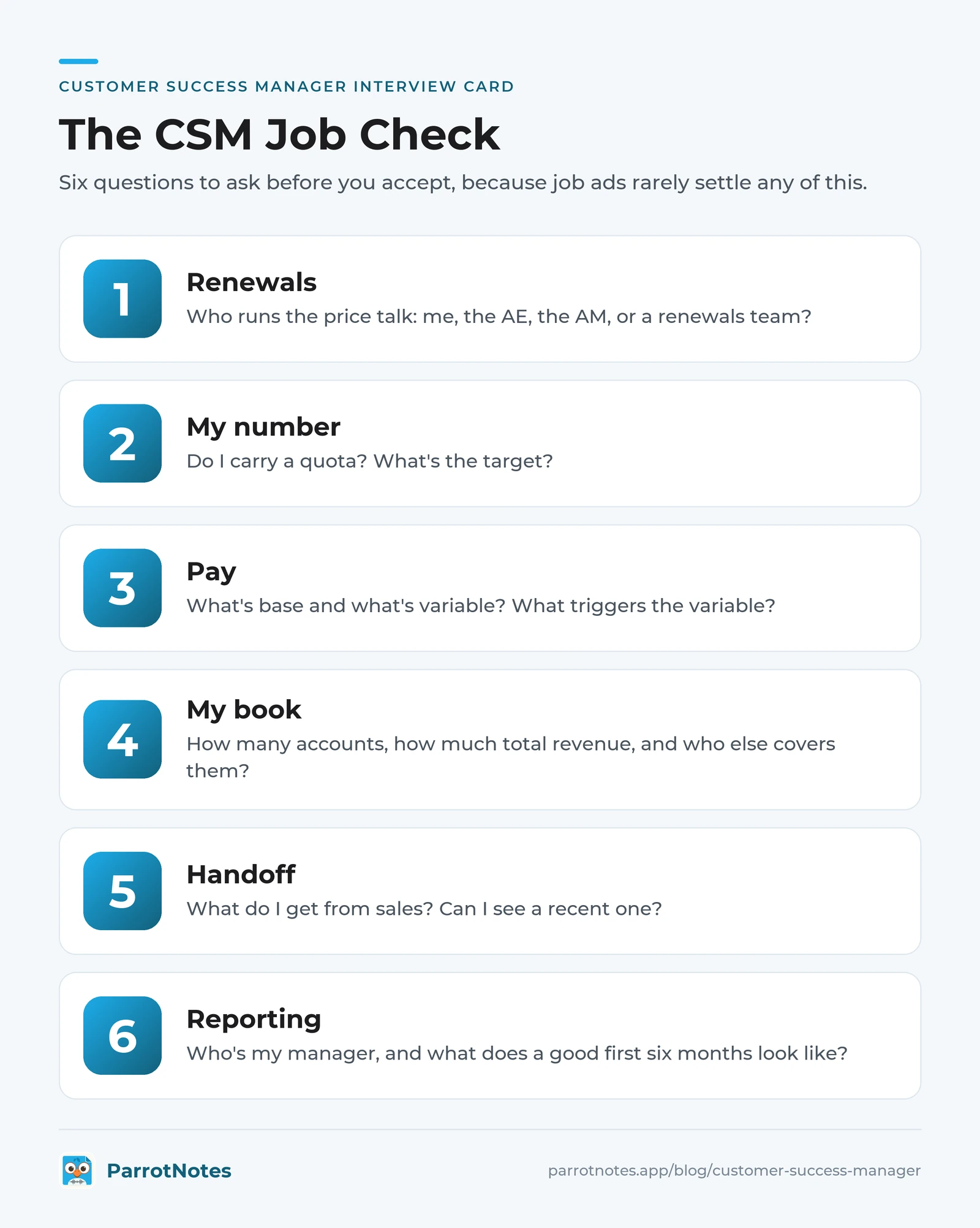
Job ads rarely settle any of this, so ask. Copy this into your interview notes.
CSM JOB CHECK
Company and title: ______
1. Renewals: who runs the price talk?     me / AE / AM / renewals team
2. My number: do I carry a quota?         yes / no   Target: ______
3. Pay: base $______ + variable $______   What triggers the variable? ______
4. My book: ___ accounts, $______ total   Who else covers them? ______
5. Handoff: what do I get from sales?     Can I see a recent one? ______
6. Reporting: who's my manager, and what does a good first six months look like? ______
Here it is filled in for Priya's Offer B.
Company and title: Mid-size software firm, Customer Success Manager
1. Renewals: me, with the AE joining on deals over $50,000
2. My number: yes. Target: 92% gross retention
3. Pay: base $96,000 + variable $24,000. Trigger: paid quarterly on retention
4. My book: 45 accounts, $1.8 million total. Solutions engineer shared
5. Handoff: a CRM note only. Asked to see one: two lines long
6. Reporting: head of sales. Good six months = no surprise cancellations
Those numbers are Priya's example, not a benchmark. Line five is the warning here: a two-line handoff means she'll be rebuilding each sale from scratch, so she knows what to fix first or what to negotiate.
Where the customer notes come from
Everything above leans on memory: what the customer's goal was, what they complained about in March, what you promised on the last call. Across 40 or 100 accounts, memory runs out quickly.
Marcus, a CSM with 40 accounts, has a business review on Thursday. In the kickoff, his customer said the goal was to cut new-hire training from six weeks to four.
If that sentence lives in a notebook, the review becomes a usage chart. If he can find it, the review opens with the customer's own goal and whether it was met. (Marcus is an illustration as well.)
ParrotNotes helps with that on your phone. Record a customer meeting, with consent where the law requires it, or talk through your notes right after a call. You get a transcript, a summary, action items, and a draft follow-up email to edit. There's no bot joining the call, so it works in a customer's office as well as online.
The takeaway on the customer success manager role
- A customer success manager owns what happens after the sale: onboarding, adoption, health, and the setup for renewal and growth.
- Who runs the renewal is the biggest difference between CSM jobs, and the title won't tell you. Ask.
- In the ads we read, 76% mention upsell or expansion, so expect commercial work at many companies.
- Salary and base figures sit around $79,000 to $91,000. The $130,000-plus figures add variable pay or lean toward software companies.
- Few of these jobs are entry level. Support, account management, and sales are the usual ways in.
Applying for a role? Take the job check into your next interview. Already a CSM? Try ParrotNotes on your next customer call, and open your next business review with what the customer said they wanted.
Frequently Asked Questions
What does a customer success manager do?
A customer success manager helps customers get what they paid for after the sale. They take the handoff from sales, run onboarding, drive adoption, watch customer health, hold business reviews, and set up the renewal and any expansion. In the 148 job ads we read on 5 November 2026, 86% mentioned adoption and 76% mentioned upsell or expansion.
How much does a customer success manager make?
Robert Half's 2027 Salary Guide gives a US national range of $68,500 to $90,250. Glassdoor's median total pay, as quoted by Coursera in October 2026, is $149,000, because it includes bonus and commission. In 54 US ads we read on 5 November 2026, the median of company midpoints was $135,000, mostly at software companies.
What is the difference between a customer success manager and an account manager?
A customer success manager focuses on adoption and outcomes, and an account manager focuses on the commercial side: renewals, pricing, and expansion revenue. Many companies blend the two, so check who runs the renewal talk in the specific job.
Is customer success manager an entry-level job?
Usually not. Only 2 of the 148 titles we read said associate or junior, and the median ad that stated a number asked for 5 years of experience. Most people arrive from support, account management, sales, or consulting.
Do customer success managers get commission?
Sometimes. In our count, 30% of ads mentioned commission or on-target earnings and 5% used the word quota. Others rule it out: Ashby's strategic CSM ad says the role doesn't currently include variable pay. Ask for base and variable separately.
Is a customer success manager a sales role?
It's next to sales, and it can be close. 76% of the ads we read use the word sales, and some CSMs carry a renewal or retention quota. Others hand all commercial talks to an account executive or a renewals team.
Will AI replace customer success managers?
Nobody can say for sure. In the ads we read, AI shows up as a work tool: Checkr asks CSMs to "use AI tools to work smarter and scale your impact across accounts," and Samsara pairs a book of 100-200 accounts with AI tooling. That points to larger books more than to no CSM, but it's only a snapshot of hiring ads.
Related Posts

Best Talk to Text App for iPhone and Android
The best talk to text app for your phone: Apple Dictation and Siri on iPhone, Gboard and Gemini on Android, with free plans compared and a voice phrase sheet.

How to Use Speech to Text on iPhone
Turn on speech to text on iPhone in 3 steps, dictate in any app, switch languages, turn it off, and record when the mic stops. Checked on iOS 27, Nov 2026.

How to Record Calls on Samsung
Samsung call recording, step by step: record or auto record calls, find the files, get Galaxy AI transcripts, or turn it all off. Checked November 2026.