
MEDDPICC Explained: What Each Letter Means on a Real Deal

Sarah Johnson
Product Manager at ParrotNotes with 5+ years of experience in productivity tools and AI technology.
Table of Contents
It's Monday's deal review. Your manager pulls up your biggest opportunity and asks one question: "Who signs the contract, and what has to happen before they can?"
You know the plant manager loves the machine. The engineer wants it installed by spring. But who signs?
You think it's the VP. You're fairly sure someone mentioned legal. It was three weeks ago, in a corridor, and you wrote none of it down.
That gap is what MEDDPICC exists to close. The eight letters are easy to memorize and hard to fill in, because the answers show up in pieces, across several meetings, from different people. Most guides stop at definitions. Few show what a letter sounds like when a customer says it out loud.
This one does. You'll get the MEDDPICC meaning in plain words, one example deal walked through all eight letters, a scorecard of that deal after three meetings, and a note template you can copy. It's written for reps who sell face to face and do their admin in the car.
What does MEDDPICC stand for?
MEDDPICC stands for Metrics, Economic buyer, Decision criteria, Decision process, Paper process, Identify pain, Champion, and Competition. It's a qualification framework, often called the MEDDPICC methodology, for complex B2B deals. Each letter is a question about the deal that you answer with evidence from the customer, so you can tell a deal that will close from one that only feels good.
Here's the MEDDPICC acronym in one table.
| Letter | Stands for | The question it answers |
|---|---|---|
| M | Metrics | What number will this purchase change, and by how much? |
| E | Economic buyer | Who has the final say on spending the money? |
| D | Decision criteria | What will they judge every option against? |
| D | Decision process | What steps and people turn "we like it" into "we've decided"? |
| P | Paper process | What happens between the decision and a signed order? |
| I | Identify pain | What's the problem, and what does it cost to leave it alone? |
| C | Champion | Who inside is selling for you when you're not in the room? |
| C | Competition | What else could they do, including nothing? |
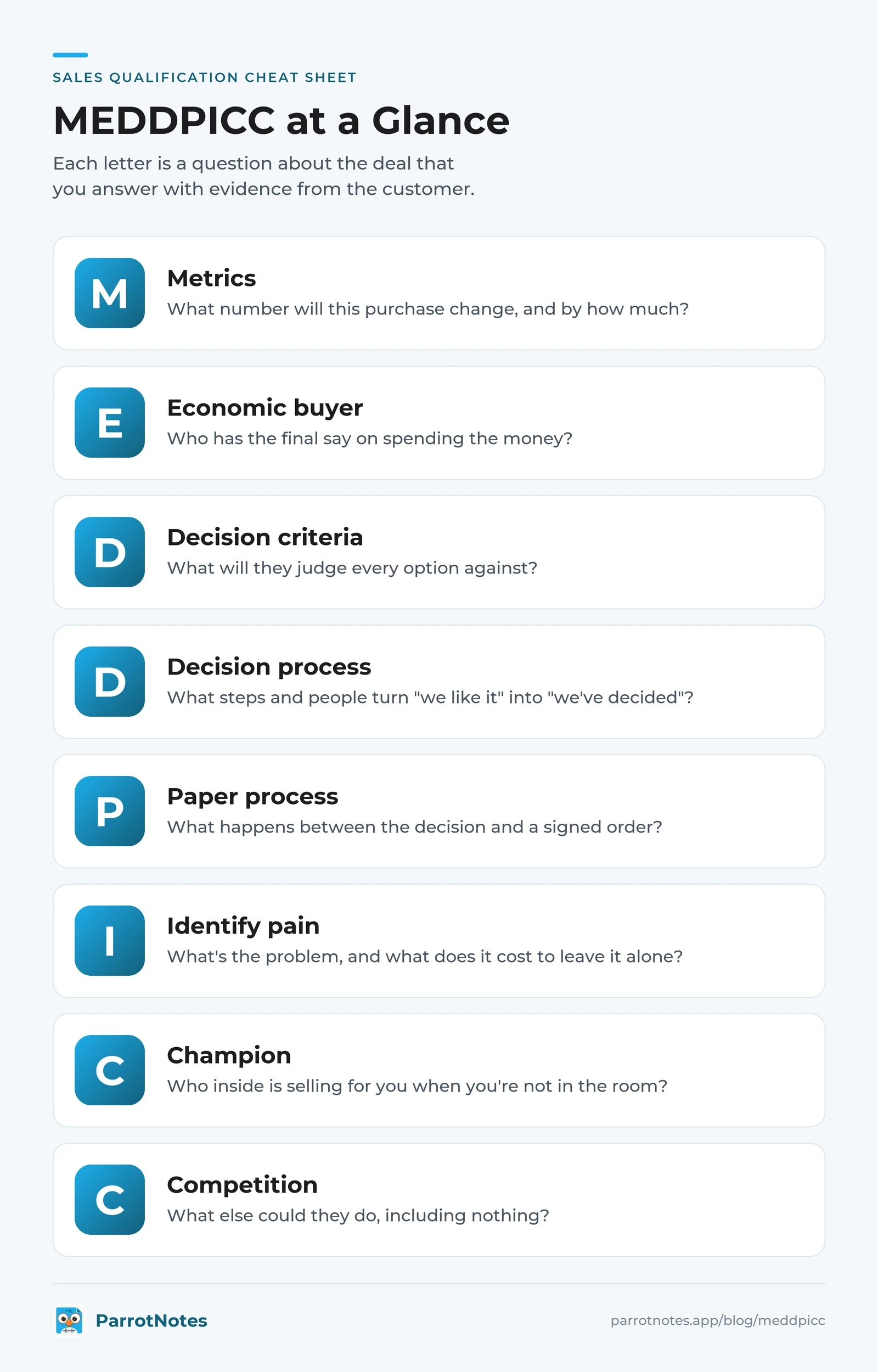
None of these is about your product. MEDDPICC maps how the customer buys, which is why it works for a software subscription and a packaging line alike.
For a quick first-call screen, a lighter method does the job, and our BANT qualification guide covers that. MEDDPICC earns its keep once a deal has several people, real money, and a formal purchase at the end.
The answers arrive in conversation, not on a form. If you'd rather talk your notes than type them, try ParrotNotes free: dictate a debrief after the meeting and get a transcript, a summary, and action items back.
Where the framework came from
MEDDPICC grew out of MEDDIC, which came from the sales team at the software company PTC in the mid-1990s. The training company MEDDICC's history of who created MEDDIC says it "was created in 1996 inside PTC by Dick Dunkel, working under SVP John McMahon alongside teammate Jack Napoli." The original had six elements: Metrics, Economic buyer, Decision criteria, Decision process, Identify pain, and Champion.
Accounts differ a little at the edges. MEDDIC Academy, another training company, describes the method as field knowledge that circulated at PTC from around 1995 and was formally published later. Both agree on the place and the decade.
The two extra letters arrived afterwards. The same MEDDICC page notes "the addition of a second C for Competition and a P for Paper Process, forming MEDDPICC." Neither source names one inventor or a date for the added letters, so be wary of any article that does.
That's why you'll see three spellings: MEDDIC is the original six, MEDDICC adds Competition, and MEDDPICC adds Competition and Paper process. If you sell to companies with procurement and legal departments, the P is worth having.
MEDDPICC letter by letter on one deal
Definitions only get you so far, so here's a MEDDPICC example: one deal, walked through every letter. It's an illustration with invented names and numbers, not a case study.
The deal
Maya is a territory rep for a packaging-equipment maker. Her prospect is a snack producer we'll call Ridgeline Foods, which packs cases by hand on two lines. She's proposing an automated case packer at about $480,000.
She's had three meetings. A plant walk on October 6 with Tom, the plant manager, and Devon, the plant engineer. A sit-down on October 15 that added Priya from procurement. And 20 minutes on October 28 with Carla, the VP of operations.
M: Metrics
Metrics are the customer's numbers, in the customer's words. MEDDICC's methodology overview defines them as "the quantifiable measures of value that your solution can provide." The test: would the buyer recognize the number if you read it back?
On the plant walk, Tom said, "We burned about $310,000 on overtime and temps in packing last year." Devon added that roughly 3% of cases get crushed or mis-packed. They run 14 packers a shift and want to run six.
- Ask: "What does packing cost you today?" and "If this works, what number moves, and who reports it?"
- Write down: the number, the unit, who said it, and whether it's measured or a guess
E: Economic buyer
The economic buyer is the person with final authority over the money. It's rarely the friendliest person you've met.
Maya assumed Tom was the buyer. He runs the plant and he talks like the boss.
Then she asked, "The last time the plant bought equipment this size, who signed the request?" Tom's answer: anything over $100,000 goes to Carla. That single question moved the whole deal up a floor.
- Ask: "Who signed off the last purchase like this?"
- Write down: the name, the spending threshold, and whether you've met them yet
Working out who plays which role is its own skill, and our stakeholder mapping guide has a template for it.
D: Decision criteria
Decision criteria are the yardsticks every option gets measured against. Expect three kinds: technical, financial, and how comfortable the buyer is with you as a supplier.
Devon gave Maya the list on October 15. The machine has to fit a 22-by-9-foot footprint, and changeover between three case sizes has to take under 15 minutes. Payback has to land inside 24 months. A service technician has to be on site within 24 hours of a breakdown.
- Ask: "How will you compare the options?" and "Which of those would rule a supplier out?"
- Write down: each criterion, who set it, and which ones are fixed versus nice to have
D: Decision process
The decision process is the path from interest to a decision: the steps, the people, and the dates. Criteria tell you what they'll judge. Process tells you how and when.
At Ridgeline, it starts with a test at Maya's demo floor using Ridgeline's own cases, followed by a written recommendation from Tom and Devon. Then comes the capital committee, which meets on the second Thursday of each month. Carla approves after the committee.
- Ask: "Walk me through what happens after the test."
- Write down: the steps in order, a name beside each step, and any fixed date
P: Paper process
Here's the letter that catches field reps out. The decision process ends at "yes." The paper process starts there, and runs to a signed order. Force Management's MEDDIC explainer describes it as "the legal, procurement, and administrative steps required to finalize a deal."
Priya laid it out in about 90 seconds. A capital request form needs three quotes attached. Legal reviews supplier terms, and "legal takes two weeks on a good month."
New suppliers also need an onboarding packet with tax and insurance documents. Only then does procurement issue a purchase order.
Maya worked backwards from the install. Ridgeline wants the machine in during its late-February shutdown. Her lead time is 14 weeks, so the purchase order has to land by November 20. That means the November 12 committee, and terms in front of legal before the end of October.
- Ask: "Once Carla says yes, what has to happen before a PO reaches me?" and "How long did that take last time?"
- Write down: each step, its owner, how long it takes, and the date it must start
I: Identify pain
Pain is the problem behind the purchase, plus what it costs to leave alone. "Packing is manual" isn't pain. It's a description.
The pain came out on October 28. Ridgeline can't staff its second shift in packing. In August it turned down a club-store promotional order because it couldn't pack the volume in time.
Carla said it herself: "I don't want to turn down another club order." Now the project isn't about a machine. It's about a channel she's been asked to grow.
- Ask: "What happens if nothing changes this year?"
- Write down: the problem in their words, the consequence, and who owns it
C: Champion
A champion is an insider who wants you to win and has the standing to push for it. MEDDICC's definition is "a person who has power, influence, and credibility within the customer's organization." A friendly contact without influence is a coach, not a champion.
Maya tested Devon rather than assuming. She asked him to get her 20 minutes with Carla, and he did. He also sent her the blank capital request form. And he has a personal win: he's been asked to lead the plant's automation plan.
- Ask: "Could you get me time with Carla?" and "What's riding on this for you?"
- Write down: what they've done for you (not said), their personal win, and the last date they acted
C: Competition
Competition is every alternative to buying from you: other vendors, a home-grown fix, a different project winning the budget, and doing nothing.
Maya knows three quotes are required, so at least two rivals exist. She also heard Tom mention refurbishing the old semi-automatic tapers. What she doesn't know is who the other vendors are, or how seriously the refurbishment idea is being taken.
- Ask: "If you didn't buy a new machine, what would you do instead?"
- Write down: each alternative, who favors it, and what they like about it
That's one deal through all eight MEDDPICC letters. Now score it.
The MEDDPICC scorecard after three meetings
A MEDDPICC scorecard is a status check on each letter. Score the evidence, not your mood. Here's Maya's, gaps included.
| Letter | Status | Evidence (who, when) | Next action |
|---|---|---|---|
| Metrics | Partial | Tom's $310,000 overtime figure, Oct 6. Damage rate is Devon's estimate | Ask Devon for the scrap report |
| Economic buyer | Strong | Tom named Carla, Oct 6. Met her, Oct 28 | Send Carla a one-page payback summary |
| Decision criteria | Strong | Devon's written list, Oct 15 | Confirm the 24-hour service term internally |
| Decision process | Partial | Steps and committee date from Tom, Oct 15 | Find out who sits on the committee |
| Paper process | Partial | Steps and timings from Priya, Oct 15 | Get terms to legal by Oct 30 |
| Identify pain | Strong | Carla on the lost club order, Oct 28 | Put her sentence in the proposal |
| Champion | Strong | Devon arranged the Carla meeting and shared the capital form | Brief Devon before the committee |
| Competition | Gap | Three quotes required. Tom mentioned refurbishment once | Ask Devon who else is quoting |
The evidence rule
A MEDDPICC letter only counts as filled when you can name who said it and when. "I think the VP signs" is a guess. "Tom said on October 6 that anything over $100,000 goes to Carla" is evidence.
This one rule changes deal reviews. Your manager stops asking "how do you feel about it?" and starts asking "who told you that?"
It also shows you where to spend your next visit. Maya's next meeting isn't another demo. It's a conversation about competition and the committee.
A MEDDPICC note template you can copy
MEDDPICC isn't a script for the meeting. Nobody wants to be walked through eight letters like a customs form. It's a structure for your notes afterwards, so copy this into whatever you use for call reports.
MEDDPICC meeting note
- Account, date, and who was in the room:
- M, Metrics: Their number, in their words. Who said it? Measured or estimated?
- E, Economic buyer: Name and title. How do we know? Have we met?
- D, Decision criteria: Technical, financial, and supplier criteria. Which are fixed?
- D, Decision process: Steps, people, and dates from here to a decision
- P, Paper process: Steps after the yes: forms, legal, supplier setup, PO. Owner and duration of each
- I, Identify pain: The problem in their words. What it costs to leave alone. Who owns it
- C, Champion: Who. What they did for us since the last meeting. Their personal win
- C, Competition: Other vendors, in-house options, do nothing. Who favors each
- New since last time: What changed on any letter
- Next step: What, who, and by when
Most meetings only move two or three letters. Write "nothing new" beside the others and move on.
The two-minute debrief script
The best time to fill in the template is the first two minutes after you leave. Typing eight fields on a phone in a parking lot is miserable, so say it instead. Read each heading aloud and answer it:
- "Meeting with [names] at [account], [date]."
- "Metrics. They said..."
- "Economic buyer. It's... I know because..."
- "Decision criteria. New today..."
- "Decision process. Their next step is..."
- "Paper process. After the yes they need..."
- "Pain. In their words..."
- "Champion. Since last time, they..."
- "Competition. They mentioned..."
- "Next step. I owe them... They owe me..."
Saying the heading matters. It splits your ramble into labeled sections, and it makes you notice the letters where you've got nothing to say.
How to capture all eight letters when you sell in person
Most MEDDPICC advice assumes a recorded video call and a CRM panel beside it. Field reps don't get that. The paper process comes out in a corridor, the real pain comes out over lunch, and by Friday the detail is gone.
Salesforce reports that sales reps spend 60% of their time on non-selling tasks. Rebuilding eight fields from memory at the end of the week is time that produces bad data.
A spoken debrief fixes both problems, and it's where ParrotNotes fits. Open the app when you reach the car, hit record, and run the two-minute script. Recording carries on with the screen off, so you can set the phone down and talk.
You get a transcript, an AI summary, and your action items pulled out. ParrotNotes can also draft the follow-up email from what you said.
ParrotNotes includes sales frameworks too: MEDDIC, SPIN, and BANT. Apply MEDDIC and the insights are organized around its six elements. Say "paper process" and "competition" out loud as headings, the way the script does, and those two sit in the transcript and summary with the rest. Frameworks work on AI-powered recordings: five a month on the free plan, unlimited on Pro.
Want to try it after your next visit? Download ParrotNotes free. The free plan includes 100 minutes of recording a month, up to 30 minutes per recording, with an AI summary on every recording.
Weeks later, the record pays you back. Before the committee meeting, Maya can search her notes for "legal" and find Priya's two-week warning. On Pro, she can ask the recording directly with AI chat: "What did Priya say has to happen before the PO?"
Pro is $19.99 a month, or $14.99 a month billed annually, with 3,000 recording minutes a month and recordings up to 3 hours.
If you record the meeting itself
A debrief is your own voice, so it's simple. Recording the customer is different.
In the US, federal law permits recording when one party to the conversation consents, but some states go further. California's Penal Code section 632, for example, requires the consent of all parties to a confidential conversation. Other countries have their own rules.
Rules vary and this isn't legal advice. The safe habit is the polite one: ask everyone's permission before you record, every time. If anyone says no, take notes and debrief afterwards. Our guide on how to never miss action items from sales calls covers that habit.
Take the eight letters to your next visit
MEDDPICC is eight questions about how your customer buys, answered with their words instead of your hopes. Here's the short version:
- Count a letter as filled only when you can say who told you and when
- Map the paper process backwards from the date the customer wants to go live
- Treat "do nothing" as a competitor
- Debrief out loud in the first two minutes after every meeting
Think back to Monday's deal review. With a two-minute debrief after each visit, "Who signs, and what has to happen first?" has an answer: Carla, after the November 12 committee, once legal has cleared the terms.
Your next customer meeting is probably already booked. Download ParrotNotes free, copy the MEDDPICC note template above, and dictate your first debrief before you leave the parking lot.
Frequently Asked Questions
What is MEDDPICC in sales?
MEDDPICC is a qualification framework for complex B2B deals. The letters stand for Metrics, Economic buyer, Decision criteria, Decision process, Paper process, Identify pain, Champion, and Competition. Each one is a question about how the customer will buy, so a team can see what it knows about a deal and what it's still guessing.
What's the difference between MEDDIC and MEDDPICC?
MEDDIC is the original six-letter version from PTC in the 1990s. The MEDDPICC framework adds two letters: P for Paper process, the steps between a decision and a signed order, and a second C for Competition. Teams selling to companies with procurement and legal departments tend to prefer the longer version.
Do I have to fill in every MEDDPICC letter in order?
No. People talk about a "MEDDPICC sales process," but the letters aren't steps. Pain and metrics tend to surface first, the economic buyer and champion next, and the paper process last. Track all eight from the first meeting, and treat an empty letter as your agenda for the next visit.
Related Posts
Sales Engineer: The Role and How to Document Technical Meetings
What a sales engineer does, what the role pays (BLS data), and a technical meeting record that keeps specs, units and promises intact. Copy the template.
Nurse Educator Guide: Record In-Services Staff Can Revisit
A working nurse educator's kit: what to record and what never to, a consent script, a session plan, and a one-page revisit sheet staff will use. Try it free.
Meeting Notes Template: Simple Formats That Work
Copy a meeting notes template that fits your meeting: six simple formats with filled-in examples, a shorthand key and a 10-minute routine for sending notes.