
Average Deal Size: How to Calculate It and Grow It

Sarah Johnson
Writes about field sales, meeting notes and voice-first workflows at ParrotNotes. Every article is reviewed by the ParrotNotes product team before it goes live.

Table of Contents
- 1.What average deal size is (and what it isn't)
- 2.How to calculate average deal size
- 3.Mean vs median: when one deal skews the average
- 4.Segment average deal size by rep, segment and source
- 5.How average deal size feeds sales velocity and forecasting
- 6.Six ways to grow average deal size from better discovery notes
- 7.What is a good average deal size?
- 8.Average deal size: the short version
Elena runs a field team of three reps. At the end of the quarter her dashboard said average deal size had jumped from $12,000 to $19,000. She started drafting next year's quotas around the new number.
Then she sorted the deals by value. One contract, a $96,000 multi-site order Marcus had closed in the last week, was doing all the work. Without it, the average was $12,000, exactly where it had been. (Elena and her team are a composite, an illustration rather than real people.)
You already know average deal size matters. It sits in every sales KPI list and in every sales velocity formula. What most guides skip is how easily it misleads.
This guide gives you the average deal size formula with a worked example, shows when to use the median instead of the mean, how to segment the number by rep and lead source, how it feeds sales velocity and your forecast, and six ways to grow it that start in discovery.
The levers at the end depend on what reps actually hear in the meeting. If those conversations happen in customers' offices, ParrotNotes records the visit with the buyer's permission and gives the rep a transcript and summary before the next stop.
What average deal size is (and what it isn't)
Average deal size is the typical value of a deal your team wins. It's sometimes called average contract value or average sale value. It answers one question: when we win, how much do we win?
It isn't a measure of how often you win (that's win rate) or how fast (that's sales cycle length). A team can grow average deal size and still shrink revenue if it wins fewer deals. That's why it's most useful next to the other numbers in your sales KPIs, not on its own.
How to calculate average deal size
The formula is simple:
Average deal size = total value of closed-won deals ÷ number of closed-won deals
Salesforce gives the same formula, with total revenue from closed-won deals divided by their count. Use one period, such as a quarter, and count deals by their close date.
Here's the quarter Elena was looking at. Every number in this guide comes from these 12 deals.
| Deal | Rep | Lead source | Value |
|---|---|---|---|
| 1 | Dana | Inbound | $8,000 |
| 2 | Dana | Outbound | $12,000 |
| 3 | Dana | Referral | $15,000 |
| 4 | Dana | Inbound | $9,000 |
| 5 | Marcus | Inbound | $7,000 |
| 6 | Marcus | Outbound | $11,000 |
| 7 | Marcus | Outbound | $96,000 |
| 8 | Marcus | Inbound | $6,000 |
| 9 | Priya | Referral | $22,000 |
| 10 | Priya | Referral | $18,000 |
| 11 | Priya | Outbound | $14,000 |
| 12 | Priya | Inbound | $10,000 |
Total closed-won value is $228,000. Divide by 12 deals and the average deal size is $19,000.
Five counting decisions to settle first
Two managers can run the same formula on the same CRM and get different answers. Agree on these before you report the number:
- Closed-won only. Open and lost deals don't count. Their amounts are guesses or never happened.
- Net of discounts. Use the price the customer signed, not list price.
- Recurring vs one-time. For subscriptions, use annual value. Report one-time fees (setup, hardware) separately or on a clear rule.
- Multi-year contracts. Annualize them. A three-year, $90,000 deal counts as $30,000 a year, or it will dwarf everything else.
- New business vs renewals. Keep renewals in their own number. Mixing them hides whether new deals are getting bigger.
Mean vs median: when one deal skews the average
The $19,000 above is a mean. It's correct arithmetic and a poor description of Elena's quarter. Eleven of the 12 deals were $22,000 or less.
Sort the values and look at the middle instead. With 12 deals, the median is the average of the 6th and 7th values: ($11,000 + $12,000) ÷ 2 = $11,500.
| Measure | How it's calculated | Result |
|---|---|---|
| Mean (all 12 deals) | $228,000 ÷ 12 | $19,000 |
| Median (all 12 deals) | Middle of the sorted values | $11,500 |
| Mean without the $96,000 deal | $132,000 ÷ 11 | $12,000 |
The NIST/SEMATECH statistics handbook puts it plainly: for data with extreme values in the tails, the median provides a better estimate of location than the mean. "Location" here means the typical value. Deal values almost always have a long right tail, because a few large accounts sit far above the rest.
A practical rule for a field team:
- Report both. Show the mean and the median side by side every quarter.
- Investigate a gap. When the mean runs well above the median, find the deals causing it before anyone reacts to the number.
- Plan on the median, or on a mean without outliers. That's what your next ordinary deal is likely to be worth.
Segment average deal size by rep, segment and source
One team-wide number hides most of what's useful. Split the same 12 deals by rep first.
| Rep | Deals won | Total | Mean | Median |
|---|---|---|---|---|
| Dana | 4 | $44,000 | $11,000 | $10,500 |
| Marcus | 4 | $120,000 | $30,000 | $9,000 |
| Priya | 4 | $64,000 | $16,000 | $16,000 |
On the mean, Marcus looks like the team's big-deal closer. On the median, his typical deal is the smallest. Priya's mean and median match, which means her deals are consistently larger, not lucky. Those are two different coaching conversations.
Now split by lead source.
| Lead source | Deals won | Total | Mean | Mean without the outlier |
|---|---|---|---|---|
| Inbound | 5 | $40,000 | $8,000 | $8,000 |
| Outbound | 4 | $133,000 | $33,250 | $12,333 |
| Referral | 3 | $55,000 | $18,333 | $18,333 |
Referrals produce the largest typical deals, and inbound the smallest. That's a planning fact: if referral deals run more than twice the size of inbound ones, a referral program may be worth more than another inbound campaign.
Segment the same way by customer size, region or product line. Keep each segment to at least a handful of deals, or one result swings the whole row.
How average deal size feeds sales velocity and forecasting
Average deal size is one of the four inputs to sales velocity, the revenue your pipeline produces per day:
Sales velocity = (open opportunities × win rate × average deal size) ÷ sales cycle length in days
Say Elena's team has 40 open opportunities, a 30% win rate and a 75-day cycle. Watch what the choice of average does:
| Average used | Calculation | Sales velocity |
|---|---|---|
| Mean, $19,000 | 40 × 0.30 × $19,000 ÷ 75 | $3,040 a day |
| Mean without outlier, $12,000 | 40 × 0.30 × $12,000 ÷ 75 | $1,920 a day |
| $12,000 grown 10% to $13,200 | 40 × 0.30 × $13,200 ÷ 75 | $2,112 a day |
The outlier inflates velocity by 58% ($3,040 against $1,920). The last row shows the honest version of growth: a 10% bigger typical deal adds 10% to velocity, and it compounds with any gain in win rate or cycle time. Try your own numbers in the sales velocity calculator, and check the win rate you feed it with the win rate calculator.
Forecasts make the same mistake in a quieter way. Many teams value early-stage opportunities that have no quote yet at the team's average deal size. With 20 such opportunities and a 30% win rate:
- At $19,000: 20 × 0.30 × $19,000 = $114,000 expected
- At $12,000: 20 × 0.30 × $12,000 = $72,000 expected
That's a $42,000 gap from one deal that will probably never repeat. Use the median or the outlier-free mean for placeholder values, and segment it if inbound and referral deals differ as much as they do here. The sales forecast calculator weights a pipeline by stage, and our guide to improving sales forecast accuracy covers how to score the forecast afterwards.
Six ways to grow average deal size from better discovery notes
Most advice on growing average deal size is about pricing pages and bundles. Those help. But for a field team, deal size is mostly decided in discovery, by how much of the customer's problem the rep finds and writes down.
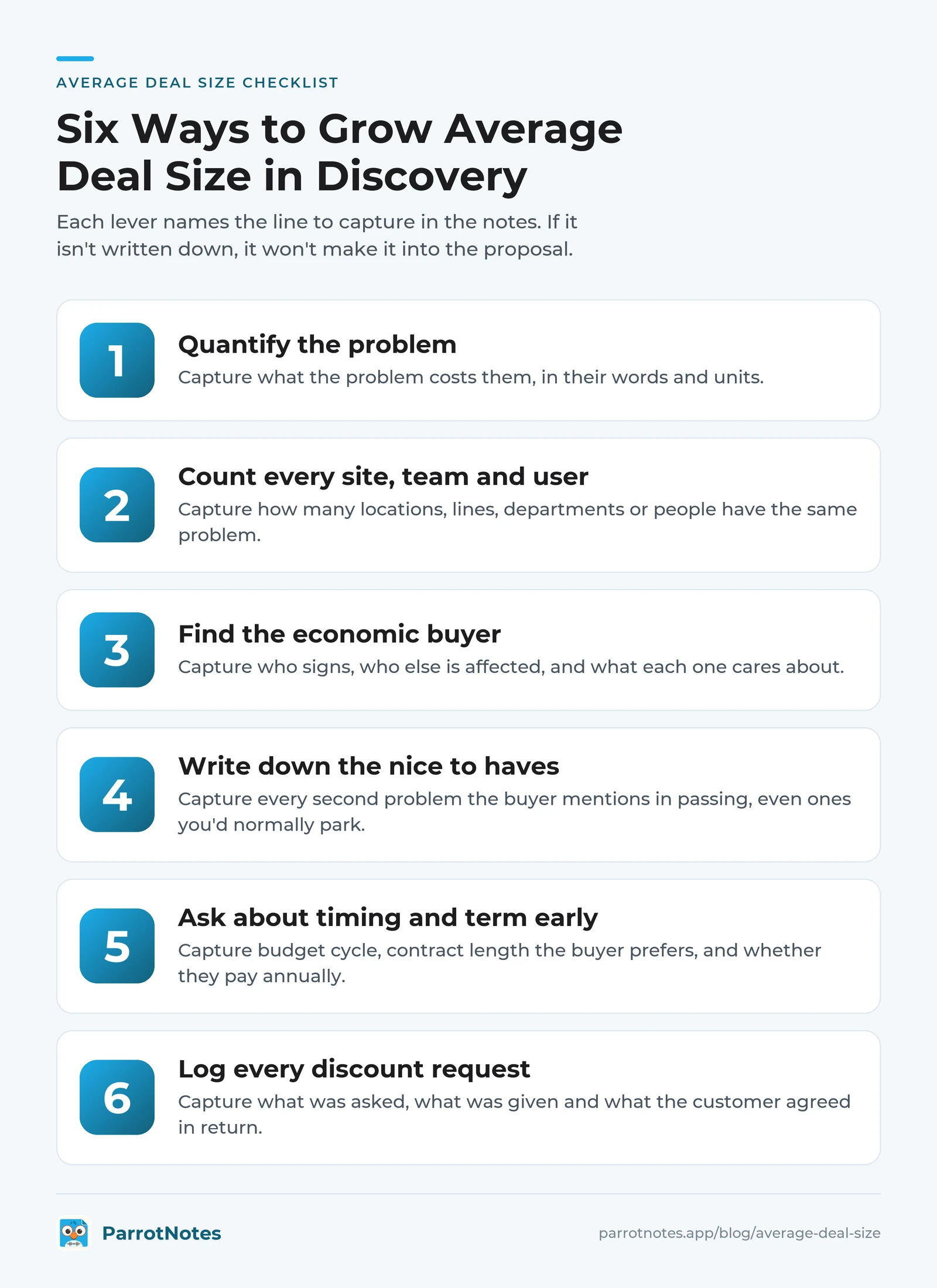
Each lever below names the line to capture in the notes. If it isn't written down, it won't make it into the proposal.
1. Quantify the problem in the buyer's numbers
Capture: what the problem costs them, in their words and units ("we lose two shifts a month to changeovers").
A proposal priced against a stated cost gets discounted less than one priced against a feature list. That's the core of value-based selling.
2. Count every site, team and user affected
Capture: how many locations, lines, departments or people have the same problem.
Marcus's $96,000 deal started as a one-site conversation. The plant manager mentioned that the other seven sites ran the same process, and Marcus asked who managed them. Most reps hear a line like that and never write it down.
3. Find the economic buyer and the other stakeholders
Capture: who signs, who else is affected, and what each one cares about.
Deals scoped by one contact stay the size of that contact's budget. Reaching the economic buyer and multithreading the deal is how scope grows past one department.
4. Write down the "nice to haves"
Capture: every second problem the buyer mentions in passing, even ones you'd normally park.
These are your add-ons and second-phase line items. The difference between a cross-sell and an upsell matters less than noticing the need while the buyer is still talking.
5. Ask about timing and term early
Capture: budget cycle, contract length the buyer prefers, and whether they pay annually.
An annual or multi-year term raises booked value without changing the price. Remember to annualize it when you calculate average deal size, so the metric stays honest.
6. Log every discount request and what you got for it
Capture: what was asked, what was given and what the customer agreed in return.
Priya rarely discounts without a trade: a longer term, a second site, a case study. Writing down the trade keeps the next rep from giving the same discount for nothing. Our guide to sales negotiation covers give-get trades in detail, and good discovery questions surface most of the lines above.
Notes from a car park rarely capture all six. Reps who record the meeting with ParrotNotes, with the buyer's permission, get a transcript and summary, and can run BANT, MEDDIC or SPIN analysis on it, so the site count and the second problem are still there when the proposal gets written.
What is a good average deal size?
There's no universal benchmark worth using. Published averages mostly come from SaaS companies, and they change with product, price point, region and how each company counts recurring and one-time revenue.
A good average deal size is one that's rising in your own history for the right reasons:
- Compare against yourself. Track the median by quarter for at least four quarters.
- Check the mix. If the number rose because you lost the small deals and not because you won bigger ones, revenue may still be falling.
- Check the economics. A deal should be large enough to cover what it costs to win and serve it.
A win-loss analysis shows whether bigger deals are being won or just quoted.
Average deal size: the short version
- Formula: total value of closed-won deals ÷ number of closed-won deals, for one period, net of discounts, with multi-year deals annualized.
- Report the median too. One large deal moved Elena's mean from $12,000 to $19,000.
- Segment it by rep, lead source and customer size. The team number hides the coaching conversations.
- Feed velocity and forecasts with the typical deal, not the inflated mean, or you overstate both by the size of your outliers.
- Grow it in discovery. The site count, the second problem and the economic buyer are found in the meeting, and kept only if someone writes them down.
Start with your last quarter: sort the closed-won deals, compare the mean and median, and split them by rep. Then make sure your reps' next discovery calls are captured in full. Get ParrotNotes free and record your next customer meeting, with the buyer's permission.
Frequently Asked Questions
What is average deal size?
Average deal size is the typical value of a deal your team wins in a period. You calculate it by dividing the total value of closed-won deals by the number of closed-won deals. It shows how much you win when you win, and works best next to win rate and sales cycle length.
How do you calculate average deal size?
Add up the value of every closed-won deal in the period and divide by the number of those deals. For example, 12 deals worth $228,000 in total give an average deal size of $19,000. Use net prices after discounts, annualize multi-year contracts, and keep renewals separate from new business.
Should I use the mean or the median for average deal size?
Report both. The mean is pulled up by a few large deals, while the median shows the typical deal. In the example in this guide, one $96,000 deal raised the mean to $19,000 while the median was $11,500. Plan quotas, velocity and forecast placeholders on the median or on a mean without outliers.
What is a good average deal size?
There's no reliable universal benchmark. Published figures mostly come from SaaS companies and depend on product and how revenue is counted. A good average deal size is one that is growing in your own history because you're winning bigger deals, not because you stopped winning small ones.
How should I answer "What is your average deal size?" in a sales interview?
Give the number, the period and whether it's a mean or a median, for example: "My median new-business deal last year was $14,000 across 31 deals." Add the range and one example of how you grew a deal, such as finding more sites in discovery. Hiring managers want to see that you know your numbers and how you influenced them.
How does average deal size affect sales velocity?
Average deal size is one of the four inputs to sales velocity: open opportunities times win rate times average deal size, divided by sales cycle length. Velocity rises in proportion to it, so a 10% larger typical deal raises velocity by 10%, as long as win rate and cycle length hold.
Related Posts

How to Use Dictation on Windows 11: Shortcut, Commands and Fixes
How to use dictation on Windows 11: press Windows key + H, say punctuation out loud, use Voice Access offline, and fix the microphone when voice typing fails.

Too Many Meetings? How to Cut Them Without Losing Alignment
Too many meetings at work? Audit your calendar in one sitting, give each cut meeting a replacement, and check after two weeks that your team is still aligned.

Sales Voicemail Scripts That Get Callbacks
Copy 10 sales voicemail scripts by situation, from first touch to breakup, each timed, plus greeting scripts for reps and a voicemail-and-email sequence.