
How to Improve Sales Forecast Accuracy

Sarah Johnson
Writes about field sales, meeting notes and voice-first workflows at ParrotNotes. Every article is reviewed by the ParrotNotes product team before it goes live.
Table of Contents
A team forecast can be 97.7% accurate and still be wrong about half the reps on the team.
That's the trap in most advice on how to improve sales forecast accuracy. It starts and ends with one number: what the team called against what it closed. If you manage field reps you rarely ride with, that number can look healthy while two of them guess in opposite directions and cancel each other out.
You already know the forecast depends on the CRM, and that the CRM is behind. This guide gives you the formula with a worked four-rep example, seven steps that fix the inputs, and a checklist for what the notes must show before a deal counts as commit.
Most of those fixes come down to evidence captured while the meeting is fresh. If your reps would rather talk than type after a visit, ParrotNotes turns a spoken debrief into a summary and action items, ready for the CRM the same day.
How to measure sales forecast accuracy
Before changing anything, score last quarter.
The formula
Sales forecast accuracy compares what you forecast with what actually closed:
Forecast accuracy = 1 − (|Actual − Forecast| ÷ Actual)
The vertical bars mean "ignore the sign": over- and under-forecasting by $50,000 count as the same miss. That's why you also need bias:
Forecast bias = (Forecast − Actual) ÷ Actual
Positive bias means the rep called high (optimism). Negative bias means they called low (sandbagging, or deals they didn't see coming).
Two rules make the number honest:
- Score a fixed snapshot. Use the forecast submitted at the same point each period, such as the end of week two. A forecast updated the night before quarter end always looks accurate.
- Score each rep, not just the team. The team total is where errors hide.
One caveat: percentage error breaks when the actual is zero. A rep who forecast $40,000 and closed nothing can't be scored this way, so review those deals by hand.
Worked example: one quarter, four reps
Priya runs a four-rep field team selling equipment to regional contractors. The figures are an illustration built for this article, not survey data. Here's her Q3, scored against the week-two forecast:
| Rep | Forecast (week 2) | Closed in Q3 | Miss | Accuracy | Bias |
|---|---|---|---|---|---|
| Andre | $300,000 | $240,000 | $60,000 | 75.0% | +25.0% |
| Beth | $200,000 | $250,000 | $50,000 | 80.0% | −20.0% |
| Carlos | $150,000 | $145,000 | $5,000 | 96.6% | +3.4% |
| Dee | $250,000 | $245,000 | $5,000 | 98.0% | +2.0% |
| Team | $900,000 | $880,000 | $20,000 | 97.7% | +2.3% |
Here's the math for Andre: |240,000 − 300,000| = 60,000, and 60,000 ÷ 240,000 = 0.25, so accuracy is 1 − 0.25 = 75%. His bias is (300,000 − 240,000) ÷ 240,000 = +25%.
The team line says 97.7%, and Priya's own manager would be happy. But the average of the four rep scores is 87.4%, because Andre's $60,000 of optimism and Beth's $50,000 of caution almost cancelled out. Next quarter they might not.
Two more numbers worth tracking
- Commit hit rate: the value of commit deals that closed in the period, divided by the value committed. Andre committed six deals worth $180,000 and closed $108,000 of them: 60%. His commit category is loose, which is more useful to know than that his total was high.
- Close-date push rate: the share of forecast deals whose close date moved out of the period at least once. A deal pushed twice is a deal whose date came from the rep, not the buyer.
Accuracy, bias, commit hit rate and push rate, one row per rep, every period: that's your forecast scorecard.
Why sales forecasts miss
Priya's two misses have different causes, and so will yours.
The record lags the conversation. Field reps learn the most important things in a customer's office or on a jobsite, then drive to the next stop. Salesforce's State of Sales research finds reps spend 60% of their time on non-selling tasks. For field reps, the CRM update is often the task that waits until Friday. By then, "the buyer mentioned a second approver" has become "went well."
Stages track activity, not buyer action. "Quote sent" says what the rep did, not that the buyer moved. For stage definitions, see our explainer on what a sales pipeline is.
Close dates belong to the rep. The rep picks month end because it's month end. The buyer never agreed to it.
Single-threaded deals. One contact who loves you isn't a decision process. When procurement appears in week eleven, the date slides.
Incentives bend the call. Some reps inflate to look busy; others sandbag to look like heroes. Bias is a habit, so it shows up rep by rep.
How to improve sales forecast accuracy in seven steps
Each step targets a cause above. None needs new software.
1. Score one snapshot every period
Pick the snapshot and score it against actuals with the table above. Share each rep's row with them; reps who see their bias tend to correct it.
2. Rewrite stage exit criteria as buyer actions
Every stage should end with something the buyer did: agreed to a site visit, shared their budget cycle, introduced the approver, asked for the final contract. If you use MEDDPICC, the letters already describe most of that evidence.
3. Give each forecast category an evidence rule
Salesforce's standard forecast categories are Pipeline, Best Case, Commit, Closed and Omitted. The names only help if each one has a rule:
| Category | Enters when the notes show | Leaves when |
|---|---|---|
| Pipeline | A confirmed problem, a real contact, a dated next meeting | No buyer contact for 30 days |
| Best Case | Pipeline evidence, plus impact the buyer quantified and a named approver | The approver or budget turns out to be unknown |
| Commit | Everything on the commit checklist below | Any checklist item goes missing or the buyer's date moves |
| Omitted | Anything without a dated next step | The rep books a dated next step |
The 30-day rule is a starting point; set it to your sales cycle.
4. Make the close date the buyer's date
Ask the buyer what has to happen before they can sign, then work back to the date together. A mutual action plan puts those steps in writing with owners on both sides. A date the buyer said out loud survives a forecast call.
5. Capture the evidence the same day
Field teams skip this step, and it feeds all the others. The rule from our field sales management guide applies: every visit gets a record within 24 hours. The quickest way is a two-minute spoken debrief before the car moves: who was there, what they said, what was promised, what happens next and when. Our guide to windshield time shows how to fit it between stops.
Want the debrief done before the next stop? Record it in ParrotNotes and you get a transcript, a summary and action items. It can also lay the conversation out against the MEDDIC, SPIN or BANT framework (on five AI-powered recordings a month free, unlimited on Pro), so a gap like "no approver named" is easy to spot.
6. Coach the bias, not the total
Andre and Beth need opposite conversations. Andre needs his commit deals checked against the checklist, one by one. Beth needs to hear that her caution cost visibility: finance planned for $200,000 from her territory and got $250,000.
Marcus, a rep on another team, always forecast low and always "overdelivered." His manager stopped praising the overdelivery and asked one question each week: "Which deal would you bet your own money on?" Within two quarters his commit list matched what he really expected.
7. Review every slipped deal
At period end, pull every forecast deal that didn't close as called and find the note from the last meeting before the date moved. The warning is usually there: a new name, a budget question, "we'll need to check with the owner."
The forecast evidence checklist for commit deals
Think of it as forecast hygiene. Before a deal enters commit, find the proof in the notes. If a rep can't point to a dated note for each item, the deal is Best Case.
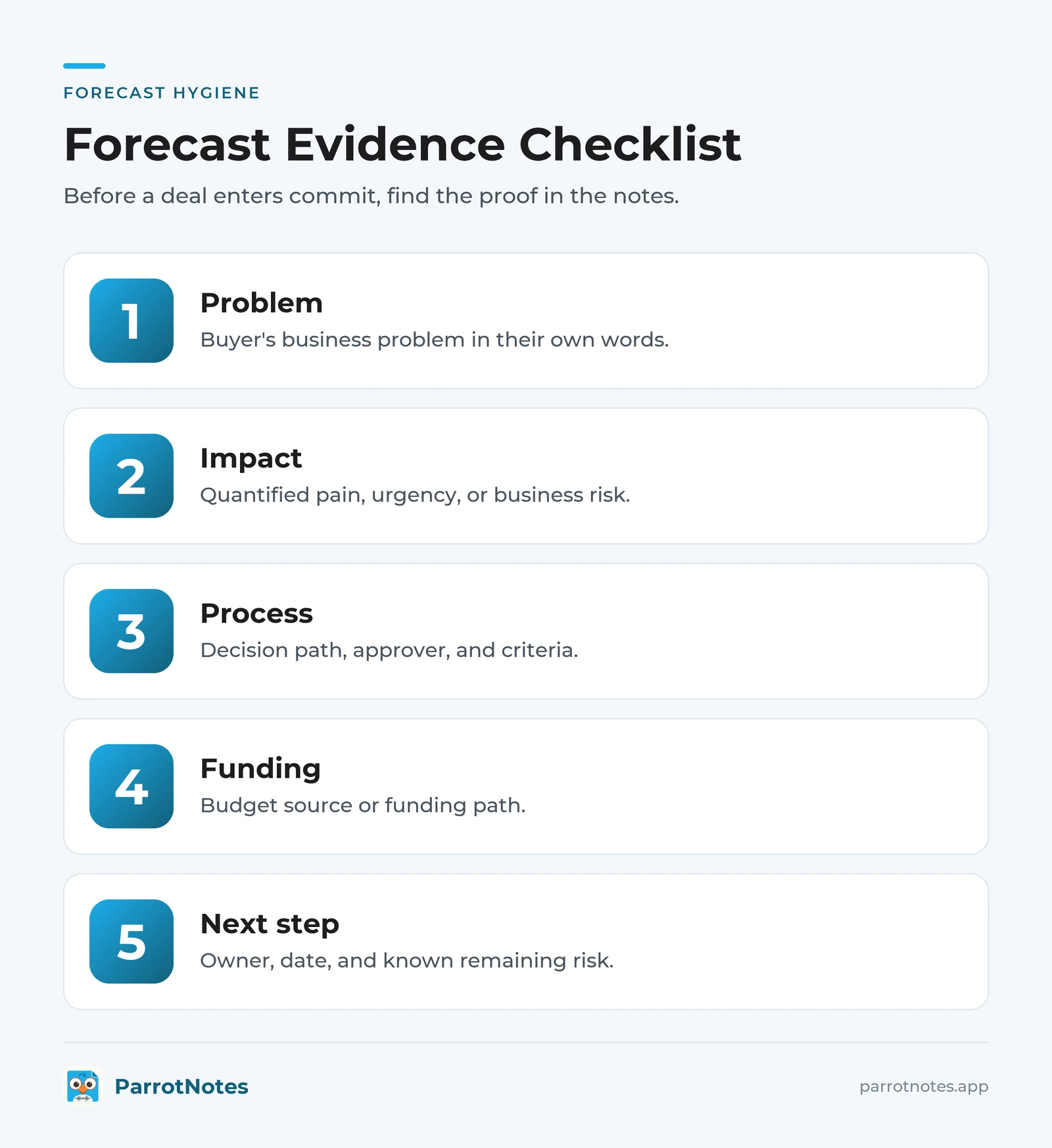
- Problem: the buyer's business problem in their own words, not the rep's summary.
- Impact: quantified pain, urgency, or business risk. "Two of our six crews sit idle on Tuesdays" beats "they need it."
- Process: the decision path, the approver, and the criteria they'll judge on.
- Funding: the budget source or funding path, and whether it's approved or still to be requested.
- Next step: an owner, a date, and the known remaining risk, stated plainly.
The checklist doesn't make a deal close. It makes a commit deal checkable by someone who wasn't in the room.
A forecast review rhythm for a field team
- Weekly (15 minutes): each rep reads their commit deals and the dated evidence for each. Anything without evidence drops a category on the spot.
- Monthly: score the snapshot, walk through slipped deals, agree one change per rep. Our sales meeting agenda templates include a monthly forecast slot.
- Quarterly: each rep brings their scorecard row to the sales QBR, and the next quarter's forecast is built from checklist-complete deals.
Back to Priya. In Q4 she added the checklist to her weekly call. In the first week Andre moved two commit deals to Best Case, because neither had a named approver in the notes. That's his forecast getting honest early instead of late.
Turn the forecast into something you can check
How to improve sales forecast accuracy comes down to measuring it honestly, then fixing what feeds it:
- Score one fixed snapshot every period, per rep, with accuracy and bias side by side
- Track commit hit rate and close-date pushes to see where the forecast is loose
- Define stages and categories by buyer actions, and let the buyer set the close date
- Put no deal in commit without dated evidence for problem, impact, process, funding and next step
- Record the evidence the same day, or none of the above has anything to work with
Priya's team number was fine all along. Her forecast got better when she could see each rep's row and read the notes behind each commit deal. Score last quarter's snapshot this week, and when your reps need a faster way to get visit evidence down before the next stop, download ParrotNotes free.
Frequently Asked Questions
What is a good sales forecast accuracy?
There's no single standard, because it depends on deal size, cycle length and how many deals each rep carries. A rep with three large deals swings more than one with forty small ones. Score your own team for two or three periods, set an improvement target from that baseline, and track bias alongside accuracy.
How do you calculate sales forecast accuracy?
Use forecast accuracy = 1 − (|actual − forecast| ÷ actual). If a rep forecast $300,000 and closed $240,000, the miss is $60,000, or 25% of actual, so accuracy is 75%. Score a fixed snapshot and score each rep separately, because offsetting misses flatter the team total.
What is the difference between forecast accuracy and forecast bias?
Accuracy measures the size of the miss and ignores its direction. Bias keeps the direction: (forecast − actual) ÷ actual. A rep at +25% is calling high, usually from optimism; a rep at −20% is calling low, often from sandbagging. Similar accuracy can need opposite coaching, so track both.
Why do sales forecasts keep missing?
The usual causes are records that lag the conversation, stages defined by rep activity instead of buyer action, close dates the buyer never agreed to, single-threaded deals and habitual optimism or sandbagging. For field teams the first is the biggest: the evidence is spoken in a customer's office and reaches the CRM days later.
How can field sales managers improve forecast accuracy quickly?
Make two changes this week. First, score last quarter's forecast rep by rep to see where the bias sits. Second, require a dated note for each item on the commit checklist (problem, impact, process, funding, next step) before a deal counts as commit. Same-day visit debriefs make the second change practical.
Related Posts

Windshield Time: Turn Drive Time Into Done Admin
Windshield time eats a field rep's day. Audit one week, keep the drive for driving, and try a two-minute parked debrief to clear your admin between stops.
What Is a Sales Pipeline? Stages, Examples and Mistakes
What is a sales pipeline? Learn the seven stages with exit criteria, follow one field deal from prospect to close, and avoid the mistakes that inflate it.
The Challenger Sale: Summary and How to Apply It in the Field
The Challenger Sale in plain English: the five seller profiles, teach, tailor, and take control, plus a six-step pitch and call sheet for your next visit.