
Too Many Meetings? How to Cut Them Without Losing Alignment

Sarah Johnson
Writes about field sales, meeting notes and voice-first workflows at ParrotNotes. Every article is reviewed by the ParrotNotes product team before it goes live.

Table of Contents
- 1.Too many meetings: how many is too many?
- 2.Why you have too many meetings at work
- 3.Step 1: Count the week (15 minutes)
- 4.Step 2: Ask "what breaks if this stops?"
- 5.Step 3: Give every cut meeting a replacement
- 6.Step 4: Step back without burning bridges
- 7.Step 5: Run a two-week alignment check
- 8.Cut too many meetings without losing alignment
Dana runs the office at a 40-person insurance agency. On a Thursday afternoon she finally counts her week: 19 hours of meetings out of 40, and only one free block longer than two hours. Most of the 19 were recurring invites she'd accepted months ago and never looked at again. (Dana is a composite, an illustration rather than a real person.)
If that sounds like your calendar, you have too many meetings. The hard part is cutting them without missing the decision made in the one you skipped.
Here's a five-step method for one sitting: count the week, test each meeting, give every cut meeting a replacement, step back politely, and check in two weeks that your team is still aligned. For the meetings you keep, ParrotNotes can record them (with everyone's permission) and hand you a summary that others can read instead of attending.
Too many meetings: how many is too many?
There's no single number, because a manager's job includes more meetings than an analyst's. A better test is what's left over. You have too many meetings when the work your role exists to do no longer fits between them.
Four signs you've crossed that line:
- No two-hour blocks. You can't find two hours in a row for focused work most days.
- The real work moves to the evening. You do your own tasks after 5 PM because the day is booked.
- You wouldn't be missed. You sit in meetings where you don't speak or decide anything.
- The same update is heard three times. A status shared in one meeting is repeated in two more.
You're not alone. In Microsoft's 2023 Work Trend Index, a survey of 31,000 workers in 31 markets, 68% said they don't have enough uninterrupted focus time in the workday. People ranked inefficient meetings as their number one productivity disruptor, and only 35% thought they would be missed in most of their meetings.
Why you have too many meetings at work
Meetings rarely pile up through one bad decision. Three habits do it.
- Meetings are the only channel. If the team has no written place for updates, every update needs a room.
- Invites go out by default. People invite the whole team to be safe, and declining feels rude.
- Recurring series never end. A weekly sync set up for a project keeps running after the project ships.
The third habit is the biggest. Shopify canceled 12,000 calendar series and events at the start of 2023, and average time per person in meetings over the next five months was 14% lower than a year earlier, its CFO told Fortune. You don't need a company-wide purge. You need to review your own recurring series one by one.
Step 1: Count the week (15 minutes)
Open your calendar for an ordinary week, not a week with a conference or a holiday. Write down three numbers.
- Hours in meetings. Include every recurring and one-off meeting you attended.
- Your longest free blocks. Count how many days had at least two hours in a row with nothing booked.
- Recurring series. List each recurring meeting with its length, how often it runs, and whether you run it or only attend.
Dana's three numbers were 19 hours, one day with a two-hour block, and 13 recurring series. Three of the 13 were meetings she only attended, run by someone else.
That split matters. You can cancel meetings you run. Meetings you only attend need a different move: stepping back.
Step 2: Ask "what breaks if this stops?"
Take each recurring series and ask one question: if it stopped next week, what would break? The answer gives you the verdict.
| If it stopped... | Verdict | What you do |
|---|---|---|
| A decision wouldn't get made | Keep | Keep it, and make sure it ends with decisions written down |
| Only part of it would be missed | Shrink | Cut the time, the frequency, or the invite list to that part |
| People would miss the information, not the conversation | Go async | Replace it with a written or recorded update |
| Nothing would break | Drop | Cancel it, or step back if it isn't yours |
Be honest about "information, not the conversation." A status round where each person reads out their week is information. A meeting where two teams argue out a trade-off is conversation. Only the second needs a room.
Here's how Dana's 13 series came out:
| Recurring meeting | Before (hours a week) | Verdict | After |
|---|---|---|---|
| Monday team meeting, 60 min | 1.0 | Shrink to 30 min with a written update first | 0.5 |
| Daily office huddle, 15 min | 1.25 | Keep | 1.25 |
| Weekly agency leadership meeting, 90 min | 1.5 | Keep: she attends and presents | 1.5 |
| Weekly IT vendor check-in, 30 min | 0.5 | Go async: email status | 0 |
| Facilities sync, 30 min weekly | 0.5 | Shrink to every two weeks | 0.25 |
| Three project status meetings, 45 min each | 2.25 | Go async: one written status per project | 0 |
| Marketing weekly, 60 min (attends) | 1.0 | Drop: read the notes | 0 |
| Claims team weekly, 60 min (attends) | 1.0 | Shrink: join the first 15 minutes | 0.25 |
| Weekly one-on-ones with three reports, 30 min each | 1.5 | Keep | 1.5 |
| Total recurring | 10.5 | 5.25 |
That's 5.25 hours back each week before touching a single one-off. The numbers are illustrative, but status meetings and meetings you only attend usually give back the most.
If you run a team and want to redesign its whole schedule rather than prune your own calendar, the meeting cadence guide maps how often each type of team meeting should run. To put a dollar figure on a meeting before you defend it, try the free meeting cost calculator.
Step 3: Give every cut meeting a replacement
Most advice skips this step, which is why cuts don't stick. A meeting moves information and gets decisions made. Cancel it without replacing those jobs and people book ad hoc calls to catch up.
Before you cancel or step back, name what replaces it.
| What the meeting did | Replacement | How it works |
|---|---|---|
| Shared status updates | Written update | Each owner posts three lines (done, next, blocked) by a set time. The free project status report template gives it a shape. |
| Made small decisions | Decision log with a comment window | The owner writes the proposal in a shared log; anyone can object within 48 hours; silence means agreed. Our decision log template has the columns. |
| Kept people in the loop | Recorded summary | The meeting still happens with fewer people, and a short summary goes to everyone who used to attend. The meeting summary template keeps it to five lines. |
| Answered questions | Office hours | One open 30-minute slot a week. People drop in when they have something; it's skipped when nobody does. |
| Built relationships | Keep a meeting | Some meetings exist to keep people connected. Don't replace those with a document; make them shorter instead. |
Marcus, a team lead in the same composite agency, learned this the hard way. He stopped attending the weekly claims and sales sync to save an hour. Three weeks later he found out the group had changed how renewal quotes were routed, and his team had sent eight quotes to the old inbox.
Nothing was wrong with skipping the meeting. What went wrong was skipping it with no replacement. He asked the organizer to add decisions to a shared log after each sync, and he read it every Friday in ten minutes. He didn't go back to the meeting.
For meetings you keep, the recorded summary is the easiest replacement to run. Want the summary without writing it? Record the meeting with ParrotNotes on your phone, with everyone's consent, and share the AI summary with the people who no longer need to be in the room. As of October 2026, the free plan includes 100 minutes of recording a month and a summary on every recording.
Step 4: Step back without burning bridges
Meetings you only attend are the hardest to cut, because declining can feel like a comment on the organizer. Keep the message short, offer the replacement, and make it easy to say yes. Here are three messages you can copy.
To step back from a recurring meeting you only attend:
"Hi Lena, I've been looking at where my time goes this quarter. I don't think I add much to the Tuesday marketing sync, so I'd like to step back from it. Could someone share the notes or the decisions afterwards? If anything needs me, tag me and I'll reply the same day."
To ask your manager to turn a meeting into a written update:
"Hi Sam, our Monday meeting is mostly status updates. Could we try a written update for two weeks instead? Everyone posts three lines by 10 AM, and we keep 30 minutes on Thursday for anything that needs a discussion. If it doesn't work, we go back."
To shrink a meeting you run:
"Hi team, from next week the facilities sync moves to every other Wednesday. I'll post the open items in our channel on the off weeks. If something can't wait, message me and we'll set up a quick call."
Each message names a replacement, so nobody fears losing information, and the second is a two-week trial, which is easier to agree to than a permanent change. For the meetings that survive, the guide to running effective meetings shows how to make them shorter and end with clear owners.
Step 5: Run a two-week alignment check
Cutting meetings is a bet that the replacements carry the information. Check it after two weeks with four questions, asked of yourself or your team:
- Did anyone find out about a decision late? If yes, that meeting's decisions need a log or a summary.
- Did ad hoc calls go up? A rise means a replacement isn't carrying enough. Fix the replacement before you bring back the meeting.
- Are the written updates being read? Ask one person a question that the update answered. If they don't know, the update is too long or posted in the wrong place.
- Is anyone blocked waiting for a meeting that no longer exists? If yes, that meeting was doing a job you didn't see. Bring back a short version.
Two weeks after her audit, Dana ran the check. The first question came back yes: the IT vendor had raised a contract renewal in an email nobody read. She added "decisions needed" as the first line of the vendor's weekly email. The other three answers were fine, and she kept the 5.25 hours.
There's evidence that cutting meetings doesn't have to hurt communication. In MIT Sloan Management Review, Ben Laker and colleagues studied 76 companies with more than 1,000 employees each that had introduced no-meeting days. With one meeting-free day a week, autonomy, communication, engagement, and satisfaction all improved.
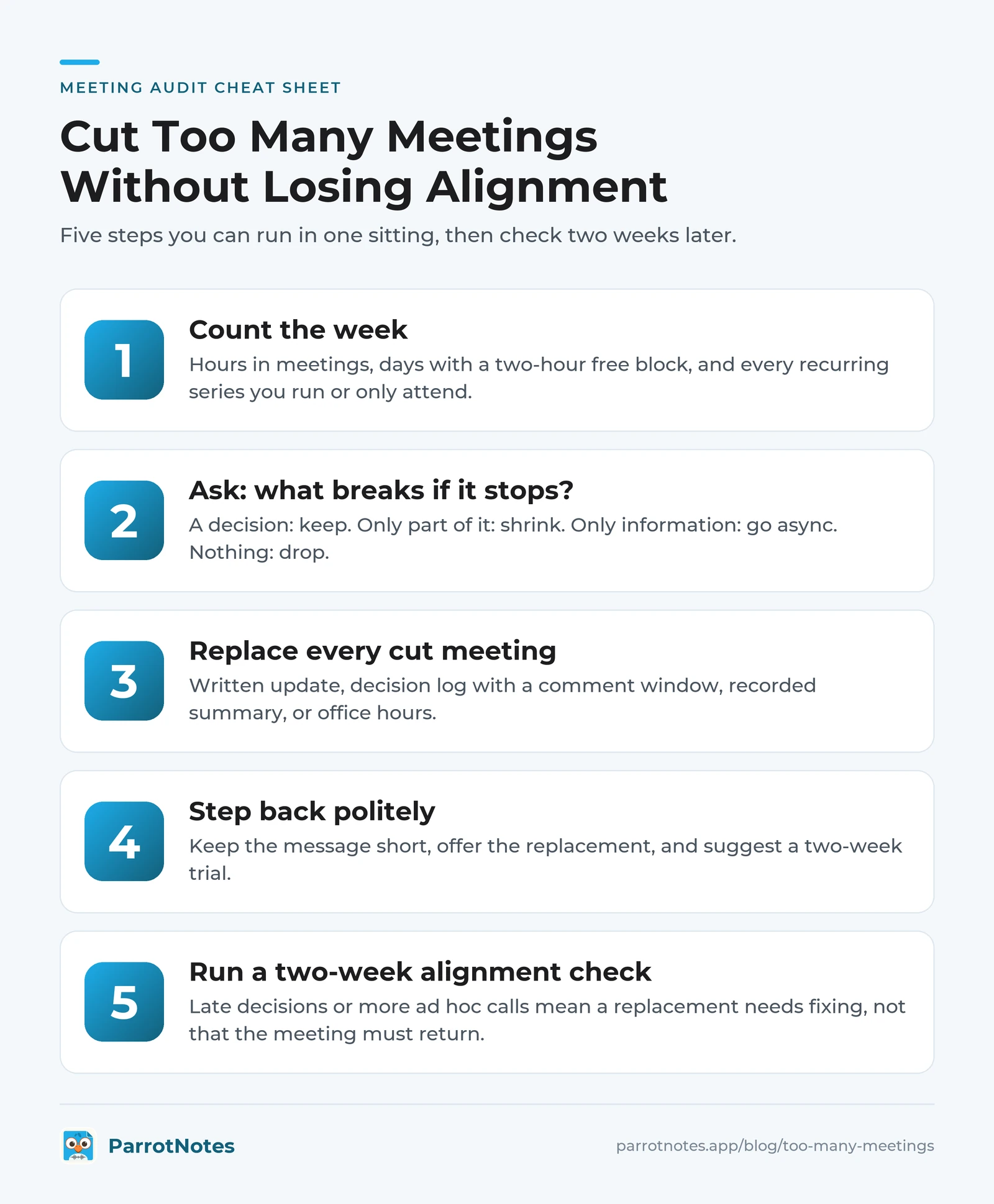
Cut too many meetings without losing alignment
Too many meetings is a calendar problem, not a character flaw, and you can fix most of it in one sitting.
- Count the week first. Hours in meetings, free two-hour blocks, and recurring series you run or only attend.
- Use one test. If nothing breaks when a meeting stops, drop it. If only information moves, go async.
- Replace before you cut. A written update, a decision log, a summary, or office hours keeps the information flowing.
- Check after two weeks. Late decisions and more ad hoc calls mean a replacement needs fixing, not that the meeting must return.
Start with the meetings you only attend: they give back the most time for the least friction. And for the meetings you keep, download ParrotNotes so one recording and one summary can stand in for the people who no longer need to be there.
Frequently Asked Questions
How many meetings is too many?
There's no fixed number, because some roles are mostly meetings. You have too many meetings when you can't find two hours in a row for focused work on most days, when your own tasks move to the evening, or when you sit in meetings where you don't speak or decide anything.
How do I deal with too many meetings at work?
Count a normal week, then ask of each recurring meeting: what breaks if it stops? Keep the ones that make decisions, shrink the ones where only part is needed, move status updates to a written update, and drop the rest. Give every cut meeting a replacement so information still flows.
How do I decline a recurring meeting politely?
Keep it short, give a reason tied to your priorities, and offer a replacement. For example: "I don't think I add much to this sync, so I'd like to step back. Could someone share the decisions afterwards? Tag me if anything needs me." Offering to read the notes shows you still care about the outcome.
How do you stay aligned with fewer meetings?
Replace each cut meeting with something that does its job: a written status update, a decision log with a 48-hour comment window, a short summary of the meetings that still happen, or weekly office hours. After two weeks, check whether anyone learned about a decision late or whether ad hoc calls went up.
Related Posts

How to Use Dictation on Windows 11: Shortcut, Commands and Fixes
How to use dictation on Windows 11: press Windows key + H, say punctuation out loud, use Voice Access offline, and fix the microphone when voice typing fails.

Sales Voicemail Scripts That Get Callbacks
Copy 10 sales voicemail scripts by situation, from first touch to breakup, each timed, plus greeting scripts for reps and a voicemail-and-email sequence.

Sales Talk Track: Examples and a Template
What a sales talk track is, how it differs from a script, plus a one-card template and examples for openers, demos, pricing, objections and next steps.