
Discovery Questions in Sales: 50 Examples That Open Buyers Up

Sarah Johnson
Writes about field sales, meeting notes and voice-first workflows at ParrotNotes. Every article is reviewed by the ParrotNotes product team before it goes live.

Table of Contents
- 1.How to choose discovery questions in sales for one meeting
- 2.The 50 discovery questions in sales, in ten groups
- 3.Asking discovery questions in person
- 4.What to write down: the one-page discovery sheet
- 5.A worked example: one visit, one sheet
- 6.Ask fewer discovery questions in sales, and keep every answer
Dana sells building materials. Last Tuesday she sat in a contractor's site trailer with a printed list of 25 questions and worked through it top to bottom. By question 12 the superintendent was checking his phone. She drove away with a full page of notes and nothing she could use: no reason to buy now, no name above his, no next step.
The list wasn't the problem. Reading it in order was.
Good discovery questions in sales don't feel like a survey. Each one follows from the last answer, and each answer lands somewhere: a problem statement, a name, a date. Below are 50 discovery questions in ten groups, what to listen for in each answer, the questions that only work in the buyer's building, and a one-page sheet for what to write down.
If you'd rather watch the buyer than your notepad, ParrotNotes turns a recorded meeting (with the buyer's permission) into a transcript, a summary, and action items before your next stop.
How to choose discovery questions in sales for one meeting
Nobody asks 50 questions. Pick 11 to 14.
That range comes from Gong Labs' analysis of more than 519,000 recorded B2B sales calls: calls with 11 to 14 targeted questions did best, and results fell back to average above that. Top performers also spread their questions through the call instead of front-loading them. The analysis dates from 2017 and Gong itself warns that correlation isn't causation, so treat the number as a ceiling, not a quota.
Before the meeting, pick one or two questions per group that you can't already answer, and write them on one card. In the meeting, ask whatever the last answer earns, card or not.
Running a named framework? Use its own questions for the pain stage: the SPIN selling question bank (built on Huthwaite's four question types), Sandler's pain funnel, BANT qualification questions, or MEDDPICC. The 50 below cover what surrounds them.
The 50 discovery questions in sales, in ten groups
The answer you want is usually a name, a number, a date, or the buyer's own words.
1. Earning the right to ask
1. "What would make this hour worth your time?" Listen for their agenda. Write it at the top of the page.
2. "I'll have a few questions about how things run. OK if I take notes?" Listen for the yes, or an offer to record. Now the notebook is agreed, not hidden.
3. "What have you heard about us so far, and from whom?" Listen for a referrer, a competitor's framing, or a bad story.
4. "What were you hoping I'd bring today?" Listen for the thing they'll judge the visit on: a price range, a sample, a spec sheet.
5. "If we're not a fit, will you tell me today?" Listen for relief. An honest "no" now beats a polite "maybe" in month six.
2. The trigger: why now
6. "What put this on your list this quarter?" Listen for an event with a date: a new contract, a failed audit, a lost customer.
7. "Who raised it first?" Listen for a name. That person often cares enough to push it.
8. "Was this on the list last year? What kept it off?" Listen for the competing priority. It may win again.
9. "What's different about the business this year?" Listen for growth, a new site, a new leader, a new system.
10. "What would knock this off the list again?" Listen for how fragile the priority is.
3. Seeing the work (only in person)
11. "Can you show me where this happens?" Listen with your eyes. Write down what you see, not just what you hear.
12. "Walk me through the last time it happened." Listen for one real incident with a date, not the general version.
13. "Which spreadsheet, form, or whiteboard keeps this running? Can I see it?" Listen for the workaround. It shows where the process breaks.
14. "What does a new hire get wrong in their first month?" Listen for the hidden steps nobody wrote down.
15. "What works well here and shouldn't change?" Listen for what you must not break during rollout.
4. The problem in their words
16. "What's the most frustrating part of this for you?" Listen for the personal version. Write it word for word.
17. "When it goes wrong, what's the first sign?" Listen for who notices first. They feel the pain first.
18. "On a bad day, who drops what to fix it?" Listen for names and the work that gets pushed aside.
19. "Is it getting better, worse, or holding steady?" Listen for direction. "Worse since spring" gives you urgency and a date.
20. "Of everything we've covered, which would you fix first?" Listen for the one problem to build your recommendation on.
5. The cost of standing still
21. "How do you measure this today, if at all?" Listen for whether a number exists. If not, you'll help build one.
22. "What number would your boss check to know it's fixed?" Listen for the metric your business case must move.
23. "Roughly how many hours a week go into the workaround, and whose?" Listen for an estimate and a job title.
24. "What have you had to turn down because of this?" Listen for lost work or a request they couldn't meet.
25. "Has this ever cost you a customer or a bid?" Listen for a named account. One can outweigh every other number.
6. The people around the decision
26. "Who else will I hear from on this, even if they're not here?" Listen for new names, and add each to your stakeholder map.
27. "Whose day changes most if you switch?" Listen for the users. They can quietly veto a deal.
28. "Who's been burned by a project like this before?" Listen for the skeptic and their story.
29. "How do calls like this get made here: one person, a committee, or whoever cares most?" Listen for how power really works.
30. "If they were in this room, what would they ask me?" Listen for objections from people you haven't met.
7. How they buy
31. "What did the last purchase like this look like, from first meeting to go-live?" Listen for steps and durations. They predict this deal.
32. "Would you trial this first, or buy outright?" Listen for how they reduce risk. A trial needs agreed success criteria.
33. "Who else are you looking at?" Listen for competitors, and for "nobody", which means doing nothing is the rival.
34. "What would make you do this in-house instead?" Listen for the internal option. It's often the strongest competitor.
35. "When you compare options, what wins a tie?" Listen for the real deciding factor: service, price, local support.
8. Money and value
36. "What did this problem cost you last year, workarounds included?" Listen for a figure to set your price against.
37. "Whose budget would this come from?" Listen for a department and a name, not "we'd find it."
38. "When does your budget year reset?" Listen for a date that can speed a deal up or freeze it.
39. "How does finance judge a project like this: payback, savings, or risk?" Listen for the test your proposal must pass.
40. "A year after buying, what would feel like a disappointment?" Listen for their bar, so you promise the right things.
9. Fit and risk
41. "What would make us the wrong choice?" Listen for the deal-breaker while you can still address it.
42. "What's gone wrong with vendors like us before?" Listen for the fear you'll have to disprove.
43. "What will your team push back on first?" Listen for adoption risk, and plan around it.
44. "What has to be true for rollout to be easy?" Listen for timing, training, and who does the work.
45. "What would you need from us six months after signing?" Listen for the service they really value.
10. Commitment and next step
46. "Let me read back what I wrote. What did I miss?" Listen for corrections. They're your most accurate notes all day.
47. "What should happen next, and who should be there?" Listen for a named person and a meeting type.
48. "What can you get done before we meet again?" Listen for a real commitment, and log it in a mutual action plan.
49. "Can we put the next meeting in the calendar while we're both here?" Listen for a date. In person, it's the easiest time to get one.
50. "If you wrote the recap to your boss tonight, what would the first line say?" Listen for how they'll sell it internally, and reuse their line.
Want every answer word for word? Record the meeting with the buyer's permission, and ParrotNotes gives you the transcript, a summary, and action items. The free plan includes 100 minutes of recording a month and an AI summary on every recording.
Asking discovery questions in person
Phone guides skip the room. In person, the room does half the work.
Put the notebook on the table. Question 2 makes note-taking something you agreed on. When the buyer sees you writing, pause and let them finish the thought.
Ask to see things. Questions 11 to 13 are the reason to visit at all. A spreadsheet taped to a wall beats ten minutes of description.
Let silence work. After a cost or priority question, stop talking. Sandler calls its pain step "not a checklist-driven part of the conversation", and silence keeps it that way.
Record only with a clear yes. Ask at the start and say why: "so I can listen instead of scribbling." Consent law varies by state and country, so check yours.
Take Marco, a packaging rep visiting a bakery plant. He asked question 11, and the plant manager walked him to the wrapping line. Taped to the machine was a handwritten log of every jam that week: 14 entries. Marco photographed it with permission, and that page became the first line of his proposal.
What to write down: the one-page discovery sheet
Discovery questions in sales only pay off if the answers survive the drive. Keep one line per group and fill the lines in whatever order the conversation gives them.
| Group | Write down | Good note looks like |
|---|---|---|
| Opening | Their agenda | "Wants a price range and lead times" |
| Trigger | Event and date | "Lost the Hartley contract, August 14" |
| The work | What you saw | "Jam log on line 2, 14 entries this week" |
| Problem | Their words, in quotes | "We babysit that machine all shift" |
| Cost | Number, and whose | "About 6 hrs/week, shift lead's time" |
| People | Names and roles | "Priya, ops director, signs over $10k" |
| Buying | Steps and durations | "Last time: trial, then 6 weeks to PO" |
| Money | Budget owner, reset date | "Ops budget, resets January 1" |
| Risk | The deal-breaker | "Can't stop line 2 for more than a shift" |
| Next step | Who, what, when | "Priya on site Oct 9, bring two samples" |
Before you start the engine, say each line out loud into your phone. If trigger, cost, people, or next step is empty, you don't have discovery yet. The finished sheet also becomes your follow-up email after the sales call.
A worked example: one visit, one sheet
Back to Dana. Two weeks after the trailer, she met a general contractor's project manager at a school renovation. This time she picked 12 questions: 6 and 7, then 11 and 13, then 23, 26 to 28, 31, 37, and 47 and 49 to close.
The walk-through did the heavy lifting. The site office had a whiteboard of back-ordered items, and three of the five were in her category. Question 23 put a number on it: the foreman spent about half a day a week chasing deliveries. Question 26 surfaced a name she'd never heard, the owner's representative, who approves substitutions.
She left with eight of ten lines filled. The two blanks, budget reset and deal-breaker, became her questions for the next meeting, already in both calendars. Her follow-up email went out from the parking lot, built from the debrief she dictated into ParrotNotes.
Ask fewer discovery questions in sales, and keep every answer
The best discovery questions in sales are the ones the last answer earned. Pick 11 to 14 from the bank, use the questions only a visit allows, and leave with a name, a number, a date, and the buyer's own words on every line of the sheet.
Then make sure none of it evaporates on the drive. Download ParrotNotes free, record your next discovery meeting with the buyer's permission or dictate the debrief in the car, and have the summary and action items ready before your next stop.
Frequently Asked Questions
How many discovery questions should you ask in a sales meeting?
Plan 11 to 14 and treat that as a ceiling. Gong Labs' analysis of more than 519,000 recorded B2B calls found that range did best, with results falling back to average above it. Pick questions you can't already answer, spread them through the meeting, and let each answer choose the next question.
What is the difference between discovery and qualification questions?
Discovery questions help you understand the buyer's situation: the trigger, how the work runs, what it costs, and who's involved. Qualification questions test whether the deal is worth pursuing, usually against BANT or MEDDPICC. They overlap in practice. Good discovery answers fill your qualification record without the buyer feeling screened.
When should you ask about budget in discovery?
After the buyer has described the problem and put a number on it. At that point a budget question sounds like the natural next step, not a gate. Ask whose budget it would come from and when it resets, not only whether money exists. Those two answers shape your timeline more than a yes or no.
What should you write down during a discovery meeting?
Names, numbers, dates, and the buyer's exact words for the problem. Leave your interpretation for later. A one-page sheet with a line per question group keeps notes short enough to write while listening. Any line still empty when you leave becomes a question for the next meeting.
Can you record a sales discovery meeting?
Yes, if the buyer agrees and local consent law allows it. Ask at the start and explain that it lets you listen instead of scribbling. ParrotNotes turns the recording into a transcript, a summary, and action items, and ParrotNotes Pro adds sales frameworks (BANT, MEDDIC, and SPIN) for structuring what you heard.
Related Posts
Windshield Time: Turn Drive Time Into Done Admin
Windshield time eats a field rep's day. Audit one week, keep the drive for driving, and try a two-minute parked debrief to clear your admin between stops.
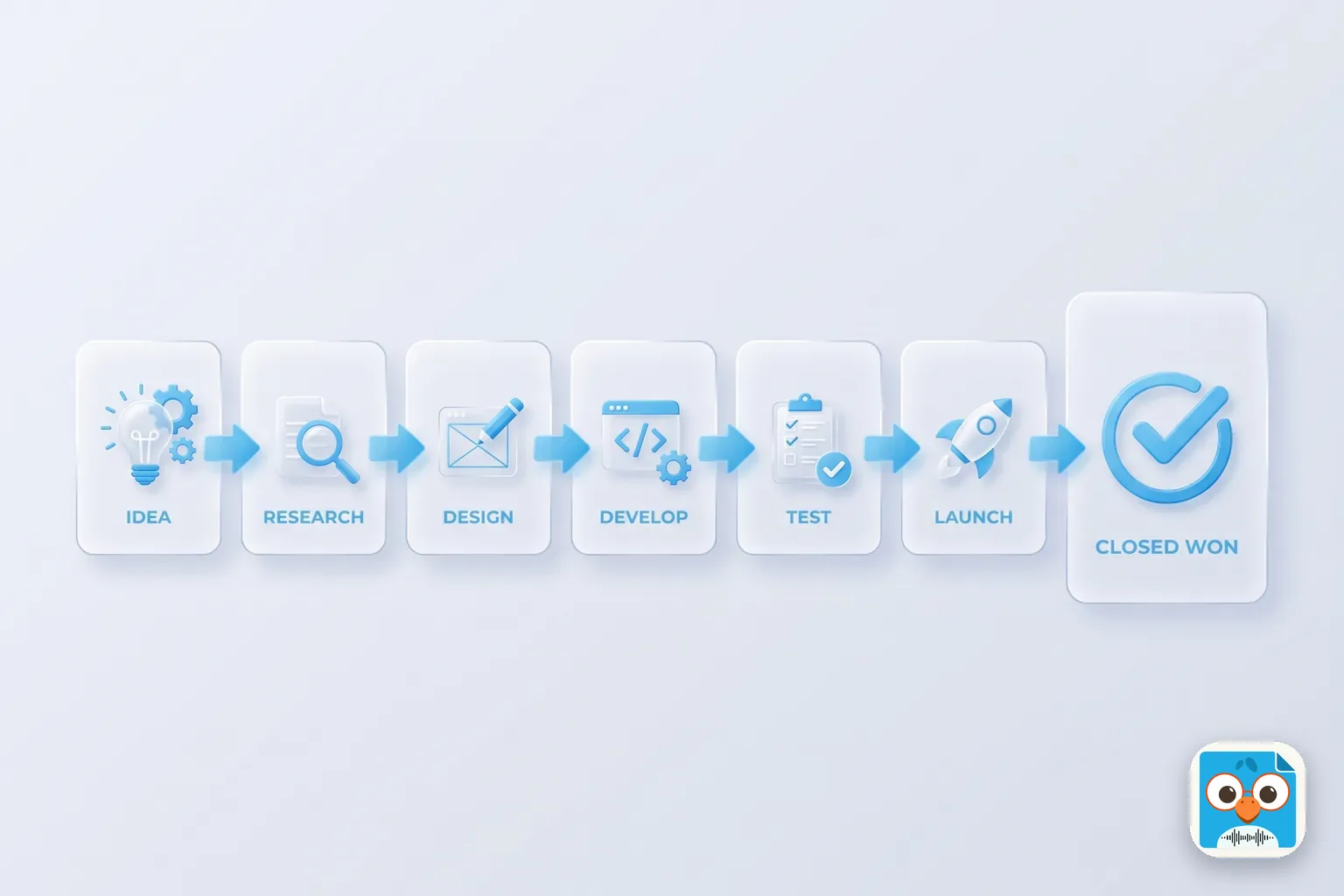
What Is a Sales Pipeline? Stages, Examples and Mistakes
What is a sales pipeline? Learn the seven stages with exit criteria, follow one field deal from prospect to close, and avoid the mistakes that inflate it.
The Challenger Sale: Summary and How to Apply It in the Field
The Challenger Sale in plain English: the five seller profiles, teach, tailor, and take control, plus a six-step pitch and call sheet for your next visit.