
Sandler Sales Methodology: The Seven Steps Explained

Sarah Johnson
Writes about field sales, meeting notes and voice-first workflows at ParrotNotes. Every article is reviewed by the ParrotNotes product team before it goes live.
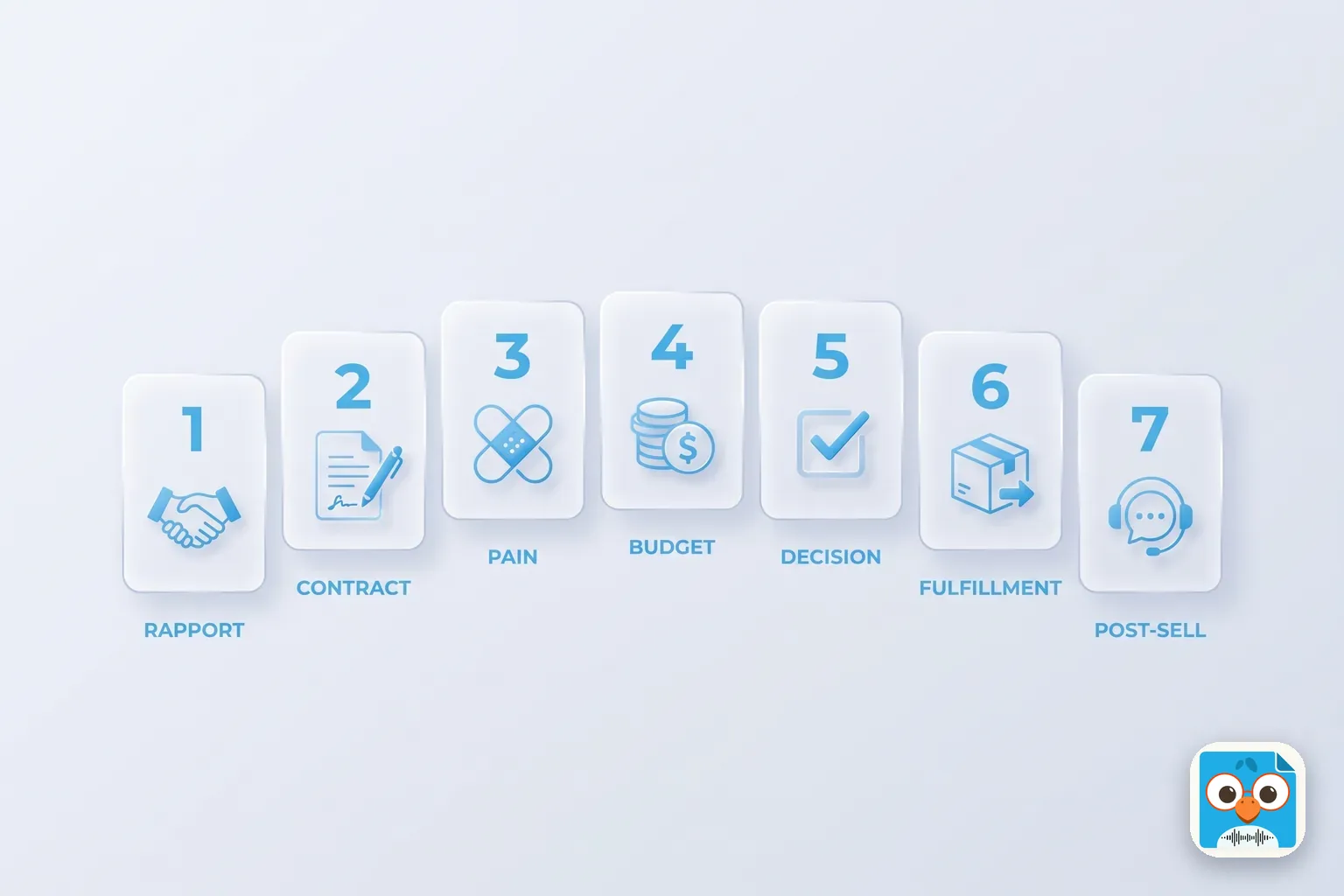
Table of Contents
- 1.What the Sandler sales methodology is, and why it's a submarine
- 2.The seven steps of the Sandler sales methodology
- 3.The Sandler call sheet: one page, seven doors
- 4.A Sandler sales methodology call, filled in
- 5.Sandler vs BANT, MEDDPICC and SPIN
- 6.Capturing Sandler notes without breaking the conversation
- 7.Run the seven steps, then write down what you heard
Marco sells packaging equipment to food plants. Last month he drove two hours to meet a plant manager and ran a 40-minute demo. The manager liked it and asked good questions. Then he said the words every rep dreads: "Let me think it over."
Marco never heard from him again. He'd presented before he knew what the problem cost, what the plant could spend, or who signed.
The Sandler sales methodology was built to stop exactly that. It's a seven-step system that puts qualifying ahead of presenting, so you only pitch to buyers with a real problem, a budget and a clear way to say yes. This guide covers each step as Sandler describes it, then gives you a one-page call sheet and a field call with the sheet filled in.
If you'd rather talk through your notes in the car than type them at the table, try ParrotNotes free and dictate your call sheet after the meeting.
What the Sandler sales methodology is, and why it's a submarine
The Sandler Selling System is, in Sandler's words, "a low-pressure, consultative selling approach that puts you, the salesperson, in control of the discovery process." Its aim is to "prevent the games from ever being played": the stalls, the free consulting, the proposal that vanishes into a drawer.
Founder David Sandler took the submarine image from World War II films: when a submarine was hit, the crew moved through each compartment and closed the door behind them to stop the flooding. Sandler's submarine article groups the seven compartments into three phases:
- Establishing the relationship: bonding and rapport, up-front contract
- Qualifying the prospect: pain, budget, decision
- Closing the sale: fulfillment, post-sell
The doors mean you don't go backwards. Move to budget before the pain is clear, and the pain conversation floods back later as "let me think it over." Sandler also expects you to disqualify in any compartment. A no in step three saves you a proposal in step six.
The seven steps of the Sandler sales methodology
Step names and quoted descriptions are from Sandler's official page. Example questions are from Sandler's 100 Great Sandler Questions, taken from its 2017 book Asking Questions the Sandler Way.
1. Bonding and rapport
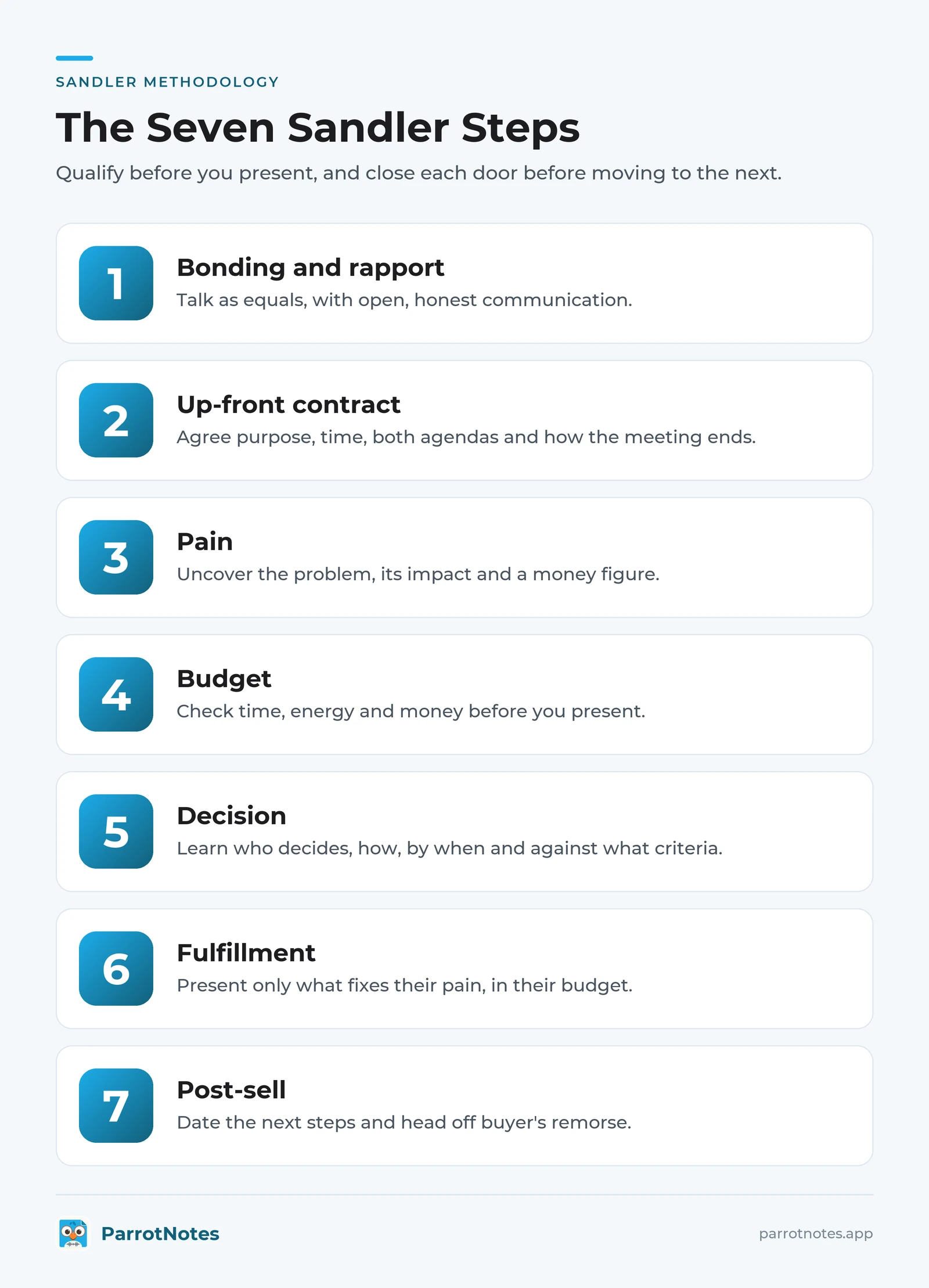
The goal is to "develop equal business stature and encourage open, honest communication." You're a peer checking for a fit, not a supplier hoping for a slot.
2. Up-front contract
The up-front contract sets "roles and ground rules." At the start, agree the purpose, the time, both agendas and how the meeting ends: a yes, a no or a scheduled next step.
3. Pain
Here you "uncover the problems and their potential impact to identify reasons for doing business." Sandler's rule is "qualify hard, close easy," and it says the Pain step isn't complete until the problem has a money figure attached. Its questions have their own guide: the Sandler pain funnel questions and template.
4. Budget
This step asks whether the buyer is "willing and able to invest the time, money, and resources needed to fix the problem." Sandler trainer David Fischer splits it into time, energy and money, with questions like "What were you hoping the investment might look like?" Sandler's list has a gentler one: "Are you imagining a 3-star, 4-star, or 5-star budget to get this fixed?"
5. Decision
This covers "the who, when, what, where, why, and how of the prospect's desired buying process." You want names, steps, dates and the criteria the buyer will judge by.
6. Fulfillment
Only now do you present, and only "your solution to the problem, within the budget, and consistent with the decision-making process." Not the full demo.
7. Post-sell
The last compartment is to "establish next steps, discuss future business, and prevent the loss of the sale to the competition or buyer's remorse." Reps skip it most. Sandler trainer Jeff Pankoff puts it bluntly in his post on the post-sell step: "A contract without a commitment is buyer's remorse in the making." His advice: raise the doubts openly, including how the buyer will tell the current supplier.
The Sandler call sheet: one page, seven doors
Most guides stop at the list, but the hard part in a meeting is knowing when a step is done. Each row gives a door-closing test based on Sandler's own step description, one Sandler question and what to write down.
| Step | Close the door when... | Ask (Sandler's wording) | Write down |
|---|---|---|---|
| 1. Bonding and rapport | You're talking as equals and they've agreed to your questions | "Will you be comfortable me asking you lots of questions about (X)?" | Their role, what they own, any change since you last spoke |
| 2. Up-front contract | You've agreed purpose, time, both agendas and how the meeting can end | "Do we still have 45 minutes to try to understand whether or not we might be a good fit?" | Time agreed, their agenda items, the outcome options |
| 3. Pain | The buyer has described the problem, its impact and a money figure | "How serious would you say the problem is right now, today?" | The problem in their words, the cost, who else feels it |
| 4. Budget | You know if they'll invest time, energy and money, and roughly how much | "What budget has been established to address these issues?" | Range or tier, who holds the budget, when it's available |
| 5. Decision | You know who decides, how, by when and against what criteria | "Who authorizes these kinds of decisions around here, and how long does it usually take?" | Names and roles, steps, dates, criteria |
| 6. Fulfillment | You've shown only what fixes their pain, in their budget, to the deciders | "What do you imagine your biggest internal barriers to implementation might be?" | Which pains your proposal covers, the barriers named |
| 7. Post-sell | Next steps are dated and the likely pushback has been discussed | "What was the single best thing that swung it for us?" | Next steps with dates, the incumbent's likely response |
One rule: if you can't fill the "write down" column for a step, that door isn't closed. Go back before you move forward.
A Sandler sales methodology call, filled in
Dana and every number here are illustrative, invented to show the shape of the notes.
Dana sells GPS fleet tracking. She meets Luis, operations manager at a plumbing company with 22 vans, and opens with the up-front contract: "We've got 45 minutes. I'll ask how you run the vans, you'll ask what this costs, and at the end we'll agree whether a second meeting makes sense. Fair?"
Pain comes out slowly. Techs write their own start times, overtime has crept up since spring, and a customer disputed a bill because nobody could prove when the van arrived. Luis puts the extra overtime at "maybe $4,000 a month." Dana writes his number, not hers.
Dana asks the hotel question, and Luis laughs: three stars, because the owner won't pay for "a Ritz." Then decision: the owner signs, the office manager has to run it, and it must be live before November.
Her sheet, in brief:
- Contract: 45 minutes; a second meeting with the owner, or a clean no
- Pain: "Techs write their own start times." Overtime about $4,000 a month (Luis's estimate). One disputed invoice
- Budget: "Three stars." The owner holds it; Luis wants a monthly cost
- Decision: owner signs, office manager approves the workflow, live before November
- Next step: Tuesday, 30 minutes, Luis, the owner and the office manager
Dana hasn't demoed anything. When she does, it'll be three screens: start times, overtime and proof of arrival. That's fulfillment the Sandler way. For more pain and decision questions, see these discovery questions in sales.
Two weeks later the owner says yes, and Dana runs post-sell before leaving: "When your current provider hears you're switching, what do you think they'll offer?" Luis guesses a discount, and they agree his answer. When the incumbent calls, he's ready. On larger deals, a mutual action plan holds these next steps.
Sandler vs BANT, MEDDPICC and SPIN
The Sandler sales methodology runs the whole conversation, so it sits alongside these rather than replacing them.
- BANT checks budget, authority, need and timing. Sandler covers it with pain first. See the BANT qualification guide.
- MEDDPICC scores complex deals. Sandler's pain and decision notes feed its Metrics, Decision criteria and Decision process letters, as the MEDDPICC guide shows.
- SPIN is a questioning sequence that fits inside Sandler's pain step. The SPIN selling guide has field examples.
Capturing Sandler notes without breaking the conversation
The Sandler selling system asks you to listen hard. Look down to write "$4,000/mo" at the wrong moment and a buyer may tidy up the answer. Write only numbers, names and dates in the meeting, then fill in the call sheet out loud afterwards.
Talk through the seven rows into ParrotNotes in the car and get a transcript, an AI summary, action items and a drafted follow-up email. The free plan gives you 100 minutes of recording a month, a summary on every recording and five AI-powered recordings a month.
Pro ($19.99 a month, or $14.99 billed annually) gives you 3,000 minutes a month and every AI feature on every recording, including built-in BANT, MEDDIC and SPIN frameworks. It also adds custom insight templates you can shape around the seven Sandler steps. If the buyer agrees, ParrotNotes can record the meeting itself from your phone, with no bot to invite.
Download ParrotNotes free and run your next Sandler debrief before you start the engine. Then use these follow-up email templates to send the buyer their own words back.
Run the seven steps, then write down what you heard
The Sandler sales methodology is easy to list and hard to run from memory:
- Set an up-front contract with a clear yes, no or next-step ending
- Qualify before you present: pain with a money figure, then budget, then decision
- Close each door before moving on, and go back if you can't fill its notes
- Finish with post-sell: dated next steps and the pushback you both expect
Marco opened the last compartment first and got silence. Dana closed every door in order and left with three names, a budget tier and a Tuesday meeting.
Print the call sheet and download ParrotNotes free to fill it in out loud on the drive back.
Frequently Asked Questions
What are the seven steps of the Sandler sales methodology?
Sandler lists them as bonding and rapport, up-front contract, pain, budget, decision, fulfillment and post-sell. They fall into three phases: establishing the relationship, qualifying the prospect and closing the sale. Sandler draws them as submarine compartments, because you close each door before moving to the next.
What is an up-front contract in Sandler?
It's a short agreement at the start of a meeting on purpose, time, what each side wants to cover and how the meeting ends. The key part is the outcome: a yes, a no or a dated next step, which heads off "let me think it over."
Why does Sandler talk about budget before presenting?
Because a presentation without a budget is a guess. Sandler puts Budget after Pain and before Fulfillment, so you know whether the buyer will invest time, energy and money, and roughly how much, before you build a proposal. Raising money late surprises buyers.
Is the Sandler sales methodology only for cold calls?
No. Sandler is often taught with prospecting, but the seven steps describe a whole sales conversation. Field reps use them in first meetings, site visits and follow-ups. Managers use them in deal reviews to spot which compartment a stalled deal never closed.
How is Sandler different from SPIN selling?
SPIN is a questioning sequence: situation, problem, implication and need-payoff. Sandler is a full sales process, from rapport to post-sell, with firm rules on qualifying before you present. Many reps use SPIN-style questions inside Sandler's pain step to reach the cost of the problem.
Related Posts
Windshield Time: Turn Drive Time Into Done Admin
Windshield time eats a field rep's day. Audit one week, keep the drive for driving, and try a two-minute parked debrief to clear your admin between stops.
What Is a Sales Pipeline? Stages, Examples and Mistakes
What is a sales pipeline? Learn the seven stages with exit criteria, follow one field deal from prospect to close, and avoid the mistakes that inflate it.
The Challenger Sale: Summary and How to Apply It in the Field
The Challenger Sale in plain English: the five seller profiles, teach, tailor, and take control, plus a six-step pitch and call sheet for your next visit.