
Sandler Pain Funnel Questions (With a Note-Taking Template)

Sarah Johnson
Writes about field sales, meeting notes and voice-first workflows at ParrotNotes. Every article is reviewed by the ParrotNotes product team before it goes live.

Table of Contents
- 1.What is the Sandler pain funnel?
- 2.The 8 Sandler pain funnel questions
- 3.The three levels the Sandler pain funnel drops through
- 4.The Sandler pain funnel note-taking template
- 5.A worked Sandler pain funnel call, with the template filled in
- 6.How to capture the answers without breaking the funnel
- 7.Mistakes that flatten the Sandler pain funnel
- 8.Where the pain funnel fits with BANT, MEDDPICC and your stakeholder map
- 9.Run the Sandler pain funnel, then write down what you heard
Leah sells industrial fasteners across three counties. On Tuesday she spent 40 minutes with Tom, the maintenance manager at a food-packaging plant. She left with one line in her notebook: "stockouts on line 2, wants better supply." In the car she couldn't have told you how often the line stopped, what a stop cost, or whether Tom cared enough to switch suppliers.
You've had that drive. The Sandler pain funnel exists for that gap: eight questions, asked in order, that turn a vague complaint into a specific, costed problem the buyer has said out loud in their own words.
This guide gives you the eight Sandler pain funnel questions as Sandler publishes them, and what to write down at each one. Then it adds a note-taking template built around the funnel, a worked call with the sheet filled in, and a way to capture the answers without breaking eye contact.
What is the Sandler pain funnel?
The Sandler pain funnel is a set of eight open-ended questions, asked in order, that moves a buyer from a general complaint to the specific cost and personal stake behind it. Each question is narrower than the last, which is why it's called a funnel. It's the "Pain" step of the seven-step Sandler Selling System, a consultative method that Sandler says trained sellers have used for more than half a century.
Sandler's own explanation is short: "It's a funnel because it starts wide with generic questions. As we uncover more and more information, the questions get more and more specific and the funnel becomes narrower." That line comes from a Sandler article on the power of the pain funnel, which also gives the reason it works: "People tend to buy emotionally and justify it logically."
The method has a story behind it. Sandler's history page describes David Sandler in 1966, in outside sales, going on 87 calls and getting 87 consecutive noes. The system he built in response now trains sellers through more than 230 centers in over 30 countries, and the Sandler pain step is the part most of them meet first.
One boundary before the questions. The full seven-step system is a course, not a blog post. This article covers the Sandler pain funnel only: the questions, the logic, and how to write down what you hear.
The 8 Sandler pain funnel questions
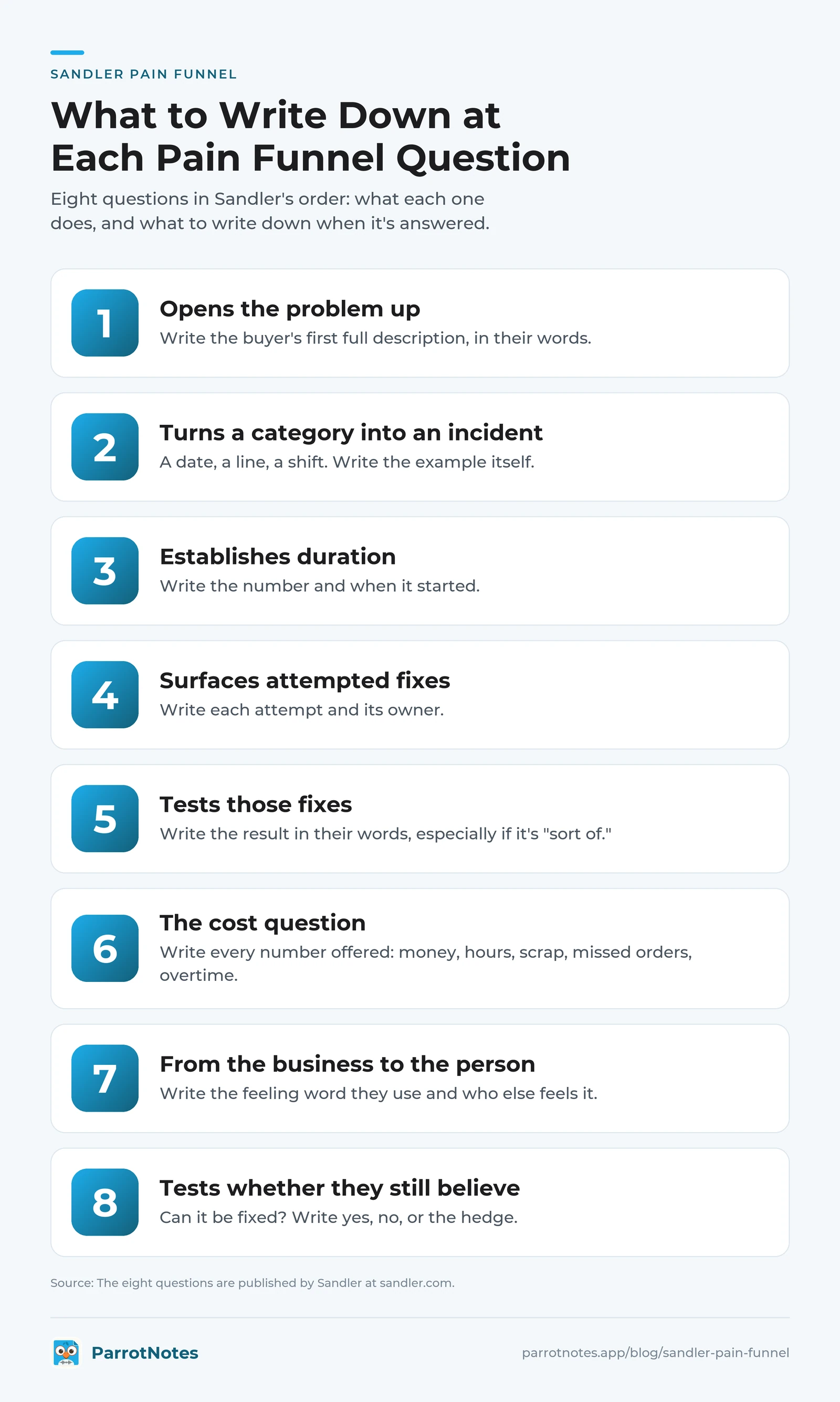
Sandler publishes the eight questions on its own site, in an article on qualifying hard and closing easy. Here they are in Sandler's order, with what each one does and what to write down when it's answered.
- "Tell me more about that…" Opens the problem up without steering it. Write the buyer's first full description, in their words.
- "Can you be more specific? Give me an example." Turns a category ("supply issues") into an incident (a date, a line, a shift). Write the example itself.
- "How long has that been a problem?" Establishes duration. Write the number and when it started.
- "What have you tried to do about that?" Surfaces attempted fixes and the people who own them. Write each attempt and its owner.
- "And did that work?" Tests those fixes. Write the result in their words, especially if it's "sort of."
- "How much do you think that has cost you?" The cost question. Write every number offered: money, hours, scrap, missed orders, overtime.
- "How do you feel about that?" Moves from the business to the person. Write the feeling word they use and who else feels it.
- "Have you given up trying to deal with the problem?" Tests whether they still believe it can be fixed. Write yes, no, or the hedge.
Two notes from Sandler's own trainers matter here. Greg Nanigian, writing on a Sandler site, says "the sequence is the most important thing, not the exact wording." Put the Sandler pain funnel questions into words you'd say, but keep the order. And Sandler's corporate article calls the pain step "not a checklist-driven" conversation: you're listening and following, not reading from a card.
That second point is the whole problem for a field rep. If it's not a checklist and you can't read from a card, how do you get eight answers onto paper? The rest of this guide answers that.
The three levels the Sandler pain funnel drops through
Sandler describes B2B pain in three levels: what the problem is, what it costs, and what's at stake if it isn't solved. The same article makes a blunt claim: most salespeople work at the first level, a few reach the second, and very few reach the third consistently. That's where the deals are.
The eight questions map onto those levels, and so does the note template below.
| Level | Sandler's question | Pain funnel questions | What ends up in your notes |
|---|---|---|---|
| 1. Problem | What is it? | 1, 2 | The problem in the buyer's words, plus one concrete example |
| 2. Cost | What does it cost? | 3, 4, 5, 6 | Duration, attempted fixes and results, every number offered |
| 3. Stake | What's at stake? | 7, 8 | The feeling word, who else is affected, whether they've given up |
Keep the levels separate on paper. A follow-up that quotes a level-1 symptom ("you mentioned stockouts") reads like every other rep's email. One that quotes levels 2 and 3 reads like someone who listened.
The Sandler pain funnel note-taking template
This pain funnel template is the original piece of this article. It's one page, it follows Sandler's eight questions in order, and it keeps the three levels apart so the cost and stake don't get buried under the symptom. Copy it into your notes app, print it, or read it aloud into a voice recorder after the meeting.
Header
- Account, site, date
- Contact and role (who owns the problem day to day)
- Stated problem (their first sentence, verbatim)
The eight rows
| # | Question (in your words) | Their words | Fact to log | Follow-up to ask |
|---|---|---|---|---|
| 1 | Tell me more about that | First full description | "What does that look like in a normal week?" | |
| 2 | Give me a specific example | One incident: date, place, people | "Who noticed first?" | |
| 3 | How long has this been going on | Duration, start point | "What changed when it started?" | |
| 4 | What have you tried | Each attempt and its owner | "Whose idea was that?" | |
| 5 | Did that work | Result of each attempt | "What got in the way?" | |
| 6 | What has it cost | Every number: money, hours, scrap, orders | "Per month or per incident?" | |
| 7 | How do you feel about that | The feeling word; who else feels it | "Who hears about it when it happens?" | |
| 8 | Have you given up on fixing it | Yes / no / hedge, and why | "What would have to be true to try again?" |
Level boxes (filled from the rows above)
- Problem, in their words: one sentence, quoted
- Cost: numbers with units and a time frame; who's affected
- Stake: what happens to the buyer personally if nothing changes, and by when
Pain summary sentence (the line your follow-up opens with): "You told me [problem] has been happening for [duration], it's costing about [cost], and [stake]."
Next step agreed: what, who, when.
Not on this page: your solution. If you catch yourself writing what you'd sell, stop. That goes on a different page, after the pain is confirmed.
Want the buyer's exact words on this sheet without writing during the meeting? Try ParrotNotes free and dictate the eight rows in the car; the transcript and summary land on your phone before you've left the lot.
A worked Sandler pain funnel call, with the template filled in
Here's Leah's Tuesday visit, replayed as it might have gone with the funnel. The people and numbers are illustrative, invented for this article to show the shape of the conversation and the notes it produces.
Tom opens the same way: "We keep getting stockouts on line 2. We need a more reliable supply."
Leah, question 1: "Tell me more about that." Tom: "The line runs a specific hex bolt, and about once a month we run out and the line stops until the buyer chases a delivery."
Question 2: "Can you give me a specific example?" Tom: "Second week of August. We ran out on a Wednesday afternoon, and the line was down until Friday morning."
Question 3: "How long has this been a problem?" Tom: "Since we added the second shift in March. Consumption doubled and nobody reset the reorder point."
Question 4: "What have you tried?" Tom: "Purchasing set up a min-max in the system. And I keep a pallet in my own cage as a buffer."
Question 5: "And did that work?" Tom: "The min-max helped for a month, then the supplier's lead time slipped and it was wrong again. My cage helps until somebody borrows from it without telling me."
Question 6: "How much do you think that's cost you?" Tom: "Line 2 runs about $1,800 an hour when it's up. Call it four stops since March, a day and a half each. Plus the overtime to catch up."
Question 7: "How do you feel about that?" Tom: "Honestly? Tired of it. The plant manager calls me, not purchasing, every time the line stops."
Question 8: "Have you given up trying to fix it?" Tom: "No. But I've stopped expecting the current supplier to fix it for me."
Leah hasn't mentioned a product. She agrees a next step (30 minutes next Thursday with Tom and the buyer, consumption data on the table) and walks to the car. Here's her filled-in sheet.
| # | Their words | Fact to log |
|---|---|---|
| 1 | "About once a month we run out and the line stops until the buyer chases a delivery." | Hex bolt, line 2, monthly stockout |
| 2 | "Second week of August. Down Wednesday afternoon until Friday morning." | One incident, about 1.5 days down |
| 3 | "Since we added the second shift in March." | 6 months; trigger: consumption doubled, reorder point not reset |
| 4 | "Purchasing set up a min-max. I keep a pallet in my cage." | Two fixes: system (purchasing), buffer (Tom) |
| 5 | "Helped for a month, then lead time slipped. People borrow from my cage." | Both partial failures; lead-time variability is the root |
| 6 | "$1,800 an hour. Four stops, a day and a half each. Plus overtime." | About 4 × 12 run-hours × $1,800 ≈ $86,000 since March, before overtime (Leah's arithmetic, to confirm with Tom) |
| 7 | "Tired of it. The plant manager calls me, not purchasing." | Feeling: tired. The stake sits with Tom personally |
| 8 | "No. But I've stopped expecting the current supplier to fix it." | Still wants a fix; the incumbent has lost his confidence |
Problem, in their words: "We keep getting stockouts on line 2." Cost: about $86,000 in lost run time since March (Leah's estimate from Tom's figures, to be confirmed), plus catch-up overtime. Stake: Tom takes the plant manager's call every time, and he's stopped expecting the incumbent to solve it. Pain summary sentence: "You told me line 2 has run out of the hex bolt four times since the second shift started in March, that each stop costs about a day and a half at roughly $1,800 an hour, and that you're the one who gets the call." Next step: Thursday, 30 minutes, Tom plus the buyer, consumption data on the table.
Same prospect, same 40 minutes. The first version left Leah with five words; the second left her with a costed problem, a personal stake, a next step and a follow-up that writes itself. The follow-up templates for in-person sales calls start from exactly this kind of summary sentence.
How to capture the answers without breaking the funnel
The pain funnel asks a person to describe something that frustrates them. Questions 6, 7 and 8 in particular need eye contact and a bit of silence. Look down to write "$1,800/hr" at the wrong moment and Tom tidies up his answer, or stops.
So the honest advice for an in-person rep is: don't try to fill the eight rows during the meeting. Do these three things instead.
1. Write only numbers and single words
Keep the notebook open, but limit yourself to what memory drops first: figures, dates, names, and the one feeling word. "Aug. W-F. $1,800/hr. 4x. Tired. PM calls Tom." Ten words is plenty; you'll hold the rest for the 15 minutes you need.
2. Run a 90-second debrief before you start the engine
The rows come from your own voice, in the car, straight after the meeting. Read the sheet aloud as a script:
- "Pain funnel debrief, Tom at the packaging plant, Tuesday."
- "Stated problem, in his words: ..."
- "Example he gave: ..."
- "How long: ..."
- "What they've tried, and who: ... Did it work: ..."
- "Cost, his numbers: ..."
- "How he feels, his word: ... Given up? ..."
- "Pain summary: ... Next step: ..."
Ninety seconds of talking captures more of the buyer's words than 10 minutes of typing that night. Salesforce's State of Sales research finds that sales reps spend 60% of their time on non-selling tasks, and it names manually entering customer notes into the CRM as one of them. The debrief shrinks that without losing the detail.
ParrotNotes is built for that minute. Open it in the car, talk through the eight rows, and it gives you a transcript, an AI summary and the action items from your own debrief. It drafts the follow-up email from what you said, so the pain summary sentence reaches Tom the same afternoon. Weeks later, ask the AI chat "what did Tom say line 2 costs per hour?" and it answers from the transcript.
The free plan gives you 100 minutes of recording a month, an AI summary on every recording, and AI action items on five recordings a month. Pro ($19.99 a month, or $14.99 a month billed annually) raises that to 3,000 minutes and adds built-in sales frameworks for BANT, MEDDIC and SPIN. Sandler's funnel isn't one of them, which is why the template above exists: it supplies the Sandler structure, and the recording supplies the words. Download ParrotNotes free and run the debrief after your next visit.
3. Record the meeting itself, if the buyer agrees
If you'd rather have Tom's exact words than your memory of them, ask before the meeting whether he minds you recording so you can write an accurate summary. Ask every time, and if the answer is no, use the debrief instead. Rules on recording conversations differ from place to place; this isn't legal advice, so check what applies where you work and get permission first.
ParrotNotes records with the screen off and the phone on the table, and its transcript makes the eight answers searchable afterwards. Recording works offline; the transcript and summary arrive once you're back on a connection. The same applies to any discovery questions you ask, not only the funnel.
Mistakes that flatten the Sandler pain funnel
Sandler's corporate article on the pain step names the biggest one: sellers skip the cost question because of what Sandler calls "head trash" about discussing money. The rest of this list comes from what goes wrong when the funnel meets a real meeting.
- Pitching at question 3. The buyer says "six months" and you hear a buying signal. You're at level 1. Keep going.
- Asking out of order. "How do you feel about that?" before "what has it cost?" gets a shrug. The feeling comes after the number.
- Leading questions. "That must be costing you a fortune, right?" gives you your number, not theirs. Ask the open version and wait.
- Interrogation tone. Eight questions in a row can feel like a deposition. Soften them ("Can I ask how long that's been going on?") and reflect back before moving on.
- Quantifying for them. Leah's $86,000 is her arithmetic. She flagged it as an estimate to confirm with Tom, rather than putting it in his mouth.
Where the pain funnel fits with BANT, MEDDPICC and your stakeholder map
As a pain funnel sales technique, Sandler's sequence does one job: depth on a single problem. It doesn't tell you whether there's budget, who signs, or when. That's why it pairs well with the frameworks you may already run.
- BANT is a first-call screen. The pain funnel turns the N into something you can quote back. Run BANT to decide whether to spend a visit, then run the funnel on the visit; the BANT qualification guide covers the screen.
- MEDDPICC has a letter for this: Identify pain. Level-2 answers feed Metrics, and level 3 points at your Champion. The MEDDPICC walkthrough shows where the output lands in a deal scorecard.
- Stakeholder mapping answers question 7's follow-up: who else feels this? Tom said the plant manager calls him, which is a second stakeholder with a different pain. The stakeholder map template gives you a place to put them.
- Action items. Question 8 and the agreed next step are commitments, and commitments made in a plant office get lost by the car park. The guide to never missing action items from sales calls covers keeping them.
Run the Sandler pain funnel, then write down what you heard
The Sandler pain funnel isn't complicated: eight questions, in order, asked by someone willing to wait for the answer. The hard part for a rep who sells in person is getting those eight answers, in the buyer's words, onto a page you can use.
Here's the short version:
- Ask Sandler's eight questions in Sandler's order, in your own words
- Keep the three levels separate: the problem, what it costs, what's at stake
- Write only numbers and single words during the meeting
- Fill the eight-row template out loud, in the car, within 15 minutes
- Open the follow-up with the pain summary sentence, quoting the buyer
- Never write your solution in the pain box
Leah's first visit produced five words and an email that said nothing. Her second produced a costed problem, a named stake, a next step and a follow-up Tom will recognise as his own words.
Your next discovery visit is already on the calendar. Copy the template, download ParrotNotes free, and dictate your first Sandler pain funnel debrief before you pull out of the customer's lot.
Frequently Asked Questions
What is the Sandler pain funnel?
The Sandler pain funnel is a sequence of eight open-ended questions from the Pain step of the Sandler Selling System. Asked in order, they move a buyer from a general complaint to a specific example, its duration, what they've tried, what it has cost, how they feel about it and whether they've given up. Sandler publishes the eight questions on sandler.com.
What are the 8 Sandler pain funnel questions?
As Sandler publishes them: "Tell me more about that." "Can you be more specific? Give me an example." "How long has that been a problem?" "What have you tried to do about that?" "And did that work?" "How much do you think that has cost you?" "How do you feel about that?" "Have you given up trying to deal with the problem?" Sandler says the sequence matters more than the exact wording.
Do I have to ask all eight pain funnel questions?
Ask them in order, in your own words, and skip one only when the buyer has already answered it. Don't skip the cost question or the two personal questions at the end. Sandler's own material says sellers drop the money question most, and it's the one that separates a complaint from a reason to buy.
Is the Sandler pain funnel manipulative?
Not when it's used as designed. The questions are open, the buyer supplies every answer, and the seller doesn't pitch until the buyer has said what the problem costs and whether they want it fixed. A simple test: if you'd be comfortable showing the buyer your filled-in template, you used it honestly.
How do I take notes during a pain funnel conversation?
Write only numbers, dates, names and the one feeling word during the meeting, then dictate the full pain funnel template in the car within 15 minutes. If you want the buyer's exact words, ask permission to record and use a tool like ParrotNotes for the transcript and summary. Keep problem, cost and stake in separate boxes.
Related Posts

Voice Notes on iPhone: Everything You Can Do With Them
Voice notes on iPhone can do more than record. Learn to capture, tidy, transcribe, sync, and share them, and which iPhone voice tool fits each job. Try it free.

Sales Meeting Agenda: Templates for Weekly Team Meetings
Running a weekly sales meeting that produces nothing? Copy four sales meeting agenda templates for field teams, plus a rep prep card and a record-ready run.
RFQ Template for Manufacturers and Distributors
Copy this RFQ template for manufacturers and distributors: a buyer-side request, a supplier quote response, and one worked example filled in on both sides.