
Windshield Time: Turn Drive Time Into Done Admin

Sarah Johnson
Writes about field sales, meeting notes and voice-first workflows at ParrotNotes. Every article is reviewed by the ParrotNotes product team before it goes live.
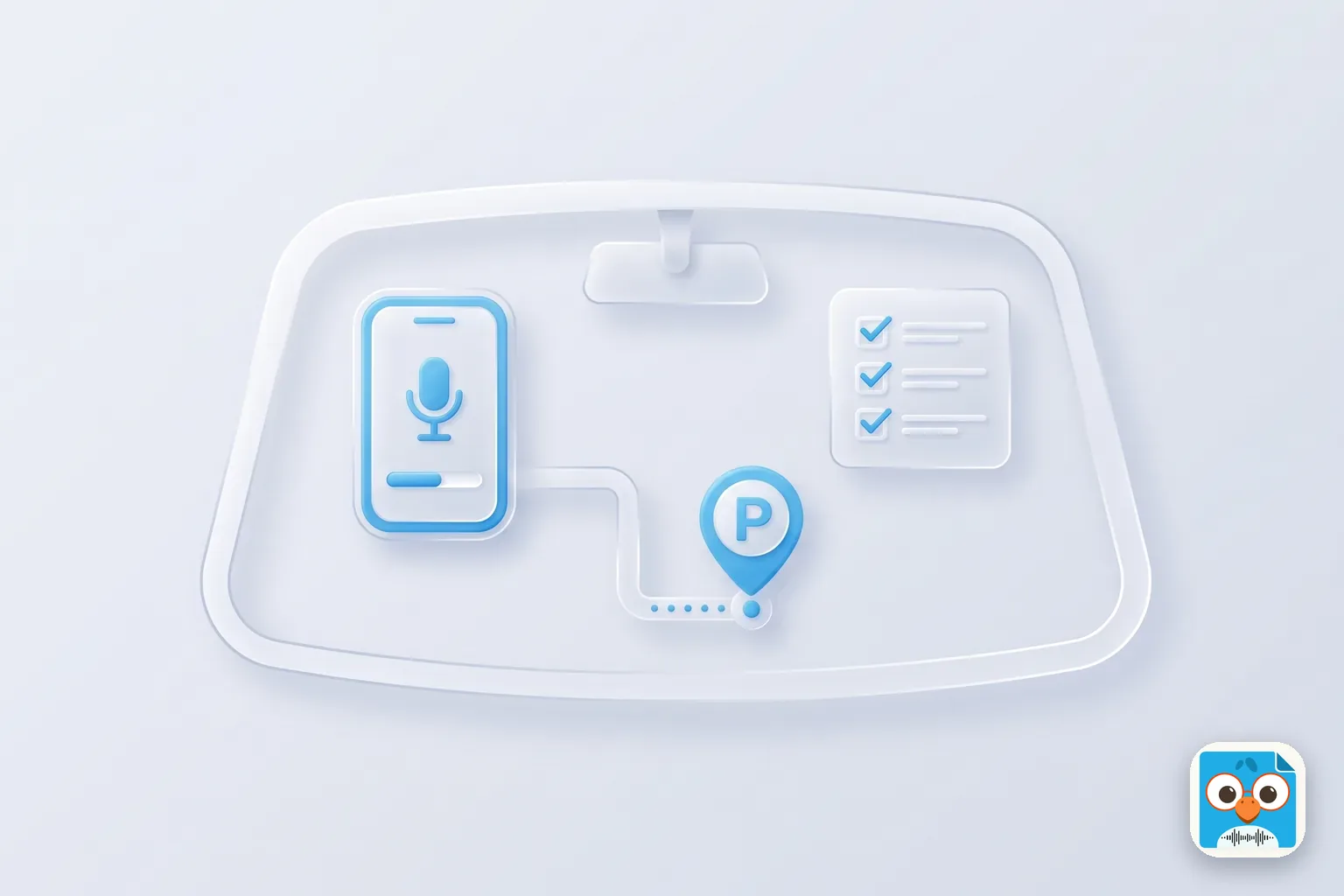
Table of Contents
- 1.What windshield time means for field reps
- 2.The moving car is for driving
- 3.The windshield time audit: one week, one sheet
- 4.The parked edges: a 3-minute prep and a 2-minute debrief
- 5.Shrink the drive itself
- 6.For managers: a windshield time policy in five lines
- 7.Your windshield time checklist
- 8.Conclusion
Marco sold uniforms across two counties last Tuesday. Six visits, three hours behind the wheel, a good day. At 9:10 that night he was at the kitchen table, typing CRM notes for visits he half remembered. The buyer at stop two wanted something by Friday. Probably samples.
If you sell in the field, you know that evening. Windshield time, the hours you spend driving between accounts, isn't the problem on its own. The admin it pushes aside is: it comes back later, colder and harder to rebuild.
This guide splits windshield time into three zones, audits one week of it on a single sheet, and fills the parked minutes around each drive with a short prep and a two-minute debrief. Managers get a five-line team policy.
If you'd rather talk a visit through than type it, try ParrotNotes free. It turns a two-minute spoken debrief into a summary you can read at the next stop.
What windshield time means for field reps
Windshield time is the time a field rep, technician or other mobile worker spends driving between work locations. In sales it's the gap between customer visits: unbillable, unavoidable and usually longer than anyone planned.
Most advice treats windshield time as one block: shrink it with routing, or fill it with audiobooks and calls. It works better as three zones:
| Zone | What it is | What it's for |
|---|---|---|
| The drive | The total minutes on the road, set by your territory and your route | Shrinking, through planning |
| The moving car | Every minute the wheels are turning | Driving. Audio you set up before you left, at most |
| The parked edges | The few minutes before you start the car and after you arrive | Prep for the next visit and a debrief of the last one |
The first zone is a planning problem, the second a safety rule. The third is where admin gets done, and the one most reps waste.
The moving car is for driving
NHTSA counts 3,208 people killed in 2024 in crashes involving distracted drivers. Reading or sending a text takes your eyes off the road for about 5 seconds, a football field at 55 mph. And any non-driving activity, NHTSA says, is a potential distraction that raises your crash risk.
NIOSH, the U.S. workplace safety institute, splits distraction at work into visual, manual and cognitive. Its cognitive examples include talking on the phone and "thinking about your next appointment." That's the honest reason a debrief belongs in a parked car: composing a clean account of a meeting takes the same attention the road needs.
So the rule is short. Drive while the car moves; work while it's parked. Set navigation and audio before you pull out, and where company policy and local law differ, follow the stricter one.
The windshield time audit: one week, one sheet
Memory is a poor stopwatch. For one normal week, fill in one row per drive, at the next stop, parked. It takes ten seconds a row.
| Day | Leg (from, to) | Drive minutes | Parked edge before the visit (min) | Debrief done before driving on? (Y/N) | Follow-up sent same day? (Y/N) |
|---|---|---|---|---|---|
| Mon | Office, Acme Supply | ||||
| Mon | Acme Supply, Riverside Hotel | ||||
| ... |
At the end of the week, work out four totals:
- Drive share: drive minutes divided by working minutes. Tells you whether routing is the first fix.
- Parked-edge minutes: time you already spend parked before visits.
- Debrief rate: visits debriefed before you drove on, divided by all visits. This number decides your evenings.
- Same-day follow-up rate: follow-ups sent the day of the visit, divided by visits that needed one.
A worked example, with fictional numbers. Tomás, a building supplies rep, logs 21 visits in a 45-hour week. His drive minutes total 780: 13 hours of windshield time, about 29% of his week. He arrived early to 16 visits, by nine minutes on average, so 144 parked minutes went unused.
He debriefed 5 of 21 visits before driving on (24%) and sent 6 of 14 needed follow-ups the same day (43%).
His fix isn't a new route. A three-minute prep and a two-minute debrief for 21 visits take 105 minutes, which fits inside the 144 he already sits in car parks.
For context, SPOTIO's State of Field Sales 2026, a survey of 452 sales professionals, found field reps spend 44% of their time on active selling, and 65% spend five or more hours a week on manual CRM data entry. A low debrief rate means more of that data entry happens from memory, hours after the visit. Our guide to sales rep productivity covers other numbers worth tracking.
The parked edges: a 3-minute prep and a 2-minute debrief
The parked edges are short, so use the same two scripts every time.
Before you walk in: three minutes
Parked outside, engine off:
- Read the last note on this account, not the whole history.
- Pick one outcome for this visit: a date, a sample, a named decision-maker.
- Choose the one question you most need answered.
Before you drive on: two minutes
Still parked, say these six lines out loud, in this order:
- Account, contact names and roles, date.
- What changed since the last visit.
- What they care about most, in their words.
- Numbers, specs, dates and names that came up.
- What you promised, and what they promised.
- The next step, who owns it and when.
Here's how it sounds when Keisha, a fictional packaging rep, finishes a 40-minute visit: "Harlow Foods, Ruth Mendel, plant manager, and Sam from maintenance, first time I've met him. They're scrapping about 4% of film on the night shift. Ruth wants a trial roll on line 3. I promised a quote for 20 rolls by Thursday. Sam will send the machine model. Next step: quote Thursday, call Ruth Friday at 9."
Ninety seconds. Written up at 9 PM, it would be three vague lines, and Sam would be missing.
This is where ParrotNotes earns its place in the car. Recording works in a car park with no signal; the transcript, summary and action items arrive once you're back in coverage, along with a drafted follow-up email. Our follow-up email templates show how to send it the same day, and our guide to catching action items from sales calls covers promises with two owners.
Want your debriefs to write themselves? Download ParrotNotes free. The free plan includes 100 minutes of recording a month and an AI summary on every recording, which covers a lot of two-minute debriefs.
Shrink the drive itself
If your drive share is high, four changes cut windshield time without cutting visits:
- Cluster by area. Group accounts by geography and give each area a regular day, so you're not crossing the territory twice in one afternoon.
- Stack nearby calls. When a visit is booked, check who else is within ten minutes and add a drop-in or a scheduled call.
- Move some check-ins to the phone or video. Keep visits for the meetings where being there changes the outcome.
- Plan tomorrow's route before you leave today.
The outside sales rep guide has a worked territory coverage plan, and our list of sales tools for field reps covers the routing apps worth a look. For the moving car, many reps use what Sales Gravy calls "Automobile University": a podcast or audiobook queued before they pull out.
For managers: a windshield time policy in five lines
Managers can't ride in every car, but they can set the habit. NIOSH's employer recommendations include banning all phone use while driving a company vehicle, hands-free included, and requiring workers to pull over in a safe location to text, look up directions or make or receive a call. A team policy built on that fits in five lines:
- No phone use while the vehicle is moving, hands-free included.
- Set navigation and audio before you pull out.
- Park to debrief. Every visit gets a two-minute recorded debrief before the next drive.
- Records within 24 hours. Each visit has a written summary and next step by the next working day.
- No expectation of instant replies from drivers. A rep on the road answers at the next stop.
Line five matters more than it looks. Jen, a fictional regional manager, used to text reps on the road and expect quick answers. Once she added line five and read the day's debriefs at 5 PM instead, her Monday pipeline call shrank from an hour to 25 minutes. The facts were already written down. Our guide to field sales management builds a full team cadence on the same daily debrief.
Your windshield time checklist
Keep this in the car until the habit sticks:
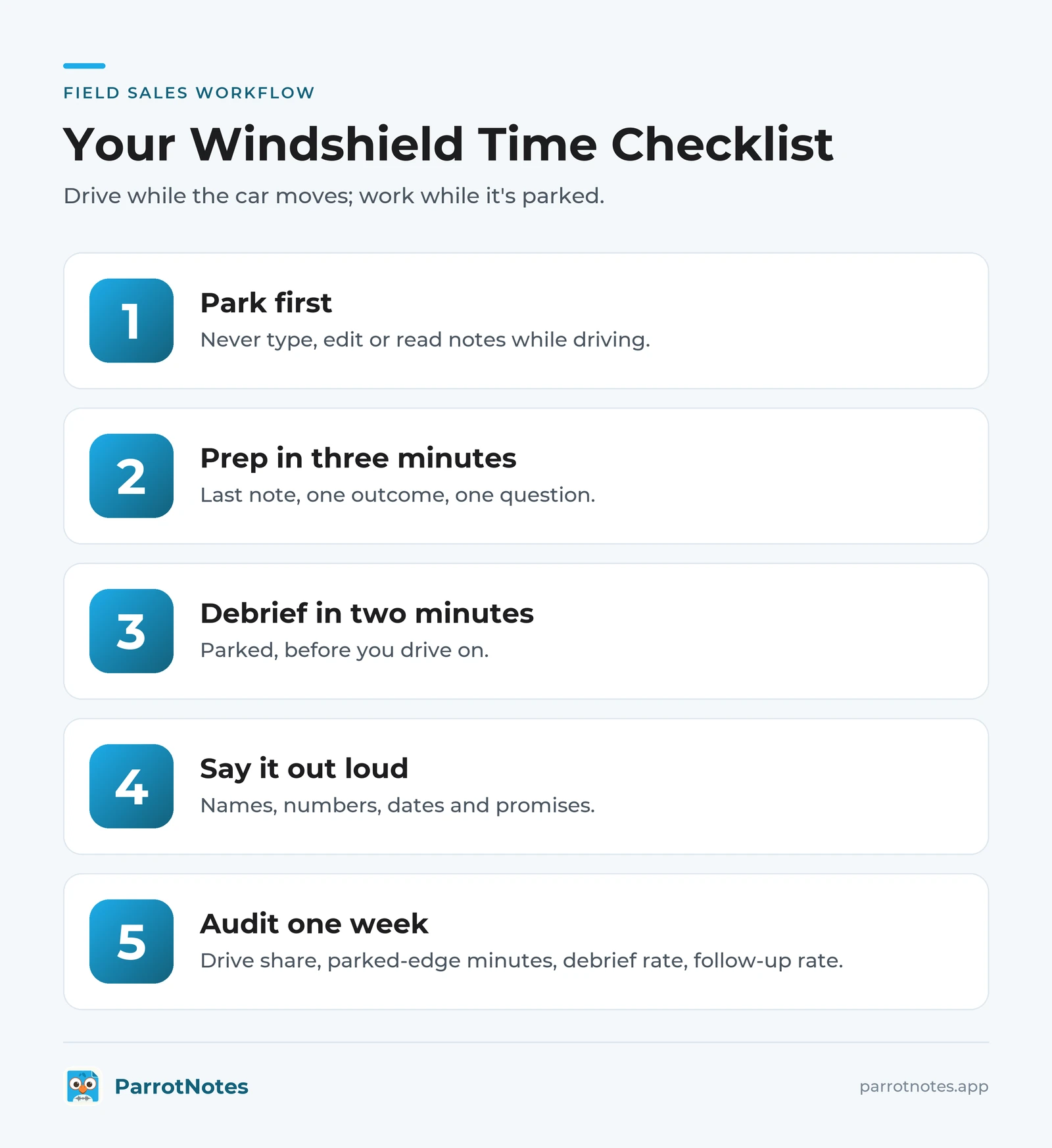
- Park first: never type, edit or read notes while driving.
- Prep in three minutes: last note, one outcome, one question.
- Debrief in two minutes, parked, before you drive on.
- Say names, numbers, dates and promises out loud.
- Audit one week: drive share, parked-edge minutes, debrief rate, follow-up rate.
Conclusion
Windshield time won't disappear from field sales, and it doesn't need to. Split into three zones, each part gets a job: planning shrinks the drive, the moving car is for driving, and the parked edges carry the admin.
Start with the audit this week. One sheet tells you whether your fix is a better route or better use of the minutes you already spend in car parks. Then run the prep and the debrief at every stop.
Had Marco debriefed before driving on, the request at stop two would have been on the record by 11 AM, not half-remembered at 9 PM.
Ready to try it on your next route? Download ParrotNotes free, record one parked debrief after your next visit, and compare it with the note you'd have typed that night.
Frequently Asked Questions
What is windshield time in sales?
Windshield time is the time a field sales rep spends driving between customer visits. It competes with selling time and pushes admin into the evening. Split it into three zones: the total drive, which routing can shrink; the moving car, which is for driving; and the parked minutes around each visit, which are for prep and debriefs.
Can I dictate sales notes while driving?
Safety agencies advise against it. NHTSA calls any non-driving activity a potential distraction. NIOSH lists "thinking about your next appointment" as cognitive distraction and advises employers to ban phone use in company vehicles, hands-free included. The safer habit: park, record a two-minute debrief, then drive on.
How much windshield time is normal for a field rep?
There's no single benchmark; it depends on territory size, account density and visits per day. The useful number is your own. Audit one normal week, log drive minutes per leg and divide by working minutes. If the share is high, start with routing. If not, the bigger win is the parked minutes you already have.
How do I reduce windshield time?
Cluster accounts by area and give each area a regular day. Stack nearby calls around every booked visit, move routine check-ins to phone or video, and plan tomorrow's route before you leave today. Measure your drive share before and after, so you know the change cut miles rather than reshuffling them.
What should a field rep capture after each visit?
Six things, in the same order every time: account, contacts and date; what changed; what the customer cares about most, in their words; numbers, specs, dates and names; what each side promised; and the next step with an owner and a date. Said out loud, parked, that takes about two minutes.
Related Posts
What Is a Sales Pipeline? Stages, Examples and Mistakes
What is a sales pipeline? Learn the seven stages with exit criteria, follow one field deal from prospect to close, and avoid the mistakes that inflate it.
The Challenger Sale: Summary and How to Apply It in the Field
The Challenger Sale in plain English: the five seller profiles, teach, tailor, and take control, plus a six-step pitch and call sheet for your next visit.
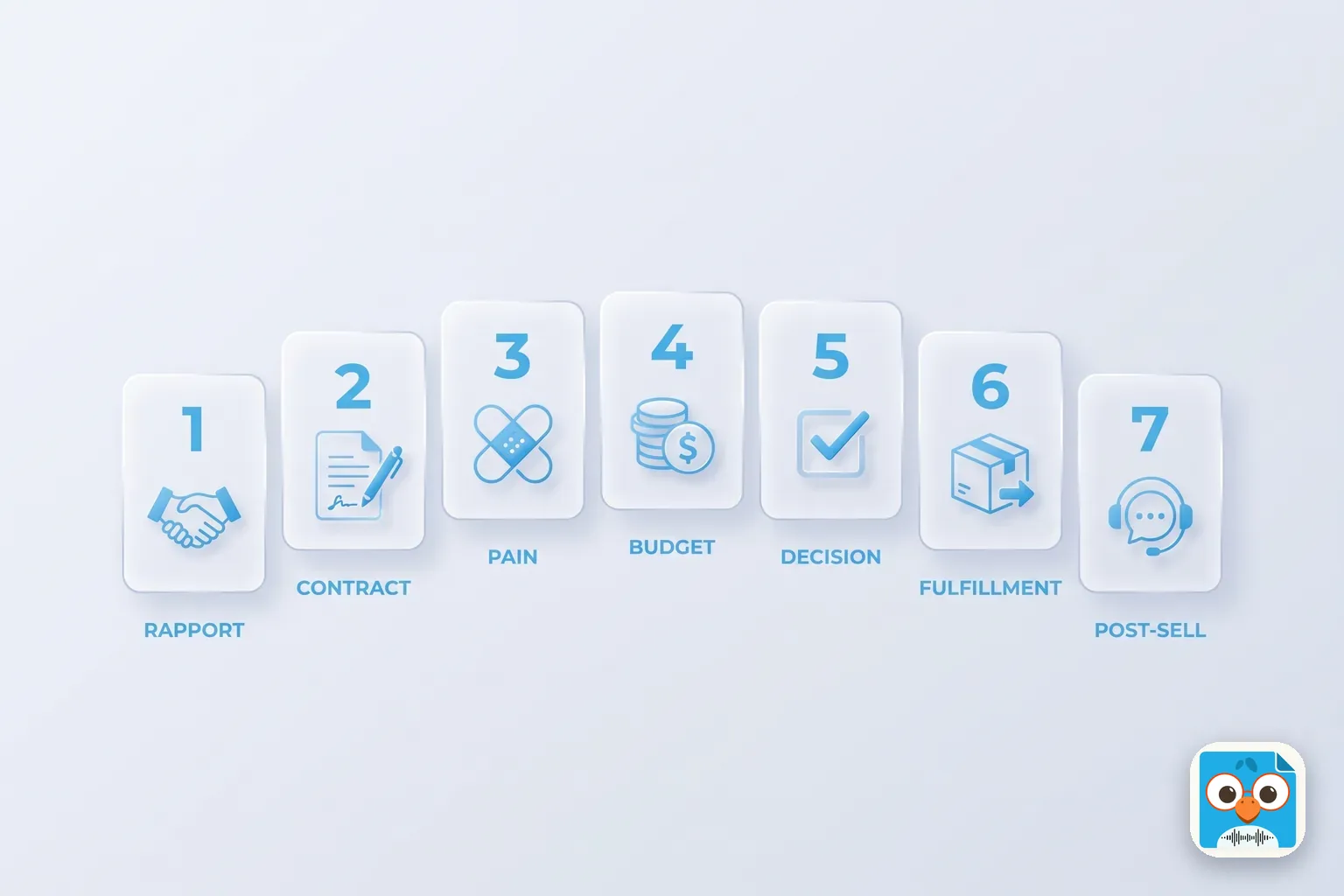
Sandler Sales Methodology: The Seven Steps Explained
The Sandler sales methodology in seven steps, from up-front contract to post-sell, with a one-page call sheet and a worked field call to copy. Try it free.