
Sales and Operations Planning (S&OP): Process and Meetings

Sarah Johnson
Writes about field sales, meeting notes and voice-first workflows at ParrotNotes. Every article is reviewed by the ParrotNotes product team before it goes live.

Table of Contents
On a plant visit in November, Tom hears that his biggest OEM customer is moving a new program into production in March. It'll add about 2,500 valves a month. Tom writes "OEM ramp?" in his notebook and drives to the next account. (Tom is an illustration, not a real rep.)
In March the orders land. The plant built to last year's run rate, so lead times slip, and the customer asks who else can quote.
The plant had a plan and Tom had a fact, but they never met. Sales and operations planning exists to make them meet, once a month, before the problem arrives.
Most guides to S&OP are written from the planner's chair. This one's for the sales side of the table. You'll get the five monthly meetings with timed agendas, a one-page sheet of what sales should bring, and one product family worked through from a field rumor to a dated executive decision.
If you're the one carrying field intel in a notebook, try saying it out loud instead. ParrotNotes turns a spoken debrief after a visit into a summary and action items, so the fact is still there when the demand review comes around.
What is sales and operations planning?
Sales and operations planning is a monthly process where sales, operations, finance, and leadership agree on one plan: what the business expects to sell, what it can make, and what it'll do about the gap.
The formal version comes from the supply chain body ASCM, formerly APICS. Its APICS Dictionary, 14th edition, calls S&OP a process that "brings together all the plans for the business (sales, marketing, development, manufacturing, sourcing, and financial) into one integrated set of plans," as quoted in an ASCM chapter handout. That's an older edition, and later ones may word it differently. The same handout lists a benefit we think matters most: regular meetings with senior executives to resolve demand versus supply trade-offs.
The idea has a clear family tree. Oliver Wight says it originated S&OP in the early 1980s, which is the firm's own account. The term is generally credited to Richard Ling, then an Oliver Wight consultant, who co-wrote Orchestrating Success with Walter Goddard in 1988.
How S&OP differs from what you already run
S&OP gets confused with three things it depends on or grew into. This table separates them.
| Term | Question it answers | Who owns it | Rhythm |
|---|---|---|---|
| Sales forecast | What do we expect to sell? | Sales | Weekly or monthly |
| Production schedule | What runs on which line, on which day? | Plant scheduling | Daily or weekly |
| S&OP | Do demand and supply match, and if not, what do we do? | Leadership team | Monthly |
| Integrated business planning (IBP) | Does the whole business plan still add up, money included? | Leadership team | Monthly |
Oliver Wight's own version of the difference: conventional S&OP aligned sales with supply, often without finance or product management in the room, while IBP brings those functions in throughout. If your company says SIOP (sales, inventory and operations planning), it's the same family with inventory named in the title. Start with whichever label your plant already uses, because the meetings matter more than the name.
The sales and operations planning process: five monthly meetings
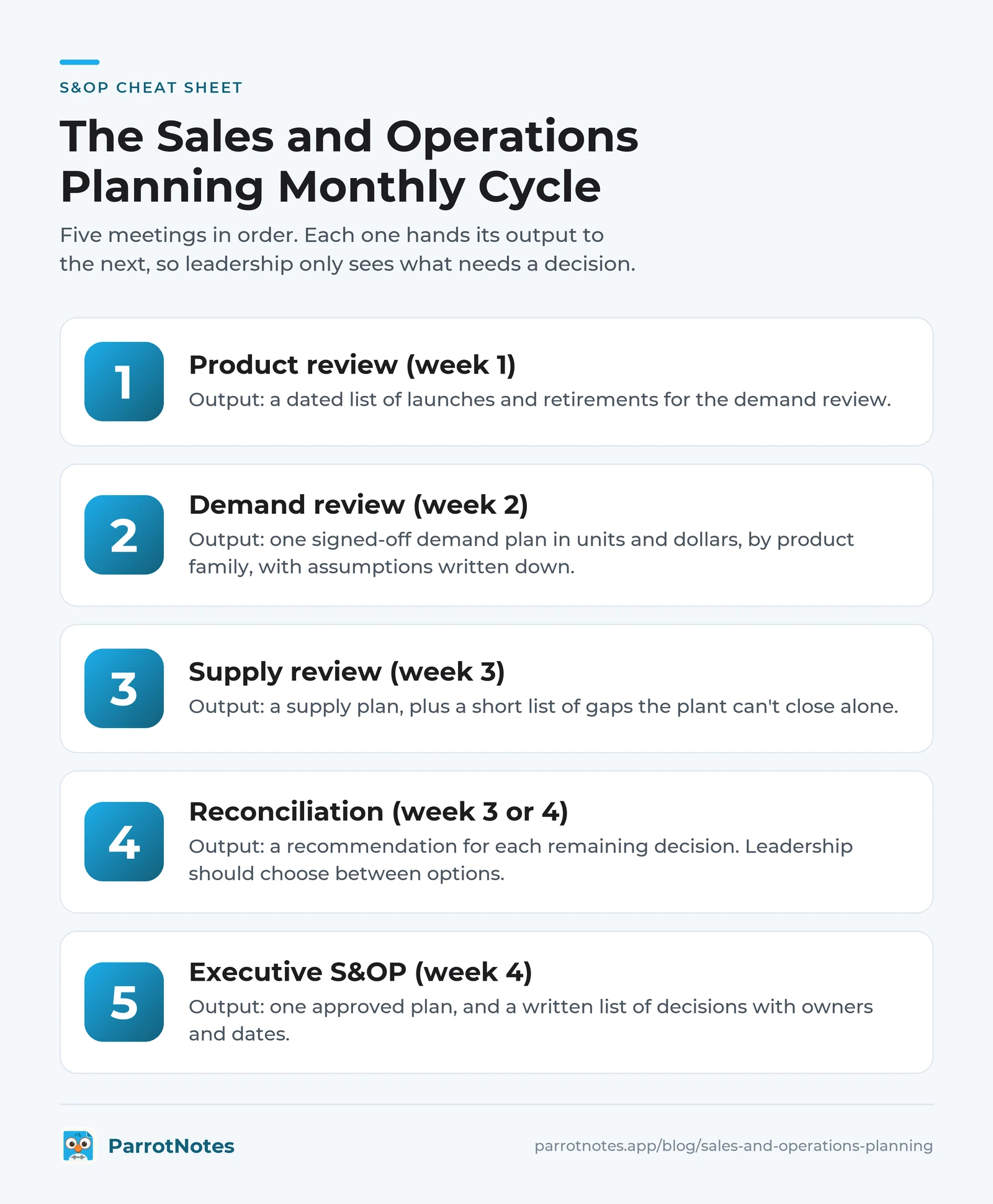
The process runs as a sequence. Each meeting hands its output to the next, so problems get smaller on the way up and leadership only sees what needs a decision.
Oliver Wight names five steps in the monthly process: product, demand, supply, integrated reconciliation, and the management business review. Other sources label them differently. Wikipedia's list starts with data gathering and calls the last two a pre-meeting and an executive meeting, and some companies add a separate finance review. The logic doesn't change.
The agendas and timings below are our suggested starting point, not a standard. Stretch or merge them to fit your business, but keep the order.
1. Product review (week 1)
Who: product manager, sales lead, engineering, and marketing.
Agenda, 30 minutes: new products and launch dates (10), products being retired, with last-buy dates (10), changes the demand team needs to reflect (10).
Output: a dated list of launches and retirements for the demand review.
2. Demand review (week 2)
This is sales' meeting. The goal is an unconstrained demand plan: what customers would buy if the plant had no limits. Supply comes later, on purpose, because a forecast trimmed to fit capacity hides the very gap this process exists to find.
Who: sales leader, demand planner, marketing, and customer service, with key account managers or reps for the families under discussion.
Agenda, 60 minutes: last month's forecast against actual, including bias (10), the planner's history-based baseline by family (10), sales' changes to that baseline, with the reason for each (25), upside and risk not yet in the number (10), and agreement on the plan (5).
Output: one signed-off demand plan in units and dollars, by product family, with assumptions written down.
3. Supply review (week 3)
Who: plant manager, supply planner, purchasing, and logistics, with someone from sales who can answer questions about the demand plan.
Agenda, 60 minutes: last month's plan against output (10), load against capacity by family (20), material and supplier limits (10), inventory and backlog against target (10), options for each gap, with costs (10).
Output: a supply plan, plus a short list of gaps the plant can't close alone.
4. Integrated reconciliation, or pre-S&OP (week 3 or 4)
Who: the people who own demand, supply, and finance, usually led by whoever runs S&OP.
Agenda, 60 minutes: turn the volume plans into dollars and compare them with the business plan (15), review each open gap and its options (30), settle what can be settled here (10), write the executive agenda (5).
Output: a recommendation for each remaining decision. Leadership should choose between options, never start from a blank page.
5. Executive S&OP or management business review (week 4)
Who: the general manager or CEO and the heads of sales, operations, finance, and product. Oliver Wight calls this step the domain of the leadership team.
Agenda, 60 minutes: last month's decisions and whether they happened (10), performance against plan (10), the decisions, one at a time (30), risks to next quarter (5), and a read-back of who owns what by when (5).
Output: one approved plan, and a written list of decisions with owners and dates.
What sales brings to S&OP
History can tell a planner what you shipped. It can't tell them that a customer's plant is shutting down for two weeks in July, or that a distributor is sitting on too much stock. That's what sales adds, and it's why a rep's visit notes belong in this process.
The trouble is the format. "Should be a big year at that account" gives a planner nothing to work with. Copy this sheet and fill in one row for each change you want made to the baseline.
| Field | What to write | Example |
|---|---|---|
| Account and product family | Who, and which family | OEM customer, 2-inch ball valves |
| Change to baseline | Units per month, plus or minus | +2,500 |
| Start month | When it begins to ship | March |
| Why | The fact behind it | New program moves into production |
| Evidence | Where you heard it, who said it, when | Buyer on plant visit, Nov 12 |
| Confidence | Committed, likely, or possible | Likely: no PO yet |
| What would confirm it | The next signal, with a date | Release schedule by Jan 15 |
Five kinds of signal are worth a row: OEM program ramps and end-of-life dates, spec-in wins, large RFQs, distributor stock changes, and customers' shutdowns or line moves. If you're a manufacturers' rep, your call reports to the principal are the natural place for these signals, and they're how your field knowledge reaches a plan you don't sit in on.
Separate the sales forecast from the sales target, too. If quota goes into the demand plan, the plant builds to a hope. Keep the forecast honest with the same evidence you'd want for a commit deal, using this guide to improve sales forecast accuracy. And don't mix up the two kinds of capacity: S&OP asks whether the plant can make what's sold, while sales capacity planning asks whether you've got enough reps to sell what the plan needs.
A worked month: one family, one decision
Here's how Tom's fact moves through the process. Harlan Fittings is a fictional manufacturer, and these numbers are made up to show the math.
It's the December cycle, and the family is 2-inch ball valves, selling at $60 each. Current shifts make 8,500 a month, finished stock is 1,500, and the company wants at least 1,000 on hand.
Using history alone, the planner's baseline is 8,000 a month. That shows a comfortable 500-unit surplus, and nobody would discuss this family at all. Then sales brings two rows to the demand review: Tom's OEM ramp, and a distributor that's cutting its stock for two months.
| Units | Feb | Mar | Apr |
|---|---|---|---|
| History-based baseline | 8,000 | 8,000 | 8,000 |
| Distributor cutting stock | -600 | -600 | 0 |
| OEM program ramp | 0 | +2,500 | +2,500 |
| Demand plan | 7,400 | 9,900 | 10,500 |
| Supply at current shifts | 8,500 | 8,500 | 8,500 |
| Gap | +1,100 | -1,400 | -2,000 |
| Stock at month end | 2,600 | 1,200 | -800 |
So the supply review finds a problem: Harlan runs out in April. A real plan looks much further out than three months (Oliver Wight sets 24 months as the IBP minimum), but three keeps the math readable.
Reconciliation takes two options to the executive meeting:
- Option A, add Saturday shifts in March and April. That's 1,000 more units a month, for $18,000 a month in overtime, or $36,000. Month-end stock becomes 2,200 in March and 1,200 in April, so the minimum holds.
- Option B, ask the OEM to start in April. No overtime, and stock ends at 3,700 in March and 1,700 in April. But 2,500 units, or $150,000 of revenue, move out a month, and the customer may not agree.
The executive team picks A, with a condition, because the ramp is only "likely." The sales leader must get a dated release schedule from the OEM by January 15. If it comes, the plant manager books the Saturday crew. If it doesn't, the plan falls back to B.
That's S&OP doing its job: a plan that spells out what happens under both outcomes, and a named person who finds out which one it is. Nothing in that decision could've happened if Tom's note had stayed in his notebook.
Where S&OP goes wrong
Better spreadsheets won't fix any of these five problems. They're about how people behave in the room.
- Re-arguing the numbers at the top. If the executive meeting debates the forecast, the demand review didn't finish its job. Send it back.
- Sales skipping the demand review. When sales sends a spreadsheet and no person, the planner's baseline wins by default.
- Quota posing as forecast. The plant builds stock against a target, and the excess shows up on the balance sheet later.
- Executives delegating. Without decision-makers in the room, the gaps come back next month, a bit bigger.
- No record of decisions. Next month's first agenda item can't be checked, so commitments quietly fade.
Track a few measures to see whether it's working: forecast accuracy and bias by family, on-time delivery, inventory against plan, and production against plan. Don't forget a simple one too, the share of last month's decisions completed on time.
Keep the decisions on the record
Picture the January meeting at Harlan. Maria, the sales director, recalls the OEM deadline as the end of January. The plant manager remembers the 15th and has already released the Saturday crew. Both are sure, and nobody wrote it down. (Maria is an illustration too.)
An hour of cross-functional debate is hard to minute while you're also taking part in it. Give the job to a recording. With everyone's okay, and in line with your company's policy and local consent rules, put ParrotNotes on the table. You'll get a transcript, a summary, and action items after each meeting, and the read-back in the final five minutes makes the owners and dates easy to find.
The Pro plan records up to three hours at a time and lets you ask a past recording a question, like "What date did we set for the OEM release?" Paste the actions into your action items template, and open the next executive meeting with that list.
Reps can use the same habit on the road. Talk through the visit in the car, and pull the input sheet's fields out of the summary when the demand review comes up. For where those signals arise along a deal, see the manufacturing sales process, and for the commercial review that sits alongside S&OP, see the sales QBR.
Start your sales and operations planning with one family
You don't need software or a consultant to begin. Here's the short version:
- Sales and operations planning gets sales, operations, finance, and leadership onto one monthly plan.
- The five meetings run in order: product, demand, supply, reconciliation, executive.
- Sales' job is to give the baseline facts it can't get from history, with evidence and a confidence level.
- Leadership chooses between costed options, and every decision gets an owner and a date.
Pick your most troublesome product family this month, fill in the input sheet, and take it to a demand review, even a small one. When the plant and the field finally compare notes, you'll probably find a Tom of your own. Download ParrotNotes so what they say is still there next month.
Frequently Asked Questions
What is sales and operations planning in simple terms?
It's a monthly process where sales, operations, finance, and leadership compare what the business expects to sell with what it can supply. Then they agree on one plan and decide what to do about any gap, such as adding shifts, building stock, or changing a delivery date.
What are the five steps of the S&OP process?
Oliver Wight's version runs product review, demand review, supply review, integrated reconciliation, and management business review. Other sources label them differently, for example data gathering, demand planning, supply planning, pre-meeting, and executive meeting. Each step hands its output to the next one.
Who attends S&OP meetings?
It varies by step. The demand review includes sales, a demand planner, marketing, and customer service. The supply review includes the plant manager, supply planning, and purchasing. The executive meeting includes the general manager and the heads of sales, operations, finance, and product.
What is sales' role in S&OP?
Sales owns the demand side. It reviews the planner's history-based baseline and changes it using what it knows from the field, such as OEM ramps, spec-in wins, large RFQs, distributor stock moves, and customer shutdowns. Each change should have a reason, evidence, and a confidence level.
What is the difference between S&OP and IBP?
They're closely related. Oliver Wight describes IBP as an advanced form of S&OP: conventional S&OP aligned sales with supply, while IBP brings in finance, product, and other functions throughout. It also looks at least 24 months ahead on a rolling basis.
How often should S&OP meetings happen?
Monthly is the normal rhythm, with the meetings spread across the month so each can use the output of the one before. Keep short-term changes out of it: daily and weekly scheduling decisions belong with the plant and shouldn't wait for the monthly cycle.
Related Posts

What Is a Byline? Meaning, Examples and Who Gets One
The meaning of byline explained with examples: byline vs dateline, who gets one under AP and NPR rules, plus a freelancer credit email to copy. Learn more.
SDR vs BDR: What Each Role Does and Why Companies Mix Them Up
SDR vs BDR compared: what each role does, the pay employers state and why titles get mixed up, from 154 live job ads. Try ParrotNotes free for hand-off notes.

Sales Email Subject Lines: Examples by Situation and What to Avoid
Sales email subject lines for every situation: 40 short examples, what to avoid, and a five-question check. Build yours from your meeting notes. Try it free.