
What Is a Manufacturers' Rep? How the Model Works

Sarah Johnson
Writes about field sales, meeting notes and voice-first workflows at ParrotNotes. Every article is reviewed by the ParrotNotes product team before it goes live.
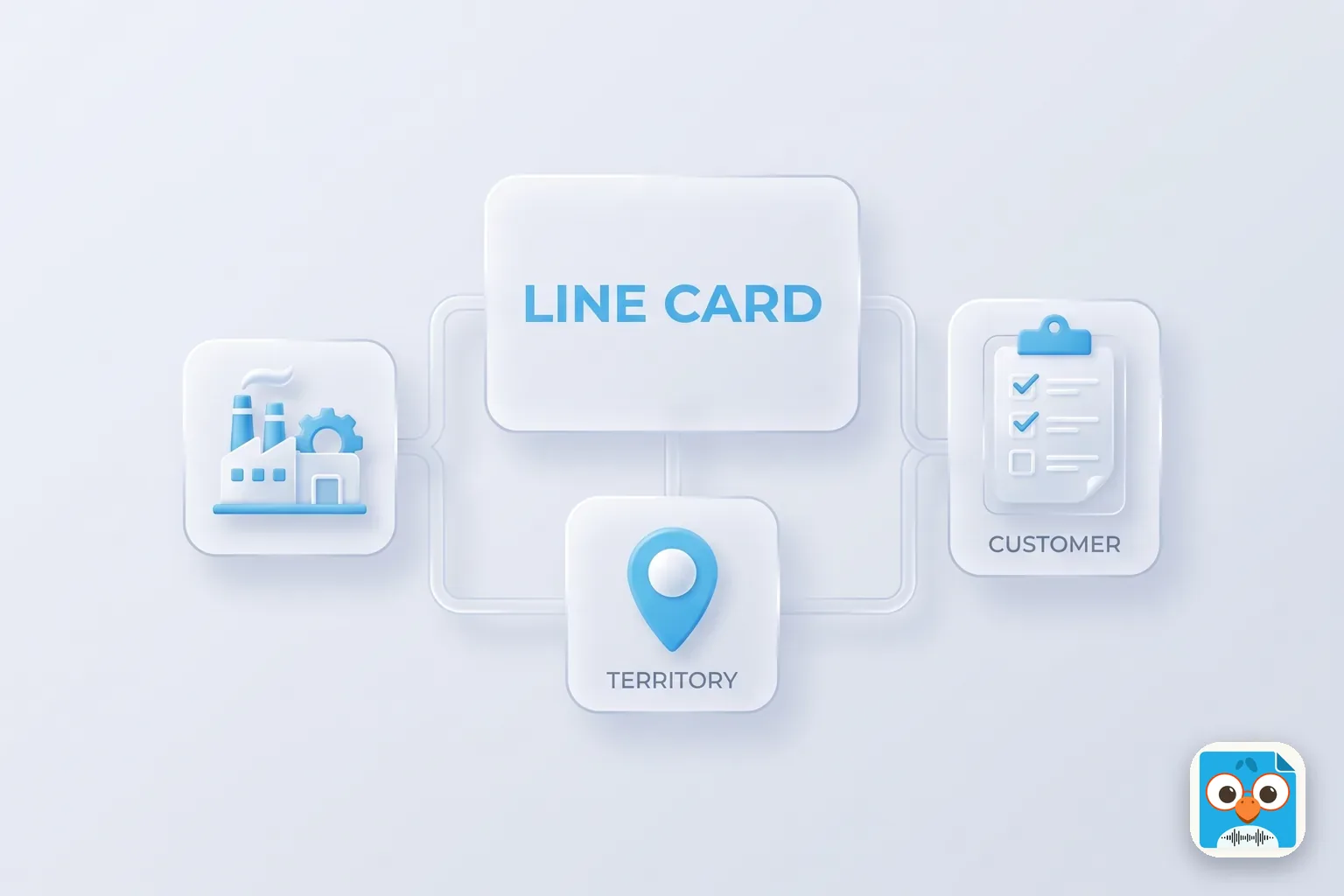
Table of Contents
- 1.What is a manufacturers' rep?
- 2.Manufacturers' rep vs distributor vs direct salesperson
- 3.How manufacturers' rep commission and agreements work
- 4.Line cards and principals: the line-fit scorecard
- 5.How to choose and work with a manufacturers' rep firm
- 6.A manufacturers' rep's week: reporting to several principals
- 7.Conclusion
Priya walks out of a pump maker's engineering office at 11:20 with one page of notes and three problems. The engineer asked about a motor, a pressure sensor, and a stainless enclosure. Those are three products from three different factories. By Friday, each factory expects its own report on what she heard.
That's the job of a manufacturers rep in one meeting. One customer, several product lines, and a report owed to every manufacturer whose name came up.
The first half of this guide explains the model: what a manufacturers' rep does, how the rep differs from a distributor, and how commission and agreements work. The second half is for rep agencies and the manufacturers who hire them: a line-fit scorecard, an interview shortlist, a principal reporting map, and one visit split three ways.
What is a manufacturers' rep?
A manufacturers' rep is an independent sales business that sells products for several manufacturers in a defined territory, usually on commission. The Manufacturers' Agents National Association (MANA) puts it plainly: manufacturers' representatives "are independent salespeople selling for multiple companies," and they "represent complementary, non-competitive companies."
A few words come with the job:
- Principal: a manufacturer the rep sells for
- Line card: the list of principals and product lines a rep agency carries
- Territory: the geography, market, or account list the rep covers for each principal
- Rep agency or rep firm: the rep's business, which can be one person or a team
You'll also hear "manufacturers' agent" or "independent sales rep." If you're weighing the job itself, our industrial sales guide has U.S. Bureau of Labor Statistics pay figures for the wider occupation.
MANA sums up the model: reps "operate as businesses in sales, not as salespeople in business." They pay their own costs and earn when their principals' products sell.
Manufacturers' rep vs distributor vs direct salesperson
| Manufacturers' rep | Distributor | Direct salesperson | |
|---|---|---|---|
| Employed by | Their own agency | The distributor | The manufacturer |
| Sells for | Several non-competing principals | Many manufacturers, from stock | One manufacturer |
| Owns inventory | No | Yes, buys and resells | No |
| Paid by | Commission from each principal | Margin on what it resells | Salary, often plus commission or bonus |
| Main job | Create demand, get specified, support quotes, report back | Stock, deliver, bill, serve local demand | Sell the company's line, report to a manager |
A rep and a distributor often work the same account: the rep brings product depth and spec-in work, the distributor ships and carries the credit. The building materials sales guide shows that split in a dealer channel.
Every one of these meetings ends with promises somebody has to write down. To say the debrief instead of typing it, download ParrotNotes free. Every recording gets an AI summary, even on the free plan.
How manufacturers' rep commission and agreements work
The Electronics Representatives Association (ERA) sums up the pay model: rep income "is generated from commissions on sales in the territory," and "commissions are paid only after orders are shipped." That's why manufacturers like it. They pay for sales, not for time.
Commission rates: no single standard
You'll see rate figures quoted online. Treat them with care. MANA ran commission surveys in 1999, 2002, and 2005, then stopped when participation fell. Its commission survey page says the aim "is not to provide a specific commission rate or set an industry standard."
MANA lists what moves the rate instead:
- The product or service
- The type of customer (OEM, reseller, or end user)
- How much business already exists in the territory
- What other services the principal requires of the rep
What a rep agreement covers
The agreement between rep and principal matters more than the rate. A 2022 inside.lighting piece lists seven contract terms reps want. Here are the ones worth checking in any industry:
- Territory and exclusivity: clear boundaries, and notice before the principal sells direct in the rep's area
- Term: long enough for the work to turn into orders, which in spec-driven sales can take more than a year
- Termination and sunset: time to register open projects, and commission on specified jobs that ship after the agreement ends
- Samples: who pays for them
- Acquisition: what happens to the rep if the principal is sold
Add two more yourself. First, house accounts: which customers the principal keeps and pays no commission on. Second, split commissions: who gets paid when a product is specified in one territory and shipped to another.
Line cards and principals: the line-fit scorecard
A rep agency's line card is its product. The right lines open doors for each other.
MANA describes a rep's evaluation of a new principal as two questions. Does the company make something that helps my customer base? And does it have the potential to be "a long-term supportive sales partner?" The scorecard below turns those two questions into eight checks. Score each from 0 to 2.
| Check | 0 | 1 | 2 |
|---|---|---|---|
| Same buyers as my current lines | Different buyers | Some overlap | Same people, same visits |
| Complements, never competes | Competes with a line | Borderline | Clearly complementary |
| Customers asked for it | Never | Once or twice | Often |
| Existing business in the territory | None, and no plan to fund it | Some | Enough to pay for the first year |
| Quote and sample turnaround | Slow or unknown | Acceptable | Fast, with a named contact |
| Training and technical support | None | On request | Scheduled, with a sales engineer on call |
| Commission paid on time, every time | Reference says no | Unknown | References confirm it |
| Agreement terms | House accounts unclear, short term | Negotiable | Clear territory, fair term, post-termination commission |
A line scoring 12 or more deserves a trial. Under 8, you'll spend your visits on a product your customers didn't ask for. MANA's advice to both sides is the same: "Get references!" Reps should ask other reps and distributors about a principal. Principals should ask other principals and two or three customers about a rep.
How to choose and work with a manufacturers' rep firm
MANA's reminder to manufacturers: "While you are evaluating the rep, the agent is evaluating you." Good agencies turn down lines.
A rep-firm interview shortlist for principals
- Which lines on your card sell to the same people ours would?
- Name three accounts in the territory where our product fits, and who you'd see first.
- Who in your agency would carry our line, and how many visits a month can they give it?
- How do you report to principals, how often, and in what format?
- What do you need from us in the first 90 days: training, samples, pricing authority, leads?
- Which principal would you call a model partner, and why?
- Can we speak to two principals and two customers?
What principals owe the rep
The rep owes you coverage and reports. You owe the rep fast quotes (a clean quote response template helps), samples, product training, leads from the territory, and commission paid on time. Tell the rep before you call on one of their accounts directly.
Picture Halden Controls, a fictional sensor maker, signing a four-person rep agency in the Midwest. Halden runs a half-day training in week one, answers quote requests within 48 hours, and sends every web lead from the territory to the agency. Six months later, that agency brings Halden into two OEM spec meetings. A second agency, signed the same month with only a price list, sends one report in six months.
A manufacturers' rep's week: reporting to several principals
A rep's week mixes customer visits, joint calls with distributors, RFQ follow-up, and the odd customer trip to a principal's factory (our manufacturing plant tour guide has the run sheet). Then Friday comes, and every principal wants its own report.
They don't all want the same one. Here's an example reporting map for a four-line agency. Yours will differ.
The principal reporting map
| Principal type | What it wants | How often | Format |
|---|---|---|---|
| Component maker selling to OEMs | Spec-in status, design wins, competitor named, samples out | Weekly | CRM or portal entry |
| Capital equipment maker | Project list with stage, budget timing, decision makers | Every two weeks, plus after each demo | Written report, then a call |
| MRO supply maker | Distributor activity, stock issues, lost orders and why | Monthly | Short email with a point-of-sale review |
| New line in its first year | Every visit where the line came up, and every objection heard | Weekly | Email, then a monthly review call |
Ask each principal at signing what it wants and when.
One visit, three reports
Back to Priya. Her pump maker meeting touched three principals, so her notes split three ways:
- Motor principal: "Engineering wants a 7.5 kW motor with a washdown rating for the 2027 pump series. Competitor quoted 14 weeks. Send datasheet and lead time by October 3."
- Sensor principal: "Pressure sensor spec'd at 0-10 bar. Engineer asked whether we can supply with a custom connector. Needs an answer from your applications team."
- Enclosure principal: "Mentioned only as a future need for the control panel. No action, flag for the Q1 visit."
She sorted it by principal before it went cold. The sales engineer guide has a technical meeting record for when a visit turns into full specs, and the plant visit debrief card gives a field for each principal's report line.
Say it, then sort it
Talk through the visit in the car before you drive off. ParrotNotes records the debrief on your phone, transcribes it, and pulls out the action items.
Ask the transcript "what did I promise the motor principal?" and paste the answer into the report. On Pro, speaker identification labels who said what on a joint call you've recorded with everyone's permission. Try ParrotNotes free on your next visit, with 100 minutes of recording a month.
Conclusion
A manufacturers rep is a sales business, not a salesperson on loan. The rep picks lines that serve the same buyers, signs agreements that protect the work, and earns commission when orders ship. Principals get coverage they'd struggle to build alone, as long as they support the line.
Score new lines before you take them, ask every principal what it wants to hear, and sort your notes by principal the same day.
Download ParrotNotes free and talk through your next visit before you leave the car park. The report is half written by the time you get home.
Frequently Asked Questions
What does a manufacturers' rep do?
A manufacturers' rep sells products for several non-competing manufacturers, called principals, in a set territory. The rep visits customers, gets products specified, supports quotes, works joint calls with distributors, and reports back to each principal. Most earn commission on what ships.
How do manufacturers' reps get paid?
Mostly by commission on sales in their territory, paid after the order ships. There's no industry-standard rate. MANA says the rate depends on the product, the type of customer (OEM, reseller, or end user), how much business already exists in the territory, and what extra services the principal asks for. The agreement between rep and principal sets the rate and when it's paid.
Is a manufacturers' rep the same as a distributor?
No. A distributor buys products, holds stock, and resells them at a margin. A manufacturers' rep doesn't own inventory: the rep creates demand and gets products specified, and the order ships from the factory or through a distributor. The two often work the same accounts together.
What is a line card?
A line card is the list of manufacturers and product lines a rep agency carries. Principals ask for it to see which markets the agency reaches. A strong line card holds complementary lines that sell to the same buyers, so one visit can serve several principals.
What should be in a manufacturers' rep agreement?
At minimum: the territory and whether it's exclusive, the commission rate and when it's paid, house accounts, the term, and what happens at termination, including commission on specified projects that ship later. Many reps also ask about sample costs, split commissions, and what happens if the principal is acquired. Have a lawyer review it.
Related Posts

Windshield Time: Turn Drive Time Into Done Admin
Windshield time eats a field rep's day. Audit one week, keep the drive for driving, and try a two-minute parked debrief to clear your admin between stops.
What Is a Sales Pipeline? Stages, Examples and Mistakes
What is a sales pipeline? Learn the seven stages with exit criteria, follow one field deal from prospect to close, and avoid the mistakes that inflate it.

The Challenger Sale: Summary and How to Apply It in the Field
The Challenger Sale in plain English: the five seller profiles, teach, tailor, and take control, plus a six-step pitch and call sheet for your next visit.