
What Is a Byline? Meaning, Examples and Who Gets One

Sarah Johnson
Writes about field sales, meeting notes and voice-first workflows at ParrotNotes. Every article is reviewed by the ParrotNotes product team before it goes live.
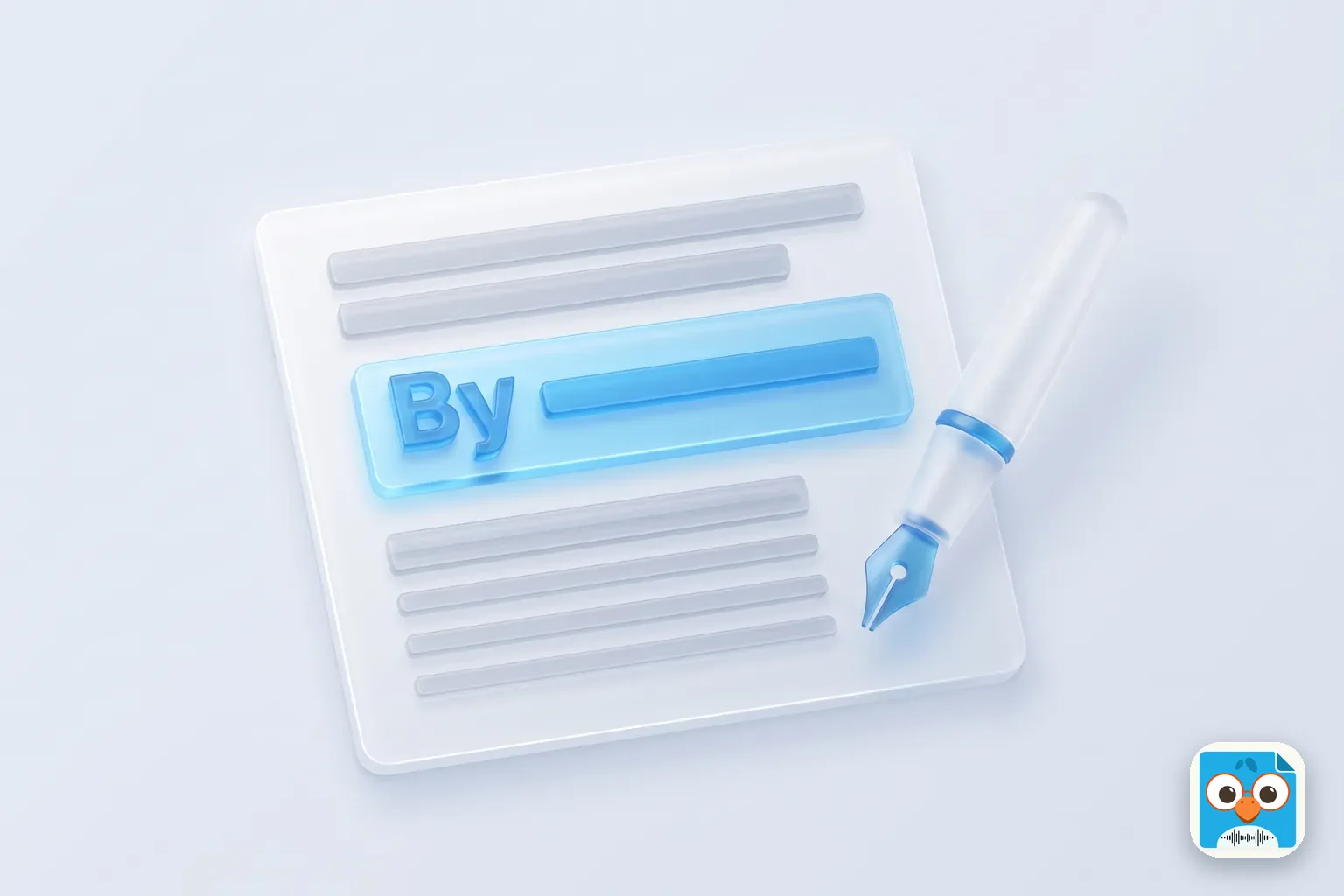
Table of Contents
Dana spent two days in a flooded river town, knocking on doors and filling a notebook. The story ran on Sunday under a colleague's name. Hers appeared in small type at the very end: "Dana Reyes contributed reporting." Was that fair? (Dana is a made-up example.)
You might be here for the simple meaning of byline, and you'll get that in the next section. But the term matters most when it's your name, your work and someone else's call. Most explanations stop at "the author's name on an article."
This guide goes further. You'll see byline examples, how a byline differs from a dateline, and what the Associated Press and NPR actually tell their staff about who gets one. You also get a decision table for 12 common situations and an email to send before you file.
A byline also means you answer for every quote under it. ParrotNotes records your interviews on your phone and gives you a searchable transcript, so you can check the exact words before your name goes on them.
What is a byline? The meaning of byline in plain words
A byline is the line on a news story or article that names the person who wrote it, usually placed between the headline and the text. Merriam-Webster defines it as "a line at the beginning of a news story, magazine article, or book giving the writer's name." The Associated Press puts it plainly: "A byline tells the reader who wrote the story."
It often starts with the word "By." Merriam-Webster dates the noun to 1916. It also lists a verb, so a reporter can byline a story, meaning they write it under their own name.
Two other meanings can confuse a search:
- Soccer: the byline is one of the two white lines at each end of the pitch, between the goal and the corner flag.
- Byline Bank: a US bank that shares the word and has nothing to do with journalism.
Byline examples
These show the common formats. The names and the outlet are invented, except where noted.
| Type | What it looks like | When it's used |
|---|---|---|
| Single | By Maya Torres | One writer |
| With a title | By Maya Torres, Health Reporter | The beat or role adds credibility |
| Shared | By Maya Torres and Sam Ortiz | Two writers or reporters |
| With a location | By Maya Torres in Riverton | The reporter's place matters to the story |
| Wire | By The Associated Press | Copy from a news agency, with no staff writer named |
| Staff | By Riverton Ledger Staff | A team effort, or a routine item |
The contributor line is a different thing, and it usually sits at the end of the story. NPR's policy gives this real example: "Eleanor Beardsley contributed to this report from Paris; John Burnett contributed from Austin, Texas."
Online, a byline usually does one more job. NPR says its bylines "may link to a person's aggregation page or bio page," so a reader can find out who you are and what else you've written.
Byline vs dateline, tagline and other credits
These terms sit close together on the page, and they're easy to mix up.
| Term | What it tells the reader | Where it goes |
|---|---|---|
| Headline | What the story is about | Top of the story |
| Byline | Who wrote it | Under the headline |
| Dateline | Where the basic information came from | Start of the first paragraph |
| Tagline or contributor credit | Who else helped | Usually the end of the story |
| Author bio | Who the writer is and their background | End of the story or a linked page |
| Photo credit | Who took the picture | Beside or under the image |
The dateline is the one people confuse most. AP says "a dateline tells the reader where we obtained the basic information for a story," which is a different question from who wrote it. For the rest of a story's structure, see our guide on how to write a news story.
Who gets a byline? What newsroom rules say
There's no universal law here. Each outlet sets its own rules, and sometimes a union contract adds to them. Published policies differ more than you might expect.
Four outlets, four policies
| Outlet | Byline policy | Source |
|---|---|---|
| Associated Press | The byline goes to the writer. On datelined text stories, the journalist must have been in that location. | AP News Values |
| NPR | "All stories published on NPR.org should have a byline." The writer gets it or comes first, and journalists "should be generous." | NPR guidance, revised November 2022 |
| The Wall Street Journal | Editors reportedly told staff in February 2025: "No more than three bylines on stories, and no taglines." | Talking Biz News |
| The Economist | Print articles are almost all unsigned, based on "a belief that what is written is more important than who writes it." | 2013 explainer, reprinted |
The Journal's limit shows how much is at stake. Its union filed a labor charge over the policy, saying management counts byline and tagline totals when it evaluates staff. The union says management told it bylines are an area of "editorial discretion."
The who-gets-the-byline decision table
We built this table from AP's and NPR's published rules. Your outlet's rules come first, so treat it as a starting point for the conversation with your editor.
| Situation | Usual credit | Rule |
|---|---|---|
| You reported and wrote it alone | Byline | AP, NPR |
| You wrote it using colleagues' reporting | Byline for you, tagline for those who gave substantial information | AP |
| You and a colleague both deserve credit, and one was in the field | Both bylines, field reporter first, tagline with each location | AP |
| The story has a dateline, and you weren't there | No byline on that text story | AP |
| A photographer or video journalist provided information the story couldn't exist without | Byline | AP |
| Someone substantially rewrote and added to your broadcast script | They get the first byline | NPR |
| You had the scoop but no time to write it | Co-byline | NPR |
| You edited, produced or researched it | Contributor credit, such as "Edited by" or "Research by" | NPR |
| You're a freelancer or outside contributor | Byline, with a note explaining who you are | NPR |
| The story relies on anonymous sources | Must carry a reporter's byline, and whoever supplied that material gets contributor credit | AP |
| It's a short, routine item such as a game story or announcement | Often no byline | AP |
| A name would put the reporter in danger | The byline can be left off | NPR |
Back to Dana. If her story had no dateline, AP's rule gives the byline to the writer and a tagline to her for substantial information. If it was datelined from the river town, AP allows a byline only for a journalist who was there, and a field reporter who deserves a byline normally goes first. So where the story was datelined could change the answer.
When people disagree, NPR's process is a good model. Journalists talk it through first. "If there is a question or a conflict, the editor of the story should decide." Raise it before the story publishes, because it's much harder to fix afterward.
Sources need the same care as credits. If you're sorting out who said what, our guide to attribution in journalism covers the rules for quotes, documents and anonymous sources.
Why a byline matters
It makes someone accountable
One early push for bylines came from wanting to know who to blame. Ford Risley, a Penn State journalism professor, wrote in The New York Times that Civil War correspondents mostly wrote anonymously or under pen names. After a leak about the Army of the Potomac in 1863, Union General Joseph Hooker issued General Order No. 48. It required reporters with his army to "publish their communications over their own signatures."
Hooker didn't invent the idea, as a Times clarification notes: some writers' names had appeared as early as the mid-1830s. But the war helped establish the habit.
NPR's current policy makes the same point: "Transparency fosters accountability – for any errors we make and for the praise that follows when we get a scoop."
It builds reader trust
Readers do look. Edmund Lee, an editor on The New York Times's trust team, told Nieman Lab in 2024: "Our research has shown that when readers disagree with a story or encounter something they dislike, they tend to click on the byline." The Times expanded its byline pages partly for that reason.
Search engines ask about it too. Google's guide to helpful content suggests asking, "Do pages carry a byline, where one might be expected?"
It builds your career
Your bylines are your proof of work. Editors judge you by your clips, which is why a journalism portfolio is mostly a curated list of them.
It gives reporters leverage
A name can also be withheld on purpose. In a byline strike, journalists keep their names off their stories to protest. In 2018, the Pittsburgh Post-Gazette's 150 newsroom employees did this during contract talks. Slate noted that union contracts often let reporters control their bylines, and that writers long ago demanded the right to pull their names from heavily changed stories.
How to get a byline and protect it
Tom, a new freelancer, wrote 800 words for a trade magazine on a handshake deal. It ran with "Staff Report" on top, and he had no clip to show for a week's work. A two-line email would have settled it. (Tom is a made-up example.)
You can avoid that with four habits:
- Agree on credit before you start. Ask how your name will appear, whether it links to a bio and what happens if the piece changes a lot.
- Find out the outlet's rules. A staff handbook or union contract may cover this, so ask your editor or union rep.
- Save the published story. Links die, so keep a PDF or an archived copy for your portfolio.
- Keep your proof. Your name stands behind every quote, so hold on to your notes and recordings.
A byline agreement email to copy
Subject: Byline and credit for [story title]

Hi [editor],

Before I file [story title], can you confirm three things?

1. Byline: it will run as "By [your name], [title or 'Special to Outlet']".
2. Bio: it will include this line and link: [one-line bio and URL].
3. Changes: if the story is substantially rewritten or combined
   with other reporting, you'll tell me before it runs and we'll
   agree on the credit together.

Thanks,
[your name]
If an editor says the outlet doesn't run bylines, you've learned that before doing the work, and you can decide whether it's still worth it. Our list of freelance journalist tools covers the rest of a working setup.
For the fourth habit, a recording beats memory. Learn how to record an interview on your phone, check the law on consent where you are, then how to quote an interview accurately. ParrotNotes lets you search the transcript for a keyword, then listen to the audio to confirm the wording before you file.
Your name is the promise
So the meaning of byline is simple: it names who wrote the story. What it carries is bigger:
- For readers, it's who to trust, or who to write to about an error.
- For you, it's a clip, a reputation and a responsibility.
- For newsrooms, it's a policy, and sometimes a labor dispute.
Before your next story, check where it sits in the decision table and send the email if credit isn't settled. Then download ParrotNotes and record your next interview, so you can stand behind every word that runs under your name.
Frequently Asked Questions
What is the meaning of byline?
A byline is the line on a news story or article that names its writer, usually between the headline and the text. AP's definition: "A byline tells the reader who wrote the story."
What is an example of a byline?
"By Maya Torres, Health Reporter" (invented name) is a typical byline. Shared ones read "By Maya Torres and Sam Ortiz." Wire copy may read "By The Associated Press."
What is the difference between a byline and a dateline?
A byline says who wrote the story. A dateline says where the basic information came from, and it usually sits at the start of the first paragraph.
Who gets a byline on a news story?
Usually the person who wrote it. AP and NPR both start there, then add rules for field reporters, rewrites and contributors. People who helped but didn't write it may get a tagline or contributor credit instead. Each outlet sets its own policy.
Do freelancers get bylines?
Usually, but confirm it first. NPR says non-staffers who create content it publishes should have bylines. Other outlets differ, so agree on your credit in writing before you file.
Why do some articles have no byline?
Common reasons are wire copy, short routine items, editorials, a safety risk to the reporter, or a byline strike. The Economist leaves nearly all its print articles unsigned on purpose.
Can you use a pen name in a byline?
It depends on the outlet, so ask your editor first. AP doesn't let staff who do voice or on-camera work use pseudonyms or "air names" unless a manager approves an exception.
Related Posts
SDR vs BDR: What Each Role Does and Why Companies Mix Them Up
SDR vs BDR compared: what each role does, the pay employers state and why titles get mixed up, from 154 live job ads. Try ParrotNotes free for hand-off notes.
Sales Email Subject Lines: Examples by Situation and What to Avoid
Sales email subject lines for every situation: 40 short examples, what to avoid, and a five-question check. Build yours from your meeting notes. Try it free.

Sales and Operations Planning (S&OP): Process and Meetings
Sales and operations planning explained: the five monthly S&OP meetings, timed agendas, what sales brings and a worked example. Try ParrotNotes free today.