
Sales Email Subject Lines: Examples by Situation and What to Avoid

Sarah Johnson
Writes about field sales, meeting notes and voice-first workflows at ParrotNotes. Every article is reviewed by the ParrotNotes product team before it goes live.
Table of Contents
Elena sells dock equipment. On Tuesday she walks a warehouse with its operations manager, and he asks for pricing on two levelers for Dock 4. That night she sends the quote with the subject line "Following up."
On Thursday he's scrolling through his inbox on a phone, between a delivery and a shift meeting. "Following up" could be anyone. "Dock 4 levelers: pricing" could only be Elena, and it's the thing he asked for.
That's the whole job of sales email subject lines: tell the right person what's inside, in the few words their phone will show. You don't need a trick for that. You need one true detail from the conversation.
This guide gives you 40 examples sorted by situation, a table that turns meeting notes into subject lines, the lines to stop using, and a five-question check before you send. Every example is 40 characters or fewer. The names and numbers in them are made up, so swap in your own.
What makes good sales email subject lines work
The best sales email subject lines are short, specific, and true. They name something the reader recognizes, such as a project, a site, or a quote number, then say what the email is for. A reader should be able to guess the contents before opening it, and the email should match that guess.
Three habits cover most of it:
- Lead with the detail. Phones cut long lines, and how much you get depends on the device and the app. Put the words that matter first.
- Say what it's for. "Line 3 walk: my notes" sets up what's inside. "Great meeting today" doesn't.
- Write it the way a colleague would. Skip the sales voice. A colleague writes "Thursday's pricing," not "Exclusive offer inside!"
What the research says, and what it doesn't
Search for email subject lines for sales and most of the open-rate numbers you'll find come from companies that sell email tools. They often disagree with each other. These are the sources we checked, along with what each one covers.
| Finding | Source | Keep in mind |
|---|---|---|
| Lines of 3-4 words drew the most responses, and response rates fell slowly as words were added | Boomerang | General email, from 2016 |
| Open rates peak at 1-5 words | Yesware, 262,518 templates | Vendor data |
| Numbers scored a 45% higher open rate than average, and questions about 10% more | Yesware, 1.2 million cold emails, 2021 | Vendor data |
| The recipient's name raised opens from 9.05% to 10.80%, and sales leads by 31% | Sahni, Wheeler, and Chintagunta, Stanford, 2018 | Field experiments on marketing email |
The sources point the same way on length: a handful of words. Treat the rest as direction. None of them measured a rep emailing a buyer they met last Tuesday, and that's where a specific detail matters most.
If typing on a phone is what makes you settle for "Following up," try ParrotNotes free. Dictate the visit in the car and you've got the details written down before the next stop.
Build the line from your notes
The best subject line is usually already in your notebook. It's the thing the buyer said, the part they pointed at, or the date they gave you. Rewriting it takes seconds.
Say Priya stops at a trade counter on a walk-in, one of the sales prospecting tips that works when you're already in the area. The counter manager mentions that second shift runs short on fittings on Thursdays. She writes it down. Her email that afternoon doesn't need a clever line. It needs "Thursday fittings, second shift," which he'll recognize as his own problem.
| What you wrote down | Subject line |
|---|---|
| Second shift runs short on fittings on Thursdays | Thursday fittings, second shift |
| Asked for pricing on two levelers, Dock 4 | Dock 4 levelers: pricing |
| Corners crush on the 12-inch tray | 12-inch tray: corner fix |
| Maria in operations has to sign off | Line 3 trial: a question for Maria |
| Freezer project starts after the March shutdown | Freezer project: before March |
| Wants a reference from another food plant | The food plant reference you wanted |
The pattern is their detail + what the email does. If your notes don't have a detail worth using, you don't have a good subject line yet. You may not have a reason to email yet either.
Sales email subject lines by situation
Each group below has a different job. A first touch has to earn attention from a stranger, while a post-visit email only has to be found again later.
Cold first touch
Use something you saw or learned about that account, and only what's true. The free cold email template builds the rest of the message, with subject lines and follow-ups. If the first email gets no reply, here's how to follow up on a cold email.
- Second-shift fittings at Harlow
- Your new Tulsa plant: who runs MRO?
- Loading dock rebuild at Harlow
- Line 3 audit: who owns packaging?
- Idea for your Q1 shutdown
- Saw your Route 9 yard expansion
- Hiring 20 techs: how's onboarding?
Referral
Lead with the person's name, and only with their permission. The name does more work than any wording you could add.
- Dana Ruiz suggested I write
- Dana at Kessler said to ask you
- Intro from Dana Ruiz: tray supplier
Asking for a meeting or visit
Give a place, a date, or a length of time, so saying yes is easy. Someone can answer "Thursday 10am at your plant?" with one word.
- In Tulsa Tuesday: 15 minutes?
- Walk Line 3 on May 12 or 14?
- Can I see the dock before we quote?
- Thursday 10am at your plant?
- 15 minutes on the freezer project?
After a visit or sales call
Name the meeting and what you owe them. Our guide to the follow-up email after a sales call has the full templates for the body.
- Harlow visit: what I promised
- Line 3 walk: my notes
- Pricing by Thursday, as promised
- Your two questions from today
- Freezer project: who does what
- Sample tray: tell me what breaks
After a trade show
Three days after a show, nobody remembers a booth. Remind them of the conversation and not the event, as in these trade show follow-up emails.
- The CIP valve sheet you asked for
- After the expo: your CIP valves
- From the show: pricing by Friday
- We met at booth 412: next step?
Sending or chasing a quote
Put the quote number in every line, so a buyer can search for it. A purchasing inbox is sorted by numbers, and quote follow-up emails work the same way.
- Quote 2217: dock levelers, rev B
- Quote 2217 valid until June 30
- Quote 2217: comparing like for like
- Quote 2217 rev 2: freight removed
When nobody replies
Reply inside your real thread when you can, so the history stays attached. When you start a new thread, bring something new. Our guide on the sales follow-up email after no response covers what to send and when.
- Re: Line 3 walk: my notes
- One new detail on Line 3 trays
- Line 3 trays: still on for June?
- Should I close out quote 2217?
Waking up a quiet deal
Give them a reason that's about them, such as a date you agreed on or something that has changed.
- Your freezer project, six months on
- Back in Tulsa in March
- New cert for your Line 3 spec
Existing customers
Customers already know you. Be plain about the date or the decision.
- Contract ends June 30: three options
- Reorder point on Line 3 gaskets
- New rep for your account: Priya
- Annual review: May 12 or 14?
Sales email subject lines to avoid
Most bad lines fail for one of two reasons. They say nothing, or they promise something the email doesn't contain.
| Instead of | The problem | Try |
|---|---|---|
| Following up | Could be from anyone | Dock 4 levelers: pricing |
| Checking in | Asks for attention and gives nothing | One new detail on Line 3 trays |
| Quick question | Used so often it says nothing | Line 3 audit: who owns packaging? |
| Great meeting today! | No way to find it next month | Line 3 walk: my notes |
| LAST CHANCE: 20% OFF | Reads as a promotion, and it's rarely true | Quote 2217 valid until June 30 |
| Re: our conversation | Fake if you never spoke | Second-shift fittings at Harlow |
| We could double your revenue | A claim you can't back up in five words | Idea for your Q1 shutdown |
The fake "Re:" deserves its own warning, because some sales advice still recommends it. Google's email sender guidelines say not to start a subject line with "Re:" or "Fwd:" unless the message is an actual reply or forward.
It's a legal point too. In the US, the FTC's CAN-SPAM compliance guide says a subject line "must accurately reflect the content of the message," adds that "the law makes no exception for business-to-business email," and puts penalties at up to $53,088 per email. Other countries have their own rules, so check the ones that apply to you.
There's a sales reason as well. Picture Tom, a rep who puts "Re: our call" on a cold email to a plant manager. It gets opened. The manager looks for the call, finds none, and now knows the first thing Tom told him wasn't true. Tom got his open and lost the account's trust.
Using someone's first name isn't a problem, and the Stanford experiments found it helped. It works best alongside a real detail, though, since "Maria, quick question" still doesn't say what you want.
A five-question check before you send
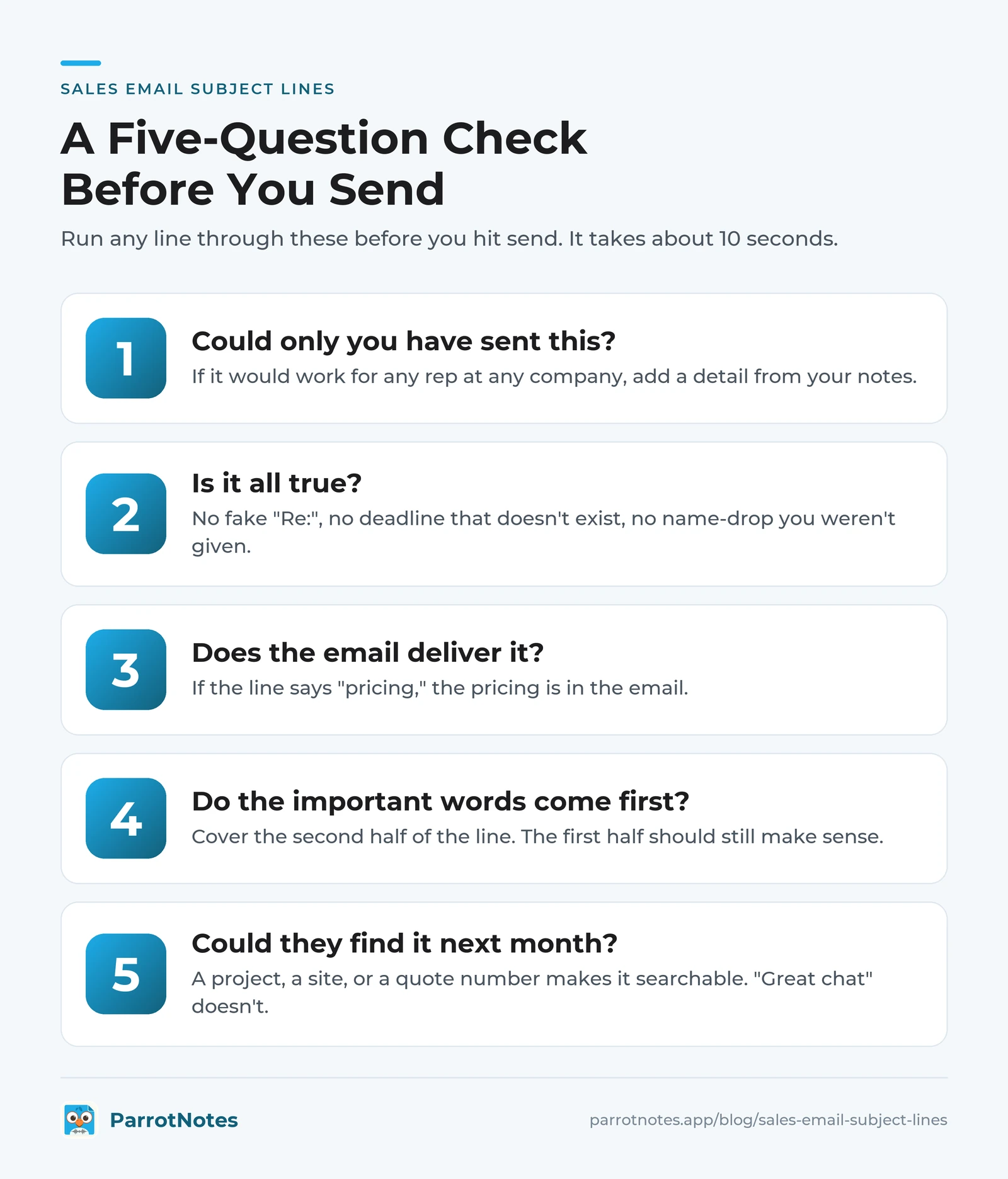
Run any line through these before you hit send. It takes about 10 seconds.
- Could only you have sent this? If it would work for any rep at any company, add a detail from your notes.
- Is it all true? No fake "Re:", no deadline that doesn't exist, no name-drop you weren't given.
- Does the email deliver it? If the line says "pricing," the pricing is in the email.
- Do the important words come first? Cover the second half of the line. The first half should still make sense.
- Could they find it next month? A project, a site, or a quote number makes it searchable. "Great chat" doesn't.
Test by replies, not opens
Open rates look like the obvious scoreboard, but they've become less reliable. Apple's Mail Privacy Protection stops senders from seeing whether a message was opened, so for anyone who turns it on, your tracking can't tell you what they did.
Replies and booked meetings can't be faked by a mail app, so count those instead. A rep doesn't need a big test to learn something:
- Pick one situation, such as a first email to plant managers.
- Write two lines that differ in one way: a detail from their site against a question about their project.
- Send each to about 20 similar people, with the same body.
- Count replies after a week, and keep the winner as your new baseline.
Twenty sends won't prove anything statistically. But it's your market and your buyers, which beats a benchmark from someone else's list. Managers can coach with this too: read a rep's last five lines aloud and ask, "Would the buyer know what this is?"
The next subject line is already in your notes
The hard part of writing effective sales email subject lines happens before the email. If you left the meeting with "dock 4, levelers, pricing Friday," the line writes itself. If you left with "good meeting," no formula will save you.
- Keep it to a handful of words, with the detail first
- Use their words: the project, the site, the quote number
- Never fake a reply, a deadline, or a referral
- Judge your lines by replies, not opens
So write down one exact phrase from the buyer before you start the car. ParrotNotes turns what you dictate into a transcript, a summary, and action items, so that phrase is still there when you sit down to write. On Pro it also drafts the follow-up email, and the free follow-up email generator works from pasted notes. Pick one of these sales email subject lines for your next email, and swap in the detail you heard today.
Frequently Asked Questions
What makes a good sales email subject line?
A good one is short, specific, and true. It names something the reader recognizes, such as a project, a site, or a quote number, and it says what the email is for. "Dock 4 levelers: pricing" tells the buyer more than "Following up" and is easier to find later.
How long should a sales email subject line be?
Aim for about three to five words. Boomerang found that lines of 3-4 words drew the most responses, and Yesware's data showed open rates peaking at 1-5 words. Both come from general or vendor data, so treat them as direction. Put the important words first, since phones cut long lines.
Should I put the prospect's name in the subject line?
It can help. In Stanford field experiments on marketing email, adding the recipient's name raised opens from 9.05% to 10.80%. Pair it with a real detail, though. A name on a vague line is still a vague line.
Is it OK to use "Re:" on a cold sales email?
No. Google's sender guidelines say not to start a subject line with "Re:" or "Fwd:" unless the message is an actual reply or forward, and the FTC says a subject line must accurately reflect the message. Use "Re:" only when you're replying inside a real thread.
Do emojis help sales email subject lines?
We didn't find solid data on emojis in one-to-one sales email, so we won't quote a number. For a buyer you met in person, they tend to look like a marketing blast. A plain line with a real detail is the safer choice.
What's the best subject line for a cold sales email?
The best one uses something specific and true about that account, such as "Loading dock rebuild at Harlow" or "Your new Tulsa plant: who runs MRO?" If you could send the same line to 500 companies unchanged, it's too generic.
Related Posts
What Is a Byline? Meaning, Examples and Who Gets One
The meaning of byline explained with examples: byline vs dateline, who gets one under AP and NPR rules, plus a freelancer credit email to copy. Learn more.
SDR vs BDR: What Each Role Does and Why Companies Mix Them Up
SDR vs BDR compared: what each role does, the pay employers state and why titles get mixed up, from 154 live job ads. Try ParrotNotes free for hand-off notes.

Sales and Operations Planning (S&OP): Process and Meetings
Sales and operations planning explained: the five monthly S&OP meetings, timed agendas, what sales brings and a worked example. Try ParrotNotes free today.