
Quote Follow-Up Email: What to Say After You Send the Quote

Sarah Johnson
Writes about field sales, meeting notes and voice-first workflows at ParrotNotes. Every article is reviewed by the ParrotNotes product team before it goes live.
Table of Contents
- 1.Why a sent quote goes quiet
- 2.Set up the quote follow-up email before you send the quote
- 3.The quote follow-up sequence: day 1 to day 30
- 4.Eight quote follow-up email templates
- 5.Keep the record so every follow-up has something new
- 6.When you lose to a lower bid
- 7.Follow up with something new every time
Priya sells for a fastener distributor. On Friday she sent quote 3318 to a pump manufacturer: 14 line items, stainless and zinc-plated, four-week lead time, valid 30 days. By Wednesday the buyer hadn't replied, and her sales manager asked the question every inside rep dreads: "Did you follow up on the Kessler quote?"
She had. She'd sent "Just checking in on the quote," which is the quote follow-up email most buyers delete without reading.
You already know you should follow up. The hard part is what to say the second, third, and fourth time without sounding like an alarm clock. This guide gives you a quote follow-up email for every state a B2B quote can be in: just sent, silent, pushed back on price, revised, about to expire, lost, or ready to close. It's built for RFQ quotes, with quote numbers, drawing revisions, lead times, and validity dates, not home-service estimates.
You'll get a day 1 to day 30 sequence, eight templates, subject lines, and a way to make sure each follow-up carries something new. If you'd rather dictate the buyer's comments after the call than try to remember them a week later, try ParrotNotes free before your next quote goes out.
Why a sent quote goes quiet
Silence after a quote rarely means no. It usually means your quote has joined a process you can't see.
In most B2B buying, the person who asked for the quote isn't the only one deciding. Forrester's 2026 State of Business Buying release reports that "the typical buying decision now includes 13 internal stakeholders and nine external influencers," and that "procurement professionals are decision-makers in 53% of business buying cycles." Your quote is probably sitting in a comparison sheet next to two others, waiting for an engineer's sign-off or a budget meeting.
That changes what a good follow-up does. It isn't a reminder that you exist. It's help for the buyer to move your quote through their process: answer the question the engineer will ask, confirm the lead time the planner cares about, or give purchasing a reason to act before the price expires.
So every quote follow-up email should carry one of three things: an answer, a piece of new information, or a date. "Just checking in" carries none of them.
Set up the quote follow-up email before you send the quote
The easiest follow-ups are the ones you planned while the buyer was still talking. Before the quote leaves your desk, get four things into it or into the call that goes with it.
A validity date. "Prices valid 30 days from quote date" gives you a natural, honest reason to write again later. It also protects you when material costs move. If you sell in the U.S., note that UCC § 2-205 treats a merchant's signed written offer that promises to stay open as irrevocable for the time stated, up to three months. Whether your quote counts as that kind of offer depends on its wording, so ask whoever owns your terms and conditions.
The evaluator's name. Ask, "Who else reviews this before a PO?" If the answer is "our quality engineer, Tom," your day 7 follow-up can answer Tom's likely question.
The decision date. "When do you expect to place the order?" turns an open-ended wait into a calendar entry.
One agreed next step. "I'll call Tuesday to walk through the exceptions" beats "Let me know if you have questions." The buyer has already said yes to the next touch.
Our RFQ template shows a quote response format with validity, lead time, and exceptions laid out in the buyer's order. And if you haven't yet sent the recap after the meeting that produced the RFQ, start with our follow-up email after a sales call guide. This post picks up once the quote is out.
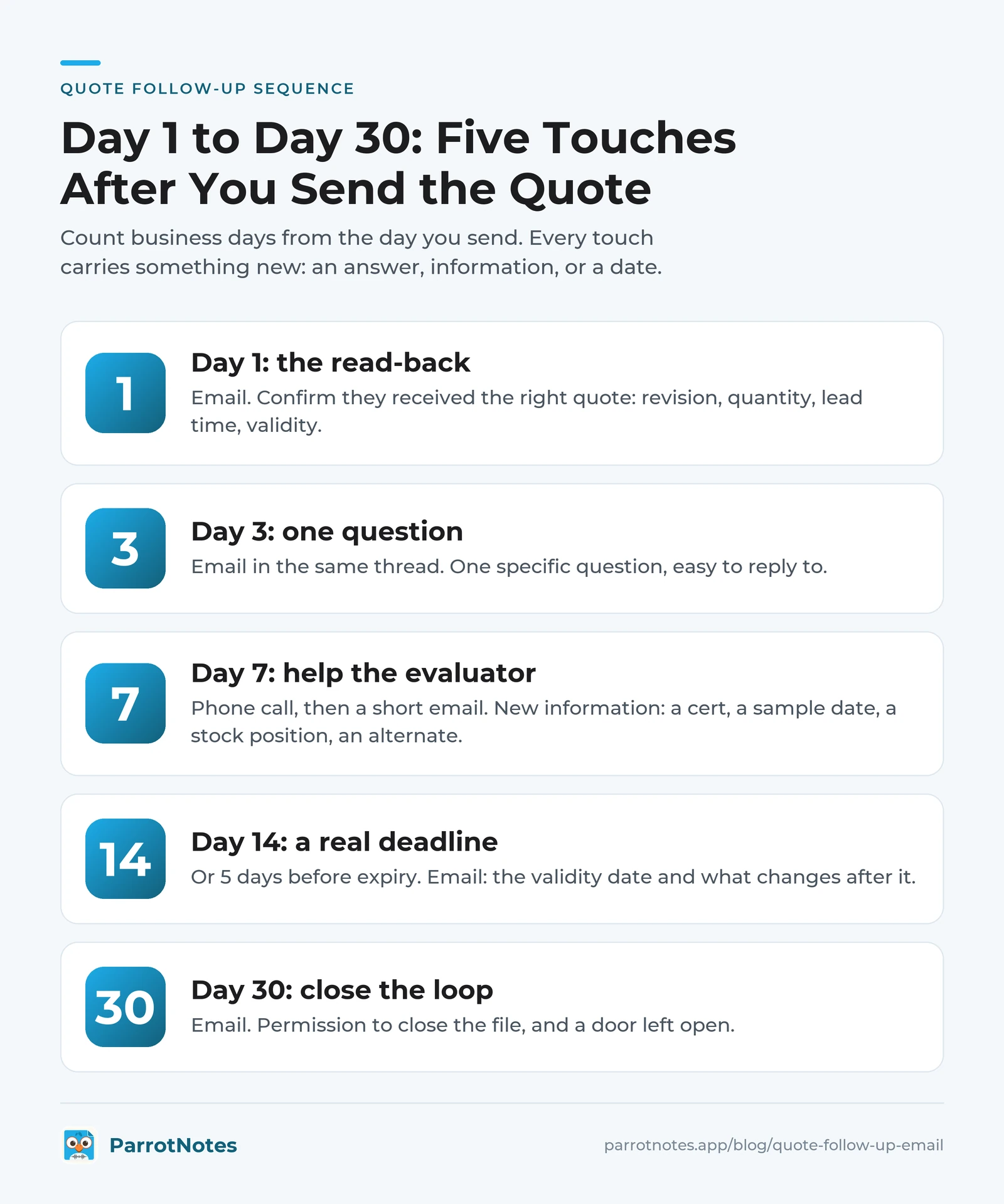
The quote follow-up sequence: day 1 to day 30
Here's a five-touch rhythm for a standard industrial or distributor quote. Count business days from the day you send. Stretch it for a capital-equipment quote with a long approval cycle, and compress it when the buyer gave you a close date inside two weeks.
| Touch | When | Goal | Channel | The new thing it must carry |
|---|---|---|---|---|
| 1 | Day 1 | Confirm they received the right quote | A read-back of the key terms: revision, quantity, lead time, validity | |
| 2 | Day 3 | Get one answer | Email in the same thread | One specific question, easy to reply to |
| 3 | Day 7 | Help the evaluator | Phone call, then a short email | New information: a cert, a sample date, a stock position, an alternate |
| 4 | Day 14, or 5 days before expiry | Create a real deadline | The validity date and what changes after it | |
| 5 | Day 30 | Close the loop | Permission to close the file, and a door left open |
Three rules make the sequence work.
Never send the same email twice. If a touch has nothing new, skip it or pick up the phone.
Change channels at least once. A call on day 7 reaches the buyer whose inbox filters quotes into a folder. Outside reps can drop in if they're already in the territory.
Stop when the buyer answers. The sequence is for silence. A reply of any kind, even "not yet," moves you to the template that fits what they said.
If you track your follow-ups in the CRM, log each touch with the quote number, so your manager's "Did you follow up?" has a one-line answer.
Eight quote follow-up email templates
Each template is short enough to read on a phone. Replace everything in brackets, and keep the quote number in the subject line so the buyer can find it in a search.
1. Day 1: the read-back
Subject: Quote [number]: [part or project], rev [X]
Hi [name],
Quote [number] is attached. To make sure we priced what you need: [quantity] of [part] at revision [X], [lead time] after PO, delivered to [ship-to], valid until [date].
Two assumptions to check: [assumption 1] and [assumption 2]. If either is wrong, tell me and I'll requote the same day.
[Your name]
The read-back catches the wrong revision before the buyer does. It also shows the engineer you listened.
2. Day 3: the one-question nudge
Subject: Re: Quote [number]: [part or project]
Hi [name],
One question on quote [number]: [does the 4-week lead time work for your build date / should we quote the zinc-plated option too / is [evaluator] reviewing the drawings this week]?
A one-line answer is plenty.
[Your name]
One question, easy to answer. Four questions in one email get none answered.
3. Day 7: new information for the evaluator
Subject: Re: Quote [number]: [the new thing, e.g. material certs attached]
Hi [name],
Something that may help [evaluator] review quote [number]: [material certs are attached / we have 400 pieces in stock that could ship this week / the sample can reach your plant by Thursday].
Would a 10-minute call with [evaluator] on [day] be useful?
[Your name]
Make the call first, then send this as the written version.
4. The price objection
When the buyer says, "You're 8% higher than the other quote," don't answer with a discount. Ask what they're comparing.
Subject: Re: Quote [number]: comparing like for like
Hi [name],
Thanks for telling me where we landed. Before I look at the price, can you help me compare like for like?
Does the other quote include [freight to your plant / certs / packaging to your spec / the same lead time]? Ours is [delivered / FOB our dock] with [lead time].
If the gap is still there once we match those, I'll see what I can do on [quantity break / release schedule / a blanket order].
[Your name]
Trade rather than cut: a larger quantity break or a blanket order keeps your margin intact. Run the numbers in our free margin calculator before you offer anything. For the conversation itself, our objection handling guide covers the pause, isolate, and reframe steps.
5. The revised quote
Subject: Quote [number] rev [2]: [what changed]
Hi [name],
Revised quote attached. What changed from rev [1]: [quantity 500 to 750 / drawing rev C to D / freight now included].
Everything else is as before: [lead time], valid until [new date].
Please use this revision for your comparison and discard the earlier one.
[Your name]
Marco, a manufacturers' rep for a hydraulic fittings line, learned why the "what changed" line matters. He sent a revised quote after a drawing change and didn't say what was different. Three weeks later the PO arrived priced from the old quote, and it took two calls and a corrected order to fix.
His next revision opened with one sentence: "What changed: drawing rev D, price per piece up $0.40." The PO came back right the first time.
6. The quote is about to expire
Subject: Quote [number] valid until [date]
Hi [name],
A heads-up that quote [number] is valid until [date]. After that, [pricing is subject to our next material review / the stock we're holding is released].
If you need more time, tell me and I'll ask about extending it.
[Your name]
Only send this if the date is real. An expiry you extend every time trains the buyer to ignore it.
7. Lost to a lower bid
Subject: Re: Quote [number]: thank you
Hi [name],
Thanks for letting me know. So I quote better next time, could you tell me roughly where we lost it: unit price, freight, lead time, or something else?
I'll keep your specs on file for the next buy.
[Your name]
Ask once. More on what to do with the answer below.
8. Day 30: close the file
Subject: Closing out quote [number]?
Hi [name],
I haven't heard back on quote [number], so I'll assume the timing or the fit wasn't right and close it on my side.
If the project comes back, reply here and I'll requote with current pricing.
[Your name]
This is often the email that gets a reply, because it asks for nothing.
Short on time? Our free follow-up email generator turns your call notes into a first draft you can edit.
Subject lines that carry the quote number
Buyers search their inbox by quote number, RFQ number, or part number, not by "Following up." Put one of them first, then the purpose.
- Quote 3318: rev C, 4-week lead time
- RFQ 4471 quote: certs attached
- Quote 3318: one question on plating
- Quote 3318 rev 2: freight now included
- Quote 3318 valid until Oct 31
- Re: Quote 3318: comparing like for like
- Closing out quote 3318?
Reply in the same thread for touches 2 and 3, so the buyer has the whole history in one place.
Keep the record so every follow-up has something new
The sequence only works if you remember what the buyer said. On the call where they told you "Tom in quality has to sign off" and "our build starts the 14th," those details were your next three follow-ups. A week later, they're gone.
That's where ParrotNotes fits. Record the quote review call, with the buyer's consent, or dictate a two-minute debrief in the car before you drive off; our windshield time guide shows how to fit it into a field day. ParrotNotes transcribes it, writes an AI summary, pulls out action items, and can draft the follow-up email from what was said.
When you sit down to write touch 3, search your notes for "3318" and the call comes up. AI chat answers "What did the buyer say about the build date?" from that recording, and on Pro, custom insight templates can sort every debrief into the same fields: evaluator, decision date, objections, next step. If the buyer's engineer spoke German or Spanish, Pro transcribes in 99+ languages and translates.
Recording works offline on the plant floor or in a basement parking lot, and the transcript is ready once you're back on a connection. The free plan gives you 100 minutes a month and an AI summary on every recording, enough to test it on this month's quotes. Download ParrotNotes free and debrief your next quote review before you leave the lot.
When you lose to a lower bid
A lost quote is data you paid for. Most reps don't collect it.
Dana, an inside rep for a packaging distributor, lost an annual corrugated quote to a competitor in March. She sent template 7 the same day. The buyer replied with one line: "You were 3% higher delivered, and they had a two-week lead time against your four."
Dana recorded the reply in her notes against the account. When the buyer's RFQ came back the next March, she quoted delivered to the plant, offered a stocking program to cut the lead time to two weeks, and won the annual business.
Three habits turn a loss into the next win:
- Ask once, politely, within a day. The buyer remembers the comparison clearly now, not in a month.
- Record the reason with the quote. "Lost on freight" or "lost on lead time" should be searchable by customer and quote number.
- Tell your principal. If you're a manufacturers' rep, the factory needs to hear it too. Our guide to what a manufacturers' rep does covers the reports principals expect.
Losses also expose request-type mistakes. If you lost because the buyer wanted a solution and you sent a price, you were answering an RFP; our RFQ vs RFP guide explains how to tell them apart next time. For the full path from request to purchase order, see what is an RFQ.
Follow up with something new every time
A quote follow-up email works when it helps the buyer move your quote through a process you can't see. The short version:
- Set up the follow-up before you send: validity date, evaluator, decision date, next step
- Run five touches over 30 days, and give each one something new
- Keep the quote number in every subject line
- On price, compare like for like, then trade rather than cut
- When you lose, ask why once and record the answer
Think back to Priya's quote 3318. Her buyer had mentioned the build date and the quality sign-off on the call; she just hadn't written them down. With the call in her notes, her day 3 email would have been one question about the build date, and her day 7 call would have gone to Tom. Get ParrotNotes free and give your next quote follow-up something worth reading.
Frequently Asked Questions
How soon should I send a quote follow-up email?
Send the first one the next business day. It isn't a nudge; it's a read-back that confirms the revision, quantity, lead time, and validity date, so any mismatch surfaces early. Then follow the sequence: a one-question email on day 3, a call plus new information on day 7, an expiry note around day 14, and a close-the-file email on day 30.
How many times should I follow up on a quote?
Five touches over about 30 business days works for most industrial and distributor quotes, as long as each one carries something new: an answer, information, or a date. Stretch the gaps for capital equipment with a long approval cycle. Stop the sequence as soon as the buyer replies and switch to the template that fits their answer.
What should I say instead of "just checking in"?
Say something the buyer can use. Ask one specific question about the quote, share new information such as material certs or a stock position, or give a real date such as the quote's validity. Put the quote number in the subject line, so the buyer can find your email when they're comparing suppliers.
How do I follow up when the buyer says our quote is too high?
Ask what they're comparing before you touch the price. Check whether the other quote includes freight, certifications, packaging, and the same lead time. If a real gap remains, trade rather than cut: offer a quantity break, a release schedule, or a blanket order. Work out your margin first so any concession is one you can afford.
Should I follow up by email or phone?
Use both. Email is best for the read-back, one-question nudges, and anything with numbers the buyer needs to forward. A call on day 7 reaches buyers whose inbox files quotes away, and it's the best way to answer an evaluator's questions. Send a short email after each call to put what you agreed in writing.
Related Posts

Voice Journal App: How to Keep a Spoken Work Journal
Use a voice journal app to keep a spoken work journal: a 3-minute daily prompt set, a 20-minute weekly review, and what to look for in the app. Start today.
Sales Territory Management: A Field Rep's Playbook
Sales territory management for the rep who runs one: a one-row-per-account ledger, visit cadence by tier, and a 40-minute Friday review. Get the template.
Sales KPIs: What to Track and What to Ignore
Sales KPIs sorted into leading and lagging, with formulas, the vanity metrics to drop, and a one-page KPI scorecard for field teams. Build yours this week.