
RFQ vs RFP: The Difference and How to Respond to Each

Sarah Johnson
Writes about field sales, meeting notes and voice-first workflows at ParrotNotes. Every article is reviewed by the ParrotNotes product team before it goes live.
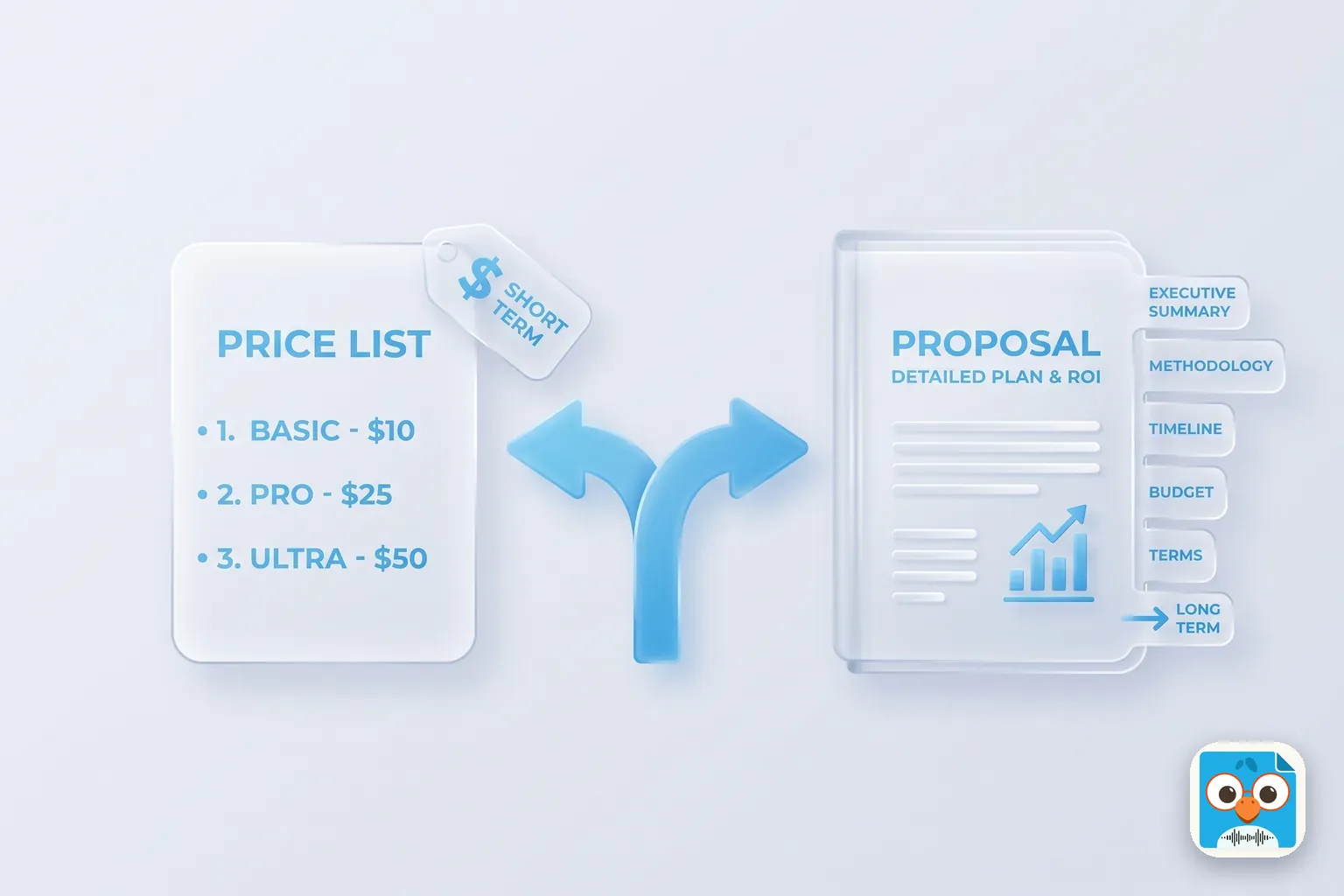
Table of Contents
- 1.RFQ vs RFP (and RFI) at a glance
- 2.What an RFQ asks for
- 3.What an RFP asks for
- 4.Where the RFI fits
- 5.The triage test: which one have you really got?
- 6.RFQ vs RFP response: how the process differs
- 7.One customer, three requests: a worked example
- 8.Where your meeting notes decide the result
- 9.Read the document, not the title
Marta, a sales engineer at a packaging machinery maker, opened an email titled "RFQ 26-118: case packer, line 4." She did what she always does with an RFQ. She priced the machine, added freight and installation, and sent a tidy two-page quote two days early.
Three weeks later she learned she'd lost on points. Page six, which she'd skimmed, said the award would go to the "best overall value," with technical approach and changeover time weighted above price. The winner sent a 30-page proposal. Her lower price didn't matter.
That's the practical side of RFQ vs RFP. An RFQ (request for quote) asks for a price on something the buyer has already specified. An RFP (request for proposal) asks how you would solve a problem, and at what cost. A third document, the RFI (request for information), asks what's out there before either is written.
Most guides are written for the buyer. This one sits in the supplier's chair: the difference in one table, what each document really asks for, a seven-question test to tell which one you've got, and how the response changes. If your spec conversations happen on the plant floor, try ParrotNotes free so what the customer said is on the record when you write the response.
RFQ vs RFP (and RFI) at a glance
The three requests come at different points in a buyer's process, and they're judged in different ways.
| RFI | RFP | RFQ | |
|---|---|---|---|
| What the buyer knows | The problem, roughly | The outcome they need | The exact spec, quantity, and date |
| The buyer's question | "What's possible, and who can do it?" | "How would you solve this, and at what cost?" | "What's your price and lead time for this?" |
| What you send back | Capabilities, options, rough ranges | A proposal: approach, plan, team, experience, price | A quote: line prices, lead time, terms |
| How it's judged | Not for award; it shapes the next document | Stated evaluation factors, price usually one of several | Mostly price, delivery, and confidence in you |
| Legal weight (U.S. federal) | Not an offer | An offer | Not an offer |
| Who writes it on your side | Rep or sales engineer | A team: sales, engineering, pricing | Rep, inside sales, or estimator |
Most comparisons skip the last two rows, and they change how you work.
What an RFQ asks for
An RFQ arrives when the thinking is done. The part is picked, the drawing revision is set, and purchasing wants comparable numbers. Your job is to price exactly what's asked, flag every assumption, and hit the deadline.
The legal weight is lighter than many reps assume. FAR 13.004, the U.S. federal rule, says "a quotation is not an offer and, consequently, cannot be accepted by the Government to form a binding contract." The purchase order is the offer, and the contract forms when you accept it. Commercial terms and local law decide the details outside federal work; this isn't legal advice.
Our seller's guide to RFQs has the five response steps and a checklist, and the RFQ template for manufacturers and distributors includes a quote format you can copy. So this guide spends its depth on the RFP.
What an RFP asks for
An RFP arrives when the buyer knows the result they need but not the best way to get it. A plant wants changeovers under 20 minutes, or a utility wants a pump station upgraded. Suppliers compete on the solution, not just the price.
The Federal Acquisition Regulation gives the cleanest definition. Under FAR 15.203, RFPs "communicate Government requirements to prospective contractors and to solicit proposals." A competitive RFP must describe four things:
- The requirement
- The anticipated terms and conditions
- The information your proposal must contain
- The factors and significant subfactors used to evaluate proposals, and their relative importance
Number four decides who wins. Government RFPs put the proposal instructions in Section L and the evaluation factors in Section M (FAR 15.204-5). Commercial RFPs use their own headings, but the same two questions are in there: how should the response be organised, and how will it be scored?
Tradeoff or lowest price technically acceptable
Read how the buyer will choose before you write a word. A tradeoff evaluation "permits tradeoffs among cost or price and non-cost factors and allows the Government to accept other than the lowest priced proposal" (FAR 15.101-1). That was Marta's case: a better technical plan beat a lower price.
In a lowest price technically acceptable (LPTA) evaluation, "tradeoffs are not permitted," and proposals are judged for acceptability but not ranked on non-price factors (FAR 15.101-2). Clear the technical bar and the lowest price wins. An LPTA RFP behaves a lot like an RFQ with a pass-fail gate in front.
A proposal is an offer
FAR 2.101 defines an offer as "a response to a solicitation that, if accepted, would bind the offeror to perform the resultant contract." Responses to RFPs are offers called "proposals," while responses to RFQs "are 'quotations,' not offers." So every promise your engineer writes into the technical section has to be one your plant can keep.
Deadlines are stricter too. Under FAR 15.208, a proposal received after the exact time set in the solicitation is "late" and, apart from narrow exceptions, isn't considered. Commercial buyers are often less strict, but don't count on it.
Where the RFI fits
An RFI usually comes first. FAR 15.201 says RFIs are used "when the Government does not presently intend to award a contract, but wants to obtain price, delivery, other market information, or capabilities for planning purposes." Responses "are not offers," and there's no required format.
For a seller, the RFI is where the RFP gets written. A clear answer can shape the requirement so your strengths are in it. Send capabilities, options, and relevant examples, and if it asks for price, give a range tied to stated assumptions.
Picture Dev, a rep for a conveyor maker, who answered a distributor's RFI with one firm figure to look decisive. Six months later that figure appeared in the RFP as the "budget," set before anyone had added the incline sections that doubled the scope. Dev spent his proposal explaining why his real price sat far above his own estimate. A range with its assumptions would have saved him.
The triage test: which one have you really got?
Subject lines lie. Buyers often call every request by whatever name their purchasing system uses. So read the document, not the title, and run these seven questions before anyone starts pricing.
| # | Question about the document | If yes, it leans toward |
|---|---|---|
| 1 | Does it say no award is planned, or that responses are for planning? | RFI |
| 2 | Is there a fixed spec: part numbers, a drawing revision, quantities, a date? | RFQ |
| 3 | Does it ask how you would do the work (approach, method, schedule)? | RFP |
| 4 | Does it list evaluation factors beyond price, with weights or an order? | RFP (tradeoff) |
| 5 | Does award go to the lowest price among responses that meet the requirements? | RFQ, or an LPTA RFP |
| 6 | Does it set page limits or ask for résumés and past performance? | RFP |
| 7 | Is the price form a fixed line-item schedule with no room for alternatives? | RFQ |
Read the pattern, not any single answer. Two mismatches are common.
The "RFQ" that is really an RFP. Yes to questions 3 and 4, whatever the title says. The buyer wants a solution and will score it. Treat it as a proposal: technical approach first, then price, and answer every evaluation factor by name.
The "RFP" that is really an RFQ. Yes to 2, 5, and 7, with a "proposal" section that only asks for company details. The buyer will buy on price. Skip the 40 pages of approach nobody will score, and send a sharp quote with clarifications and exceptions.
Still can't tell? Ask the named contact one line before the questions deadline: "Will technical approach be scored, or is this a price-only award?" The answer changes your whole plan.
RFQ vs RFP response: how the process differs
Both responses follow the same arc: decide, ask, build, check, send, follow up. What changes is the size of each step and who's involved.
| Step | Responding to an RFQ | Responding to an RFP |
|---|---|---|
| Bid or no bid | Same day: can we make it, by that date, at a price that works? | A meeting: do we fit the evaluation factors, and can we staff the response? |
| Questions | A short list on the spec: revision, dimensions, quantities, Incoterms | Formal questions by the deadline; answers often go to every bidder |
| Plan | The RFQ's line items are the plan | A compliance matrix mapping every requirement to a page of your response |
| Build | Price each line, split lead time, write clarifications and exceptions | Technical approach, management plan, past performance, and price, each aimed at a scoring factor |
| Review | One colleague checks the numbers | A read against the evaluation factors, then a final compliance check |
| Send | Before the deadline, RFQ number in the subject | Before the exact time, in the required format; late is lost |
| After | Read the quote back, follow up before validity expires | Answer clarifications, prepare for orals, ask for a debrief win or lose |
The compliance matrix lists each requirement down the left and where your response answers it on the right. An evaluator scoring against Section M should find every answer without hunting. Build it first, then write to it.
Lead each section with what's scored. If the RFP weights changeover time above price, open the technical section with your changeover number and the evidence behind it. Evaluators score what they can find.
Match the price to the plan. A plan that promises an on-site technician for 12 weeks and a price that assumes four is the mismatch evaluators catch. Map who scores which section with our stakeholder mapping guide. Rep firms should bring the principal in at the bid decision, as our manufacturers' rep guide explains.
One customer, three requests: a worked example
Here's how all three documents can come from one account. Harlow Bottling and every number below are invented to show the process, not to report a real deal.
March, the RFI. Harlow's operations director asks five suppliers about cutting changeover time on Line 4. Priya, a manufacturers' rep for a packaging line maker, asks for a site visit first. The maintenance lead tells her changeovers run about 55 minutes, mostly on guide rails.
In the car she records a debrief: what she heard, who said it, what she promised. Her RFI answer offers tool-less rail adjustment with a price range and three stated assumptions.
June, the RFP. The RFP asks for a solution to bring changeovers under 20 minutes, with technical approach weighted first, then support, then price. Priya's team builds the compliance matrix, and her March recording becomes the evidence: the 55-minute baseline and the rail problem, in the maintenance lead's words.
August, the award. Harlow picks Priya's principal. Her price wasn't the lowest. Her proposal answered the problem the plant had described.
November, the RFQ. Purchasing now wants 12 spare rail sets at a stated part number and revision, delivered by December 15, on a fixed price form. Priya answers it like an RFQ: line prices, lead time, one clarification on the revision, sent a day early.
Same customer, three documents, three responses.
Where your meeting notes decide the result
Harlow's RFP was won in March, on a plant floor, weeks before the document existed. In industrial selling, the baseline number, the real pain, and who decides usually come from site walks long before the request lands.
ParrotNotes keeps those conversations usable. Record the debrief in the car after the walk; recording keeps going with the screen off and works offline, and transcription and AI run once you're connected. You get a transcript, an AI summary on every recording, and action items. When the RFP arrives, search "Line 4" and the maintenance lead's words are there.
ParrotNotes Pro adds custom insight templates, so a debrief comes back sorted into the fields your responses need, plus AI semantic search, speaker identification, and 99+ languages with translation. If you're recording a meeting rather than yourself, ask everyone first. Our plant tour guide covers site phone rules, and the sales engineer guide shows how to keep numbers straight from a technical meeting.
Working an RFP this quarter? Download ParrotNotes free. The free plan includes 100 minutes of recording a month (up to 30 minutes per recording), an AI summary on every recording, and five AI-powered recordings a month. Pro is $19.99 a month, or $14.99 a month billed annually, with 3,000 minutes a month and recordings up to 3 hours.
Then track the outcomes. Our free win rate calculator shows whether your quotes or your proposals convert better.
Read the document, not the title
The RFQ vs RFP difference comes down to what the buyer already knows. An RFQ has a fixed spec and wants your price. An RFP has a problem and wants your solution, scored on factors it spells out.
- Run the seven-question triage test before anyone prices a request
- Quote an RFQ: exact lines, clarifications, exceptions, on time
- Propose on an RFP: compliance matrix first, then answer every factor by name
- Use the RFI to shape the RFP, with ranges, not firm numbers
- Remember the legal weight: a quote isn't an offer, a proposal is
Most of all, capture the site walks that come before any document. That's where Priya won Harlow. Download ParrotNotes free and record your next plant walk debrief, so the facts are ready when the request lands.
Frequently Asked Questions
What is the main difference between an RFQ and an RFP?
An RFQ asks suppliers for a price on something the buyer has already specified, so responses are compared mostly on price, lead time, and terms. An RFP asks how you would solve a problem and at what cost, so responses are scored on stated factors such as technical approach, experience, and price. If the buyer wants you to design the solution, it's an RFP.
Which comes first, an RFI, an RFP, or an RFQ?
Usually the RFI, while the buyer is still learning what's possible. An RFP follows when they know the outcome but not the solution. An RFQ comes when the specification is fixed: right away for a standard part, or after an RFP award for follow-on items like spares. Many purchases skip one or two of these steps.
Is a proposal legally binding?
In U.S. federal buying, a proposal is an offer: FAR 2.101 defines an offer as a response that, "if accepted, would bind the offeror to perform the resultant contract." A quotation is not an offer under FAR 13.004. Commercial practice depends on the documents' terms and local law, so write only what you can deliver. This isn't legal advice.
How long should an RFP response be?
As long as the RFP asks for, and no longer. Follow any page limits and volume structure exactly, because evaluators score against their criteria and may ignore pages past a limit. Without limits, answer every requirement and evaluation factor clearly, check coverage with a compliance matrix, and cut anything that doesn't earn points.
What should I do if a document is labelled RFQ but asks for my approach?
Treat it as an RFP. If it asks how you'd do the work and lists evaluation factors beyond price, a bare quote will lose on points. Write a short technical approach that answers each factor by name, then the price. If you can't tell how it'll be scored, ask the named contact before the questions deadline.
Related Posts

How to Translate Audio to English From a Recorded Conversation
Translate audio to English the right way: pick a route for your recording, keep names and numbers intact, then check the English with our six-point sheet.

Meeting Cadence: How Often Your Team Should Actually Meet
Set a meeting cadence that fits your team: a map from daily to quarterly, a five-question calendar audit to cut meetings, and notes that let you meet less.

How to Quote an Interview: Find, Check, Edit and Cite
Learn how to quote an interview: find the line in a long recording, check it against the audio, edit it ethically, and cite it in APA or MLA. Free template.