
Objection Handling in Sales: Techniques That Hold Up In Person

Sarah Johnson
Writes about field sales, meeting notes and voice-first workflows at ParrotNotes. Every article is reviewed by the ParrotNotes product team before it goes live.
Table of Contents
- 1.What objection handling is, and why the room changes it
- 2.Five objection handling techniques that hold up in person
- 3.Three moves that only work face to face
- 4.The in-person objection log
- 5.A worked visit: three objections, logged
- 6.Objection handling mistakes that only show up in the room
- 7.For managers: coaching from the log
- 8.Handle it in the room, keep it in the log
Dana has been in the facilities manager's office for 35 minutes, and it has gone well. Samples on the desk, a floor plan marked up, nods in the right places. Then, as she slides the samples back into her bag, he says: "We tried something like this three years ago and it peeled within a year."
On a video call, she'd have a second to think while she found the unmute button. In the room, everyone is looking at her, and the next thing she says is the thing he'll remember.
That gap is where most objection handling advice falls short. It was written for phone and video calls: a script to read, a chat window to glance at, a follow-up email to fix what you fumbled. In a customer's office, on a shop floor, or across a café table, you get none of that. You get a face, a pause that everyone can see, and one chance to answer well.
Below: what objection handling is and why the in-person version is different, five techniques that hold up when someone is watching you think, three moves that only work face to face, and an objection log you can copy so nothing said in the room gets lost in the car park. It's written for field reps and the managers who coach them. (The ten-second brush-offs on a cold call are a different problem, covered in our cold call script guide.)
If you'd rather dictate that log than type it, you can try ParrotNotes free before your next visit.
What objection handling is, and why the room changes it
Objection handling is how a seller responds when a prospect raises a concern that could stop the deal: the price, the timing, a past bad experience, a person who isn't in the room, a doubt about whether it will work for them. Done well, it means hearing the concern fully, finding out what sits underneath it, answering that, and confirming the answer landed. Done badly, it means talking faster.
The stakes are bigger than one awkward moment. Matthew Dixon and Ted McKenna's analysis of more than 2.5 million recorded sales conversations, published in Harvard Business Review, found that "anywhere between 40% and 60% of deals today end up lost to customers who express their intent to purchase, but ultimately fail to act." An objection that gets a rushed answer rarely kills the deal on the spot. It goes quiet, and the deal goes with it.
Three things change when the objection arrives in person rather than on a call.
The pause is visible. On a call, silence reads as a bad connection. In a room, silence is a decision you're making in front of them, and it works for you if you hold it on purpose.
There's more than one face. Field meetings often have two or three people in them. The operations lead objects, the office manager looks at the floor, and the owner watches you. The objection belongs to one person; the answer is for all of them.
It comes when you're packing up. The real objection is often the doorway one, raised after the "official" meeting because that's when it feels safe to say. You're standing, your notes are closed, and there's no slide to lean on.
The techniques below are the standard ones, chosen and adjusted for those three conditions.
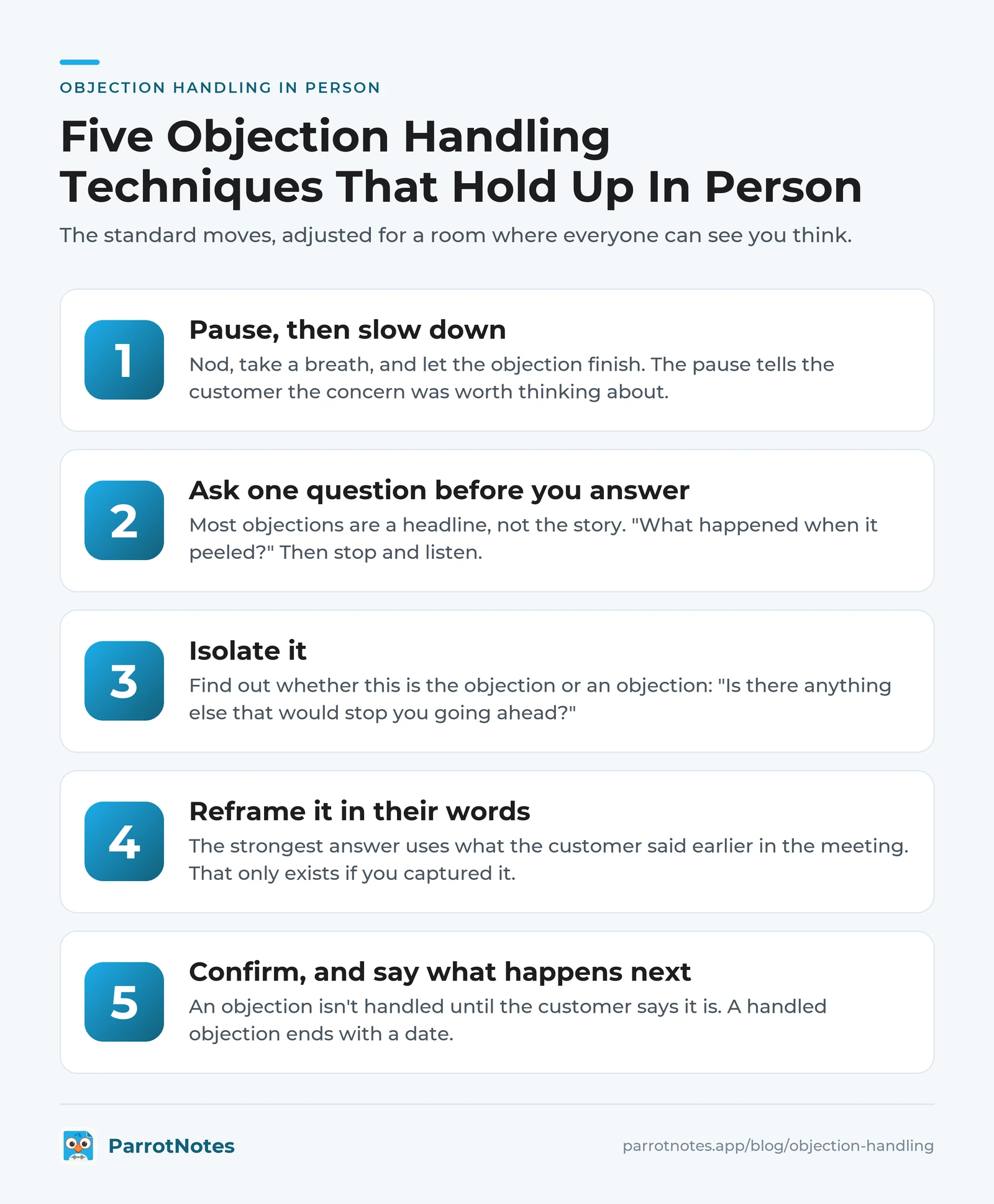
Five objection handling techniques that hold up in person
1. Pause, then slow down
The first technique is doing nothing for a moment. Gong Labs analysed 67,149 sales meetings and found that successful reps pause after an objection, for longer than at other points in the conversation, while less successful reps interrupt and pounce on it. The same analysis found that reps who get flustered speed up, from an average of 173 words per minute to 188.
In a room, that pause is a signal. Nod, take a breath, and let the objection finish. If your hand is on a pen, write the objection down before you speak (more on that below). The pause tells the customer the concern was worth thinking about, and it stops you from answering the objection you expected instead of the one you heard.
2. Ask one question before you answer
Most objections are a headline, not the story. "We tried this before and it peeled" is a headline. The story might be a bad installer, a product that wasn't rated for the traffic, or a warranty claim that went nowhere. Each one needs a different answer, and you can't know which until you ask.
One question, open, and about them: "What happened when it peeled?" or "What would have to be different this time?" Then stop and listen. One is the right number in person, because two in a row feels like an interrogation when there's no screen between you.
This is where discovery pays off. If you ran the Sandler pain funnel earlier in the meeting, or asked the BANT qualification questions on the first visit, the objection usually connects to something they already told you.
3. Isolate it
Before you answer, find out whether this is the objection or an objection. "If we can show you why the last installation failed and how this one is different, is there anything else that would stop you going ahead?" If the answer is "well, there's also the budget," you've learned that the peeling story was the easier thing to say.
Isolating protects you from the in-person trap of answering one objection brilliantly, shaking hands, and finding out a week later that it was never the real one.
4. Reframe it in their words
The strongest answer to an objection uses what the customer said earlier in the meeting. "You told me at the start that the loading floor is why you lose an hour a week to forklift damage. The product that peeled was a residential-grade coating. This one is rated for forklift traffic, which is the problem we're here to solve."
That answer only exists if you captured the earlier statement. It's the same reason MEDDPICC sellers keep a note of the customer's own words for pain and metrics: the reframe is built from them. A rep working from memory reframes in vague terms. A rep working from notes reframes in the customer's own sentence.
5. Confirm, and say what happens next
An objection isn't handled until the customer says it is. "Does that answer the peeling question, or is there something I've missed?" Then, in person, add what happens next: "I'll bring the traffic rating sheet and the installer's reference on Thursday." A handled objection ends with a date.
If it isn't handled, that's fine too. The confirm step turns "I'm not sure" into a task rather than a loss. Which brings us to the moves you can only make in the room.
Three moves that only work face to face
Write it down in front of them
When someone objects in person, pick up your pen, or your phone, and write the objection in their words. Say it back as you write: "So: it peeled within a year, and nobody came back to fix it." Two things happen. The customer sees the concern being taken seriously, and you get a verbatim line for the log instead of a memory of the gist.
It also buys you the pause from technique one without any awkwardness, because writing is a reason to be quiet.
Let the room answer
If there are three people in the room, the answer to one person's objection is sometimes sitting next to them. "Marcus, you were there for the last install. What went wrong from your side?" Often the colleague supplies the context ("it was the cheap contractor, not the product") and the objection shrinks before you've said a word.
Use this carefully. It works when the colleague has the context and the tone in the room is open. It backfires when it puts someone on the spot in front of their boss. When in doubt, answer it yourself.
Take it with you, with a date
Some objections can't be answered in the room: you don't have the traffic rating to hand, or the objection is about a person who isn't there. On a video call you'd promise a follow-up email. In person, the promise needs more shape.
"I can't answer that properly standing here. Let me get you the rating sheet and a call with a site that's had the product down for three years. I'll have both to you by Thursday. Does that work?" Then it goes into the log with an owner and a date, and it gets done from the car park, not from memory on Friday.
The in-person objection log
Here is the record that makes objection handling carry over from one visit to the next. Most reps leave a meeting with the objection in their head as a feeling ("he was worried about durability"). Two visits later, the feeling has faded, and the follow-up email answers a question nobody asked.
The log fixes that. Five columns, one row per objection, filled in before you drive off.
| Column | What goes in it | Example |
|---|---|---|
| 1. Objection, verbatim | The words they used, in quotation marks, with their name | "We tried something like this three years ago and it peeled within a year." (Rob, facilities manager) |
| 2. When it came up | Early, mid-meeting, or at the door; who else was in the room | At the door, packing up; Marcus (operations lead) present |
| 3. What sat underneath it | The answer to your one question, in their words | "The contractor never came back." Bad installer, not the product |
| 4. What you said | The reframe, in one sentence | Residential coating versus forklift-rated; tied to the hour a week of forklift damage |
| 5. Status and what's owed | Handled, parked, or open; what you owe, to whom, by when | Parked. Traffic rating sheet and a reference call, to Rob, by Thursday |
Three rules make it work. Column 1 gets quotation marks or it doesn't count: "worried about durability" is your paraphrase, and paraphrases lose the detail the reframe needs. Column 3 is the one most reps skip and the one that matters most at the next meeting. Column 5 gets a date, or the objection isn't parked, it's dropped.
Four rows is a lot for one visit. If you're logging six, the meeting had a discovery problem, and the fix is earlier questions, not better answers.
A worked visit: three objections, logged
The visit below is invented to show the log doing its job. Dana, the customer, and the company don't exist, and nothing in it is evidence for how any real deal goes.
Dana sells industrial floor coatings. She's at Marbury Logistics, a regional distribution warehouse, meeting Rob Halloran (facilities manager) and Marcus Ng (operations lead) about recoating a 4,000-square-metre loading floor. Three objections come up.
Objection 1, twelve minutes in. Marcus: "We can't shut the loading floor for five days." Dana pauses, writes it down, and asks: "Which days is the floor quietest?" Marcus: "Sunday and Monday are dead." Dana's reframe: two phases, half the floor each Sunday and Monday across two weeks. Confirmed, if it's in writing.
Objection 2, twenty-five minutes in. Rob: "I'd need to run it past the ops director, and she's tight on capital this quarter." Dana isolates it: "If she's comfortable with the number, is there anything else in the way?" Rob: "Not from me." She takes it with her: a one-page summary in Rob's terms by Wednesday, and an offer to present it with him.
Objection 3, at the door. Rob: "We tried something like this three years ago and it peeled within a year." Dana: "What happened when it peeled?" Rob: "The contractor never came back." Marcus adds: "That was the cheap coating, not the floor." Dana's reframe: that was a residential-grade coating with no installer warranty; this one is forklift-rated, and the warranty is in the quote. Parked: rating sheet and a reference call by Thursday.
Here is Dana's log, filled in from the car park:
| # | Objection, verbatim | When | Underneath | What I said | Status and owed |
|---|---|---|---|---|---|
| 1 | "We can't shut the loading floor for five days." (Marcus) | 12 minutes in | Sunday and Monday are quiet | Two-phase install over two weekends | Handled. Two-phase plan in the quote, to Marcus, Wednesday |
| 2 | "I'd need to run it past the ops director, and she's tight on capital this quarter." (Rob) | 25 minutes in | Rob is sold; the director owns the money | Isolated: nothing else in the way | Parked. One-page summary in Rob's terms, Wednesday; offer to present with Rob |
| 3 | "We tried something like this three years ago and it peeled within a year." (Rob) | At the door | Cheap contractor, residential coating; Marcus confirmed | Forklift-rated product, installer warranty in the quote | Parked. Rating sheet and reference call, to Rob, Thursday |
Three rows, three dates, and a follow-up email that answers the questions Rob and Marcus asked rather than the ones Dana expected. Our follow-up email templates include one for a visit with more than one stakeholder; the log gives it its content.
The 90-second objection debrief
Typing the log takes ten minutes in the evening, which is why it doesn't happen. Saying it takes 90 seconds in the car, which is why it does. Here's the script, spoken before you pull out:
"Objection debrief, Marbury Logistics, Tuesday. Three objections. One: Marcus said, quote, we can't shut the loading floor for five days, twelve minutes in. Underneath it: Sunday and Monday are quiet. I offered a two-phase install. Handled; two-phase plan goes in the quote by Wednesday. Two: Rob said, quote, I'd need to run it past the ops director, she's tight on capital. Isolated; nothing else in the way from Rob. Parked; one-pager for the director by Wednesday, offer to present with Rob. Three: at the door, Rob said, quote, we tried something like this three years ago and it peeled within a year. Underneath: the contractor never came back, and Marcus said it was the cheap coating. I said forklift-rated plus installer warranty. Parked; traffic rating sheet and reference call by Thursday."
Open ParrotNotes, press record, and say that. Recording keeps going with the screen locked, so the phone stays in the cup holder. When you stop, you get a transcript, an AI summary, and a list of action items with owners, so column 5 is already pulled out. Recording works without signal; the transcript and summary arrive once you're back in coverage.
If the meeting itself was recorded, with everyone's permission, the transcript gives you column 1 in the customer's exact words instead of your reconstruction. Ask before you press record, every time, and skip it if anyone hesitates. In the United States, federal law permits recording a conversation you're part of (18 U.S.C. § 2511(2)(d)), but some states and countries require everyone's consent. This isn't legal advice.
A debrief you dictate alone in the car needs none of it. If the customer's site has confidentiality rules, you can read how we protect your data first.
Want the log filled in before you leave the car park? Download ParrotNotes free. The free plan gives you 100 minutes of recording a month, up to 30 minutes per recording, with an AI summary on every recording and AI insights on five recordings a month. Pro is $19.99 a month, or $14.99 a month billed annually, with 3,000 minutes a month, recordings up to 3 hours, sales frameworks (BANT, MEDDIC, and SPIN), and AI chat for asking "what did Rob say about the last install?" before the next visit.
Objection handling mistakes that only show up in the room
- Answering the objection you rehearsed. The customer says "peeled"; you hear "price" and deliver the value speech. The pause and the one question prevent it.
- Filling the silence. Three seconds of quiet in a room feels like thirty. Reps who can't hold it start talking, and Gong's objection handling data shows what happens to their pace.
- Winning the argument. A rebuttal that works on a call can read as a correction in front of a colleague. Reframe with their words; don't tell them they're wrong.
- Treating the doorway objection as small talk. It's raised at the door because it's the real one. Stop, put the bag down, and write it.
- Leaving with a feeling instead of a row. "He's worried about durability" is not a log entry. The verbatim line is.
For managers: coaching from the log
If you manage field reps, you rarely see objection handling happen; you see the deal go quiet a fortnight later. The log changes that. Ask each rep to bring their objection rows to the one-on-one, and coach on three things.
- Column 1 quality. Are the objections verbatim, with names, or paraphrased? Paraphrases hide the real concern.
- Column 3 presence. Did the rep ask the one question? A blank "underneath" column means the answer was given to the headline.
- Column 5 dates. Parked objections with no date are the ones that turn up in a stalled-deal review.
Picture Theo, who manages six reps he sees twice a month. Before the log, his pipeline review ran on "they're worried about price" and "I think it's going well." After a quarter of rows, he can see that "I'd need to run it past" comes up in a third of first visits, and that the reps who isolate it get a second meeting with the decision maker. That's a coaching conversation with evidence in it.
Handle it in the room, keep it in the log
Objection handling in person is the same craft as on a call, under harder conditions: a pause everyone can see, more than one face, and the real concern raised at the door. The objection handling techniques that hold up are the plain ones, done slowly.
The short version:
- Pause, then slow down; the data says flustered reps speed up
- Ask one question before you answer, and connect it to what discovery already uncovered
- Isolate the objection, then reframe it in the customer's own words
- Confirm it's handled, or park it with an owner and a date
- Write every objection down verbatim, and fill in the five-column log before you drive off
Think back to Dana at the door with the samples half in her bag. With the log, the peeling story is a row with a date on it by the time she's in the car. Overcoming objections in sales starts with hearing them properly and ends with a record of what was said. Download ParrotNotes free, copy the five columns, and dictate your first objection debrief before you pull out of the car park.
Frequently Asked Questions
What is objection handling?
Objection handling is how a seller responds when a prospect raises a concern that could stop the deal, such as price, timing, a past bad experience, or a decision maker who isn't present. It means hearing the concern fully, asking what sits underneath it, answering that, and confirming the answer landed. The goal is a clear next step, not a won argument.
What are the steps of objection handling in sales?
Five steps hold up in person: pause and let the objection finish; ask one open question to find what's underneath it; isolate it by asking whether anything else stands in the way; reframe your answer using what the customer told you earlier; and confirm it's handled, with a date for whatever you owe. Then write the objection down verbatim before you leave.
How do you handle objections in a face-to-face sales meeting?
Use the same five objection handling steps, with three adjustments for the room. Write the objection down in front of the customer as you say it back, which shows you're taking it seriously and gives you a verbatim record. Let a colleague in the room answer when they have the context. Park anything you can't answer on the spot, with an owner and a date.
What should you do when you can't answer an objection on the spot?
Say so, and give the promise a shape: what you'll bring, to whom, by when. "I'll get you the rating sheet and a reference call by Thursday. Does that work?" Then log it as parked with the date, and do it from the car park. An objection parked with a date is still in play; one answered vaguely is usually dropped.
Are objections a good sign in sales?
Often, yes. Gong's analysis of 67,149 sales meetings found that buyers raise more objections and concerns as they move toward a purchase, not fewer. A prospect who objects is still engaged. The risk is the deal that goes quiet instead, which is why every objection, handled or parked, deserves a written row and a dated next step.
Related Posts
What Is B2B Sales? A Plain Guide for New Reps
What is B2B sales? A plain-English guide for new reps: B2B vs B2C, the seven-stage cycle, who does what, a first-30-days checklist and a jargon decoder.
Solar Sales: How Closers Keep Track of Every Household
What solar sales is, how closers work, and an eight-field household record for every in-home consultation, plus the follow-up and referral rhythm. Copy it.

Sales Pitch Examples for In-Person Meetings
Eight sales pitch examples written for meetings in the room: structure, filled-in script, when each works, and a 90-second debrief to capture the reaction.