
Insurance Objection Handling Scripts for Agents

Sarah Johnson
Writes about field sales, meeting notes and voice-first workflows at ParrotNotes. Every article is reviewed by the ParrotNotes product team before it goes live.

Table of Contents
- 1.How to use these insurance objection handling scripts
- 2.Insurance sales objections about price
- 3.When the client says "I already have coverage"
- 4.Insurance objection handling scripts for timing and decisions
- 5.Trust and need objections in insurance sales
- 6.The say / never say / write down sheet
- 7.After the appointment: the 60-second debrief
- 8.Keep the insurance objection handling script honest
Maria has spent 40 minutes at the Okafors' kitchen table. Mortgage, two kids, what the family would need if one income stopped. Then Daniel Okafor leans back and says, "We're fine, honestly. I've got life insurance through work."
Most agents have a comeback for that. Many were written to close, not to help, and some cross a line your state insurance department would care about. A good insurance objection handling script does two jobs: it answers the concern honestly, and it keeps you inside the rules you're licensed under.
Below are scripts for the eight objections agents hear most, each with a line you should never say and a note for the client file. It's written for agents who sell face to face, and for the agency owners who coach them.
If you'd rather dictate appointment notes in the car than type them at 9 p.m., try ParrotNotes free before your next appointment.
How to use these insurance objection handling scripts
Every script below is a three-part card:
- Say: a response to adapt into your own words
- Never say: the version that sounds persuasive but misstates coverage, promises too much, or pushes too hard
- Write down: what goes in the client file, so the next conversation starts where this one ended
Two rules sit above all eight.
Your carrier and your state come first. Insurance is regulated state by state, and states build many of their rules on model laws from the National Association of Insurance Commissioners (NAIC). The NAIC's Unfair Trade Practices Act (Model 880) treats as unfair any "sales presentation, omission or comparison" that "misrepresents the benefits, advantages, conditions, or terms of any policy." Use carrier-approved language where it exists. When in doubt, your state insurance department is the authority.
Ask before you answer. "It's too expensive" might mean the premium, the coverage amount, or doubt about the need. One open question tells you which, the same habit behind consultative selling. Our general guide to objection handling in sales covers the technique. This one stays at the kitchen table.
Insurance sales objections about price
1. "It's too expensive"
Say: "That's fair. What felt too high: the monthly number, or the amount of coverage? If it's the monthly number, we can look at a smaller amount or a different term."
Never say: "It's less than your daily coffee." And never quote a premium you haven't confirmed. Model 880 names "any intentional misquote of premium rate" as a misrepresentation.
Write down: the budget in their words, and which option you'll bring back.
2. "I can't afford it right now"
Say: "Understood. Should we set a date to look at this again, or would a smaller starting amount work for now?"
Never say: "What happens to your family if you die next month?" Fear isn't a needs analysis.
Write down: the revisit date, and what changes by then.
When the client says "I already have coverage"
3. "I have coverage through work"
Daniel's line. Group coverage is a real benefit, so don't talk it down.
Say: "Good to know. Do you know how much it pays, and what happens to it if you change jobs? Your benefits booklet will say. If it covers what you need, you may not need me. If there's a gap, we'll talk about just the gap."
Never say: "Work coverage is worthless" or "you lose it the day you leave." You haven't seen their plan, and plans differ.
Write down: the employer, the amount they think they have, and whether they'll check the booklet.
4. "I'm happy with my current policy"
Say: "Keeping a policy that works is usually right. Would a quick review help, to check the amount still fits? If it does, I'll tell you."
Never say: anything that runs down their insurer, or "drop it before the new one starts." If a sale would replace life insurance or an annuity, the NAIC's Replacement Model Regulation (Model 613) sets out a notice the client signs, warning that they "will pay acquisition costs and there may be surrender costs." Check how your state applies it.
Write down: current carrier, policy type, and whether they asked for a review.
Insurance objection handling scripts for timing and decisions
5. "I need to talk to my spouse"
Say: "Of course. Could we find a time when you're both here, so I can answer questions directly?"
Never say: "Sign today and tell them later." Going around a partner loses the household.
Write down: the partner's name, their likely questions, and the joint appointment date.
6. "Just send me something"
Say: "Happy to. What's the one thing you'd want it to answer? And when should I check back?"
Never say: "I'll send it over," with no question and no date.
Write down: what they asked to see, the send date, and the follow-up date. A follow-up email after the meeting that answers their one question beats a brochure.
7. "I need to think about it"
Say: "That makes sense. Which part are you least sure about? I'd rather you think about the right question than the whole thing."
Never say: "This rate is only good today," unless the carrier has set that deadline in writing.
Write down: the part they named, and the check-in date.
Trust and need objections in insurance sales
8. "I don't trust insurance companies" (or "I'm young and healthy")
Both deserve a straight answer, not a clever one.
Say (trust): "A lot of people feel that way. Can I ask what happened? I can also show you exactly what this policy covers and excludes, in writing, before you decide."
Say (young): "Is anyone relying on your income, or co-signed on something with you? If not, you may not need much. If so, it's worth a look."
Never say: "We pay every claim" or "it covers everything." For cash-value products, never present an illustration as a guaranteed return.
Write down: the story behind the distrust, in their words, any exclusions they asked about, and who depends on them.
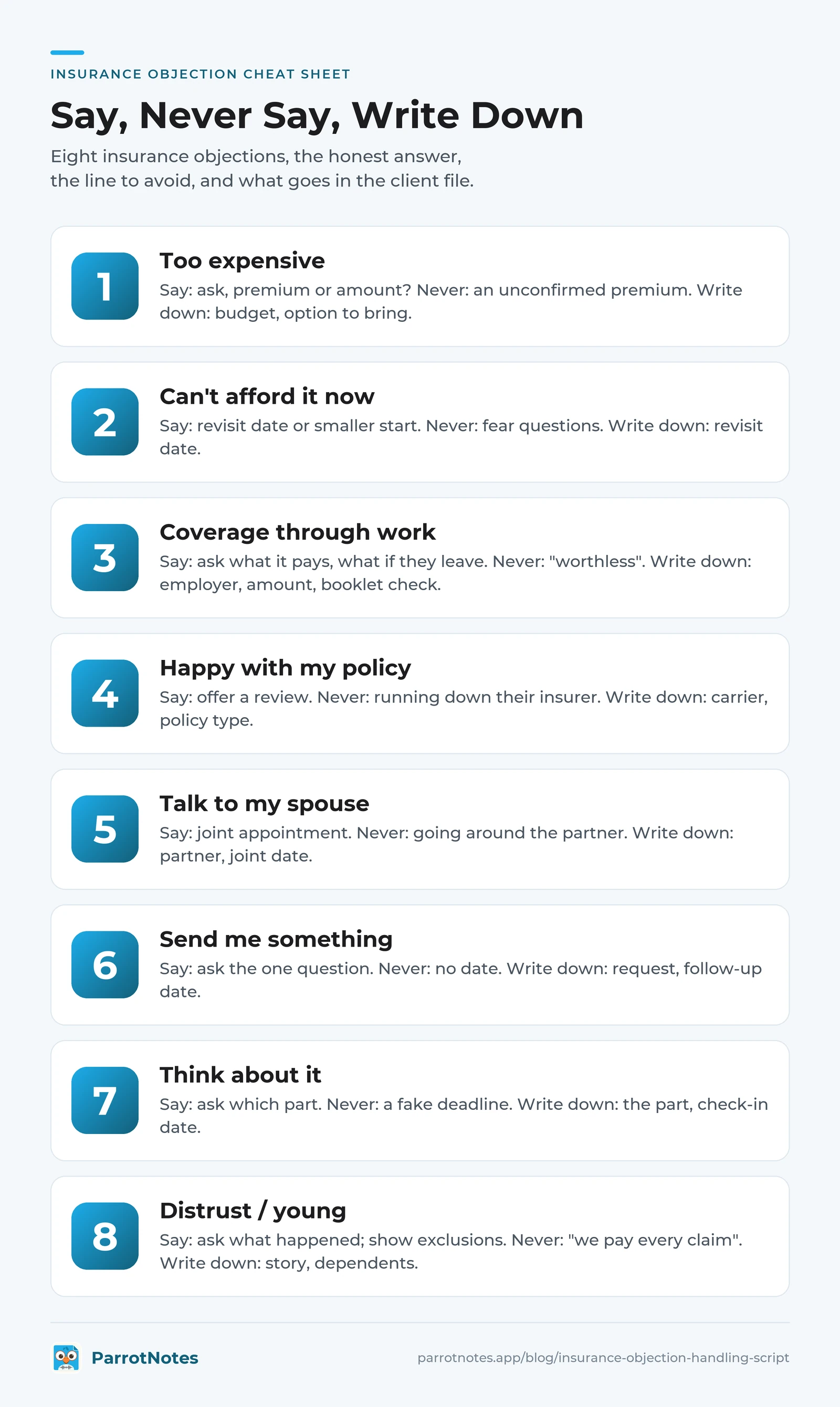
The say / never say / write down sheet
Keep this on your phone.
| Objection | Say | Never say | Write down |
|---|---|---|---|
| Too expensive | Ask: premium or amount? | Unconfirmed premium | Budget, option to bring |
| Can't afford it now | Revisit date or smaller start | Fear questions | Revisit date |
| Coverage through work | Ask what it pays, what if they leave | "Worthless" | Employer, amount, booklet check |
| Happy with my policy | Offer a review | Running down their insurer | Carrier, policy type |
| Talk to my spouse | Joint appointment | Going around the partner | Partner, joint date |
| Send me something | Ask the one question | No date | Request, follow-up date |
| Think about it | Ask which part | A fake deadline | The part, check-in date |
| Distrust / young | Ask what happened; show exclusions | "We pay every claim" | Story, dependents |
After the appointment: the 60-second debrief
Objection handling usually breaks down in the car, not at the table. By Thursday, a clear objection has become "they were worried about money."
After the Okafors, Maria sits in the driveway and says this before she starts the engine:
"Okafor debrief. Daniel has life insurance through work, doesn't know the amount, will check the booklet. Ada asked if the policy covers both of them or just Daniel. Budget: Ada said, quote, under a hundred a month or it's not happening. Next step: call Thursday after seven. Send a one-page comparison of single and joint cover first."
Open ParrotNotes, press record, and say that. Recording works without signal and keeps going with the screen locked. Once you're connected, you get a transcript, an AI summary, and the action items. Before Thursday's call, ask the transcript "what did Ada say about the budget?"
A debrief to yourself needs no one's permission. Recording the appointment is different: ask first, and follow your carrier's rules.
Federal law allows recording a conversation you're part of (18 U.S.C. § 2511(2)(d)), but some states require everyone's consent, such as California under Penal Code § 632. This isn't legal advice.
Want client notes written before you leave the driveway? Download ParrotNotes free. The free plan gives you 100 minutes a month and an AI summary on every recording. Pro is $19.99 a month, or $14.99 billed annually, with 3,000 minutes a month, speaker identification, and sales frameworks like BANT and SPIN.
For agency owners: coaching from the debriefs
Frank runs a four-agent office. Before debriefs, his Monday meeting ran on "it went well" and "they're thinking about it." After a month of dictated debriefs, he can see which objections come up and how each agent answered.
One agent hears "just send me something" at nearly every first appointment and never gets a date. That's a coaching conversation. Another told a client their work coverage "won't be there when you need it." That's a compliance conversation, caught early.
For agents who prospect by phone or door to door, pair this with a cold call script and a discovery call structure. Needs found early mean fewer objections late.
Keep the insurance objection handling script honest
Insurance objection handling isn't about winning. It's answering the real concern in words you'd happily read back to your regulator, then leaving with a next step.
- Ask one question before you answer
- Treat the "never say" column as a hard line
- Find the gap in existing coverage; don't run down the policy
- Give every stall a date
- Write the objection down in the client's words before you drive away
Daniel's "I've got coverage through work" became a benefits-booklet check and a Thursday call, not an argument. Download ParrotNotes free and dictate your first 60-second debrief after your next appointment.
Frequently Asked Questions
What is an insurance objection handling script?
It's a prepared response to a concern a prospect raises in an insurance appointment, such as price, existing coverage, or needing to talk to a spouse. A good one starts with a question, answers the real concern honestly, and ends with a next step. Adapt it to your words and your carrier's approved language.
What are the most common objections in insurance sales?
The eight in this guide: price ("it's too expensive"), timing ("I can't afford it right now," "I need to think about it"), existing coverage ("I have coverage through work," "I'm happy with my current policy"), decision-makers ("I need to talk to my spouse"), stalls ("just send me something"), and trust or need ("I don't trust insurance companies," "I'm young and healthy").
How do you handle "I have coverage through work"?
Ask how much the group coverage pays and what happens to it if the client changes jobs, and point them to their benefits booklet for the answer. If it meets their needs, say so. If there's a gap, talk about the gap only. Never describe their plan's terms without seeing them.
What should insurance agents never say when handling objections?
Never misstate what a policy covers, quote an unconfirmed premium, promise a return on a product with non-guaranteed elements, invent a deadline, or run down a client's current insurer to push a replacement. The NAIC Unfair Trade Practices Act treats misrepresenting a policy's benefits or terms as unfair. Follow your state and carrier rules.
Can I record insurance appointments to capture objections?
Only with the client's permission, and within your carrier's rules and your state's law. Federal law allows recording a conversation you're part of, but some states, such as California, require every party's consent. The simpler option needs no consent: dictate a short debrief to yourself straight after the appointment.
Related Posts

Voice Journal App: How to Keep a Spoken Work Journal
Use a voice journal app to keep a spoken work journal: a 3-minute daily prompt set, a 20-minute weekly review, and what to look for in the app. Start today.

Sales Territory Management: A Field Rep's Playbook
Sales territory management for the rep who runs one: a one-row-per-account ledger, visit cadence by tier, and a 40-minute Friday review. Get the template.
Sales KPIs: What to Track and What to Ignore
Sales KPIs sorted into leading and lagging, with formulas, the vanity metrics to drop, and a one-page KPI scorecard for field teams. Build yours this week.