
Insurance Cold Calling Script: Openers and Objections

Sarah Johnson
Writes about field sales, meeting notes and voice-first workflows at ParrotNotes. Every article is reviewed by the ParrotNotes product team before it goes live.
Table of Contents
Kevin has a list of 200 homeowners and a new script that opens with "I can save you up to 30% on your home insurance." On call 14, a man cuts him off: "I'm on the Do Not Call list. How did you get this number?" Kevin doesn't know. The list came from a vendor, and nobody checked it against the registry. (Kevin is an illustration, not a real agent.)
Under the FTC's rule, a call like that can cost up to $53,088.
A good insurance cold calling script does two jobs. It books a 15-minute review, and it keeps you inside the rules before anyone picks up. Below: a pre-dial check for each insurance line, five openers, a voicemail, the six objections you hear in the first 30 seconds, and a one-line call log.
We wrote these scripts as samples. We haven't tested them on live calls, so change them until they sound like you.
Want the outcome of every call saved without typing between dials? Try ParrotNotes free and say each result out loud after you hang up.
Before you dial: who an insurance agent can cold call
This is general information, not legal advice. Your agency's compliance contact, your carrier and your state insurance department are the authorities, and state rules can be stricter than the federal ones below. Rules were checked on 6 November 2026.
In insurance, the rules change with the line you sell.
| Who you're calling | Can you cold call? | The rule behind it |
|---|---|---|
| Consumers about auto, home, renters or life | Yes, if the number isn't on the National Do Not Call Registry or your own do-not-call list | FTC Telemarketing Sales Rule and FCC rules |
| People about Medicare Advantage or Part D plans | No. No cold calls, robocalls, texts or voicemails | CMS, 42 CFR 422.2264 |
| Business owners about commercial lines | Usually yes; the registry doesn't cover most business-to-business calls | FTC Telemarketing Sales Rule |
| Your clients who bought or paid on a policy in the last 18 months | Usually yes, even if they're on the registry | Established business relationship |
| People who asked your agency about a policy in the last 3 months | Usually yes | Established business relationship (inquiry) |
| Anyone who asked you to stop calling | No, even if they're a client | Company-specific do-not-call request |
The FTC's Do Not Call Q&A sets out the 18-month and 3-month windows and says a stop request wins: if a consumer asks not to be called, "the company may not call, even if it has an established business relationship with the consumer."
For Medicare Advantage and Part D, CMS bans "telephone solicitation (that is, cold calling)" outright. A call is fine only when the person asked for it or gave consent. Our guide to Medicare sales covers what you can do instead.
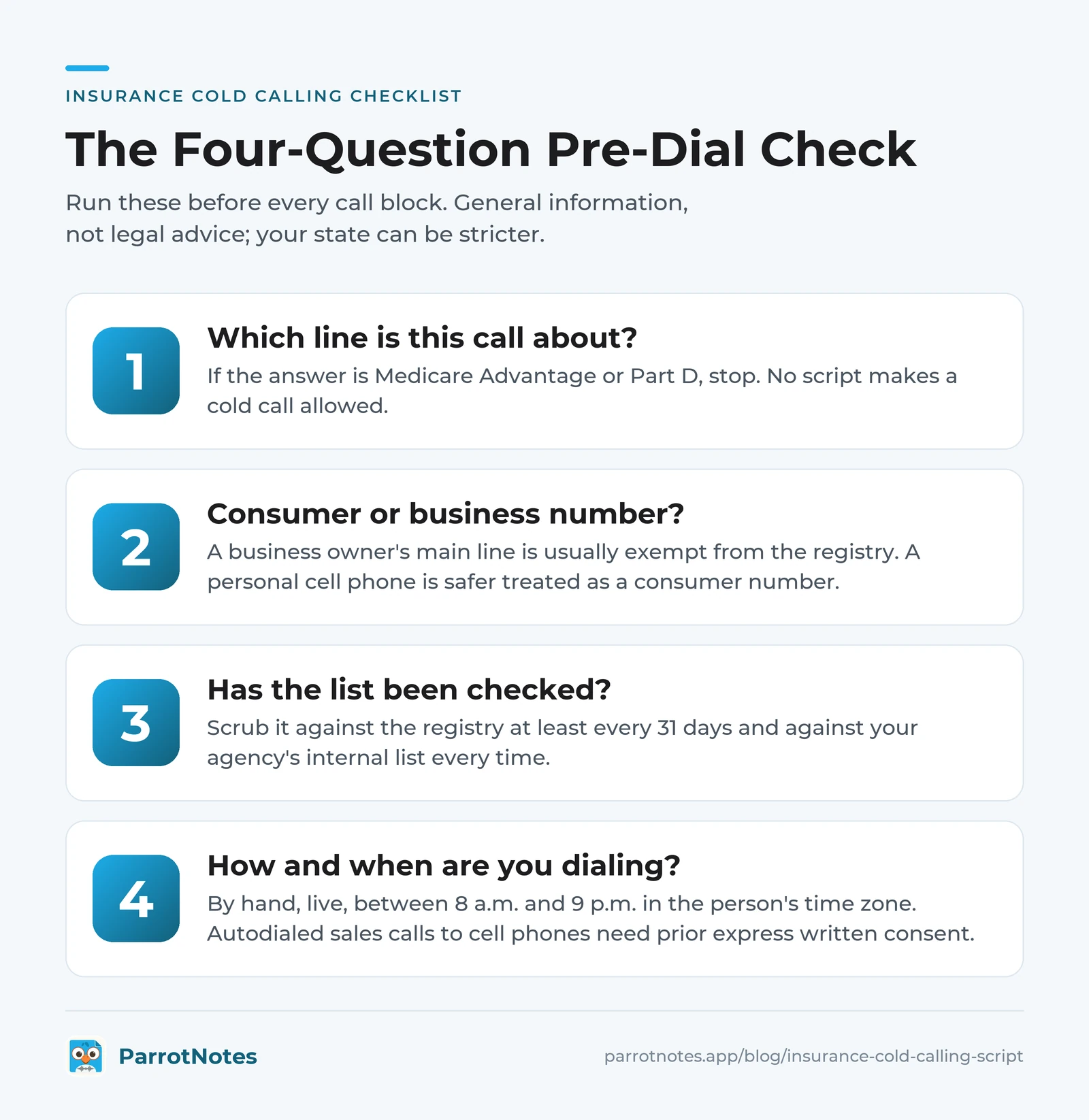
The four-question pre-dial check
Run these before every call block:
- Which line is this call about? If the answer is Medicare Advantage or Part D, stop. No script makes a cold call allowed.
- Is this a consumer or a business number? A business owner's main line is usually exempt from the registry. A personal cell phone that belongs to a business owner is safer treated as a consumer number.
- Has the list been checked? Scrub it against the registry at least every 31 days and against your agency's internal list every time. As of November 2026, the FTC charges nothing for up to five area codes and $85 a year for each extra one.
- How and when are you dialing? Call by hand, live, between 8 a.m. and 9 p.m. in the person's time zone, as 47 CFR 64.1200 requires. Autodialed or prerecorded sales calls to cell phones need the person's prior express written consent. Some states go further: Florida stops calls at 8 p.m. and allows no more than three calls in 24 hours on the same subject.
Bought leads need care. In January 2025 a federal appeals court struck down the FCC's "one-to-one consent" rule for lead forms, but the basic consent rules stand. Ask the vendor how consent was collected.
How an insurance cold calling script is built
A cold call isn't the place to sell a policy. Its job is to book a review: 15 minutes on the phone or at the kitchen table, where the life insurance sales script or a commercial risk review takes over.
Every insurance cold calling script below follows the same five parts, and each takes about 30 seconds:
- Who you are. Your name, your agency and a callback number if asked. Federal rules require the caller's name and the business they're calling for.
- Why you're calling them. One local or personal reason, not a product.
- Permission. Give them an easy way out.
- One question. Something about their situation they can answer in a sentence.
- The small ask. A short review with a day and time attached.
Leave out savings promises: you can't back one up before you've seen their policy. For a general B2B version, see our cold call script examples.
Five insurance cold calling script openers
These cold calling scripts for insurance agents each fit one line. Fill in the brackets, read each one aloud, and cut any word you wouldn't say.
1. Personal lines (auto and home)
"Hi, is this [first name]? This is [your name] with [agency], an independent agency here in [town]. Is this an OK time for 30 seconds? ... Thanks. Many people here haven't looked at their home and auto coverage since they bought it. I'm not selling anything on this call. Would 15 minutes next week be worth it to go over your current policy together, just to check nothing's missing?"
Write down: renewal month, current carrier, and whether they own or rent.
2. Life insurance
"Hi [first name], this is [your name] with [agency]. I help families in [area] check whether their life insurance still fits their mortgage and their kids' ages. Most people I speak to have coverage through work and haven't looked at it since they started the job. Do you know roughly how much yours would pay out? ... That's common. Could we take 20 minutes, at your place or on a video call, to see where you stand?"
Use this life insurance script for cold calling only on numbers that pass the check above. Don't ask health questions on a cold call; they belong in the application, later, with the client's agreement.
3. Commercial lines
Priya, a commercial producer, calls a bakery owner on the shop's main line at 2:30 p.m., after the lunch rush. She mentions no product, asks one question, hears "March" and books a call for mid-January. (Priya is an illustration.)
"Hi, is this [owner's name]? This is [your name] with [agency]. I work with restaurants and food businesses in [county] on their business insurance. Many owners I talk to have added equipment or staff since their policy was written, and their limits haven't kept up. When does your policy renew? ... Would it help if I called you six weeks before that to compare?"
Write down: the renewal date (the "X-date"), who decides, and what's changed in the business. Our guide to commercial insurance sales picks up from there.
4. Past client cross-sell
"Hi [first name], it's [your name] at [agency]. We've had your auto policy since [year]. I'm calling all our clients this month to check their policy still fits: a new driver, a new car, a move? ... Good to know. One more question: who looks after your home insurance right now?"
Usually allowed under the 18-month rule, unless they ever asked you not to call.
5. Web lead callback
"Hi, this is [your name] with [agency]. You asked about a term life quote on our website this morning, so I'm calling back like I said I would. Is now still a good time for five minutes?"
Call fast, by hand. An inquiry to your agency gives you a three-month window. A lead you bought from a vendor is different: check what the form said and who it named.
The voicemail
"Hi [first name], it's [your name] with [agency] in [town], calling about your [home / business] insurance renewal. I'd like to set up a 15-minute review. You can reach me at [number], that's [number]. Thanks."
Leave it live, under 30 seconds. Never leave one for a Medicare Advantage or Part D prospect, and don't use prerecorded or "ringless" drops without legal advice. Our sales voicemail script guide has more versions, and the free voicemail script generator writes one from your details.
Want each call's outcome in your notes before the next dial? Download ParrotNotes, say "renewal March, call back January 10" after you hang up, and get a summary with the action item pulled out.
Cold call objections in the first 30 seconds
These come before the prospect knows what you're offering. Price, "I need to talk to my spouse" and "I have coverage through work" come later; our insurance objection handling scripts cover those.
"How did you get my number?"
Say: "Fair question. It came from [the source: a county business list, our client file, the form you filled in on our site]."
Never say: "It's just a random number." If you don't know the source, you're not ready to make the call.
"Is this a sales call?"
Say: "Yes, it is. I'm calling to see if a short review of your coverage would be useful. If it isn't, just say so and I'll let you go."
Never say: "No, it's a courtesy call." They'll see through it, and a misleading answer is the one that ends up in a complaint.
"I already have an agent."
Say: "That's good, most people I call do. I'm not asking you to switch. When does your policy renew? I'd be glad to give you a second opinion before then."
Never say: anything negative about their agent or their carrier. You haven't seen their policy.
"Not a good time."
Say: "Understood. Would Thursday morning be better for two minutes, or should I leave it?"
Never say: "This will only take a second" and carry on talking.
"Just send me something."
Say: "Happy to. So I send the right thing, is it home, auto or both? And can I call Tuesday to see if it was useful?"
Never say: "Sure" and hang up with no date. That's a polite no, and you've logged nothing.
"Take me off your list" or "I'm on the Do Not Call list"
Say: "I'm sorry for the call. I'll add your number to our do-not-call list today, and you won't hear from us again." Then end the call.
Never say: "This is an exempt call" or "Can I just finish?" Federal rules require you to honor a stop request within 10 business days and for five years; same day is safer. If they're on the registry, find out how the number reached your list.
The one-line call log
Write one line after every dial. It protects you if someone complains and shows which insurance agent cold calling script works for your market.
| Time | Line | Number source | Scrubbed on | Outcome | Next step | Stop request? |
|---|---|---|---|---|---|---|
| 9:05 | Home | Client file (auto client) | Nov 3 | Renews March | Call Jan 10 | No |
| 9:11 | Commercial | County business list | Nov 3 | Voicemail | Retry Fri p.m. | No |
| 9:14 | Life | Website inquiry Nov 5 | n/a (inquiry) | Booked review | Thu 6 p.m. | No |
| 9:20 | Home | Purchased list | Nov 3 | "Take me off" | Added to internal list | Yes |
Luis, an agency owner, reads his team's logs every Friday. After two weeks he sees that one purchased list produced three stop requests in a day, and that morning personal lines calls mostly hear "not a good time." He moves mornings to commercial calls and drops that vendor. (Luis is an illustration.)
Once a prospect becomes a client, see how insurance agents keep client notes. Our cold calling tips cover timing and attempts.
Where ParrotNotes fits
Typing a log line while the next number rings is where notes get skipped. With ParrotNotes you say it instead. After each call, dictate the outcome into your phone: "Garcia, home, renews March, already has an agent, call January 10." You get a transcript, a summary and the action item, ready to paste into your CRM.
A few rules keep this clean:
- A note to yourself needs nobody's permission. Recording the call itself is different: some states require everyone on the call to agree. Ask first, and check the one-party and two-party consent states.
- Keep health details out of your notes. Medical history, Social Security numbers and policy numbers belong in the carrier's application, not in a sales note.
- Know the limits. The Free plan includes 100 recording minutes a month, an AI summary on every recording and five AI-powered recordings with action items. Pro is $19.99 a month (or $14.99 a month billed annually) for 3,000 minutes a month.
Try ParrotNotes free on your next call block.
Make your insurance cold calling script a short one
Kevin's problem wasn't his voice. It was a list nobody checked and an opener that promised savings before he knew anything about the person he was calling.
Here's the short version:
- Check before you dial. Know the line, the number type, the scrub date and the time zone. Medicare Advantage and Part D are never cold calls.
- Ask for a review, not a sale. Who you are, why them, permission, one question, a day and time.
- Stop when asked. "Take me off your list" ends the call and goes on your internal list the same day.
- Log every dial. One line per call shows you which opener works and protects the agency.
Pick one opener from this insurance cold calling script, change it into your own words, and run a 30-minute call block this week.
Frequently Asked Questions
Is it legal for insurance agents to cold call?
Generally yes, for most lines, if the number isn't on the National Do Not Call Registry or your own do-not-call list, you call by hand between 8 a.m. and 9 p.m. local time, and you identify yourself and your agency. Medicare Advantage and Part D are the exception: CMS bans cold calls for those plans. This is general information, not legal advice.
Can I cold call people about Medicare plans?
Not for Medicare Advantage or Part D. CMS rules prohibit telephone solicitation, robocalls, texts and voicemails to prospects who haven't asked to be contacted. You can return a call, or call someone who gave consent or asked for information.
What is a good opening line for an insurance cold call?
Say who you are, then give one local or personal reason for the call and ask permission: "This is [name] with [agency] in [town]. Is this an OK time for 30 seconds?" Leave savings promises out of the first minute.
Can I cold call business owners who are on the Do Not Call list?
Most calls selling to a business are exempt from the National Do Not Call Registry, so commercial lines calls to a business number are usually allowed. A business owner's personal cell phone is safer treated as a consumer number, and autodialed sales calls to any cell phone need prior express written consent.
What should I do when someone says "take me off your list"?
Apologize, confirm you'll add their number to your agency's do-not-call list, and end the call. Federal rules require you to honor the request within 10 business days and for five years, even for existing clients.
Related Posts
Best Talk to Text App for iPhone and Android
The best talk to text app for your phone: Apple Dictation and Siri on iPhone, Gboard and Gemini on Android, with free plans compared and a voice phrase sheet.
How to Use Speech to Text on iPhone
Turn on speech to text on iPhone in 3 steps, dictate in any app, switch languages, turn it off, and record when the mic stops. Checked on iOS 27, Nov 2026.
How to Record Calls on Samsung
Samsung call recording, step by step: record or auto record calls, find the files, get Galaxy AI transcripts, or turn it all off. Checked November 2026.