
Door-to-Door Sales: How Top Reps Remember Every Conversation

Sarah Johnson
Writes about field sales, meeting notes and voice-first workflows at ParrotNotes. Every article is reviewed by the ParrotNotes product team before it goes live.
Table of Contents
- 1.What is door-to-door sales?
- 2.The door-to-door sales day in numbers you control
- 3.The doorstep conversation: what to ask and what to write down
- 4.Why top door-to-door sales reps record every house, not just the sales
- 5.The doorstep record: seven fields per house
- 6.A worked afternoon on one street
- 7.Same-day follow-up: close the loop before 8 PM
- 8.Door-to-door sales tools that fit in one pocket
- 9.Door-to-door sales mistakes the record prevents
- 10.Keep every door on the record
Door 61, 3:40 on a Thursday afternoon. Tariq is selling quarterly pest control, and the woman who answers says the thing every rep wants to hear: "We've got a company, but honestly they're useless. Contract ends in March. Come back then." He thanks her, walks to door 62, and by door 70 he could not tell you which house it was.
That house was the best door to door sales conversation of his day. It's also the one most likely to vanish, because nobody writes down a "come back in March" at 3:40 PM with 40 doors still to knock.
Most guides to door-to-door sales are lists of tips: smile, know your product, handle the objection, follow up. Good advice, and the top reps already do it. What separates them is quieter. They keep a record of every house, not just the sales, and they fill it in between doors, not at the kitchen table at 9 PM.
This guide covers the job as it's worked in solar, pest control, roofing, telecom and home security: the knock, the doorstep conversation, and what to ask. Then it gives you what the tip lists skip: a seven-field record for every door, a 20-second way to dictate it, a worked afternoon on one street, and the same-day follow-up built from it.
Want to try the dictation before you read the rest? Download ParrotNotes free, and the first record you speak between doors comes back as text with the next step pulled out.
What is door-to-door sales?
Door-to-door sales is selling a product or service by going to the customer's home, or business, uninvited, and holding the first conversation on the doorstep. There is no inbound lead and no appointment. The rep's territory is a set of streets, the pitch takes 30 seconds, and the goal at most doors is not a sale but a next step: an appointment, a callback, or permission to come back.
It's an old channel that has not gone away. The Direct Selling Education Foundation puts U.S. direct selling retail sales at $34.2 billion in 2025, with 5.2 million people working to build a selling business that year. Direct selling is wider than knocking on doors, but the doorstep is still where much of the home-services industry starts.
The trades that still knock
Each trade has its own doorstep conversation and follow-up rhythm. The record in this guide is the same for all of them.
| Trade | What the doorstep conversation is about | What the follow-up usually looks like |
|---|---|---|
| Solar | The electric bill, roof age and orientation, who owns the home | A sit-down with both decision-makers, a proposal, a site survey |
| Pest control | What they've seen (ants, wasps, rodents), current provider, contract end date | Same-week service, or a callback when the contract ends |
| Roofing and exteriors | Roof age, storm damage, an inspection offer | A scheduled inspection, an estimate, sometimes an insurance claim |
| Telecom and fiber | Current provider, monthly cost, whether fiber just reached the street | Installation booked at the door or a callback with the other adult home |
| Home security | Recent incidents nearby, existing system, rental or owned | A demo appointment or same-day install |
| Windows and remodeling | Age of windows, drafts, a free quote | An in-home quote with both homeowners present |
Door-to-door sales jobs: what the ads leave out
A lot of searches for door to door sales come from people weighing a job offer. The ads promise high commission and a fast start, and both can be true. What they leave out is the arithmetic: most doors don't open, most that open say no, and the income comes from the small share that turn into appointments and sales.
One more thing to check before you say yes: many cities require a solicitation permit and set hours or no-knock lists, and the rules vary by city, so ask the company how it handles them (this isn't legal advice). If you're still deciding, our comparison of inside sales vs outside sales shows what an outside rep's day looks like hour by hour.
The door-to-door sales day in numbers you control
Every guide quotes a "door to door sales success rate", and they don't agree with each other: anywhere from 2% to 30%, rarely with a source. We're not quoting one. The rate depends on the trade, the offer, the neighborhood and the season, and you can't control it directly.
What you can control is the funnel above it:
- Doors knocked. The only number that is purely up to you.
- Doors answered. Timing moves this: late afternoon and early evening on weekdays, late morning on Saturdays.
- Real conversations. More than a "no thanks" through the screen door.
- Next steps set. Appointments, callbacks with a time, and permission to return.
- Sales. The result of the four numbers above, plus follow-through.
The number nobody tracks is conversations you can still remember accurately at the end of the day. It falls fast. In a 2015 replication of Ebbinghaus's forgetting-curve experiment, published in PLOS ONE, the subject retained about two thirds of learned material after 20 minutes, under half after an hour, and about a fifth after a day. It's a lab study of nonsense syllables, not doorsteps, but every rep knows the shape: what was said at door 61 is mostly gone by door 75.
So the fix isn't a better memory. It's a record made before the next knock.
The doorstep conversation: what to ask and what to write down
The tip lists cover the pitch well, so this section stays short and focuses on what the conversation needs to produce: a next step, and the details that make the next step work.
The knock. Knock, then step back off the porch so the homeowner sees a person, not a body filling the doorframe. Keep your ID visible.
The open. Name, company, and one sentence about why you're on this street, not why you're great. "Hi, I'm Tariq with Northline Pest. We're treating four houses on this block this week, and I'm checking whether anyone else has seen the ants yet." Then stop talking.
Three questions. Whatever the trade, three questions do most of the work:
- What's the current situation? (Provider, system, roof, bill, problem.)
- What would have to be true for you to change it? (Price, timing, contract end, a second opinion.)
- Who else is part of the decision? (Spouse, partner, landlord, adult child.)
The ask. Not "are you interested?" but a specific next step with a time: "Can I come back Saturday at 10 when you're both here?" or "Can I text you a quote tonight?"
Here's what to write down after each answer, because the answer is only useful later if the detail survives:
| What they say | What to write down |
|---|---|
| "We already have someone" | Who, roughly what they pay, when the contract ends |
| "Not a good time" | The time that would be, and whether that was a polite no |
| "I'd need to talk to my wife / husband / partner" | Their name if given, when they're home, whether to call or knock |
| "How much is it?" | The number you quoted, and what it included |
| "We're renting" | Whether the landlord handles it, and the landlord's name if offered |
| "Come back in March" | Which month, why (contract end, budget, season), and a callback date |
| "No thanks" | Just the outcome code. Don't argue, don't write an essay |
Objections at the door sound like objections on the phone, and the responses transfer. The objection lines in our cold call script examples work on a porch with small changes.
Why top door-to-door sales reps record every house, not just the sales
Picture Tariq's Thursday without a record. 112 knocks, 38 doors answered, nine real conversations, one sale, two appointments. The canvassing app has the sale and the appointments. The other seven conversations are in his head, and by the time he sits down at 8:30 PM to update the CRM, they've merged into "a few maybes on the east side".
The seven include the March house. They also include a renter whose landlord owns four other properties on the street, a homeowner who asked "my neighbor at 40 uses you, are they happy?", and a "not now" that was clearly a "yes in two weeks when the wasps come back".
None of those is a sale today. All of them make the same street worth more on the second pass than the first, but only if the second pass starts from a record, not from a feeling. That's the whole idea behind the record below: every house gets an entry, every entry takes seconds, and the entries are made before the next knock.
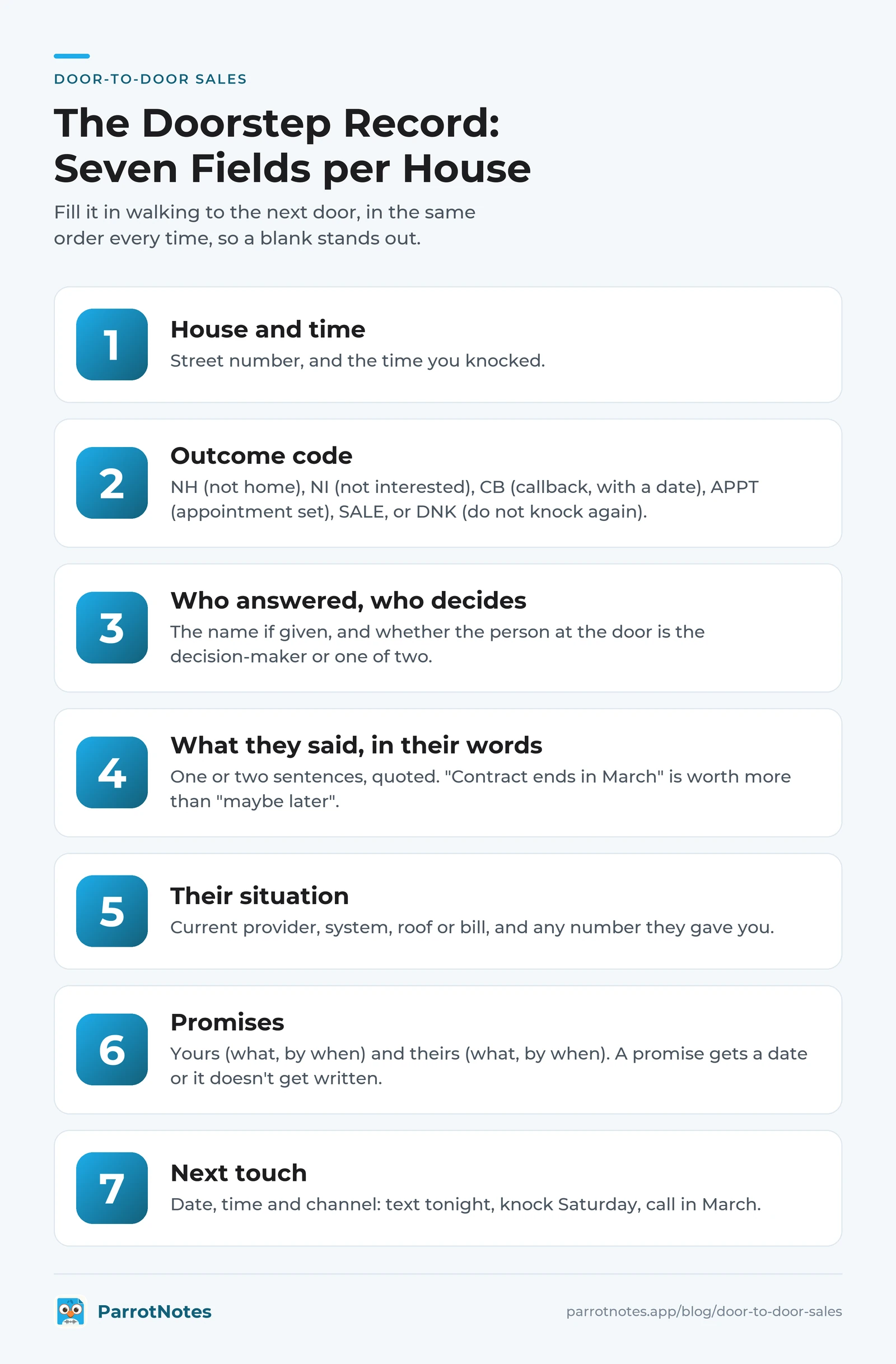
The doorstep record: seven fields per house
This is the record. Seven fields, one house. It fits in a canvassing app's note field, a CRM activity, or a plain note on your phone. Fill it in walking to the next door, in the same order every time, so a blank stands out.
- House and time. Street number, and the time you knocked.
- Outcome code. One of six: NH (not home), NI (not interested), CB (callback, with a date), APPT (appointment set, with a date and time), SALE, or DNK (do not knock again).
- Who answered, who decides. The name if given, and whether the person at the door is the decision-maker or one of two.
- What they said, in their words. One or two sentences, quoted. "Contract ends in March" is worth more than "maybe later".
- Their situation. Current provider, system, roof or bill, and any number they gave you.
- Promises. Yours (what, by when) and theirs (what, by when).
- Next touch. Date, time and channel: text tonight, knock Saturday, call in March.
Three rules make it work. Field 4 uses their words, not yours, so the follow-up can quote them back. Field 6 gets a date or it doesn't get written. Field 2 is always filled, even for NH, because a house with three NH entries at 4 PM needs a 6:30 PM knock, and you only know that from the record.
The 20-second between-doors dictation
Typing seven fields on a phone while walking takes a minute and gets skipped by door 30. Saying them takes 20 seconds. Here's the script, spoken as you walk:
"Forty-one Larkspur, 3:40. Callback. Woman, first name Dana, she and her husband decide together. She said, quote, we've got a company but they're useless, contract ends in March, come back then. Current provider is a national chain, she thinks about 45 a month. I promised a text tonight with our quarterly price. Next touch: text tonight, calendar callback for first week of March."
That's the whole record. Open ParrotNotes as you step off the porch, hit record, say it, and stop. The transcript comes back as text, the AI summary gives you the one-line version, and the action items pull out "text tonight" and "callback first week of March" with the house attached. Recording works even where the signal drops between houses; the transcript and summary arrive once you're back in coverage.
By the end of the day you have a list of houses with what each person said, in their words, instead of a map with pins and a memory of "a few maybes".
Never record the homeowner
One thing to be clear about: the record is your own voice, after the door closes. Don't record the homeowner at the door. It isn't necessary, they haven't agreed to it, and the laws on recording a conversation vary by state and country.
If a doorstep conversation turns into a sit-down at the kitchen table and you'd like to record it, ask first, in plain words, and skip it if they hesitate. Ask every time; this isn't legal advice. The between-doors dictation needs none of that. It's you, alone, on the sidewalk.
A worked afternoon on one street
The afternoon below is invented to show the record doing its job. Tariq, Larkspur Lane, the homeowners and the company don't exist, and the numbers are chosen to illustrate, not to prove anything about real territories.
Tariq is selling quarterly pest control. Twelve doors on Larkspur Lane between 3:20 and 4:35 PM on a Thursday.
| # | House | Time | Code | One-line record |
|---|---|---|---|---|
| 1 | 31 Larkspur | 3:20 | NH | Car in drive, no answer. Try after 6 |
| 2 | 33 Larkspur | 3:24 | NI | "No thanks." Polite, firm |
| 3 | 35 Larkspur | 3:28 | CB | Renter. Landlord owns 35, 37 and 39. Landlord's name given, Marisol; renter will text her |
| 4 | 37 Larkspur | 3:33 | NH | Renter too (see 35) |
| 5 | 39 Larkspur | 3:36 | NH | Renter too (see 35) |
| 6 | 41 Larkspur | 3:40 | CB | Dana. "Company's useless, contract ends in March." Text quote tonight |
| 7 | 43 Larkspur | 3:47 | APPT | Wasps under the deck. Service Saturday 9 AM. Both owners home then |
| 8 | 45 Larkspur | 3:55 | NI | "We do it ourselves." Left a card |
| 9 | 47 Larkspur | 3:59 | CB | Man, decision is joint, partner home after 7. "Text me and I'll show her" |
| 10 | 49 Larkspur | 4:08 | SALE | Quarterly plan signed at the door. First service Monday. Gave receipt and cancellation forms |
| 11 | 51 Larkspur | 4:22 | DNK | No-soliciting sign, asked not to return |
| 12 | 53 Larkspur | 4:30 | NI | "Ask 43, they're the ones with the wasps." Already covered |
Here are two of the records in full, as dictated.
43 Larkspur (appointment)
1. 43 Larkspur, 3:47. 2. Appointment, Saturday 9 AM. 3. Answered by Ben, owns the house with his wife, both home Saturday. 4. "There's a wasp nest under the deck and my kid got stung twice this week." 5. No current provider, has tried a spray from the hardware store. 6. Ours: technician Saturday 9 AM, I'll confirm by text tonight. Theirs: keep the kids off the deck until then. 7. Text tonight to confirm, then Saturday 9 AM.
47 Larkspur (callback)
1. 47 Larkspur, 3:59. 2. Callback. 3. Answered by Luis, decision is joint with his partner, who's home after 7. 4. "Text me the price and I'll show her. If it's less than what we're paying now we'll probably switch." 5. Current provider is a local firm, he thinks around 50 a month, doesn't know the contract end. 6. Ours: text the quarterly price and the two-pest guarantee by 7 PM. Theirs: show it to his partner tonight. 7. Text by 7 PM, knock again Saturday after the 9 AM at 43.
Notice what the street looks like now: one sale, one appointment, three callbacks with dates, one landlord who controls three houses, and three not-homes to retry after 6. Without the record, it looks like one sale and one appointment.
Want to try it on tomorrow's turf? Download ParrotNotes free, and dictate the seven fields at the first door you leave with a next step.
Same-day follow-up: close the loop before 8 PM
The follow-up is where the record pays. Everything you promised in field 6 is due tonight, and the text you send can quote the homeowner's own words back from field 4.
At 6:10 PM, from the truck, Tariq's list is short:
- 41 Larkspur (Dana): text the quarterly price. "Hi Dana, Tariq from Northline Pest, we spoke this afternoon. You mentioned your contract ends in March. Here's our quarterly price so you have it: [price]. I'll check in the first week of March, no need to reply now."
- 47 Larkspur (Luis): text the price and the guarantee by 7 PM, so it's on his phone when his partner gets home.
- 43 Larkspur (Ben): confirm Saturday 9 AM.
- 35 Larkspur: text the renter a two-line note she can forward to the landlord.
- 31, 37, 39: knock again at 6:30 on the way out.
Every message comes from a field in the record, and none needs Tariq to remember anything. ParrotNotes can draft the text from the dictation, so the wording is ready before the truck is; our follow-up email templates cover the longer written version after a sit-down.
The three-day rule is part of the sale
One more same-day item, for the SALE code at 49 Larkspur. In the United States, the FTC's Cooling-Off Rule gives a buyer the right to cancel most sales made at their home, for $25 or more, until midnight of the third business day after the sale. The seller has to tell the buyer about that right at the time of the sale, and give them a dated receipt or contract with the seller's name and address, plus two copies of a cancellation form. Saturday counts as a business day; Sundays and federal holidays don't.
The FTC's rule page puts it bluntly: it's unfair and deceptive for a door-to-door seller to skip those disclosures. Some sales are excluded (real estate, insurance, emergency repairs), and states add their own rules, so follow your company's paperwork and treat this as background, not legal advice.
For the rep, the practical point is that a sale at the door isn't finished for three business days. A thank-you text the same evening and a day-two "your first service is Monday, anything you'd like me to know?" turn a nervous signature into a customer who stays. Put both in field 7 when the code is SALE.
Door-to-door sales tools that fit in one pocket
A door-to-door sales rep carries less than any other kind of field rep. Our guide to sales tools for field reps covers the full carry checklist; here's the short version for a route.
- Canvassing or mapping app. Which doors you've knocked, the outcome codes on a map, and the turf for tomorrow. Most trades already provide one.
- Your phone's microphone. For the seven-field record, spoken between doors. Search it later by house, name or the words the homeowner used.
- The CRM. Where the record ends up, pasted from the transcript rather than retyped from memory.
- Paperwork. Permit, ID, receipts and cancellation forms for the trades that close at the door.
ParrotNotes covers the middle two. The free plan gives you 100 minutes of recording a month, up to 30 minutes per recording, with an AI summary on every recording and AI insights, including action items, on five recordings a month. Pro is $19.99 a month, or $14.99 a month billed annually, with 3,000 minutes a month, recordings up to 3 hours, a drafted follow-up on every recording, and AI chat for asking your notes a question. It runs on iOS, Android and macOS.
Picture Priya, selling solar, three weeks after a first pass through a subdivision. A homeowner on Maple Court had said her husband handled "anything with the roof" and would be back from a work rotation "around the 20th". Priya asks ParrotNotes what the homeowner on Maple said about her roof and her husband, and gets the answer, with the date, in seconds.
She knocks on the 21st, opens with the roof, and the sit-down is booked. Priya, Maple Court and the homeowner are invented; the search is how the feature works. A record like that holds a homeowner's name, address and details about their house, so treat it like the CRM you'd paste it into. You can read how we protect your data before your first route.
Door-to-door sales mistakes the record prevents
The same afternoon, with no record. It's invented too, but every canvassing manager has seen each of these.
- The callback with no date. "Come back in March" becomes "call sometime". March passes; the contract renews.
- The joint decision filed as a no. "I need to talk to my partner" coded NI. The partner would have said yes to the number.
- The landlord nobody wrote down. Three houses on one street, one decision-maker, never contacted.
- The 9 PM CRM update. Nine conversations become "a few maybes on the east side", and the second pass starts from zero.
None of those is a selling mistake. They're record mistakes, and the record takes 20 seconds a door.
Keep every door on the record
Door-to-door sales is a job of streets, second passes and short conversations that matter weeks later. The pitch gets you the conversation. What you carry away from the doorstep, in the homeowner's words with a date on it, is what turns the conversation into the sale.
The short version:
- Door-to-door sales is uninvited selling at the home, in solar, pest, roofing, telecom, security and remodeling, and the goal at most doors is a next step
- Track the numbers you control: knocks, answers, conversations, next steps
- Fill in the seven-field doorstep record for every house, in the same order, with the homeowner's words in field 4 and a date in field 6
- Dictate it in 20 seconds between doors, never at 9 PM, and never record the homeowner
- Do the follow-up the same evening, straight from the record, and treat the three-day cancellation window as part of the sale
Think back to Tariq at door 61. With a record, "contract ends in March" is a text tonight and a calendar entry for the first week of March. Download ParrotNotes free, copy the seven fields, and dictate your first doorstep record before the next knock.
Frequently Asked Questions
What is door-to-door sales?
Door-to-door sales is selling a product or service by going to homes or businesses uninvited and holding the first conversation on the doorstep. It's common in solar, pest control, roofing, telecom and fiber, home security, and windows and remodeling. At most doors the goal is a next step, an appointment or a callback, rather than a sale on the spot.
Is door-to-door sales worth it?
It depends on the trade, the company's pay structure and how you work a territory. Most door-to-door sales jobs pay largely on commission, so ask exactly how leads, appointments and cancellations affect pay before accepting. The reps who do well keep a record of every house, not just the sales, and follow up the same day.
Is door-to-door sales legal?
In the United States, door-to-door selling is legal, but many cities require a solicitation permit, set hours or keep a no-knock list, and a no-soliciting sign should be respected. Under the FTC's Cooling-Off Rule, most sales made at a home for $25 or more can be cancelled within three business days, and the seller must say so and provide cancellation forms. Rules vary by city and state; this isn't legal advice.
How many doors should a door-to-door sales rep knock a day?
There's no fixed number that fits every trade, and published conversion rates disagree so widely that none is worth quoting. Track the four numbers you control, doors knocked, doors answered, real conversations and next steps set, for two weeks, and the right daily number for your trade shows up in your own data.
What should a door-to-door sales rep write down after each house?
Seven things: the house and time, an outcome code (not home, not interested, callback, appointment, sale or do not knock), who answered and who decides, what they said in their words, their current situation, promises on both sides with dates, and the next touch with a date and channel. Dictate it walking to the next door.
Related Posts

What Is B2B Sales? A Plain Guide for New Reps
What is B2B sales? A plain-English guide for new reps: B2B vs B2C, the seven-stage cycle, who does what, a first-30-days checklist and a jargon decoder.
Solar Sales: How Closers Keep Track of Every Household
What solar sales is, how closers work, and an eight-field household record for every in-home consultation, plus the follow-up and referral rhythm. Copy it.

Sales Pitch Examples for In-Person Meetings
Eight sales pitch examples written for meetings in the room: structure, filled-in script, when each works, and a 90-second debrief to capture the reaction.