
Commercial Insurance Sales: Running the Risk Review Meeting

Sarah Johnson
Writes about field sales, meeting notes and voice-first workflows at ParrotNotes. Every article is reviewed by the ParrotNotes product team before it goes live.

Table of Contents
- 1.What commercial insurance sales looks like at renewal
- 2.The commercial insurance sales renewal timeline
- 3.What to gather before the risk review
- 4.The risk review meeting agenda (60 minutes)
- 5.The business-change question bank
- 6.A filled-in risk review note
- 7.After the meeting: submission, recap and declinations
- 8.Capture the meeting without losing the owner's trust
- 9.Keep the account by knowing the business
In March, a landscaping owner bought two used dump trucks and hired a crew for snow removal. He meant to call his agent. He didn't. In January, one of the new trucks slid into a parked car, and the first question from the carrier was why it wasn't on the schedule. (The owner and agent in this article are composites, not real people.)
His agent had renewed the account the previous fall by email. Same coverages, a small rate change, "let me know if anything's different." Nothing in that email asked about trucks.
If you work in commercial insurance sales, you already know the renewal is where accounts are kept or lost. This guide is about the one meeting that protects both: the risk review. You'll get a 120-day timeline, a 60-minute agenda, 15 questions to ask a business owner, a filled-in review note and a recap email. If your reviews end with notes you can't read a year later, try ParrotNotes free and dictate the debrief before you leave the owner's lot.
What commercial insurance sales looks like at renewal
Commercial insurance sales is selling property, liability, auto, workers' compensation and other business coverage to companies, usually through an agent or broker who places it with one or more carriers. New business gets the attention. Renewals pay the bills, and every renewal is also a chance for a competitor to quote your account.
Business owners rarely know what changed in their own risk. In the 2025 Hiscox underinsurance report, 77% of US small businesses were underinsured, and 74% of owners misunderstood what a general liability policy covers (Digital Insurance). That's not a reason to scare anyone. It's a reason to ask better questions once a year.
The market makes the meeting matter more right now. In the Council of Insurance Agents & Brokers survey for Q2 2026, premiums fell an average of 2% across all accounts and commercial property fell 6.3%. Umbrella rose 5.3% and commercial auto rose 4.5% (Insurance Journal).
When prices move in different directions by line, a renewal sold only on price invites the owner to shop. A renewal built on the owner's own business is much harder to take away.
The insurance sales tips guide covers the kitchen-table side of the trade. Commercial lines work differently: more people at the table, more documents, and exposures that change every month the business grows.
The commercial insurance sales renewal timeline
A risk review held two weeks before expiration is a formality. Start early enough that what you learn can still change the submission.
| Days before renewal | What happens | Who owns it |
|---|---|---|
| 120 | Pull loss runs, last year's review note and any mid-term changes | Producer, account manager |
| 90 | Send the owner a short "what's changed" list and book the review | Producer |
| 75–60 | Hold the risk review meeting, in person if you can | Producer, owner, the owner's finance or operations lead |
| 60–45 | Update exposures and send the submission to carriers | Account manager |
| 30 | Present options, explain changes in plain words, get decisions in writing | Producer |
| 0 | Bind, deliver policies, confirm certificates and the next review date | Account manager |
The 120-day start isn't new. A Willis broker told Business Insurance that he'd "typically recommend starting the formal renewal process at least 120 days out" for mid-market accounts (Business Insurance). For a small account you can compress the middle steps, but keep the meeting at least 60 days out.
What to gather before the risk review
Walk in knowing the account better than the owner expects. Before the meeting, pull together:
- Loss runs for each line, and the story behind every open or large claim
- Last year's review note, including what the owner declined and why
- Mid-term changes: vehicles added, locations, endorsements, certificates of insurance issued
- The exposure bases the premiums are rated on, such as payroll by class code, gross sales or vehicle count
- The last premium audit, if there was one, and any surprise it produced
- Contracts the owner shared, especially insurance requirements from their customers or landlords
Certificate requests are an underrated signal. If the owner asked for three certificates naming a new general contractor, that's a new customer with contract requirements, and it belongs on your agenda.
Send the owner a five-line email two weeks before: "Please bring your current vehicle list, this year's payroll estimate, any new contracts or leases, and anything you've bought or started doing since last year." It turns the meeting from a memory test into a review.
The risk review meeting agenda (60 minutes)
Keep the meeting about the business, not about the policy forms. This agenda works for a small to mid-size account:
| Minutes | Block | What you're after |
|---|---|---|
| 0–5 | Purpose | "I want to make sure next year's program fits the business you're running now." |
| 5–25 | What's changed | Work through the question bank below; let the owner talk |
| 25–35 | Claims and incidents | Each claim on the loss run, what caused it, what changed since |
| 35–45 | Contracts and customers | Insurance requirements in new contracts, leases and bids |
| 45–55 | Gaps and options | Exposures you heard that the current program may not address; what you'll quote |
| 55–60 | Next steps | Who sends what by when; the date you'll present options |
Two rules hold the agenda together. First, ask before you recommend: the owner's answers decide what you quote. Second, you describe exposures and options, and the policy wording and the carrier decide coverage. Don't tell an owner "you're covered for that" in the meeting. Say "Let me check that against the policy and confirm in writing."
Running six reviews this month? Download ParrotNotes free, record a two-minute debrief after each one, and get a summary and action items you can paste into your agency management system.
The business-change question bank
These 15 questions are grouped by exposure, the way an underwriter will read your submission. You won't need all of them for every account. Pick the groups that fit the business.
Operations
- What work are you doing now that you weren't doing a year ago?
- Any new services, products or locations planned for next year?
- Do you use subcontractors, and do you collect their certificates?
People 4. How many employees do you have now, and what's next year's payroll estimate? 5. Has anyone been hurt on the job, even if no claim was filed?
Property and equipment 6. What have you bought: equipment, tools, inventory, improvements to the building? 7. If this location closed for a month, what would that cost you?
Vehicles 8. Which vehicles have you added, sold or replaced? 9. Who drives for the business, including employees using their own cars?
Contracts and customers 10. Which new contracts or leases came with insurance requirements? 11. Who's your biggest customer now, and has that changed?
Data and money 12. What customer data do you store, and where? 13. Who can move money out of the business, and how are payments approved?
The owner 14. What worries you most about the next 12 months? 15. Is anything coming up, like a sale of the business, a partner leaving or a big job, that I should know about?
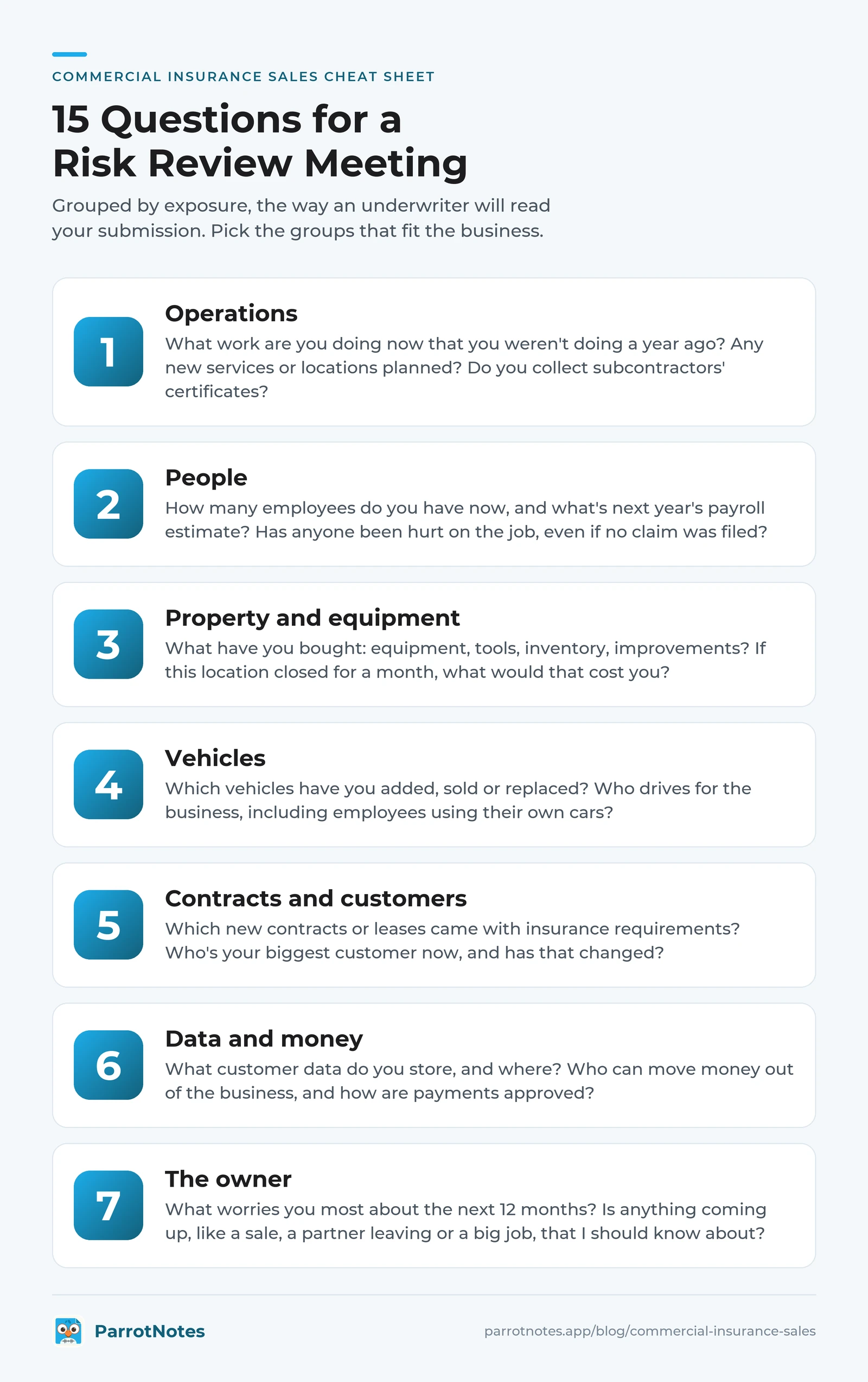
Question 14 often gives you the real agenda. Owners who mention a big new contract or a hiring push are telling you where next year's exposure is. Write their words down, because you'll use them in the submission and the recap.
If the owner pushes back on a new quote with "we've never had a claim," the insurance objection handling scripts have lines you can adapt. And when the review surfaces a line the agency doesn't write yet, our guide to cross-selling vs. upselling explains the difference in how you raise it.
A filled-in risk review note
Here's what the landscaping account from the opening should have looked like at the review. The business and every number are invented for illustration.
RISK REVIEW: Greenline Landscaping LLC     Date: Sep 4     Renewal: Nov 1
Who: Tom Reyes (owner), Ana Reyes (office manager); Priya Shah (producer)

1. WHAT CHANGED
   Added snow removal for 14 commercial lots starting Dec
   Bought 2 used dump trucks in March; one driven by new hire (Luis)
   Payroll estimate up from $610k to $780k; 4 seasonal hires
   New contract with property manager requires additional insured status

2. CLAIMS AND INCIDENTS
   One GL claim (mower threw a rock, broken window), closed
   Employee strained back lifting pavers in June; no claim filed

3. WHAT WE DISCUSSED
   Trucks and new driver to be added to the auto schedule
   Snow removal is a new operation; underwriters will ask about it
   Property manager contract: sending to account team to compare requirements

4. OWNER DECISIONS
   Add both trucks now, before renewal
   Wants quotes with and without higher umbrella limit
   "Not ready to talk about cyber yet, ask me next year"

5. NEXT STEPS
   Priya: auto change request today; quotes by Oct 2
   Ana: send updated payroll by class and the property manager contract by Sep 11
   Recap email sent: Y, Sep 4
Block 4 matters most. "Owner declined cyber quote, asked to revisit next year" is a sentence that settles a later dispute. Our guide to insurance agent client notes explains why written declinations protect the agent, and what to keep out of a note.
After the meeting: submission, recap and declinations
The review only pays off if what you heard reaches the underwriter and the owner sees it in writing. Do three things the same day.
Update the account. Change exposures in your agency management system: vehicles, payroll by class, new operations. For a mid-term change, the free insurance pro rata calculator works out the return or additional premium for the days left in the term.
Send the recap. It gives the owner a chance to correct you, and it gives you a record the client has seen:
Subject: Recap of today's risk review

Hi Tom and Ana,

Thanks for walking me through the year. What I heard:
- Snow removal for 14 commercial lots starting in December
- Two dump trucks added in March; Luis will drive one
- Payroll estimate about $780k next year, with 4 seasonal hires
- The property manager contract asks to be named as additional insured

What happens next:
- I'm adding both trucks to your auto policy today
- Ana will send payroll by class and the contract by Sep 11
- I'll bring renewal options, with and without a higher umbrella limit, by Oct 2
- You'd like to revisit cyber next year; I've noted that

If I've missed or misheard anything, just reply.

Priya
Diary the declines. Anything the owner passed on gets a date to raise again. That's the start of next year's review, and the reason you'll have one.
Priya's renewal went differently from the one in the opening. The trucks were scheduled in September, the snow work was in the submission, and in January, when one truck slid on ice, the claim call took ten minutes. The owner renewed and sent her a referral the same spring.
When that happens, our guide to asking for referrals helps you ask for the next one.
Capture the meeting without losing the owner's trust
A risk review throws off details fast: payroll figures, vehicle years, a customer's name, a worry the owner mentions once. You can't write all of it and still listen.
Darnell, a commercial lines producer covering contractors and restaurants, uses a simple routine. In the meeting he takes short notes by hand. In the truck afterward, he talks for two minutes into his phone: what changed, what was claimed, what the owner decided and what he owes them by when.
With ParrotNotes, he gets a transcript, a summary and the action items, plus a follow-up email draft he edits into the recap. He labels each recording with the business name, so a year later he searches "Greenline" and has every review in one place. (Darnell is an illustrative example.)
Three habits keep it professional:
- Ask before you record the meeting itself. Some states require every party's consent; see our guide to one-party and two-party consent states, and follow your agency's policy. A debrief to yourself after the meeting needs nobody's permission.
- Keep sensitive numbers out of voice notes. Tax IDs, bank details, employee Social Security numbers and health details belong in your agency and carrier systems, not in a debrief.
- File the note the same day. Your agency management system is the official record; the debrief is how you get the detail there while it's fresh.
The Free plan gives you 100 minutes of recording a month with an AI summary on every recording, enough for a debrief after every review. For more recap structures, see these follow-up email templates after a sales call.
Keep the account by knowing the business
Commercial insurance sales is won at new business and kept at renewal. The risk review is where you keep it:
- Start 120 days out, with loss runs, last year's note and the owner's documents in hand
- Run a 60-minute meeting about the business, not the forms
- Ask the questions that surface new operations, people, vehicles and contracts
- Write down decisions and declines, recap the same day, and diary what to raise next year
The landscaping owner in the opening didn't need a better price. He needed a meeting where someone asked about his trucks. In commercial insurance sales, that meeting is your job, and the producers who run it well rarely lose an account on price alone. Download ParrotNotes free and capture your next risk review before you pull out of the lot.
Frequently Asked Questions
What is commercial insurance sales?
Commercial insurance sales is selling business coverage, such as property, general liability, commercial auto, workers' compensation and umbrella, to companies. Producers usually work for an agency or brokerage that places the business with one or more carriers, and they handle new business, renewals and risk reviews with business owners.
What is a risk review meeting in commercial insurance?
A risk review is a meeting with the business owner, usually 60 to 75 days before renewal, to find out what has changed in the business: operations, employees, property, vehicles, contracts and claims. The producer uses the answers to update the submission and to discuss options. Coverage decisions still come from the policy wording and the carrier.
When should a commercial renewal review happen?
Start about 120 days before renewal by pulling loss runs and last year's notes, and hold the meeting 60 to 75 days out. That leaves time to update exposures, send the submission to carriers and present options about 30 days before the policy expires.
How do commercial insurance agents get paid?
Most commercial producers are paid commission, usually a percentage of the premium on new business and renewals. Many agencies combine commission with a base salary, especially for newer producers, and the split depends on the agency and the producer's book.
Can I record a meeting with a business client?
Ask the client first and follow the recording consent law in your state and theirs, plus your agency's policy. Some states require every party's consent. Dictating a debrief to yourself after the meeting needs nobody's permission.
Related Posts

Voice to Text on Mac: Built-In Dictation and the Apps Worth Using
Set up voice to text on your Mac with built-in Dictation, change the settings that matter, and find out which voice to text Mac app is worth paying for.

Telecom Sales: Selling Business Phone and Internet Face to Face
Telecom sales guide for field reps: read the business bill with the owner, run a site survey, answer contract objections and switch lines honestly. Try it free.

Status Meeting: How to Keep Project Updates Short
Run a status meeting in 20 minutes: a run sheet, a three-line RAG update card, a notes template, and when to send it in writing. Try ParrotNotes free.