
Cold Call Script: Examples for B2B Reps

Sarah Johnson
Writes about field sales, meeting notes and voice-first workflows at ParrotNotes. Every article is reviewed by the ParrotNotes product team before it goes live.
Table of Contents
- 1.What a cold call script should include
- 2.Cold call script examples: structure first, then filled in
- 3.Cold call objection handling: responses that keep the call going
- 4.What the data says about openers and timing
- 5.Before and after the call: the 30-second note and the 60-second debrief
- 6.Cold call script mistakes to cut
- 7.Make every call leave a record
Fourteen dials. One conversation. And when the call block ends, the note in the CRM for that one conversation says "call back next month."
Next month, nobody will remember what the facilities manager said about the boiler contract coming up for renewal, or the reference he asked for. The call went fine. The record of it is one line.
That's the gap in most guides to the cold call script: they stop when the prospect says yes. This one doesn't. You'll get seven scripts written for B2B reps, each shown as a labelled structure and then filled in, three objection responses, two data points from vendors who have measured a lot of calls, and the part the other guides skip: a 30-second note before you dial and a 60-second debrief after you hang up, so the call survives as a CRM note and a follow-up email.
What a cold call script should include
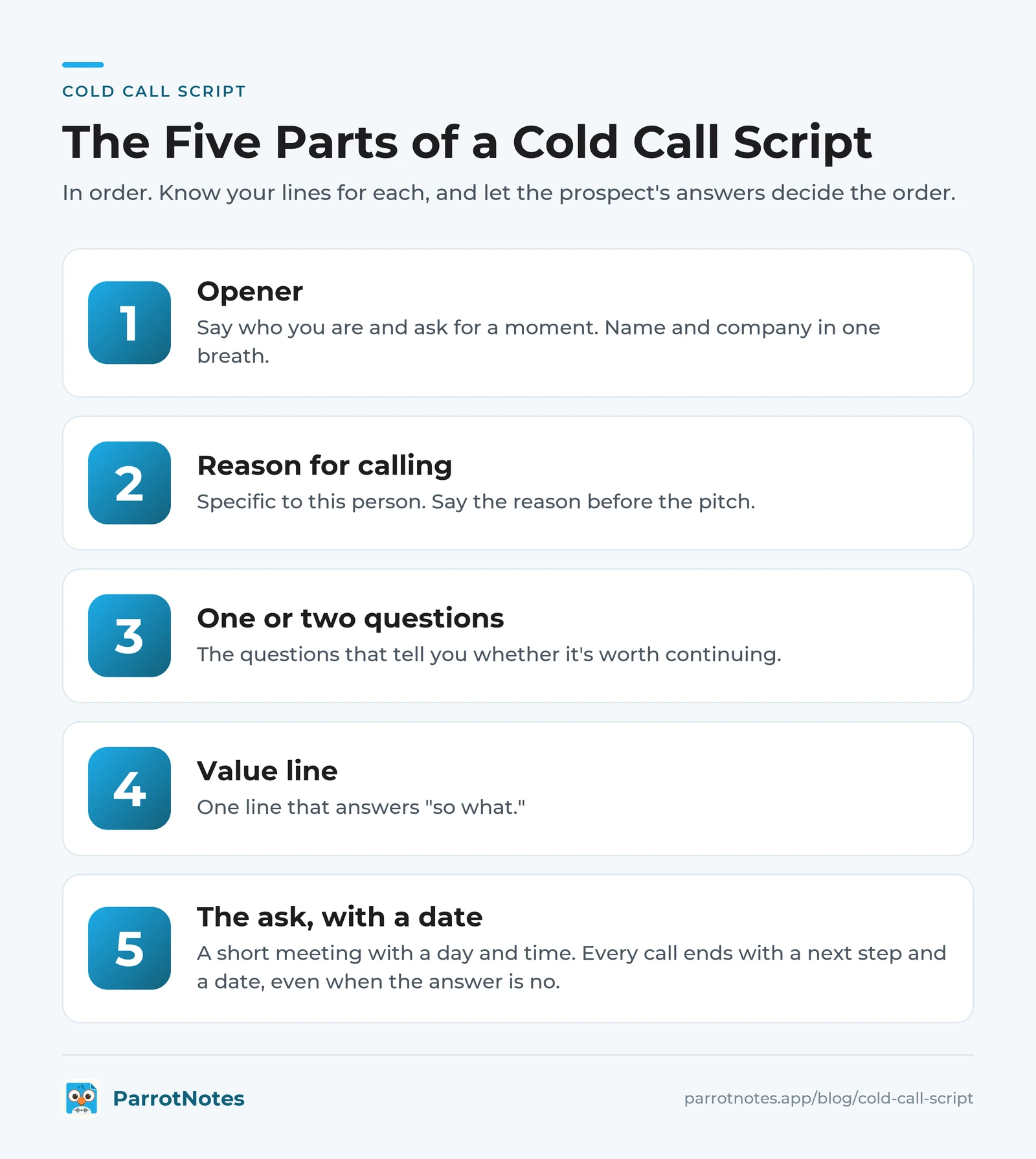
A cold call script for sales has five parts, in order: an opener that says who you are and asks for a moment, a reason for calling that's specific to this person, one or two questions that tell you whether it's worth continuing, a value line that answers "so what," and an ask with a date attached. Everything else is optional.
A cold call script isn't a speech. Read it word for word and you'll sound like you're reading. Use it the way a pilot uses a checklist: know the five parts, know your lines for each, and let the prospect's answers decide the order.
Two rules make every cold call script below work:
- Say the reason before the pitch. The prospect is deciding whether to hang up. "The reason I'm calling" buys you a sentence; a feature list doesn't.
- Every call ends with a next step and a date, even when the answer is no. "Call back in Q1" is a date. "Not interested, ever" is a date too: it's the date you stop.
Our BANT qualification guide covers the qualifying questions in depth. On a cold call you get one or two of them, which is why each script below carries exactly that many.
Cold call script examples: structure first, then filled in
The examples below are invented for illustration. Leo, Hana and the people they call don't exist, and the details are chosen to show each structure working, not to prove anything about real results.
Leo sells planned HVAC maintenance contracts to facility managers and does most of his cold calling from the car between site visits. Hana is a sales development rep at a payroll software company, calling from a desk in hour-long blocks; her examples are the cold call script for software sales.
1. The standard opener
Structure
1. Name and company (one breath)
2. Ask for a moment (the honest version, not "did I catch you at a bad time?")
3. The reason for the call, specific to them
4. One qualifying question
5. The ask: a short meeting with a day and time
Filled in (Leo)
"Hi Tom, it's Leo Marsh from Ridgeline Mechanical. Have you got 30 seconds? I'll be quick.
The reason I'm calling: I look after planned maintenance for a few distribution sites on the Route 9 corridor, and I noticed your Brightwater building went up in 2019, which usually means the rooftop units are coming off their first service plan about now.
Who handles the HVAC contract at your end, is that you?
[Tom: it is, we're with a national provider.]
Got it. I'm not asking you to switch today. Would it be worth 20 minutes next Tuesday morning for me to look at what the current plan covers and tell you where it usually falls short on a site like yours? If it's fine, I'll say so."
The reason for the call does the work in this cold call script. It names something true about Tom's building, which tells him Leo did five minutes of homework, and it leads to a question Tom can answer without committing to anything.
2. The permission-based opener
Structure
1. Name and company
2. Admit it's a cold call
3. Ask permission to take a set amount of time
4. If yes, the reason for the call in one sentence
5. One question, then the ask
Filled in (Hana)
"Hi Marisol, this is Hana Sato with Clearpay. Full disclosure, this is a cold call. Can I take 40 seconds to tell you why, and you can tell me to go away?
[Marisol: 40 seconds, go.]
Thanks. You're hiring for a second payroll coordinator, which usually means the current setup is taking two people to run month-end. We work with about 60 firms your size that got that down to one person and a Tuesday afternoon.
Is month-end the painful part, or is it something else?
[Marisol: month-end and the multi-state filings.]
Then it's worth a look. I've got 15 minutes free Thursday at 10 or Friday at 2. Which is worse for you?"
Admitting it's a cold call disarms the reflex to hang up, and asking for a set number of seconds makes the request small enough to grant. Note the closing line: two slots, and the question is which one is worse, which is easier to answer than "are you free?"
3. The referral cold call script
Structure
1. Name and company
2. The referrer's name, first, before anything else
3. What the referrer said (in their words, briefly)
4. Why the referrer thought of them
5. The ask
Filled in (Leo)
"Hi Dana, it's Leo Marsh at Ridgeline Mechanical. Priya Nair over at Northgate Supply suggested I call you.
We've looked after Northgate's three warehouses for two years, and when I mentioned I was heading your way she said, 'Talk to Dana, they've got the same rooftop units we had trouble with.'
I don't know whether that's true for you. Would you have 20 minutes next week for me to walk the roof with you and tell you what we found at Northgate? If your units are fine, you'll know that too."
The referrer's name goes in the first sentence, because it's the only reason Dana is still listening. Everything after it is the standard cold call script with the homework done by someone the prospect trusts.
4. The follow-up call after a visit
This one is for field reps. You dropped in, met someone on a site walk, left a card, and now you're calling. It's warmer than a cold call, but only if you remind them fast.
Structure
1. Name and company
2. Where and when you met, and one detail they'll remember
3. What you said you'd do, and that you've done it
4. The ask
Filled in (Leo)
"Hi Sam, Leo Marsh from Ridgeline. We met Thursday when I was at your Dock 4 building, you were the one dealing with the forklift charger that kept tripping.
You asked whether we'd done any work on chillers of that age. I said I'd check. We have, at two sites in the same industrial park, and I've got the service reports.
Could I bring them by Tuesday or Wednesday morning, 15 minutes, and you can see whether it's the same problem?"
The detail Sam will remember is the forklift charger, not the chillers. Lead with what stuck for them, then deliver on what you promised.
5. The voicemail script
Most cold calls end in voicemail. A voicemail's job isn't to sell; it's to make the next call recognisable.
Structure
1. Name and company, slowly
2. One sentence: the reason you called (the same reason you'd use live)
3. What you'll do next (call again on a named day, or send an email)
4. Number, said twice
Filled in (Hana)
"Hi Marisol, Hana Sato at Clearpay. I'm calling because you're hiring a second payroll coordinator, and I've got a couple of ideas on month-end that might mean you don't need to. I'll send a short email today so you've got it in writing, and I'll try you again Thursday morning. My number's 555-0142. That's 555-0142. Thanks."
Under 30 seconds, no "hope you're well," no feature list. The email uses the same reason for calling, so when Hana rings on Thursday, Marisol has heard the story twice.
6. The gatekeeper script
Gatekeepers are doing a job. The cold call script that works treats them as the person who knows the building, not as an obstacle.
Structure
1. Name and company, as if they're expected
2. Ask for the person by name
3. If asked what it's about: the reason, honestly and briefly
4. If the person isn't available: ask when, and ask the gatekeeper's name
5. Thank them by name; use it next time
Filled in (Leo)
"Morning, it's Leo Marsh at Ridgeline Mechanical. Is Tom Adeyemi around?
[What's it regarding?]
The planned maintenance on the rooftop units at Brightwater. It's not urgent, I'd just rather speak to him than send a cold email.
[He's on site until two.]
That's helpful, I'll try after two. Sorry, I didn't catch your name?
[It's Grace.]
Thanks, Grace."
Grace now knows Leo's name, his reason, and that he'll call after two. When he does, she'll put him through, because she told him to.
Want the next steps from these calls written up before your next dial? Try ParrotNotes free and speak the debrief straight after you hang up. The routine is later in this guide.
Cold call objection handling: responses that keep the call going
An objection on a cold call is rarely about your product. It's a reflex to end an interruption. Cold call objection handling has one structure: agree with the objection, ask one question, and offer a smaller next step than the one you asked for.
"Send me some information"
"Happy to. So I send the right thing rather than a brochure, can I ask one question first: is it the cost of the current contract that's on your mind, or the response time when something breaks?
[Response time.]
Then I'll send our response-time terms and one page on how we staff the on-call rota. If it reads well, is a 15-minute call next week reasonable?"
"Send me information" usually means "get off the phone politely." One question turns it into a real request, and the follow-up is booked before the email goes out.
"We already have a vendor"
"Most people I call do. I'm not asking you to change anything today. Can I ask how the renewal went last time, did the price move?
[It went up about 8%.]
That's what I usually hear. Would it be useful to have a second number in the file before the next renewal, so you're not negotiating against nothing? That's a 20-minute site walk, no proposal unless you ask for one."
The incumbent is a fact, not an objection. The renewal question finds the crack, and "a second number in the file" costs the prospect nothing with their current vendor.
"Not interested"
"Fair enough, and I'll let you go. Before I do, is it that maintenance isn't a problem right now, or that you've got no time to look at it this quarter?
[No time this quarter.]
Understood. Can I call you in the first week of January, and I'll keep it to ten minutes?"
Two "not interested"s are different: no problem, or no time. The first is a genuine no, and you write it down. The second is a date.
What the data says about openers and timing
Two vendors have published numbers from their own call data; both pages were checked on September 23, 2026.
Gong analysed 90,380 cold calls and reported a 1.5% baseline success rate for booking a meeting. Opening with "The reason for my call is…" raised the success rate by 2.1x, "How have you been?" was 6.6x the baseline, and "Did I catch you at a bad time?" made a booked meeting 40% less likely. That's why every cold call script above states the reason early and none opens with the bad-time question.
Cognism's cold calling statistics, from its State of Cold Calling report on 204,000+ cold calls and 27,000+ conversations, put the average cold call at 93 seconds. Connecting took three attempts on average, the best time to call was 10 to 11 am followed by 2 to 3 pm, and Tuesdays had the highest success rate for booking meetings.
Take the timing as a starting point, not a law. Take the 93 seconds seriously: it's the length of the scripts above, and it's why the after-call routine matters. When a conversation lasts a minute and a half, the details are gone by the next dial.
Before and after the call: the 30-second note and the 60-second debrief
This is what separates a call block from a pile of "call back next month" notes. It takes 90 seconds per conversation, and it's spoken, not typed.
The 30-second pre-call note
Before you dial, say out loud (or write in one line) the three things you need in front of you:
1. Who I'm calling, and the one thing I know about them (the reason for the call)
2. The question I'll ask if they answer
3. The next step I want, with a day and time
Leo's version, spoken to his phone in the car park before calling Tom:
"Calling Tom Adeyemi, facilities manager at Brightwater. Building's from 2019, rooftop units likely off the first service plan. Question: who holds the HVAC contract. Ask: 20 minutes Tuesday morning to review the current plan."
Thirty seconds, and the opener is in his mouth when Tom picks up. If it goes to voicemail, the note is the voicemail.
The 60-second post-call debrief
The moment the call ends, before the next dial, say what happened in this order:
1. Who I spoke to, and the outcome in one word (meeting, callback, no, voicemail)
2. What they said that matters, in their words
3. The objection I heard, and what I said back
4. What I promised, and by when
5. The next step, with a date
Leo, after the call with Tom:
"Spoke to Tom Adeyemi, outcome: meeting. He said they're with a national provider, renewal is in March, and, in his words, 'the last two callouts took three days.' Objection was 'we already have a vendor,' I offered a second number in the file. I promised to send our response-time terms today. Next step: 20 minutes on site, Tuesday the 6th at 9:30."
That's the CRM note. It's also most of the follow-up email, and it's why the March renewal will be in the pipeline instead of in Leo's memory. Our guide on how to never miss action items from sales calls covers the wording that turns "he'll think about it" into a date.
Cold calling from the car between visits
Field reps have a cold-calling advantage nobody talks about: windshield time. The gap between two site visits is five or six dials, and the calls are warmer because you can say "I'm on the industrial park this afternoon."
Two changes to the routine. Speak the pre-call notes for the whole block while you're parked after the last visit, not while driving. Then speak each debrief parked, at the next car park, the same habit as the two-minute visit debrief in our guide to sales tools for field reps.
Picture Leo's Tuesday. Three site visits, nine dials in the gaps, two conversations, one meeting booked, one callback for January. Both debriefs spoken before he pulled out, both in the CRM by the time he got home, because pasting a transcript takes less time than remembering.
Where ParrotNotes fits
ParrotNotes is the recorder for the two spoken notes around the call. Open the app before you dial, record the 30-second pre-call note, and stop. After you hang up, record the 60-second debrief. Only you are speaking, so there's nobody to ask for permission.
Each debrief comes back as a transcript, an AI summary and extracted action items, so "send response-time terms today" and "Tuesday the 6th at 9:30" are pulled out with dates on them. ParrotNotes can draft the follow-up email from the debrief, the one Hana promised in her voicemail and the one Leo owes Tom. Our follow-up email templates cover the five lines that email needs, so you're editing a draft rather than starting one.
Label each note with the account name and "Brightwater" brings up every pre-call note and debrief on the account. On Pro, you can ask a recording directly: "What did Tom say about callouts?" and get the sentence back.
Want the debrief written up before your next dial? Download ParrotNotes free. The free plan gives you 100 minutes of recording a month, up to 30 minutes per recording, with an AI summary on every recording and AI insights on five recordings a month. Pro is $19.99 a month, or $14.99 a month billed annually, with 3,000 minutes a month, recordings up to 3 hours, all AI features on every recording, and sales frameworks (BANT, MEDDIC, SPIN) for the discovery meetings your cold calls book.
Cold call script mistakes to cut
Picture a second rep, Jordan, whose call block goes badly for reasons that have nothing to do with the product. Jordan is invented too, but these are the mistakes that turn up in every call review.
- Opening with "Did I catch you at a bad time?" It invites "yes," and the data above says it costs meetings. Ask for 30 seconds instead.
- Pitching before the reason. Jordan's second sentence is a feature list. The prospect hasn't heard why the call is for them, so they end it.
- Treating "send me information" as a result. Without a question and a booked follow-up, it's a polite no.
- Typing the note later. Jordan's CRM says "spoke, call back." Tom's line about three-day callouts and the March renewal: gone.
- Ignoring the gatekeeper's name. Grace would have put Jordan through on the second call. Jordan never asked.
Make every call leave a record
A good cold call script gets you 90 seconds with a stranger. What you do with the 90 seconds after it decides whether the call was worth making.
Here's the short version:
- Know the five parts and speak them; don't read the script
- State the reason for the call before anything resembling a pitch
- Handle objections by agreeing, asking one question and offering a smaller step
- Say a 30-second pre-call note before you dial and a 60-second debrief after you hang up
- Let the debrief become the CRM note and the follow-up email the same day
Think back to the note that said "call back next month." With the debrief, it says who, what they said, what you promised and a date. Download ParrotNotes free, record the debrief after your next conversation, and see what the CRM note looks like when the call is still fresh.
Frequently Asked Questions
What should a cold call script include?
A cold call script has five parts: an opener with your name, company and a request for a moment; a reason for calling that's specific to the person; one or two qualifying questions; a value line that answers "so what"; and an ask with a day and time attached. Keep it near 90 seconds, and end every call, including a no, with a dated next step.
How do you start a cold call?
Say your name and company in one breath, ask for a set amount of time ("Have you got 30 seconds?"), and give the reason for the call in one sentence that shows you know something about them. Gong's analysis of 90,380 cold calls found that "The reason for my call is…" raised success rates by 2.1x, while "Did I catch you at a bad time?" made a meeting 40% less likely.
How do you handle objections on a cold call?
Agree with the objection, ask one question, then offer a smaller next step than the one you asked for. "Send me information" gets a question about what to send and a booked follow-up call. "We already have a vendor" gets a question about the last renewal and an offer of a second number in the file. "Not interested" gets one question to separate "no problem" from "no time."
What is the best time to make cold calls?
Cognism's State of Cold Calling data, checked September 23, 2026, found the best time was between 10 and 11 am, followed by 2 to 3 pm, with Tuesdays the strongest day for booking meetings. Treat that as a starting point and track your own connect rate by hour for a month.
Related Posts
Sales QBR: Agenda and Template for Sales Teams
Run a sales QBR that ends in a forecast you believe. Copy a timed 90-minute agenda, a rep's one-page prep template, and a filled-in example, all copy-ready.
How to Build a Sales Playbook From Your Team's Real Calls
Build a sales playbook from your team's real customer meetings: the sections it needs, a six-step method, a template, and one play built from three debriefs.
SaaS Sales: How It Works and How Reps Track Every Conversation
What is SaaS sales? Learn the subscription model, PLG vs sales-led, SDR/AE/CSM roles and the demo-to-renewal cycle, plus a deal log to track every call.