
Sales Leave-Behind: Ideas and Examples That Get Read

Sarah Johnson
Writes about field sales, meeting notes and voice-first workflows at ParrotNotes. Every article is reviewed by the ParrotNotes product team before it goes live.
Table of Contents
- 1.What is a sales leave-behind?
- 2.Why most leave-behinds go in the bin
- 3.The five-block sales leave-behind template
- 4.A worked sales leave-behind example
- 5.12 sales leave behind ideas by deal stage
- 6.Leave behind swag: the rules on gifts
- 7.Print it, send it, or both
- 8.Build it from what the buyer said
- 9.The six-question test before you leave it
- 10.Leave something that sells for you
Dana's sales leave behind was the weak spot, not her pitch. She had a good first meeting with the operations manager at a regional food plant. Forty minutes, real problems on the table, a promise to "run it past the owner."
On her way out she left the company's 12-page brochure. Two weeks later she called back. The manager hadn't shown it to anyone: "It's mostly about your company. I didn't know which page to send him." (Dana is a composite, not a real customer.)
You already know the meeting isn't the sale. The buyer you met still has to sell your idea to someone who wasn't in the room. A sales leave behind is the page that does that job for them, or fails to.
This guide covers what to put on one, why most go straight in the recycling, a five-block template with a filled-in example, 12 sales leave behind ideas sorted by deal stage and cost, the rules on gifts, and a six-question test to run before you hand anything over.
The best leave-behinds start from what the buyer actually said. If you'd rather talk the meeting through in the parking lot than scribble it down, try ParrotNotes free.
What is a sales leave-behind?
A sales leave-behind is a short document, object or file you give a prospect at the end of a sales meeting, so they can remember what you discussed and pass it on to the people who decide. The good ones are about the buyer, not the seller. A useful one contains:
- The buyer's problem, in their words
- What changes if they fix it
- One piece of proof that fits their situation
- What waiting costs them
- A clear next step with a date
That's the whole job. A logo, a product list and a mission statement are optional. The five points aren't.
Why most leave-behinds go in the bin
Most leave behind document examples you'll find online are brochures, folders and branded gifts. They're printed once for every prospect, so they can't say anything about this prospect. That's the first problem.
The second is length. A buyer who has to forward your case needs one page to forward, not twelve. If they have to edit it, summarize it or explain which page matters, it usually stays on their desk.
The third is that buyers do more of the work without you. Gartner's June 2025 sales survey found that 61% of B2B buyers prefer a rep-free buying experience. Once you're back in your car, the leave-behind is the part of you that stays in the conversation. It should be able to make your case alone.
The five-block sales leave-behind template
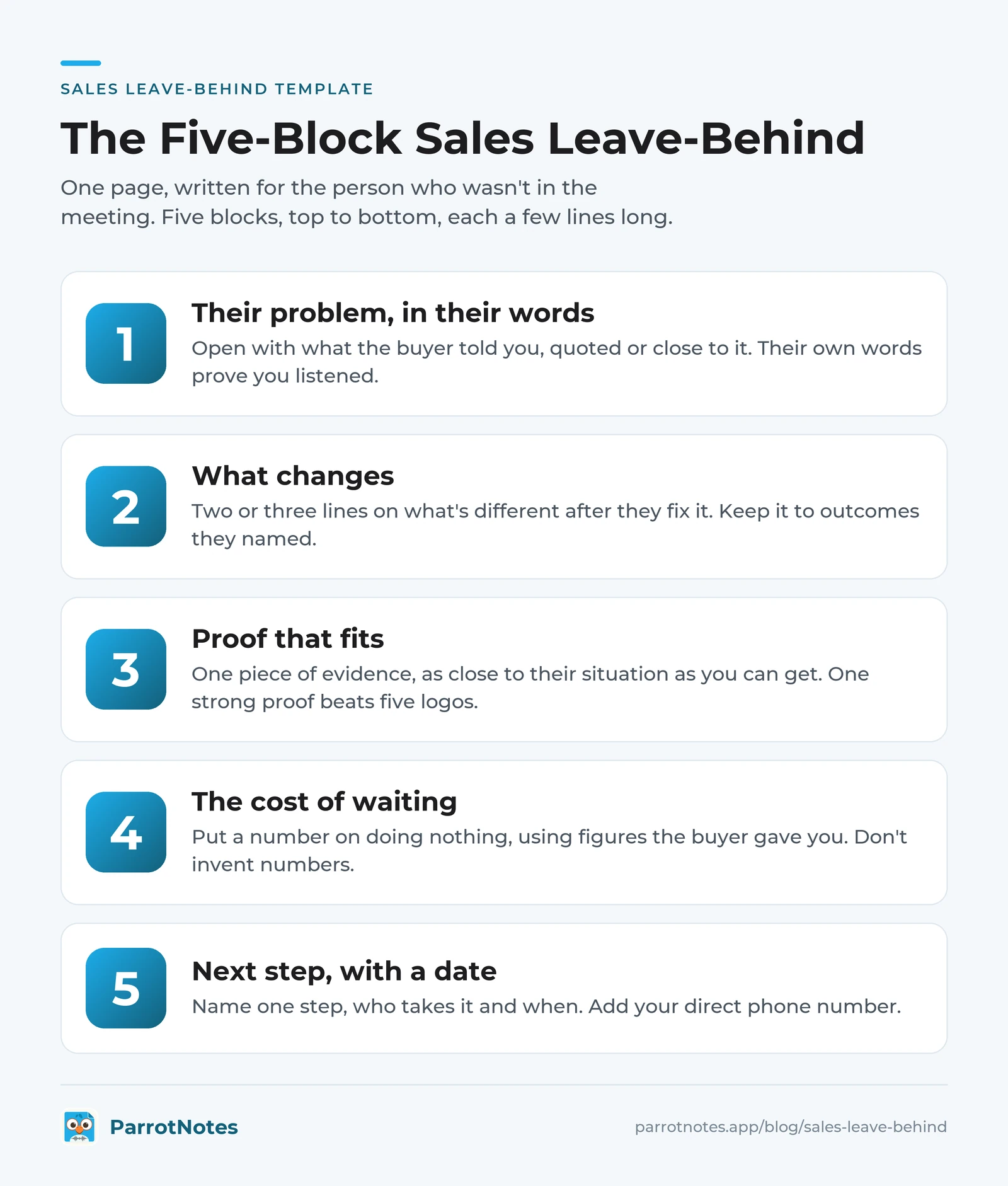
Use one page. Five blocks, top to bottom, each a few lines long. Write it for the person who wasn't in the meeting.
1. Their problem, in their words
Open with what the buyer told you, quoted or close to it. "Line 3 loses about two hours a week to jammed cases" beats "Improve operational efficiency." Their own words prove you listened, and the person reading it later recognizes the problem at once.
2. What changes
Two or three lines on what's different after they fix it. Keep it to outcomes they named: fewer stoppages, fewer returns, less overtime. Skip your feature list.
3. Proof that fits
One piece of evidence, as close to their situation as you can get: a customer in the same industry, a trial result, a short case study. One strong proof beats five logos. If you need to write one, the free case study template gives you the structure.
4. The cost of waiting
Put a number on doing nothing, using figures the buyer gave you. If they said jams cost two hours a week, show what that is over a quarter. Don't invent numbers they didn't give you; leave a blank and ask on the follow-up call instead.
5. Next step, with a date
Name one step, who takes it and when: "Free line trial, week of November 9, Dana sets it up with Tom." Add your direct phone number. A leave-behind without a next step is a brochure.
You can build this page in a few minutes with the free one-pager template: fill in the problem, the solution, the proof and the next step, then print it or save it as a PDF.
A worked sales leave-behind example
Here's the page Dana wrote for her second visit, using the five blocks. The plant, the people and the numbers are an illustration.
For: Tom Reyes, Operations, and Linda Park, Owner, Harvest Valley Foods
What you told us. "Line 3 jams about once a shift on the 12-pack cases, and we run two shifts. Each jam is 10 to 15 minutes and someone gets pulled off another line."
What changes. A heavier-gauge case sized to your filler cuts jams caused by case flex. Your crew stays on their own lines.
Proof. A snack producer in the same region switched case specs on a similar filler last spring. We can arrange a call with their plant manager.
The cost of waiting. At your numbers (about two hours a week of lost line time), that's roughly 26 hours a quarter, plus the overtime to catch up.
Next step. Free 500-case trial on Line 3, week of November 9. Dana sets it up with Tom. Linda, a 15-minute call on November 17 to review the jam log?
Dana Morales, 555-0142
Notice what's missing: no company history, no product catalog, no "solutions" language. Tom can forward it to Linda without changing a word. That's the test.
Ready to build yours from the meeting itself? Download ParrotNotes free, record a two-minute recap after your next visit, and pull the buyer's exact words from the transcript.
12 sales leave behind ideas by deal stage
Not every leave-behind is a page. Match the idea to where the deal is and what it's worth.
| Idea | Best stage | Cost | When it works |
|---|---|---|---|
| Five-block one-pager | Any meeting | Free | Every time a buyer must resell to someone else |
| Meeting recap in their words | First meeting | Free | They raised several problems and need a summary |
| Cost-of-waiting sheet | Discovery | Free | They gave you numbers you can multiply |
| Sample of the product | Discovery | Low | Physical products buyers can test or hand round |
| Short case study from their industry | Evaluation | Free | They doubt it works for "a business like ours" |
| Side-by-side with their current setup | Evaluation | Free | They're comparing you with what they have now |
| Demo results sheet | After a demo | Free | You ran an in-person demo with their data |
| Trial plan with dates | Evaluation | Low | They're ready to test but need a plan to approve |
| Short video walkthrough | Evaluation | Low | The decider never saw your demo |
| Reference contact card | Late stage | Free | They want to hear from a peer, not from you |
| Mutual plan with dates | Late stage | Free | Several people need to sign off |
| Useful branded item | Any | Low | Something they'll use at work, within gift rules |
Creative leave behinds get remembered: a sample cut to their spec, a mock-up with their logo, a printed photo of their own line. But creative only works if the five blocks are there too. A clever object with no next step is a nice gift and nothing more.
Leave behind swag: the rules on gifts
Branded items are fine for most sales reps, with two limits worth knowing.
- Tax. In the US, you can deduct no more than $25 a year for business gifts to each person, according to IRS Publication 463. Spend more and the extra isn't deductible.
- Medical sales. If you sell medicines to clinicians, the PhRMA Code bars "reminder" items such as pens, note pads and mugs with company or product logos, even cheap ones. Check your company's policy before you leave anything at all.
Many buyers' employers have their own gift rules too. When in doubt, leave paper, not presents.
Print it, send it, or both
A printed page works in the meeting. You can hand it over, point to the next step and watch them read it. A PDF works after the meeting, because it's the version they can forward.
The strongest approach for field reps is both. Leave a printed page if you prepared one, then send a version tailored to what they said within 24 hours. Put it in the body of your follow-up email after the sales call or attach it as a one-page PDF.
Luis, a composite rep selling commercial floor-cleaning equipment, used to send his generic brochure after every visit. He switched to a one-page recap built from each meeting, sent the same evening. Within a month, two buyers forwarded it to their facilities directors without being asked, and one replied with "This is what I needed to show my boss." The page cost him ten minutes a visit.
Build it from what the buyer said
The hardest block is the first one. To quote the buyer, you need their words, and by the third visit of the day they're gone.
So capture them before you drive off. Park, open your phone and talk through the meeting for two minutes: the problem in their words, the numbers they gave you, who else decides, and the next step you agreed. Our sales call debrief guide lists the seven questions to answer. Never take notes or dictate while you're driving.
That recap is what ParrotNotes is built for. Record on your phone, and you get a transcript and an AI summary. AI-powered recordings add action items and key points, and Pro drafts the follow-up email for you.
Recording works without signal; transcription and the summary run once you're back online. From the transcript, copy the buyer's exact phrases straight into block one.
Priya, an illustration of a medical device rep, records a recap in the hospital parking lot after each visit. When she builds a leave-behind for the next meeting, she searches the transcript for what the department head said about turnaround times and quotes it. Buyers notice when their own sentence comes back to them on paper.
The six-question test before you leave it
Before you print or send, read your leave-behind as the person who wasn't in the meeting, and ask:
- Is the first line their problem, not our company?
- Does it fit on one page?
- Could they forward it without editing a word?
- Is there one proof point that fits their situation?
- Is every number one they gave us or one we can source?
- Is there a next step, with a name and a date?
Six yeses and it's ready. Any no, fix that block first. For more on running the whole visit, see our guide to the outside sales rep role and its typical day.
Leave something that sells for you
A sales leave-behind isn't a brochure. It's the page that makes your case when you're not there.
- Write for the person who wasn't in the room. They decide.
- Use the five blocks: their problem, what changes, proof, cost of waiting, next step.
- Keep it to one page and quote the buyer's own words.
- Match the idea to the deal stage, and stay inside gift rules.
- Send a tailored version within 24 hours, even if you left a printed one.
It all starts with remembering exactly what the buyer said. Download ParrotNotes free: you get 100 minutes of recording a month and an AI summary on every recording, enough to build your next five leave-behinds from the meeting itself.
Frequently Asked Questions
What is a leave-behind in sales?
A leave-behind is a short document, file or object a sales rep gives a prospect after a meeting. It reminds the buyer what was discussed and helps them pass the case on to others who decide. The best ones are one page, written about the buyer's problem, and end with a clear next step.
What should a sales leave-behind include?
Five things: the buyer's problem in their own words, what changes if they solve it, one piece of proof that fits their situation, what waiting costs them, and a next step with a name and a date. Add your direct contact details. Company history and product lists are optional.
How long should a leave-behind be?
One page. The buyer often needs to forward it to someone who wasn't in the meeting, and a single page is easy to read and share. If you have more to say, put it in a separate case study or proposal.
What are some creative leave-behind ideas?
A product sample cut to the buyer's spec, a mock-up with their logo, a photo of their own site or line, a short video for the decider who missed the demo, or a cost-of-waiting sheet built from their numbers. Creative works best when it still includes the problem and a next step.
Should a leave-behind be printed or digital?
Both, if you can. A printed page lets you point to the next step in the meeting. A PDF or email version, sent within 24 hours, is the one buyers can forward to colleagues. Tailor the digital version to what was said in the meeting.
When should you give a leave-behind?
At the end of the meeting, after you've agreed the next step, so the page can confirm it. If you didn't have one ready, send a tailored version the same day. Giving it at the start invites the buyer to read instead of talk.
Related Posts
Store Visit Checklist for Field Reps and Managers
A store visit checklist for field reps and managers: 30 rep checks, a 12-line manager version scored 0 to 2, and what to run for each type of store visit.

Solution Selling vs Consultative Selling: What Actually Changes on the Call
Solution selling vs consultative selling, shown on one forklift sales call run both ways: what you ask, when the product appears, and what goes in your notes.
Sales Performance Review Template and Questions for Managers
A sales performance review template with weighted sections, a 1-4 rating scale, 30 questions for reps and managers, and a filled example. Copy it free.