
Challenger Sales Questions: How to Teach, Tailor and Take Control

Sarah Johnson
Writes about field sales, meeting notes and voice-first workflows at ParrotNotes. Every article is reviewed by the ParrotNotes product team before it goes live.

Table of Contents
- 1.What makes a question a Challenger sales question
- 2.Swap these questions for a teaching statement
- 3.Challenger sales questions for each step of the teaching pitch
- 4.Tailoring Challenger sales questions to five stakeholders
- 5.The Mobilizer test: five questions
- 6.Challenger sales questions to take control of the deal
- 7.Write down the answers, word for word
- 8.Ask fewer Challenger sales questions, and better ones
Nadia sells fleet telematics. For a year she opened every first meeting the same way: "What keeps you up at night?" Every fleet manager gave her the same answer, fuel costs, and every competitor heard it too. She left with a polite "send me something" and a price comparison she couldn't win. (Nadia is a composite, not a real customer.)
You've probably asked that question yourself. It feels open and respectful. But in the Challenger model, it's the wrong first question, because it asks the buyer to teach you.
Challenger sales questions work the other way round. They test and carry an insight you bring into the room. This guide gives you 40 of them: questions for each step of the teaching pitch, for tailoring to each stakeholder, for spotting the buyer who'll push your deal internally, and for taking control of money and next steps. Each comes with what to listen for.
Want the buyer's answers word for word without writing during the meeting? Try ParrotNotes free and get a transcript and summary after every visit.
What makes a question a Challenger sales question
A Challenger sales question checks whether your insight is landing, gets the buyer's own numbers behind it, or moves the decision forward. It doesn't ask the buyer to diagnose their own problem.
The model comes from The Challenger Sale by Matthew Dixon and Brent Adamson (2011), built on research at CEB, now part of Gartner. If you want the full summary, the five seller profiles and a worked visit, read our guide to The Challenger Sale. This post is only the questions.
Challenger Inc., which now owns the methodology, says Challengers "leave room for questions, but they don't build their sales process around them." On its methodology page, it also names "What keeps you up at night?" as the opener Challengers avoid. They tell the buyer what should keep them up instead, then ask questions to see whether it's true for this buyer.
That's the difference from discovery questions, which collect facts neutrally, and from SPIN selling, which builds the whole call on a question sequence. You still need discovery. You just don't stop there. For open questions at every stage of a deal, see our open-ended sales questions.
Swap these questions for a teaching statement
Some questions hand control to the buyer before you've said anything worth hearing. Replace them with a statement, then ask one question about it. The statements below are examples of the shape; swap in a claim you can prove for your own industry.
| Instead of asking | Say this, then ask |
|---|---|
| "What keeps you up at night?" | "Fleets your size usually lose more to idle time than to fuel price. How does that compare with what you see?" |
| "What are your goals this year?" | "Distributors opening a second site tend to underestimate the stock they'll tie up. Is that on your radar?" |
| "Are you happy with your current supplier?" | "Most happy customers we meet haven't measured stock-outs per month. Do you know yours?" |
| "What would the ideal solution look like?" | "Here's what teams that fixed this did differently. Which part would be hardest here?" |
| "Is price the main factor?" | "Unit price is the visible cost. The bigger one is usually downtime. Would that hold here?" |
The statement has to be true and specific to the buyer's industry. If you can't back it with evidence, you're guessing, and a guess delivered with confidence costs you trust.
Challenger sales questions for each step of the teaching pitch
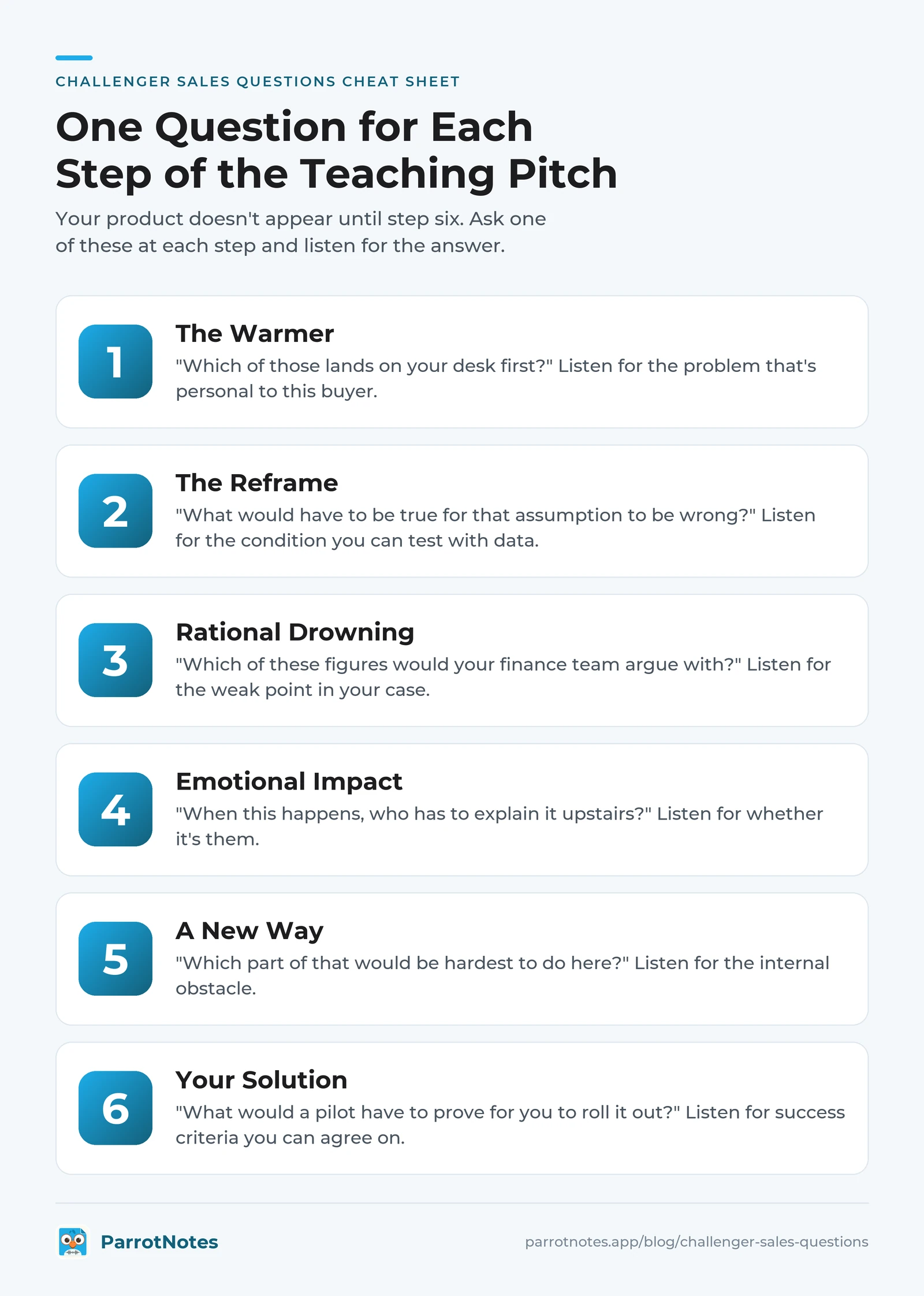
Challenger Inc. lays out six steps for delivering a commercial insight in its article on selling to informed buyers: the Warmer, the Reframe, Rational Drowning, Emotional Impact, A New Way, and Your Solution. Here are four questions for each.
1. The Warmer: show you understand their world
-
"Plants running two shifts on older equipment tell us the same three things. Does that match here?" Listen for which of the three they pick. That's where the reframe should aim.
-
"Which of those lands on your desk first?" Listen for the problem that's personal to this buyer, not the company.
-
"How do you decide that today: by unit price, by habit, or by a number someone tracks?" Listen for the assumption you're about to challenge.
-
"Is there anything about how you run this that you'd say is just how it's always been done?" Listen for the habit nobody has questioned in years.
2. The Reframe: introduce a problem they hadn't weighed
-
"Most teams count the cost per part. What would change if the number that mattered were hours of stoppage?" Listen for "I hadn't thought of it that way." If they say "we know," you're confirming, not teaching.
-
"Why do you believe that's what you need, and what did you do to arrive at that conclusion?" Challenger Inc. suggests this pair of questions for buyers who arrive with a fixed solution. Listen for how solid their reasoning really is.
-
"What would have to be true for that assumption to be wrong?" Listen for the condition you can test with data.
-
"Has anyone here looked at it from the other side, the cost of not having it?" Listen for a name. That person may become your ally.
3. Rational Drowning: put their numbers behind the reframe
-
"If I run this with your own figures, what's the right hourly rate for the line?" Listen for a number. Their number is harder to dismiss than yours.
-
"Which of these figures would your finance team argue with?" Listen for the weak point in your case, before finance finds it.
-
"Where would the real figure come from: a log, a report, or a person?" Listen for the source, then ask to see it.
-
"Is that higher or lower than you expected?" Listen for surprise. Surprise means the insight landed.
4. Emotional Impact: make it personal
-
"When this happens, who has to explain it upstairs?" Listen for whether it's them.
-
"What does a week like that do to your own plans?" Listen for the personal cost: weekends, targets, a promotion case.
-
"Who on your team is quietly absorbing this right now?" Listen for the people doing workarounds. They'll back a change.
-
"If nothing changes, what does next year look like for you?" Listen for urgency in their own words. Write it down exactly.
5. A New Way: describe the fix before your product
-
"If you were fixing this from scratch, with no vendor involved, what would you change first?" Listen for their version of the solution. Build on it.
-
"What would you need to see to believe this is fixable?" Listen for the proof you'll have to bring.
-
"Which part of that would be hardest to do here?" Listen for the internal obstacle: a system, a person, a contract.
-
"Who would have to own it day to day?" Listen for whether an owner exists, or whether you'll have to help create one.
6. Your Solution: connect the new way to what you do
-
"Here's how we'd deliver that. Which part do you want to test first?" Listen for the piece they care about most. That's your pilot.
-
"What would a pilot have to prove for you to roll it out?" Listen for success criteria you can write down and agree on.
-
"Where does this fall short of what you pictured a minute ago?" Listen for the gap between their new way and your product. Better to hear it now.
-
"What would make you say this is just another vendor pitch?" Listen for their skepticism. Answer it directly.
Notice that your product doesn't appear until question 21. If you reach it by question 5, you've skipped the teaching.
Tailoring Challenger sales questions to five stakeholders
Challenger Inc. defines tailoring as "adapting the message to the priorities of different stakeholders." The insight stays the same. The question changes with what each person is measured on.
| Stakeholder | Tailored question | Listen for |
|---|---|---|
| Operations lead | 25. "How would this change the way your shift runs?" | Disruption they fear |
| Finance | 26. "Which budget year would you want this cost to land in?" | Timing and approval rules |
| End users | 27. "What would you stop doing if this worked?" | The workaround they'd drop |
| IT or compliance | 28. "What would you need to sign off on before a pilot?" | Hidden gates |
| Executive sponsor | 29. "Which of this year's goals would this move?" | The goal you tie the deal to |
Owen sells industrial lubricants. He took the same insight, that unplanned bearing failures cost a plant more than its whole lubricant budget, to a maintenance manager and then a plant controller.
The manager answered question 25 with a worry about extra greasing rounds. The controller answered question 26 and wanted it out of this year's spend. Owen wrote two versions of the proposal, one page each. (Owen is an illustration, not a real case.)
Map each person before you visit with a stakeholder mapping template, so you know which question to bring.
The Mobilizer test: five questions
The follow-up book, The Challenger Customer (2015, by Brent Adamson, Matthew Dixon, Pat Spenner and Nick Toman), sorts buyers into seven profiles. Three are Mobilizers, the people who push change inside their company: the Go-Getter, the Teacher and the Skeptic. Challenger Inc.'s customer profiles page says sellers who target Mobilizers are 31% more likely to be high performers, citing CEB research.
The same page says to judge a contact by their reaction to an insight, not by their title. Mobilizers pressure-test what you say, ask how it applies to their organization, offer introductions, and say "we" more than "I." Talkers share information but don't ask hard questions. Blockers ask none.
-
"Does that insight hold for your business, or am I missing something?" A Mobilizer argues with it. A Talker agrees politely.
-
"Who here would disagree with it most?" A Mobilizer names someone and explains why.
-
"How would you explain this to your team?" Listen for "we." A Mobilizer is already planning the case.
-
"Who would you bring into the next conversation?" A Mobilizer offers a name and a date. A Talker says "I'll mention it."
-
"What would it take to put this on the agenda this quarter?" A Mobilizer describes the internal steps. A Blocker changes the subject.
Lena sells packaging film. Her friendliest contact, a purchasing manager, always took her calls and never moved a deal.
On one visit, a quality engineer sitting in pushed back on question 30: "That only works if our changeovers stay under 20 minutes." Then he asked to see the data and booked a call with his director. Lena had been talking to a Friend for a year. The Skeptic was the Mobilizer. (Lena is a composite.)
Challenger sales questions to take control of the deal
Challenger Inc. describes take control as "guiding the buying process, making clear recommendations, and helping customers move toward a decision." It's where the deal stalls when a rep goes quiet about money.
-
"Based on what we found, I'd recommend a 60-day pilot on line 2. What would stop you from agreeing?" Listen for the real objection, then deal with it now.
-
"If waiting costs about $12,000 a quarter, what are you weighing that against?" Listen for the competing priority. Use their number, not yours.
-
"Who needs to hear this before you can say yes, and can we brief them together this month?" Listen for a name and a date, then log it in a mutual action plan.
-
"Is your concern the price, or that the savings might not show up?" Listen for which one. They need different answers; our price objection guide covers the first.
-
"What happens if we pick this up next quarter instead?" Listen for whether the cost of waiting is real to them.
-
"Am I pushing too hard on this?" Listen to the answer and the tone. Constructive tension helps until the buyer stops thinking and starts defending.
The numbers in 35 and 36 are placeholders. Use the figures the buyer gave you in the rational drowning step.
Write down the answers, word for word
A Challenger question is only as useful as your record of the answer. Three things matter most after the meeting:
- The reaction to the reframe, in their words. "I hadn't thought of it that way" and "we already track that" lead to very different next visits.
- Every number they gave, with its source. You'll reuse them in the proposal and in front of finance.
- The Mobilizer signals. Who argued, who said "we," and who offered a name.
Our Challenger call sheet has a full before-and-after template, and a sales call debrief helps you fill it in before you drive off.
Writing all that down while running a reframe is hard. With the buyer's OK, ParrotNotes records the meeting on your phone, with no meeting bot, and gives you a transcript and an AI summary of every recording. On an AI-powered recording you can also get action items and ask questions like "What did the controller say about the budget year?"
The Free plan includes 100 minutes of recording a month and 5 AI-powered recordings. Download ParrotNotes free and keep every answer in the buyer's own words.
Ask fewer Challenger sales questions, and better ones
You don't need all 40 in one meeting. Pick two or three per step, depending on where the deal is:
- Swap "What keeps you up at night?" for a statement you can back with evidence.
- Use the buyer's own numbers to prove the reframe.
- Tailor one question to each stakeholder's scorecard.
- Test for a Mobilizer by how people react, not by their title.
- Ask for the commitment, and check whether you're pushing too hard.
Nadia's next first meeting opened with an idle-time figure for fleets like the buyer's, then question 12. The fleet manager said the number was higher than he'd guessed and asked her to run it on his own data.
Start with one account this week and three Challenger sales questions you can back with evidence. Download ParrotNotes free, record your next Challenger conversation with the buyer's OK, and let the transcript hold the answers while you focus on the next question.
Frequently Asked Questions
What are Challenger sales questions?
Challenger sales questions test and support an insight the rep brings to the buyer, instead of asking the buyer to describe their own problem. They check whether the reframe lands, get the buyer's own numbers behind it, tailor the message to each stakeholder, and move the deal to a decision.
Do Challenger reps ask discovery questions?
Yes, but they don't build the call around them. Challenger Inc. says Challengers leave room for questions without making them the whole sales process. Reps still need facts, people and process, often gathered before or alongside the teaching pitch.
What is a good Challenger opening question?
Open with a short statement about what companies like the buyer's usually miss, then ask whether it matches their experience. For example: "Fleets your size usually lose more to idle time than to fuel price. How does that compare with what you see?"
How many Challenger sales questions should I ask in one meeting?
Usually 8 to 12. Pick two or three for the steps you'll reach in that meeting, one tailored question per stakeholder in the room, and at least one take control question before you leave.
How do I find a Mobilizer in the buying group?
Share an insight and watch the reaction. According to Challenger Inc., Mobilizers pressure-test what you say, ask how it applies to their organization, offer introductions and talk about "we." Friendly contacts who agree with everything are often Talkers.
How are Challenger questions different from SPIN questions?
SPIN builds the call on a sequence of situation, problem, implication and need-payoff questions that help the buyer find the problem. Challenger questions follow a teaching pitch: the rep brings a view of the problem first, then asks questions to test and support it.
Related Posts
Store Visit Checklist for Field Reps and Managers
A store visit checklist for field reps and managers: 30 rep checks, a 12-line manager version scored 0 to 2, and what to run for each type of store visit.

Solution Selling vs Consultative Selling: What Actually Changes on the Call
Solution selling vs consultative selling, shown on one forklift sales call run both ways: what you ask, when the product appears, and what goes in your notes.

Sales Performance Review Template and Questions for Managers
A sales performance review template with weighted sections, a 1-4 rating scale, 30 questions for reps and managers, and a filled example. Copy it free.