
Customer Needs Analysis in Sales: Questions and a Simple Template

Sarah Johnson
Writes about field sales, meeting notes and voice-first workflows at ParrotNotes. Every article is reviewed by the ParrotNotes product team before it goes live.

Table of Contents
- 1.What is a customer needs analysis in sales?
- 2.When to run a customer needs analysis
- 3.How to conduct a customer needs analysis in six steps
- 4.Customer needs analysis questions
- 5.The customer needs analysis template (copy this)
- 6.A customer needs analysis example
- 7.Common mistakes in a customer needs analysis
- 8.Capture the needs by voice, then analyze
- 9.Conclusion
Priya has just walked out of a 50-minute visit with a regional bakery chain. Her notebook holds two pages: complaints about the current supplier, a delivery window, a finance director who "approves every invoice," a plant manager who hates downtime, and a stray note that says "maybe Q1?" It was a good meeting. But if her manager asked what this buyer needs most, and whether her company can deliver it, she'd have to guess.
That gap is what a customer needs analysis closes. Discovery gets the buyer talking. The analysis turns what they said into a short, ranked list of needs, sorted by who holds each one, and an honest answer to one question: can we meet the needs that matter?
This guide covers the analysis step, not the questions you ask in the meeting. You'll get six steps, a handful of ranking questions to ask the buyer, a one-page template you can copy, and a worked example. Insurance agents sizing a policy run a different calculation, covered in our life insurance needs analysis guide.
What is a customer needs analysis in sales?
A customer needs analysis is the work of turning what a buyer told you into a prioritized list of what they need from a solution, then checking each need against what you can actually deliver. Its output is a decision: pursue the deal, go back and requalify, or walk away.
Market researchers use the term for surveys and product research. In sales it's smaller: one account, your meeting notes as the data, about 20 minutes in the car.
Needs, pains and wants
The three words get used loosely, so it helps to pin them down:
- A pain is a problem the buyer has today: "We lose half a shift every time the mixer seal fails."
- A need is what must be true of a solution for that pain to go away: "They need seal replacements within four hours, on site."
- A want is a preference that won't decide the deal on its own: "It'd be nice to order through a portal."
Your notes are mostly pains and wants. The analysis converts them into needs, because needs are what you can match to a product and service level. For digging out pains in the first place, see our guide to customer pain points.
Four types of customer needs
Sorting by type stops one loud need from hiding the others:
- Business needs: results the company cares about. Cost, revenue, risk, compliance, growth.
- Operational needs: how the work has to run. Lead times, uptime, delivery windows, training, integration with what they already use.
- Personal needs: what an individual buyer needs to look good or stay safe. Fewer surprises for the plant manager, a clean approval for the CFO.
- Constraints: limits a solution must fit inside. Budget ceiling, contract end date, approved-vendor rules, site access.
Personal needs rarely appear in a proposal, but they often decide who champions you.
When to run a customer needs analysis
Run it after each discovery meeting and before anything you present: a demo, a quote, a proposal. A discovery call gives you the raw material; the analysis tells you what to show and what to leave out.
Run it again whenever a new person joins the deal. Buying groups are big: Forrester's State of Business Buying 2026 reports that typical purchase decisions draw on 13 internal stakeholders and nine external influencers.
They don't share one set of needs. In Gartner's May 2025 survey of B2B buyers, 74% of buyer teams showed "unhealthy conflict" during the decision, including members with conflicting objectives. A needs analysis that lists only one person's needs is a guess about the rest.
The analysis is only as good as your notes. Record the conversation (with the buyer's permission) or talk through it straight after, and you keep the exact words and numbers. ParrotNotes turns that recording into a summary and action items on your phone; you can try it free before your next visit.
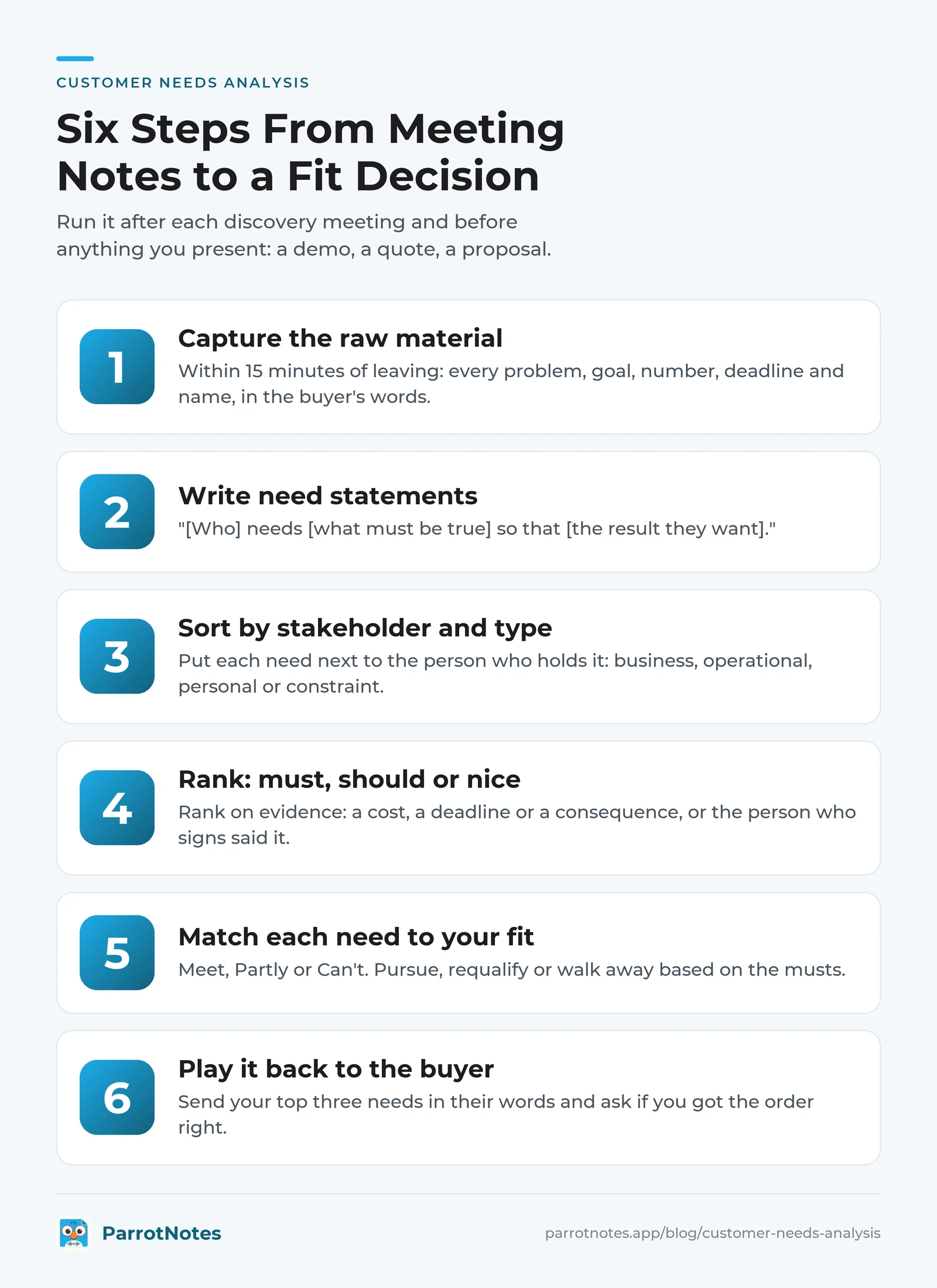
How to conduct a customer needs analysis in six steps
1. Capture the raw material
Within 15 minutes of leaving, get everything down: every problem, goal, number, deadline and name, in the buyer's words. Don't sort yet. Fifteen to 25 raw lines from a good meeting is normal.
2. Translate each line into a need statement
Rewrite every pain or goal as one sentence: "[Who] needs [what must be true] so that [the result they want]." For example: "The plant manager needs seal replacements on site within four hours so that a failure costs less than one batch."
If you can't finish the "so that," you don't know why it matters yet. Mark it as a question for the next meeting.
3. Sort by stakeholder and type
Put each need next to the person who holds it, then tag its type. You'll usually see a pattern: finance holds the business needs, operations holds the operational ones, and everybody has a personal one. A stakeholder map helps when more than three people are involved.
4. Rank each need: must, should or nice
- Must: if it isn't met, the deal doesn't happen. The buyer said so, or the need is a hard constraint.
- Should: it carries real weight, but the buyer would trade it for something else.
- Nice: a want. Mention it only if you meet it easily.
Rank on evidence, not on how strongly the buyer complained. A need counts as a must when the buyer gave you a cost, a deadline or a consequence, or when the person who signs said it.
5. Match each need to your fit
For each need, write Meet, Partly or Can't, and the proof you'd show: a spec sheet, a reference customer, a service-level clause. Then apply one rule:
- Pursue: you meet every must, and most shoulds.
- Requalify: you meet most musts, but one is "Partly" or untested. Your next meeting is about that need.
- Walk away (or reshape): you can't meet a must and no workaround exists. Saying so early protects your forecast and your reputation.
This is narrower than lead qualification. For the full fit and intent scorecard, see sales lead qualification.
6. Play it back to the buyer
Send or say your top three needs in their words and ask if you got the order right: "The three things that matter most are A, B and C, in that order. Is that right, and is anything missing?" A correction now is far cheaper than one after the proposal.
Want to see how this works in practice? Record your next debrief in ParrotNotes and paste the summary into step 1.
Customer needs analysis questions
The question bank for the meeting itself is in our 50 discovery questions in sales. The questions below help you rank and confirm needs instead, near the end of a meeting or on a short follow-up call.
Ranking questions to ask the buyer
- "If we could fix only one of these, which would you pick?"
- "What happens if we solve the first one but not the second?"
- "Which of these would stop you signing if it wasn't there?"
- "Who else needs this to be true before they say yes?"
- "Is there a date after which this stops mattering?"
Questions to ask yourself during the analysis
- Which needs did the buyer attach a number, a date or a consequence to?
- Whose needs am I missing? Who signs, who uses it, who could block it?
- Which must-have am I least sure we can meet?
- What proof would make each "Meet" believable to a skeptic?
If an answer to the last two worries you, that's your next meeting's agenda.
The customer needs analysis template (copy this)
Fill in one row per need. Keep it to one page; if you have more than ten rows, merge duplicates.
Account: | Date: | Meeting: | People present:
| # | Need statement (who needs what, so that) | Whose need | Type | Buyer's words | Must / Should / Nice | Fit (Meet / Partly / Can't) | Proof to show |
|---|---|---|---|---|---|---|---|
| 1 | |||||||
| 2 | |||||||
| 3 |
Under the table, add four lines:
- Decision: pursue, requalify or walk away, and the reason in one sentence
- Top three needs to play back: in the buyer's words
- Open questions: needs without a "so that," or musts marked Partly
- Missing voices: stakeholders whose needs you haven't heard yet
The "Buyer's words" column is the one reps skip and later regret. It's what you'll quote in the follow-up email and the proposal, and the buyer will recognize it.
A customer needs analysis example
This example is a composite built for this article. The company, people and numbers are illustrative.
Back to Priya. She sells food-grade lubricants and maintenance services. Her visit to the bakery chain included Tom, the plant manager, and a 10-minute stop with Elena, the finance director. In the car, she talks through the meeting for four minutes and then fills in the template.
| # | Need statement | Whose need | Type | Buyer's words | Rank | Fit | Proof to show |
|---|---|---|---|---|---|---|---|
| 1 | Plant needs seal and bearing service on site within 4 hours so that a failure costs less than one batch | Tom | Operational | "Every hour that line sits, I'm throwing out dough." | Must | Meet | Service-level clause, response log from a nearby site |
| 2 | Finance needs one monthly invoice across three plants so that approvals stop stalling | Elena | Business | "I approve 40 invoices a month for grease." | Must | Partly | Ask billing if consolidated invoicing covers three sites |
| 3 | Plant needs food-grade (H1) lubricants only so that audits pass | Tom | Constraint | "Auditors check every can." | Must | Meet | H1 registration sheets |
| 4 | Tom needs fewer surprise breakdowns so that he isn't explaining downtime every Monday | Tom | Personal | "I'm the one in the hot seat." | Should | Meet | Lubrication schedule from a similar plant |
| 5 | Ordering through a web portal | Tom | Operational | "Would be handy." | Nice | Meet | Mention only |
Decision: requalify. Two musts are met, but the consolidated invoice is "Partly," and it's Elena's must.
Top three to play back: the four-hour on-site response, one invoice for three plants, H1-only products.
Missing voices: the purchasing manager, who Tom mentioned once and Priya hasn't met.
Priya's follow-up email doesn't pitch the portal or the full product line. It plays back the three needs, says she's confirming the invoicing question with billing by Thursday, and asks to meet purchasing. That's a shorter email, and a much more useful one. For the email itself, see how to write a follow-up email after a sales call.
Common mistakes in a customer needs analysis
Listing features instead of needs. "Needs our premium plan" is your need, not theirs. Every row should make sense to the buyer without your product in it.
Ranking by volume. The person who complained loudest isn't always the person who signs. Marcus, a rep in the same composite territory, spent three meetings on a supervisor's wish list before learning the owner only cared about cash flow. A per-stakeholder column would have shown him the gap after the first visit.
Treating "Partly" as "Meet." A must you only partly meet is the likeliest reason the deal stalls later. Name it and plan the next meeting around it.
Skipping the play-back. Your ranking is a hypothesis until the buyer confirms it.
Doing it once. Needs change when a stakeholder joins or a deadline moves. Update the sheet after every meeting, and carry the musts into your mutual action plan once the deal is real.
Capture the needs by voice, then analyze
The slowest part of a customer needs analysis is step 1, and the template is only as good as what goes into it.
A faster habit: record the meeting with the buyer's agreement, or record a three-minute voice debrief before you start the car. As of November 2026, the ParrotNotes Free plan includes 100 minutes of recording a month, an AI summary on every recording, and five AI-powered recordings a month with action items, key points and sales frameworks (BANT, MEDDIC, SPIN).
Use the summary and the buyer's quotes as your raw lines, then do steps 2 to 6 yourself. The judgment about what's a must and whether you can meet it should stay yours.
Conclusion
A customer needs analysis is the step between a good meeting and a good proposal:
- Turn every pain and goal into a need statement with a "so that"
- Sort needs by stakeholder, because buying groups rarely agree
- Rank must, should and nice on evidence, and let the musts decide whether you pursue
- Play the top three back to the buyer before you build anything
Try it after your next meeting this week. Copy the template, capture the raw lines by voice, and see how much shorter your follow-up gets. Download ParrotNotes free to record that debrief.
Frequently Asked Questions
What is a customer needs analysis?
In sales, a customer needs analysis turns what a buyer said in discovery into a ranked list of needs, sorted by stakeholder, and checks each need against what you can deliver. The result is a decision to pursue, requalify or walk away, plus the top needs to play back to the buyer.
What are the four types of customer needs in sales?
A simple way to sort them is business needs (cost, revenue, risk), operational needs (how the work has to run, such as lead times and uptime), personal needs (what an individual buyer needs to look good or avoid trouble) and constraints (budget, contract dates, approved-vendor rules).
What should a customer needs analysis template include?
One row per need with the need statement, whose need it is, its type, the buyer's own words, a must, should or nice rank, your fit (meet, partly or can't) and the proof you'd show. Under the table, add your decision, the top three needs to play back, open questions and stakeholders you haven't heard from.
What is the difference between a discovery call and a needs analysis?
The discovery call is the conversation where you ask questions and listen. The needs analysis is the work you do afterwards with your notes: translating, ranking and matching needs to your solution. Discovery collects the facts; the analysis decides what they mean for the deal.
How long should a customer needs analysis take?
For one meeting, about 20 minutes if your notes are complete. Most of the time goes into translating raw notes into need statements. Recording the meeting or a short voice debrief right after it speeds up the first step.
Related Posts

Warm Calling vs Cold Calling: What Changes and When Each Works
Warm calling vs cold calling: what changes on the call, a five-question warmth test, six warm-call openers, and when a cold call is still the right move.

TurboScribe Review: Free Plan, Limits and Alternatives
TurboScribe review from its own pages, checked November 2026: free plan limits, the $10 Unlimited plan, safety, fine print, alternatives. Try ParrotNotes free.
How to Transcribe Audio in Word: Upload or Record
How to transcribe audio in Word: upload or record, which accounts and devices have Transcribe, the 300-minute limit, fixes for a missing button, and an example.