
Sales Talk Track: Examples and a Template

Sarah Johnson
Writes about field sales, meeting notes and voice-first workflows at ParrotNotes. Every article is reviewed by the ParrotNotes product team before it goes live.

Table of Contents
Priya had the meeting going well. The facility manager at a 40,000-square-foot distribution center had walked her through the floor, named the problem (two cleaners, three shifts, dust that never settles) and asked to see the ride-on scrubber. Then he asked, "So what does this thing cost?"
Priya knew the price. What she didn't have was the next sentence. She said the number, he went quiet, and she filled the silence with a discount nobody had asked for. (Priya is an illustration, not a real rep.)
Most reps can explain their product. Where they slip is the handful of moments that come up in every call: the opener, the move into questions, the price, the same three objections, the ask for a next step. A sales talk track is the short, prepared answer for each of those moments, and it's what Priya was missing.
This guide gives you a definition, how a talk track differs from a script, a one-card template, six filled examples and a monthly routine for refreshing your talk tracks from real call notes. To build them from what buyers actually say, ParrotNotes records the meeting on your phone and gives you the transcript.
What is a talk track in sales?
A sales talk track is a short, prepared answer for one recurring moment in a sales conversation: what you're trying to achieve, the core line you say, one proof point and the question that hands the conversation back to the buyer. It's usually 20 to 40 seconds of talking, not a page.
A team keeps one per moment: the opener, the bridge into discovery, the demo, the price, each common objection and the close. Reps learn the intent and key phrases, then use their own words. It's the team's best answer, written down so nobody has to invent it under pressure.
Sales talk track vs script: what's the difference?
People use the words loosely, so here's the distinction that matters in practice.
| Script | Talk track | |
|---|---|---|
| Covers | A whole call, in order | One moment, used whenever it comes up |
| Wording | Read or memorized as written | Key phrases learned, rest in your words |
| Length | Minutes | 20 to 40 seconds |
| Best for | New reps, voicemails, high-volume calls | Reps who know the product, any call type |
| Ends with | The next line of the script | A question back to the buyer |
| Fails when | The buyer goes off the page | Nobody updates it |
You need both. A script gives a call its order. Our sales call script covers the six parts of a booked meeting, and the cold call script covers openers, gatekeepers and voicemails for calls nobody expects. Talk tracks are the answers you drop into any of those calls when a known moment arrives, in whatever order it arrives.
The sales talk track template
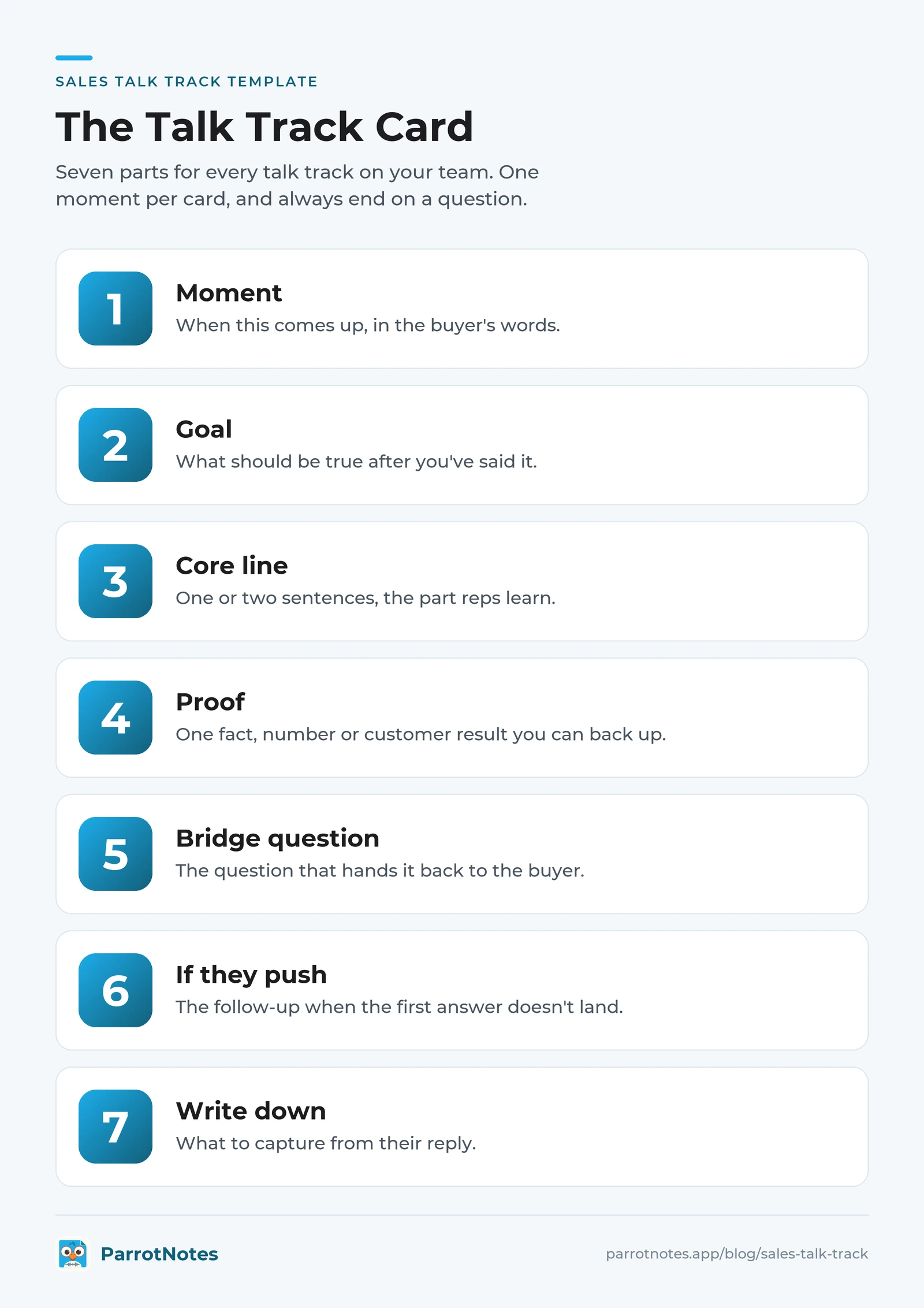
Every talk track on your team should use the same card. When the parts are fixed, reps can compare versions and managers can see which part is weak.
TALK TRACK CARD
Moment:          (when this comes up, in the buyer's words)
Goal:            (what should be true after you've said it)
Core line:       (one or two sentences, the part reps learn)
Proof:           (one fact, number or customer result you can back up)
Bridge question: (the question that hands it back to the buyer)
If they push:    (the follow-up when the first answer doesn't land)
Write down:      (what to capture from their reply)
Last reviewed:   (date)      Source calls: (which calls this came from)
Three rules make the card work:
- One moment per card. "Pricing and objections" is two cards.
- Always end on a question. A talk track that ends on a statement turns into a monologue.
- Name the source. "Came from the Hartley and Reyes calls in September" tells the next rep this line was tested, not written at a desk.
Rule 2 has data behind it. Gong Labs analyzed 67,149 demo call recordings and found that average reps answer an objection with a "knee-jerk" monologue of 21.45 seconds, while top reps pause longer and respond with a question (Gong Labs on handling objections). A short core line plus a bridge question builds that habit in.
Sales talk track examples for six moments in a call
These examples follow Priya, who sells commercial floor-care equipment to facility managers at warehouses and plants. The details are illustrations: swap in your product and your own proof, and keep the shape.
1. Opener talk track (booked meeting)
- Moment: The first minute, after hellos.
- Goal: The buyer agrees on why you're there and how the meeting ends.
- Core line: "Thanks for the time. You mentioned on the phone that the floors aren't keeping up since the third shift started. I'd like to understand how cleaning runs today, and at the end we can decide together if a next step makes sense."
- Proof: None needed yet. The proof is that you remembered what they said.
- Bridge question: "Is that still the main thing, or has something else come up?"
- If they push ("just show me the machine"): "Happy to. So I show you the right one, can I ask two quick questions first?"
- Write down: The reason for the meeting in their words.
2. Discovery transition talk track
- Moment: Moving from small talk or the agenda into questions.
- Goal: The buyer starts describing the problem, with numbers.
- Core line: "Most facility managers I talk to have one of three problems: labor hours, floor safety or audit scores. Which one is costing you most right now?"
- Proof: The three problems are what Priya's own past calls show. Use the ones your notes show.
- Bridge question: "Walk me through the last time it went wrong. What happened next?"
- If they push ("all of them"): "If you could fix only one by spring, which would it be?"
- Write down: The problem they pick, the cost and who feels it.
For the questions that follow, our guide to discovery questions in sales has 50 to pick from.
3. Demo talk track
- Moment: Before you show the product.
- Goal: The demo is about their problem, not your feature list.
- Core line: "You said the night shift spends about four hours on the dock area. I'm going to show you one thing: how this machine covers that area, and you tell me if it would work on your floor."
- Proof: One run on a floor like theirs, or a reference site they can call.
- Bridge question: "What would your night lead need to see to trust it?"
- If they push ("what else does it do?"): "Plenty, but let's see if this part solves the dock first."
- Write down: What made them lean in, and what they skipped past.
Running the demo in person? See our guide to the in-person product demonstration.
4. Pricing talk track
- Moment: "What does it cost?"
- Goal: The price lands next to the value the buyer already named.
- Core line: "The machine is $X, or $Y a month on the service plan. Set against the four hours your night shift spends on the dock, here's what that works out to each month."
- Proof: The buyer's own number from discovery, plus one comparable site.
- Bridge question: "How does that compare to what you expected?"
- If they push ("that's a lot"): "Compared to what? The current labor, or another quote?"
- Write down: Their first reaction, word for word, and any number they compare it with.
Timing matters as much as the line. In a Gong analysis of 25,537 B2B sales conversations, top reps most often talked price between the 40 and 49 minute mark of their calls, while average reps spread it across the call (Gong on how top reps discuss pricing). If price comes up early, it's fine to say, "I'll give you the number. Can I ask two questions first so it's the right number?"
5. Objection talk tracks (three common ones)
Each objection gets its own card. Here are the core line and bridge question for the three Priya hears most.
| Objection | Core line | Bridge question |
|---|---|---|
| "We already have a supplier." | "Most of my customers did too. I'm not asking you to switch today." | "What would you change about the current setup if you could?" |
| "Send me some information." | "I will. So it's not a generic brochure, what's the one thing it should answer?" | "Who else will read it?" |
| "Now isn't a good time." | "Fair enough. When does the budget for next year get set?" | "What would need to be true by then for this to be on the list?" |
Pause before you answer any of them. For the full method (pause, ask, isolate, reframe, confirm), see objection handling in sales, and for the money version, how to handle the price objection.
6. Next step talk track
- Moment: The last five minutes.
- Goal: An action, an owner and a date, agreed out loud.
- Core line: "Based on what we covered, the next step I'd suggest is a trial on the dock floor for one week, with your night lead there on the first run. Does the 12th work?"
- Proof: The problem and cost they named earlier, repeated back.
- Bridge question: "Who else needs to be in the room for that?"
- If they push ("let me think about it"): "Of course. What's the one thing you're still weighing?"
- Write down: The date, the people and what they need to see.
Want these talk tracks filled with the buyer's own words? Try ParrotNotes free on your next customer meeting and pull the exact phrases from the transcript.
How teams build and refresh talk tracks from real call notes
Talk tracks written in a conference room sound fine and fail in the field. The ones that work are lifted from calls that went well, then checked against calls that didn't.
Build each one from calls, not from the brochure
- List your moments. The six above, plus any objection your team hears weekly.
- Collect three good calls per moment. Recordings (with everyone's consent; rules vary by state, see one-party consent states) or detailed debrief notes from your strongest reps.
- Copy the exact words. What the rep said, and what the buyer said right after. The reply tells you whether the line worked.
- Write the card. Core line under 40 words, every part filled in, source calls named.
- Role-play it once. Say it to a colleague playing a tough buyer and cut what you stumble on.
Talk tracks belong in your team's sales playbook, next to the plays they support.
The monthly 30-minute refresh: keep, rewrite or retire
Talk tracks go stale: prices change, competitors change their offer, buyers use new words. Book 30 minutes once a month.
| Step | Time | What you do |
|---|---|---|
| 1. Pull the moments | 10 min | Each rep brings two call notes where a talk track moment came up, good or bad |
| 2. Read the replies | 10 min | For each card, read what buyers said after the core line |
| 3. Decide | 10 min | Mark each card keep, rewrite or retire, then update the date |
The decision rules:
- Keep when buyers answer the bridge question with something specific (a number, a name, a date).
- Rewrite when buyers keep asking the same follow-up. The follow-up is telling you what the core line left out.
- Retire when nobody on the team has used it in two months, or the proof point is no longer true.
Marco manages six field reps for the same distributor as Priya. In one monthly refresh, three reps brought notes where buyers answered the "already have a supplier" line with "we're locked into a contract." Nobody had a card for that. The team wrote one ("When does it come up for renewal?"), and the next month two of those accounts had a renewal date in the CRM. (Marco is an illustration, not a real manager.)
The notes show you the objection you haven't written yet. To review a single call with a rep, use our sales call review format.
Where ParrotNotes fits
Building talk tracks from real calls needs the real words. Face to face, you can't hold eye contact and copy down the buyer's reply at the same time.
ParrotNotes records in-person meetings on the phone you already carry, with no meeting bot, and keeps recording with the screen locked. You get a transcript and a summary on every recording. Ask the recording "What did the buyer say after I gave the price?" and copy the reply into the card. After a phone call, speak your notes into the app before you start the car.
As of October 2026, the Free plan includes 100 minutes of recording a month, a summary on every recording and 5 AI-powered recordings (action items, key points, and the BANT, MEDDIC and SPIN frameworks). Pro costs $19.99 a month, or $14.99 a month billed annually, and adds 3,000 minutes a month, unlimited AI-powered recordings and AI search across your notes, so a manager can find every call where a buyer mentioned a competitor. Download ParrotNotes free and bring real call notes to your next refresh.
Build your first talk track card this week
A sales talk track is the team's best answer to a moment that keeps coming up, kept short enough to say in half a minute and ending on a question. Use the same card for every one: moment, goal, core line, proof, bridge question, fallback and what to write down. Start with the six moments in this guide, take the wording from calls that went well, and review the cards once a month against what buyers actually said.
Priya didn't need a longer pitch. She needed one line after the price and a question to follow it. Pick the moment that trips your team most often, write that card first, and get ParrotNotes free so the next refresh starts from the buyer's real words, not from memory.
Frequently Asked Questions
What is a talk track in sales?
A talk track is a short, prepared answer for one recurring moment in a sales conversation, such as the opener, the price question or a common objection. It sets out the goal, a core line of one or two sentences, one proof point and a question that hands the conversation back to the buyer. Reps learn the intent and key phrases and say the rest in their own words.
What is the difference between a talk track and a sales script?
A script covers a whole call in order and is often read or memorized as written. A talk track covers one moment and is used whenever that moment comes up, in any call. Scripts suit new reps, voicemails and high-volume calling; talk tracks suit reps who know the product and need a reliable answer for known moments.
How long should a sales talk track be?
Aim for 20 to 40 seconds of speaking, with a core line under 40 words. Gong Labs found that average reps answer objections with a monologue of about 21 seconds, while top reps pause and ask a question, so shorter answers that end in a question work better.
How do you write a sales talk track?
Pick one moment, collect three calls where it went well, copy what the rep said and how the buyer replied, then fill in a card: moment, goal, core line, proof, bridge question, what to say if they push and what to write down. Role-play it once and note which calls it came from.
How often should you update talk tracks?
Review them once a month in a 30-minute session using recent call notes. Keep a talk track when buyers answer its question with specifics, rewrite it when buyers keep asking the same follow-up, and retire it when nobody has used it in two months or its proof point is no longer true.
Related Posts
How to Use Dictation on Windows 11: Shortcut, Commands and Fixes
How to use dictation on Windows 11: press Windows key + H, say punctuation out loud, use Voice Access offline, and fix the microphone when voice typing fails.
Too Many Meetings? How to Cut Them Without Losing Alignment
Too many meetings at work? Audit your calendar in one sitting, give each cut meeting a replacement, and check after two weeks that your team is still aligned.
Sales Voicemail Scripts That Get Callbacks
Copy 10 sales voicemail scripts by situation, from first touch to breakup, each timed, plus greeting scripts for reps and a voicemail-and-email sequence.