
How to Build a Sales Playbook From Your Team's Real Calls

Sarah Johnson
Writes about field sales, meeting notes and voice-first workflows at ParrotNotes. Every article is reviewed by the ParrotNotes product team before it goes live.
Table of Contents
- 1.What is a sales playbook?
- 2.What a sales playbook should include
- 3.Why sales playbooks written from theory stop being read
- 4.How to build a sales playbook from real calls in six steps
- 5.The sales playbook section template
- 6.Worked example: one play built from three meeting debriefs
- 7.Where ParrotNotes fits
- 8.Build the sales playbook your reps will open
Open your team's sales playbook. Now open the notes from your best rep's last three customer meetings. If you had to hand a new hire one of the two on their first Monday, which would you pick?
Most managers pick the meeting notes, then feel guilty about it. The playbook took a weekend to write. It has the mission statement, the personas, and a page of objection responses nobody has said out loud in a year. The notes have what a customer said on Tuesday and what the rep said back that worked.
That gap is the whole argument of this guide. A sales playbook should be built from the second document, not the first. Below you'll find what a sales playbook is and which sections it needs, kept short because every other guide covers that. Then the part they skip: a six-step method for building the deal-deciding sections from your team's real in-person meetings, a copy-ready section template, and one play built from three meeting debriefs.
Picture Nadia, who manages six field reps selling point-of-sale systems to independent restaurants. She's invented for this article, but her problem isn't.
In January she wrote a 38-page playbook from memory and a competitor's template. By June, the file's "last opened" history showed two names: hers and one new hire's. Meanwhile her top rep, Leah, had found an answer to "we're locked into our processor contract" that advanced three deals in a row. It wasn't in the playbook, because Nadia had never heard it.
If you already suspect the meeting notes are the better document, the good news is that building a playbook from them is mostly a capture habit. Try ParrotNotes free and record one debrief today; the rest of this guide shows what to do with it.
What is a sales playbook?
A sales playbook is a written guide to how your team sells: who you sell to, the steps a deal moves through, what to ask and say at each step, and how to handle the moments that decide deals, such as objections, pricing, and competitors. The entries for those moments are called sales plays. The playbook is the collection; a play is one page in it.
The useful test is a Tuesday test. A rep walks out of a meeting where the buyer said something hard. Can they open the book, find that moment, and see what a teammate said in the same spot last month?
If yes, it's a sales playbook. If not, it's a company handbook with a sales cover.
What a sales playbook should include
Vendor guides such as Salesforce's sales playbook guide agree on the standard sections. Here they are, with the question each one answers and where the words usually come from today.
| Section | Question it answers | Where the words usually come from |
|---|---|---|
| Company and product overview | What do we sell, and why does it matter to this buyer? | Marketing |
| Ideal customer and personas | Who buys, who blocks, and what does each care about? | Marketing, plus the founder's memory |
| Sales process and stage definitions | What has to be true to move a deal forward? | The CRM admin |
| Qualification method | What do we need to know before we invest more time? | A framework such as BANT or MEDDPICC |
| Discovery questions | What do we ask, and in what order? | The manager's best guesses |
| Plays: objections, pricing, competitors | What do we say when the buyer pushes back? | Whoever wrote the book |
| Messaging and templates | What do our recaps, emails, and proposals look like? | Marketing and one senior rep |
| Metrics and review cadence | How do we know it works, and when do we update it? | Rarely written down |
Look at the right-hand column. Almost none of it is written by someone who was in the meeting. Yet the sections that decide deals, discovery, plays, and templates, are the ones your reps could fill from what customers said last week.
The rest of this article swaps that column for one source: the record of your team's real customer meetings.
Why sales playbooks written from theory stop being read
Three things happen to a theory-first sales playbook.
It describes a buyer nobody has met. Persona pages tell reps the restaurant owner "values reliability and simplicity." The owner at the last meeting said, "The last system went down on a Friday night and I lost the tickets for 40 covers." Only one of those sentences helps a rep open the next conversation.
In Highspot's State of Sales Enablement Report 2025, as summarised on its blog, 41% of go-to-market leaders said their reps struggle with engaging new buyers effectively. Hearing how a teammate opened with the same kind of buyer last month fixes more of that than a persona paragraph.
It asks for time reps don't have. Salesforce's 2026 State of Sales statistics report that sales reps spend 60% of their time on non-selling tasks, and that 57% of sales professionals say the sales cycle is getting longer. Asking reps to write playbook content on top of that fails quietly. Asking them to record what they already do, in two minutes after each meeting, doesn't.
Nobody hears field meetings. For an inside team, every call runs through a dialer and a manager can listen back. A field meeting happens in a restaurant back office or a plant corridor and leaves nothing behind except a CRM note that says "good meeting, send quote." Our guide to AI sales coaching for field teams covers this capture problem in depth. The playbook has the same problem coaching does: no record, no raw material.
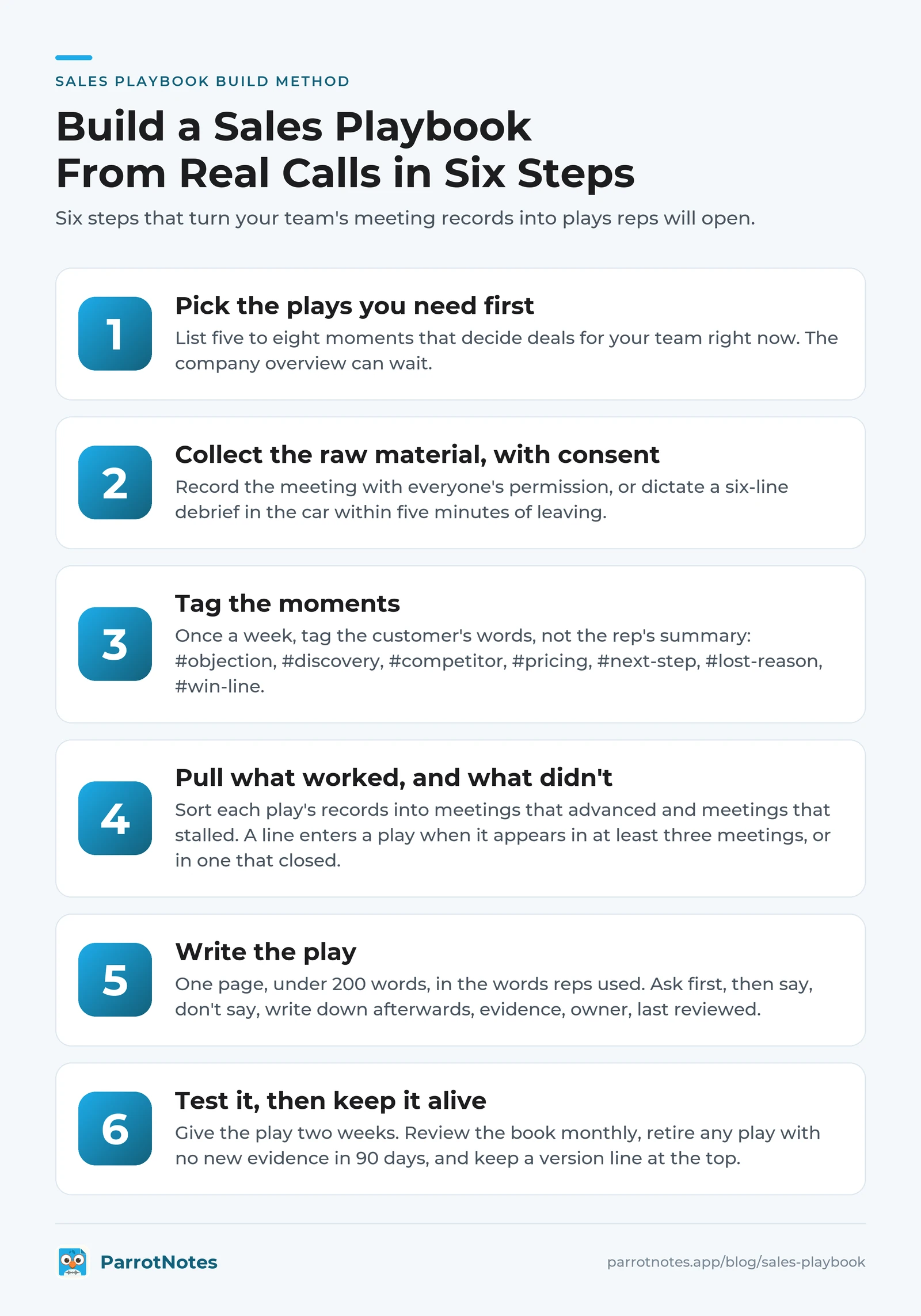
How to build a sales playbook from real calls in six steps
Here is the method in one list, then step by step.
- Pick the plays you need first
- Collect the raw material, with consent
- Tag the moments
- Pull what worked, and what didn't
- Write the play
- Test it, then keep it alive
Step 1: Pick the plays you need first
Don't start with the company overview. Start with a list of five to eight moments that decide deals for your team right now. Two questions in your next team meeting produce it: "Which moment in the last month did you wish you'd handled differently?" and "Which one did you handle well?" Add whatever your CRM's lost-reason field says most often.
Nadia's list came out as: the processor-contract objection, the "send me a quote" brush-off, the meeting where the owner isn't there, the competitor's free-hardware offer, and the second-visit demo. Five plays. The company overview can wait; nobody loses a deal for lack of a mission statement.
Step 2: Collect the raw material, with consent
An in-person meeting leaves a record in one of two ways. The rep records it on a phone, with everyone's permission, or the rep dictates a debrief in the car within five minutes of leaving. Phone and video calls work the same way: a spoken debrief straight after the call. Either way, the record has to exist before you can build anything from it.
Ask before recording, every time. Under US federal law it isn't unlawful to record a conversation you're a party to, or one where a party has consented (18 U.S.C. § 2511(2)(d)), but some states require every party's consent, and other countries have their own rules. This isn't legal advice: set the rule with your own counsel, write it down for the team, and stop if anyone in the room would rather you didn't.
Tell reps what the recordings are for, too. A playbook project dies the day reps decide it's surveillance. Keep the records somewhere the team can search and you can control; ParrotNotes' security page explains how recordings and transcripts are protected.
When the customer says no, or the meeting was a call, the debrief carries the play. Keep it to six lines, in the same order every time:
1. Who was in the room, and their role
2. What they said they wanted, in their words
3. What they pushed back on, in their words
4. What I said back
5. What happened next (commitment, owner, date)
6. What I'd do differently
Line 5 is where deals leak. Our guide on how to never miss action items from sales calls covers the wording that turns "they'll think about it" into an owner and a date.
How much material do you need? Three to four weeks of every rep debriefing every meeting. For Nadia, six reps at five visits a day for three weeks is around 90 records, more customer language than most playbooks are built on in their whole life.
Step 3: Tag the moments
Once a week, spend 20 minutes reading the new records and tagging the moments that belong to a play on your Step 1 list. Tag the customer's words, not the rep's summary of them. "Pushed back on price" is a summary. "We're paying $89 a month now and I don't see why I'd pay more" is a tag-worthy line.
A small tag key is enough:
| Tag | What it marks | Example line from a record |
|---|---|---|
| #objection | Any push-back, with the customer's words | "We're locked in with our processor until next year" |
| #discovery | A question that got a useful answer | "What happened the last time the system went down?" |
| #competitor | Any mention of another vendor or of doing nothing | "The other company said the terminal is free" |
| #pricing | A number the customer said or reacted to | "Anything over $100 a month and my partner says no" |
| #next-step | What was agreed, with owner and date | "Owner to send current contract by Thursday" |
| #lost-reason | Why a deal stalled, in the customer's words | "We went with the one our accountant uses" |
| #win-line | Something the rep said that visibly moved the meeting | "Would it help if I read the contract with you?" |
Fewer tags beat more; seven is plenty. If your notes app supports labels and search, tag there. If the records live in a folder, a tag at the top of each note works.
Step 4: Pull what worked, and what didn't
Take one play from your list. Gather every record tagged for it. Sort them into two piles: meetings that advanced (a second visit booked, a contract sent, a signature) and meetings that stalled. Then look for the line that shows up in the advanced pile and not in the stalled one.
Use an evidence rule, and write it into the playbook so everyone knows the bar: a line enters a play when it appears in at least three meetings, or in one meeting that closed and can be quoted. Below that bar, it's an idea, and ideas go in a "trying this" list, not the book.
Keep the failed answers too. "Don't lead with our rates being lower over time" is as useful as the line that worked, and it carries the same evidence.
Write down which meetings each line came from: rep, customer type, and date. That evidence line is what makes a play trusted; a rep who doubts it can read the three debriefs behind it.
Step 5: Write the play
A play is one page, under 200 words, in the words reps used, not marketing's. Use the same card every time so the blanks show:
PLAY CARD

Play name:
Trigger (what the customer says or does):
Why they say it (from the records):
Ask first:
Then say:
Don't say (and why, from the records):
Write down afterwards:
Evidence (rep, customer type, date, outcome) x3:
Owner:
Last reviewed:
"Ask first" comes before "Then say" on purpose. In almost every set of debriefs, the answer that worked was preceded by a question, and the one that stalled was an answer given straight away. The card makes that order the default.
Step 6: Test it, then keep it alive
Give the play two weeks. Reps run it and debrief with the same six lines, so you can compare the new records with the old ones. If the line keeps working, it stays. If it doesn't, the evidence line tells you what changed.
Then set the cadence that keeps a sales playbook alive:
- A 30-minute playbook review once a month, inside a meeting you already hold, with one question: which plays got new evidence, and which got none?
- Retire any play with no new evidence in 90 days. Move it to an archive; don't delete it.
- A version line at the top of the book: "v4, September 2026, built from 112 meeting records."
- Play cards where reps already look: the notes app or CRM they open in the car, not a slide deck on a shared drive.
- A new hire's first week is reading the plays and the three debriefs behind each one. That's onboarding built from customers' words, not slides.
If you're choosing a tool to hold the records and run the reviews, our sales coaching software guide has a scorecard for field teams. The playbook and the coaching programme draw from the same records.
The sales playbook section template
Here is the standard set of sections again, this time with the meeting-record source for each one and the fields to fill. Copy it, delete what you don't need, and build the bottom half first.
| Section | Build it from | Fields to fill |
|---|---|---|
| Company and product overview | Keep from marketing, one page, plus the three #win-line customer quotes that explain the product better than the brochure | Product in one paragraph; three customer quotes with evidence lines |
| Ideal customer and personas | Records tagged #discovery: what each role said they wanted, in their words | Role; what they wanted (quoted); what they pushed back on; who else was in the room |
| Sales process and stage definitions | Records tagged #next-step: what was agreed when a deal moved a stage | Stage; exit criterion written as what the customer did; typical days between stages |
| Qualification method | Your framework, filled from real meetings. Our MEDDPICC guide shows all eight letters on one worked deal | Framework; for each letter, the question that got an answer and one example answer from a record |
| Discovery questions | Records tagged #discovery. The Sandler pain funnel questions are a good starting set; the playbook records which ones your customers answer | Question; what a good answer sounds like (quoted); what to write down |
| Plays: objections, pricing, competitors | Records tagged #objection, #pricing, #competitor, sorted into advanced and stalled | One play card per moment (template above) |
| Messaging and templates | Your best recap emails and proposals, taken from deals that advanced | Template; the deal it came from; when to use it |
| Metrics and review cadence | Your evidence rule and review schedule | Evidence rule; review day; retire rule; version line |
Two notes on using it. First, build the plays section before the personas. Personas written after 90 debriefs are shorter and truer than personas written before them.
Second, everything quoted carries its evidence line, even in the overview. If a quote can't be traced to a meeting, it's marketing copy, and it goes back to marketing.
Worked example: one play built from three meeting debriefs
Everything below is invented to show the method. Ridgeline POS, the reps, the restaurants, and every number are fictional, and the fees are chosen to make the example clear, not to describe any real market.
Nadia picked the processor-contract objection as the first play. In the first three weeks of debriefs, three records carried the #objection tag with "contract" or "locked in" in the customer's words.
The three debriefs
Debrief 1: Leah, Marlowe's Kitchen, stalled. Line 3: "We've got 14 months left with our processor and there's a $495 early termination fee." Line 4: "I explained that our rates are lower, so they'd make the fee back over the first year." Line 5: "Owner said, 'Send me a quote.' Sent Tuesday. No reply."
Debrief 2: Andre, Bao House, advanced. Line 3: "We signed a three-year deal with our processor last spring, so this is probably a waste of your time." Line 4: "I asked what the contract says happens if they switch. She didn't know. I asked if she'd be willing to pull it up, and offered to read it with her." Line 5: "Fee is $350. Showed her month by month where that lands. Second meeting booked with her business partner for the 14th."
Debrief 3: Leah, The Copper Pot, won. Line 3: "We're tied in until next year." Line 4: "Tried Andre's question from the team meeting. Asked if she knew the exit fee. Said most of the ones we see are a few hundred dollars and I'd rather work it out with her now than have it surprise her later. She pulled up the contract: $400. I put it in the proposal as a line item we offset." Line 5: "Signed on the second visit."
What the tags show
Sorted into piles, the pattern is plain. The stalled meeting had an answer with no question in front of it. Both advanced meetings had a question first ("What does the contract say?" and "Do you know the exit fee?"), followed by an offer to look at the number together.
The fee itself wasn't the objection. Not knowing the fee was. Three meetings, two advanced, one closed and quotable: the line clears the evidence rule.
The finished play
PLAY CARD

Play name: The processor-contract objection
Trigger: Customer says they're locked in, tied in, or mid-contract with
  their current processor.
Why they say it: They assume the exit fee is large and they don't know
  the number. (All three records: none knew the fee before the meeting.)
Ask first: "Do you know what the contract says happens if you switch?"
  If they don't: "Would it help if we pulled it up and read it together?"
Then say: "Most exit fees we see are a few hundred dollars. I'd rather work
  that out with you now than have it surprise you later." Show where the
  fee lands month by month, and put it in the proposal as a line item.
Don't say: Lead with "our rates are lower, so you'll make it back."
  (Marlowe's Kitchen: answer before question, stalled at "send me a quote.")
Write down afterwards: Contract end date, exit fee, who else has to agree,
  and the date of the second visit.
Evidence: Andre, Bao House, Sep 4, advanced to partner meeting.
  Leah, The Copper Pot, Sep 11, signed on second visit.
  Leah, Marlowe's Kitchen, Aug 28, stalled (counter-example).
Owner: Nadia
Last reviewed: September 2026
That's a play. It took three debriefs and about 40 minutes of reading and writing. The next new hire reads it in two minutes and knows what to ask, what to say, what not to say, and which three meetings to trust.
Where ParrotNotes fits
ParrotNotes turns the capture step into something reps will do. In the meeting, with the customer's permission, a rep opens the app on the phone they already carry, taps record, and sets it down. Recording continues with the screen locked. In the car afterwards, a rep who didn't record talks through the six debrief lines instead.
Either way, when they stop, they have a transcript, an AI summary, and extracted action items, so line 5 of the debrief is already pulled out with an owner attached.
Tagging happens where the records live. Labels are unlimited on every plan, so #objection, #discovery, and #win-line sit on each note, and keyword search across every recording finds them in seconds. For Nadia, "termination fee" returns all three restaurant meetings at once.
On Pro, the pull step gets faster. AI chat lets you ask a recording a question in plain language, and AI semantic search finds the moment even when the customer didn't use the exact word. Custom insight templates let a team define the six debrief lines, or the play card fields, as the shape every summary takes.
Speaker identification keeps the customer's words separate from the rep's, which is what the evidence rule needs. ParrotNotes also includes sales frameworks (BANT, MEDDIC, SPIN), so the qualification row of the template fills itself from each recording. Pro exports notes to docx and PDF, so finished play cards can live in whatever file your team opens.
Ready to collect your first 90 records? Download ParrotNotes free. The free plan gives you 100 minutes of recording a month, up to 30 minutes per recording, an AI summary on every recording, AI insights on five recordings a month, and unlimited written notes, labels, and keyword search. Pro is $19.99 a month, or $14.99 a month billed annually, with 3,000 minutes a month, recordings up to 3 hours, all AI features, custom insight templates, speaker identification, and multilingual transcription in 99+ languages with translation.
Build the sales playbook your reps will open
Think about Jonah, a new hire who starts at Ridgeline on a Monday in October. He's invented, like the rest of the example. Instead of 38 pages, he gets five play cards and the three debriefs behind each one.
On Thursday, a restaurant owner tells him they're locked into their processor contract, and he asks what the contract says happens if they switch. He didn't learn that from a persona page. He learned it from Andre's debrief on September 4.
Here's the short version:
- A sales playbook is a collection of plays, and a play is one page for one moment
- Cover the standard sections, but build discovery, plays, and templates from meeting records
- Collect records with permission, or dictate a six-line debrief after every meeting
- Tag the customer's words, sort by outcome, and apply an evidence rule before anything enters the book
- Write one-page play cards that ask before they tell, and carry their evidence
- Review monthly, retire stale plays, and onboard new hires from the debriefs
The first play takes three debriefs and 40 minutes. Download ParrotNotes free, ask two reps to record this week's meetings with permission or debrief in the car, and build your sales playbook from what your customers said.
Frequently Asked Questions
What is a sales playbook?
A sales playbook is a written guide to how a team sells: the buyers it targets, the stages a deal moves through, the questions to ask, and the plays for the moments that decide deals, such as objections, pricing, and competitors. A play is a single entry; the playbook is the collection. The best ones are built from what customers said in real meetings.
What should a sales playbook include?
The standard sections are a company and product overview, ideal customer and personas, the sales process with stage definitions, a qualification method, discovery questions, plays for objections, pricing, and competitors, messaging and templates, and the metrics and review cadence. Build the plays, discovery questions, and templates from your team's meeting records first.
How do you create a sales playbook from real calls?
Pick five to eight deal-deciding moments, then have every rep record meetings with permission or dictate a six-line debrief afterwards for three to four weeks. Tag the customer's words, sort each moment's records into meetings that advanced and meetings that stalled, and write a one-page play from the lines in the advanced pile. Give each play an evidence line and review the book monthly.
How long should a sales playbook be?
Shorter than most. Each play should fit on one page and run under 200 words, and a team usually needs five to eight plays to start. The full book, with a one-page overview, personas, process, qualification, and templates, rarely needs more than 20 to 30 pages. A short book reps open beats a long one they don't.
How often should a sales playbook be updated?
Review it monthly in a 30-minute slot inside a meeting you already hold, asking which plays got new evidence and which got none. Retire any play with no new evidence in 90 days, and keep a version line at the top of the book with the date and the number of meeting records behind it.
Related Posts
Sales QBR: Agenda and Template for Sales Teams
Run a sales QBR that ends in a forecast you believe. Copy a timed 90-minute agenda, a rep's one-page prep template, and a filled-in example, all copy-ready.
SaaS Sales: How It Works and How Reps Track Every Conversation
What is SaaS sales? Learn the subscription model, PLG vs sales-led, SDR/AE/CSM roles and the demo-to-renewal cycle, plus a deal log to track every call.
Otter.ai Alternatives for In-Person Meetings (7 Options Compared)
Looking for an Otter.ai alternative that works in a room, not on Zoom? Seven options scored on bots, minute caps and phone apps, prices checked Sept 2026.