
Sales Rep Productivity: The Metrics That Matter and How to Lift Them

Sarah Johnson
Writes about field sales, meeting notes and voice-first workflows at ParrotNotes. Every article is reviewed by the ParrotNotes product team before it goes live.
Table of Contents
Marco had 16 customer meetings last week, drove 410 miles and answered every email. On Friday his manager asked which deals had moved. He named two, and one of those was a maybe.
Nobody would call Marco lazy. His activity report looked great. But sales rep productivity isn't how full the week is. It's how much progress the week buys: meetings that end with a next step, recaps sent while the buyer still remembers, deals that move for a reason you can write down.
This guide shows outside reps, and the managers who coach them, how to measure that. You'll run a one-week time audit, score four sales rep productivity metrics with simple formulas, find where your hours leak, and follow a 30-day plan to lift the numbers.
One habit carries most of the plan: a two-minute spoken debrief after every visit. If you'd rather talk than type, ParrotNotes turns that debrief into a summary, action items and a follow-up draft before your next stop.
What sales rep productivity measures (and what it doesn't)
Sales rep productivity is the sales progress a rep creates per hour of available time. Activity counts (calls, visits, emails) are inputs. Nothing moves without them, but they can't tell a productive week from a busy one.
The hours are tighter than most reps think. Salesforce's State of Sales 2026, a survey of 4,050 sales professionals in 22 countries, found that the average seller spends 40% of their time selling. Salesforce's own sales statistics page puts the other side plainly: reps spend 60% of their time on non-selling tasks such as finding materials, updating the CRM and chasing internal approvals.
Field reps aren't far off. SPOTIO's State of Field Sales 2026, a survey of 452 sales professionals, puts active selling at 44% of the week. Of the respondents who gave a definite answer, 65% spend five or more hours a week on manual CRM data entry.
So the question isn't "how do I do more?" It's "where did the other 56 to 60% go?" You can't answer that from memory. You need a week of data.
Start with a one-week time audit
Before you set any target, log one normal week (not a trade-show or holiday week) in seven categories:
| Code | Category | What counts |
|---|---|---|
| S1 | Face-to-face selling | Time with a customer or prospect, in the room or on site |
| S2 | Remote selling | Phone and video conversations with buyers |
| D | Driving | Windshield time between stops |
| P | Prep and research | Account planning, call prep, quotes you build before a meeting |
| N | Notes and CRM | Writing up visits, call reports, updating opportunity fields |
| F | Follow-up | Recap emails, sending materials, chasing answers |
| I | Internal | Team meetings, approvals, training, expenses |
At the end of each day, open your calendar and mileage log and tally hours into the seven codes, rounded to the half hour. Evening and weekend work counts too, and it usually lands in N or F.
Here's Marco's audit. The numbers are an illustration, not research:
| Code | Hours | Share of week (rounded) |
|---|---|---|
| S1 Face-to-face selling | 14 | 31% |
| S2 Remote selling | 4 | 9% |
| D Driving | 9 | 20% |
| P Prep and research | 3 | 7% |
| N Notes and CRM | 7 | 16% |
| F Follow-up | 4 | 9% |
| I Internal | 4 | 9% |
| Total | 45 | 100% |
Selling time is S1 plus S2: 18 of 45 hours, or 40%. What surprised Marco wasn't the driving. It was seven hours of notes and CRM, four of them on Sunday night, rebuilt from scribbles he could barely read.
The four sales rep productivity metrics
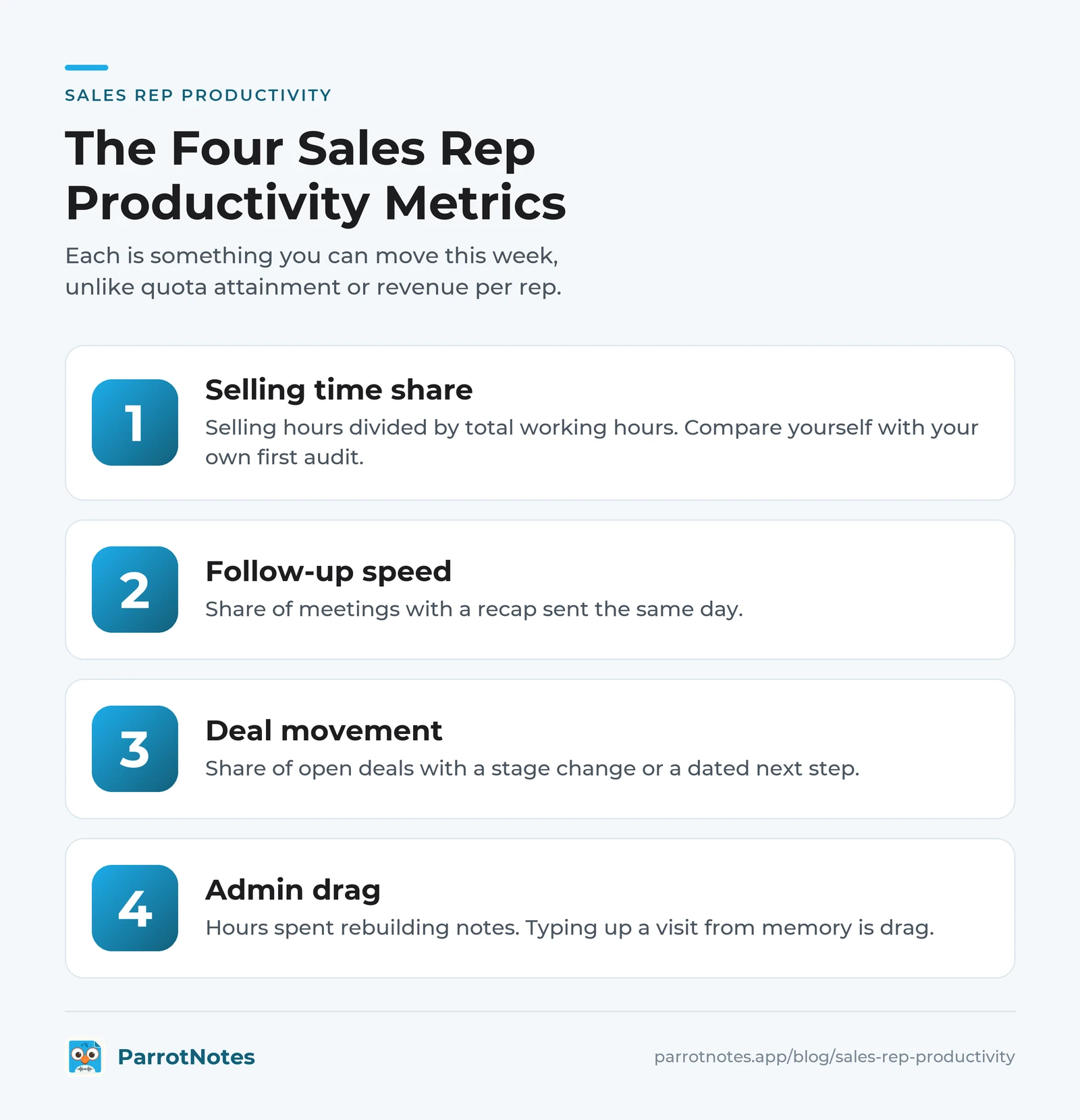
Now score four metrics. Each is something you can move this week, unlike quota attainment or revenue per rep, which lag by months.
| Metric | Formula | How to count it | Suggested starting target |
|---|---|---|---|
| 1. Selling time share | (S1 + S2) ÷ total working hours | Your weekly time audit | Your baseline plus 5 points within a quarter |
| 2. Follow-up speed | Meetings with a recap sent the same day ÷ meetings held | Sent folder against your calendar | Every meeting on an active deal |
| 3. Deal movement | Open deals that moved a stage or have a buyer-agreed next step with a date ÷ open deals | Your pipeline view, every Friday | Two out of three at first; review any deal with no dated step for 30 days |
| 4. Admin drag | Hours per week spent rebuilding notes and typing up visits (category N) | Your weekly time audit | Half your baseline within a month |
The targets are suggested starting points, not industry benchmarks. Territories and sales cycles vary too much for one number to fit every rep, so compare yourself with your own first audit.
1. Selling time share
The Salesforce and SPOTIO figures give a rough reference point of 40 to 44%. Don't chase a big jump. The gain comes from shrinking categories N and F, not from cramming in more visits.
2. Follow-up speed
A recap sent the same afternoon beats a perfect one sent on Thursday, and it becomes the record of what was agreed. Marco sent same-day recaps after 6 of his 16 meetings: 38%. Our guide to the follow-up email after a sales call has templates.
3. Deal movement
A deal moves when something changes that the buyer would agree with: a stage advanced on evidence, or a next step with an owner and a date. "Went well, will follow up" isn't movement. Marco had 11 of 24 open deals with a dated next step: 46%. For what counts as evidence at each stage, see what a sales pipeline is and how its stages work.
4. Admin drag
Admin drag is time spent reconstructing what happened, not acting on it. Typing up a visit from memory is drag. Sending the quote the buyer asked for is follow-up. Keeping them apart shows which admin is waste.
Where the hours leak, and the lever for each
Your audit will show one or two categories that are too big. Match each one to a lever:
| If your audit shows | The likely leak | The lever |
|---|---|---|
| N over 5 hours a week | Notes written hours after the meeting, from memory | Debrief out loud in the car before the next drive, then paste into the CRM once a day |
| F piling up at night | Recaps written from a blank page | Send the recap from the debrief, the same day, using a template |
| Deal movement under half | Meetings end without a dated next step | Ask for the next step and date before you stand up, and say it into your debrief |
| D over 25% of the week | Route built around whoever called last | Group visits by area and use parked time for debriefs (see windshield time) |
Lena, an illustrative building-products rep, found 8 hours in category N on her first audit, most of it after dinner. She changed one thing. After every jobsite visit, she parked and talked through four prompts: who was there, what they said, what she promised and what happens next.
Two weeks later, N was down to 3 hours. Her same-day recap rate nearly doubled, because the debrief already held the recap. Admin drag and slow follow-up often share a root cause. Fix the capture and both numbers move.
Want to try the parked-car debrief this week? Download ParrotNotes free. The free plan gives you 100 minutes of recording a month and an AI summary on every recording, enough to test the habit on a week of visits.
A 30-day plan to lift sales rep productivity
Change one thing a week and measure it.
Week 1: Baseline. Run the time audit and score the four metrics. Change nothing yet.
Week 2: Capture. Debrief every meeting out loud before you drive away: who, what they said, what you promised, next step and date. Recording works offline, so a dead zone at a jobsite isn't a problem; the transcript and summary follow once you have signal.
Week 3: Follow-up. Send a recap from each debrief the same day. Batch CRM updates into one 30-minute slot at the end of the day.
Week 4: Next steps. Walk into every meeting with a proposed next step. Leave with a date. For bigger deals, turn the steps into a shared mutual action plan.
At the end of week four, run the audit again and compare.
Marco's second audit (again, an illustration) looked different. Notes and CRM dropped from 7 hours to 3. Same-day recaps went from 6 of 16 meetings to 13 of 15, and 17 of 25 open deals had a dated next step.
His selling time only moved from 40% to 44%. But his Friday answer changed: he could name six deals that had moved and say why. That's the payoff of lifting sales rep productivity.
What managers should do with the scorecard
If you manage reps, don't turn these four metrics into a leaderboard. Use them for coaching: the rep brings their audit and scorecard, and you pick one metric to work on together.
- Compare each rep with their own baseline, not with the team's best rep.
- Ask about the leak, not the number: "What's filling category N?" gets a better answer than "Why is your admin drag high?"
- Coach from written records, not from memory.
For team-level metrics, see our guide to field sales management. Keep the thread going with a running one-on-one meeting template, and see the outside sales rep guide for a typical day in the role.
Conclusion
Sales rep productivity isn't a fuller calendar. It's how much progress each hour buys. To recap:
- Run a one-week time audit before you set any target.
- Score four metrics you can move this week: selling time share, follow-up speed, deal movement and admin drag.
- Fix capture first; admin drag and slow follow-up usually share a cause.
- Re-audit after 30 days and keep the changes that moved the numbers.
Start Monday with the audit and a two-minute debrief after your first visit. Download ParrotNotes free and turn each spoken debrief into a summary, action items and a follow-up draft before you start the car.
Frequently Asked Questions
What is sales rep productivity?
Sales rep productivity is the sales progress a rep creates per hour of available time. It covers how much of the week goes to selling, how fast follow-ups go out, whether deals move with a dated next step, and how many hours are lost to rebuilding notes. Calls and visits are inputs, not the measure.
How do you measure sales rep productivity?
Log one normal week in seven time categories, then score four metrics: selling time share (selling hours divided by total hours), follow-up speed (share of meetings with a same-day recap), deal movement (share of open deals with a stage change or dated next step), and admin drag (hours spent rebuilding notes). Compare against your own baseline.
What percentage of time do sales reps spend selling?
Salesforce's State of Sales 2026, a survey of 4,050 sales professionals, found that the average seller spends 40% of their time selling, and its statistics page says reps spend 60% on non-selling tasks. SPOTIO's State of Field Sales 2026 puts field reps' active selling time at 44%. Your own time audit will tell you where you sit.
How can field sales reps improve productivity quickly?
Start with capture. Debrief each visit out loud before you drive on, send the recap from that debrief the same day, batch CRM updates into one slot, and leave every meeting with a dated next step. The early gain usually comes from fewer hours rebuilding notes, not from more visits.
What is a good selling time percentage for a sales rep?
There's no universal target, because territory, product and cycle length vary. Surveys give a reference point: 40% for the average seller in Salesforce's 2026 research, 44% for field reps in SPOTIO's. A sensible starting target is your own audited baseline plus five points within a quarter, gained mainly by cutting admin time.
Related Posts
Windshield Time: Turn Drive Time Into Done Admin
Windshield time eats a field rep's day. Audit one week, keep the drive for driving, and try a two-minute parked debrief to clear your admin between stops.
What Is a Sales Pipeline? Stages, Examples and Mistakes
What is a sales pipeline? Learn the seven stages with exit criteria, follow one field deal from prospect to close, and avoid the mistakes that inflate it.

The Challenger Sale: Summary and How to Apply It in the Field
The Challenger Sale in plain English: the five seller profiles, teach, tailor, and take control, plus a six-step pitch and call sheet for your next visit.