
Outside Sales Rep: The Role, the Tools and a Typical Day

Sarah Johnson
Writes about field sales, meeting notes and voice-first workflows at ParrotNotes. Every article is reviewed by the ParrotNotes product team before it goes live.
Table of Contents
- 1.What is an outside sales rep?
- 2.What an outside sales rep does
- 3.Outside sales rep salary and job outlook
- 4.A typical day for an outside sales rep
- 5.The tools an outside sales rep uses
- 6.How outside sales reps capture notes between visits
- 7.Planning a territory: a worked coverage plan
- 8.Starting in outside sales: a 30-60-90 day plan
- 9.The job happens in the room, the month happens in the car
Picture Priya at 7:10 on a Tuesday morning, engine running in a supermarket car park, coffee in the cup holder, phone on the dash. Five stops today: a distributor at 8:30, a plant manager at 10:00, lunch with a buyer who has been "nearly ready" since June, a cold walk-in on an industrial estate, and a 4:00 with a customer who wants to renegotiate. Between the stops, about two hours of driving. Her office for the day is the driver's seat.
That is the job of an outside sales rep as it is lived: not a desk and a headset, but a route, a territory, and a series of conversations in other people's buildings. Most of what the job pays for happens in those rooms. Most of what makes or breaks the month happens in the ten minutes after each one.
If you searched the term to find out what the job is, the first half of this guide covers it from primary sources: what an outside sales representative does, what the U.S. Bureau of Labor Statistics says it pays, and why the pay stub usually has no overtime line. If you already sell from a car, the second half is yours: a typical day hour by hour, the tools by moment of the day, how reps capture notes between visits, a worked territory coverage plan, and a 30-60-90 day plan if you're about to start.
If you'd rather dictate a visit note in the car than type it at 9 PM, you can try ParrotNotes free before your next stop.
What is an outside sales rep?
An outside sales rep sells in person, on the customer's ground: their office, their plant, their store, their jobsite, or the café nearest to it. The rep travels to the customer instead of calling them from a desk, covers a defined territory, and is measured on what that territory buys. Other names for the same job are field sales rep, territory rep, and, in some trades, account manager.
The U.S. Bureau of Labor Statistics describes the role in its handbook entry for wholesale and manufacturing sales representatives: "Outside sales representatives spend much of their time traveling to and visiting with current clients and prospective buyers. During a sales call, they discuss the client's needs and suggest how they can meet those needs with merchandise or services." The same page adds that some reps "have large territories and travel considerably," and that where a region covers several states, they "may be away from home for several days or weeks at a time."
Outside sales reps sell most of what businesses buy from other businesses: packaging, building materials, industrial supplies, medical devices, insurance, uniforms, food and drink to stores and restaurants. The trade changes the vocabulary. The shape of the day stays the same.
Outside sales rep vs inside sales rep
The short version: an inside sales rep sells from a fixed desk by phone, email, and video; an outside sales rep sells face to face at the customer's site. That one difference drives the others: fewer but longer conversations, longer cycles, larger deals on average, and notes written after the meeting instead of during it.
We compared the two roles row by row, with the same deal worked from both desks, in our guide to inside sales vs outside sales. This article stays on the outside seat.
Why most outside sales reps are "exempt"
If you're reading a job offer, you'll probably see the word exempt. It refers to the U.S. Fair Labor Standards Act, which has a specific exemption for outside sales employees. The Department of Labor's Fact Sheet #17F (revised August 2024) sets out a two-part test.
First, the employee's primary duty "must be making sales... or obtaining orders or contracts for services or for the use of facilities for which a consideration will be paid by the client or customer." Second, the employee "must be customarily and regularly engaged away from the employer's place or places of business."
Two details matter for reps. The fact sheet says "the salary requirements of the regulation do not apply to the outside sales exemption," so there is no minimum salary threshold. And "outside sales does not include sales made by mail, telephone or the Internet unless such contact is used merely as an adjunct to personal calls," which is the legal line between an outside rep and an inside one. This isn't legal advice, and state rules can differ; if it matters to your offer, ask HR how your role meets the test.
What an outside sales rep does
Job descriptions list a dozen duties in no particular order. On the road, they collapse into five jobs, and each one leaves something behind that has to be written down.
| The job | What it looks like on the road | What it leaves behind |
|---|---|---|
| Find | Cold walk-ins, referrals from customers, trade shows, a morning phone block to book next week | New contacts, who referred whom, what they might need |
| Visit | The core of the day: discovery, demos, samples, walking the customer's site, lunch with a buyer | Needs in the customer's words, objections, who else has a say, next steps |
| Quote and close | Pricing, terms, delivery dates, negotiating a renewal, getting the signature | Numbers and dates promised, what was conceded |
| Keep | Follow-up visits, delivery or quality problems, stock checks, training the customer's staff | Problems raised, who owns the fix, the date you gave |
| Report | CRM updates, call reports, forecasts, expenses and mileage | Everything above, in a form the manager and the CRM can use |
The BLS lists the last row too: besides selling, reps "analyze sales statistics, prepare reports, and handle administrative duties such as filing expense accounts, scheduling appointments, and making travel plans." That row is the one that eats evenings, and the notes section below is about shrinking it.
Outside sales rep salary and job outlook
Most outside sales rep salary pages quote an average without saying where it came from. Two sources, both opened on September 24, 2026.
The BLS doesn't split inside from outside, but its closest occupation is the one whose handbook entry describes outside reps: wholesale and manufacturing sales representatives. Figures are for May 2025.
| BLS line (May 2025) | Median annual wage | Lowest 10% | Highest 10% |
|---|---|---|---|
| Sales representatives, wholesale and manufacturing (all) | $76,460 | ||
| Except technical and scientific products (food, office supplies, clothing, and similar) | $72,080 | Under $39,090 | Over $137,550 |
| Technical and scientific products (industrial equipment, pharmaceuticals, medical instruments) | $104,920 | Under $52,600 | Over $200,440 |
| Total, all occupations | $50,980 |
Indeed's salary page for outside sales representative, updated September 20, 2026 and built from 93.1k salaries in job postings over the past 36 months, shows an average base of $86,351 a year plus $22,560 in commission.
Read the numbers as a direction, not a promise. The BLS notes that "most employers use a combination of salary and commissions or salary plus bonuses," and that "compensation for representatives varies considerably with the type of firm and the product sold." Before you accept an offer, ask what the base is, what the quota is, and what happens to commission on a deal that closes after you've changed territories.
On outlook, the BLS projects little or no change in employment from 2025 to 2035, but about 123,400 openings a year across the occupation, mostly to replace people who retire or change jobs. Online wholesale sales, it adds, are "mostly expected to complement, rather than replace, face-to-face selling."
On getting in: a high school diploma is typical for nontechnical products and a bachelor's degree for scientific and technical ones. Training is often on the road. The BLS describes new reps being trained "by going along with experienced workers on their sales calls," which reps call a ride-along, until "they eventually get their own territory." Expect long days: many reps "work more than 40 hours per week," and "income and job security often depend directly on the amount of merchandise they sell."
A typical day for an outside sales rep
No two territories run the same, but the day has a shape. Here is Priya's Tuesday from the introduction, with the times filled in. She and her accounts are invented to show the rhythm; the pattern is the point.
6:45 to 7:30. Plan the route. Coffee, CRM open on the phone, five stops confirmed. She reads yesterday's notes on the first two accounts and re-orders the stops so the cold walk-in sits between two booked visits on the same estate.
7:30 to 8:20. Drive, and the phone block. Forty minutes of windshield time. Hands-free, she returns two calls and books a first meeting for next week. If cold calls are part of your morning, our cold call script examples include a 60-second post-call debrief, spoken after the call ends.
8:30 to 9:30. Visit 1: the distributor. Stock check, a delivery problem from last week, a request for a price on a new line. Three promises made across the counter.
9:30 to 9:40. The ten minutes in the car. This is where the day is won or lost, and it's the subject of the next two sections. Priya either captures what just happened or carries it in her head into the next room.
10:00 to 11:15. Visit 2: the plant manager. Discovery. She walks the line, hears "we're scrapping 4% on the night shift," meets a maintenance lead who wasn't on the invite, and leaves with a request for a trial. Ten minutes in the car afterwards, same routine.
12:00 to 1:15. Lunch with the buyer who's been "nearly ready" since June. No laptop, no notebook on the table. The buyer names the real blocker for the first time: the finance director wants a two-year price hold.
1:30 to 2:15. The cold walk-in. Reception, a business card, the name of the operations manager, and the fact that they're "reviewing suppliers in Q1." Two minutes of value, five minutes of note.
2:30 to 3:45. Drive. The long hop across the territory, with hands-free calls to the office about the trial units and the price hold.
4:00 to 5:00. Visit 5: the renewal. She concedes a delivery term, holds the price, and agrees a date for the paperwork.
5:30 onwards. Close the day. Five CRM updates, three follow-up emails, an expense entry, tomorrow's route. Whether this takes one hour or three depends on what she did in the ten-minute gaps.
Salesforce's State of Sales statistics (2026) report that sales reps spend 60% of their time on non-selling tasks. For an outside sales rep, a large share of that is driving, and most of the rest is the close-the-day hour. You can't shrink the driving. You can shrink the hour.
The tools an outside sales rep uses
A field rep carries fewer tools than an inside rep, and each one has to earn its place in a pocket or a car. The table ties each tool to the moment of the day it serves. For the full kit, the four-question carry test, and the printable checklist, see our guide to sales tools for field reps.
| Moment of the day | Tool | What it does for you |
|---|---|---|
| Planning the route | Your CRM's mobile app, a route planner | Yesterday's notes on today's accounts; stops in the right order |
| Driving | Hands-free calling, a phone mount | The phone block, and a place for the phone to sit while it records a debrief |
| In the visit | A notebook and pen, a sample case, a tablet for demos and e-signature | Nothing between you and the customer but paper |
| Between visits | A recorder that turns speech into notes, action items, and an email draft | The ten-minute debrief, done in three |
| Closing the day | CRM, email, expense and mileage tracking | Turning the day's records into updates and reports |
Notice where the recorder sits. Not in the visit, where a phone on the table changes the conversation, but in the car afterwards, where you have ten minutes, a closed door, and a memory that's still complete.
How outside sales reps capture notes between visits
Here's the problem in one fictional afternoon. Dale, a uniform rep, has a good 2:15 with a hotel's operations manager: 140 staff, two brands to replace, a budget meeting on the 12th, and a complaint about the current supplier's turnaround. He drives to a 3:30, then a 4:45.
At 9 PM he opens the CRM and types "Good meeting. Interested. Follow up." The 140, the 12th, and the turnaround complaint are gone, and with them the follow-up email that would have landed the next morning.
The fix isn't discipline. It's moving the note to the ten minutes when the detail is still there, and making it something you say rather than type.
The five-line spoken debrief
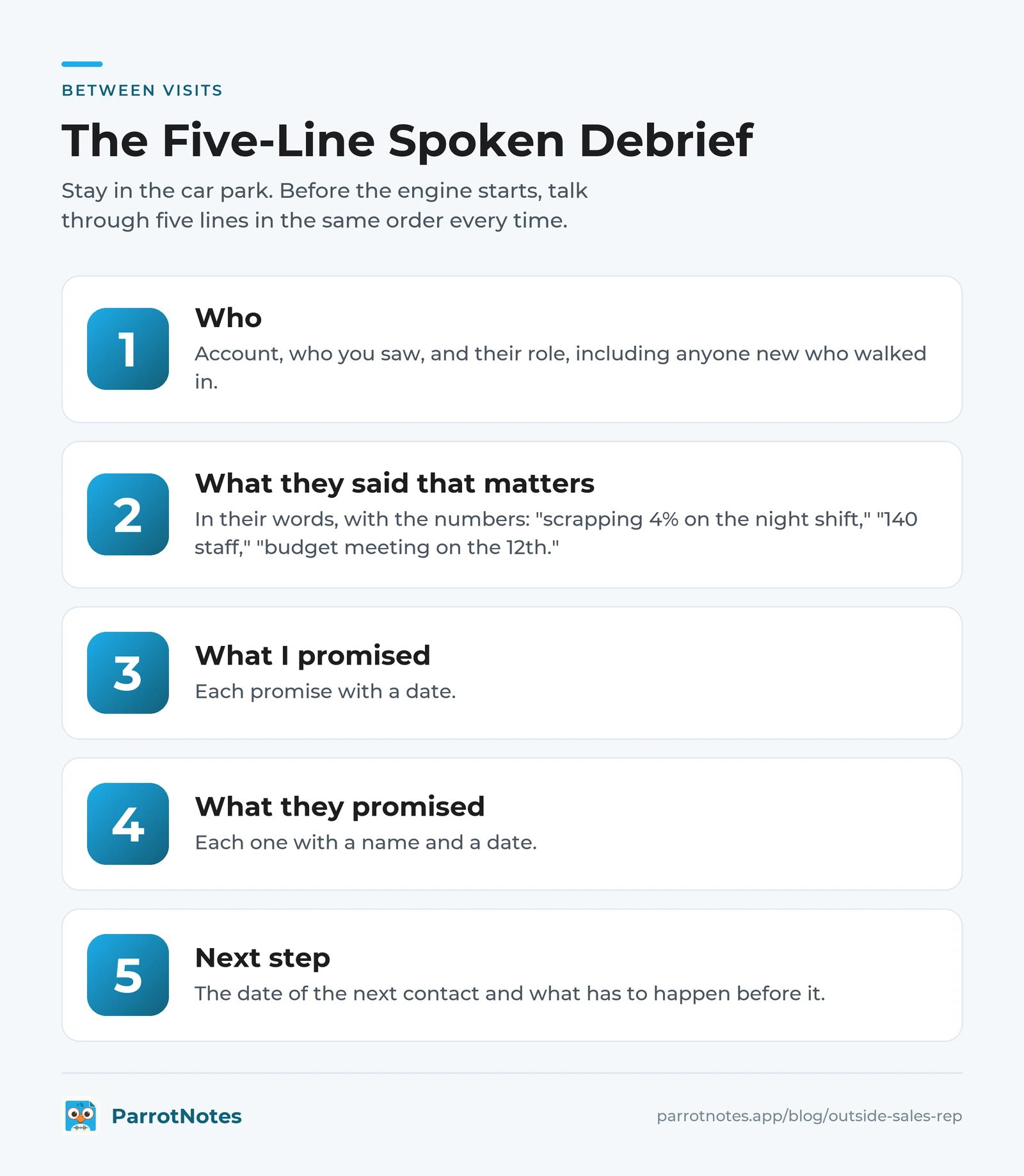
Stay in the car park. Before the engine starts, talk through five lines in the same order every time:
- Who. Account, who you saw, and their role, including anyone new who walked in.
- What they said that matters. In their words, with the numbers: "scrapping 4% on the night shift," "140 staff," "budget meeting on the 12th."
- What I promised. Each promise with a date.
- What they promised. Each one with a name and a date.
- Next step. The date of the next contact and what has to happen before it.
Three minutes spoken beats twelve minutes typed at 9 PM, and it happens while you still remember who said what. The five lines are also the skeleton of the CRM update and the follow-up email, so nothing gets written twice.
Where ParrotNotes fits
ParrotNotes is built for exactly this gap. Open the app, press record, and say the five lines. Recording keeps going with the screen locked, so the phone sits in its mount while you talk. When you stop, you get a transcript, an AI summary, and a list of action items, so lines 3 and 4 are already pulled out with owners and dates.
Recording works in a car park with no signal; transcription and the AI run once you're back in coverage, often before you've parked at the next stop. ParrotNotes also drafts the follow-up email from the debrief, so "two-year price hold, I'll confirm by Thursday" reaches the buyer in writing the same afternoon. Our follow-up email templates include a 60-second car-park dictation script, and our guide to capturing action items from sales calls covers what to do when a promise has two owners.
If the customer is happy for the meeting itself to be recorded, the transcript becomes line 2 in their exact words. Ask before you press record, every time, and skip it if anyone hesitates; laws on recording conversations vary by state and country, and this isn't legal advice. A debrief you dictate alone in the car needs none of that. Recordings and transcripts are encrypted in transit and at rest; the details are on our security page.
Want to try it between tomorrow's first two visits? Download ParrotNotes free. The free plan gives you 100 minutes of recording a month, up to 30 minutes per recording, with an AI summary on every recording and AI insights, including action items, on five recordings a month. Pro is $19.99 a month, or $14.99 a month billed annually, with 3,000 minutes a month, recordings up to 3 hours, and sales frameworks (BANT, MEDDIC, SPIN) applied to every recording.
Planning a territory: a worked coverage plan
Every outside sales rep guide says "manage your territory." Few show the arithmetic. Here it is, worked on an invented territory so you can swap in your own numbers. Marcus, the rep, and his 80 accounts don't exist; the method does.
Step 1: tier the accounts by how often they need a visit, not by size alone. An A account is one where a missed month costs you something: a large customer with a live project, a distributor who reorders weekly, a prospect in an active buying cycle.
| Tier | Accounts | Visit frequency | Visits a month |
|---|---|---|---|
| A | 12 | Twice a month | 24 |
| B | 28 | Monthly | 28 |
| C | 40 | Every other month | 20 |
| Total | 80 | 72 |
Step 2: add prospecting. Marcus's manager wants eight new-logo first meetings a month. That makes 80 visits a month, or about 18 a week.
Step 3: turn visits into days. At four booked visits a day plus one walk-in, Marcus needs four road days a week and can hold one as a flex day for the office, ride-alongs, and the visits that slip. Here's the week, with the debrief slot written in, because a route without it is a plan to forget things.
| Day | Zone | Stops | Debrief slots |
|---|---|---|---|
| Monday | North (two A, two B, one walk-in) | 5 | 5 × 3 minutes in the car |
| Tuesday | East (one A, three B, one new logo) | 5 | 5 × 3 minutes |
| Wednesday | Flex: office, pipeline review, two slipped visits, a ride-along with the new hire | 2 | 2 |
| Thursday | South (two A, two C, one new logo) | 5 | 5 × 3 minutes |
| Friday | West (one A, three C, one walk-in), finish by 3 for the weekly CRM sweep | 5 | 5 × 3 minutes |
Twenty-two stops, 22 debriefs, about 66 minutes of talking across the week, and a Friday CRM sweep that reads notes instead of reconstructing them.
Step 4: zone by geography, re-tier by quarter. Group the days by area, not by tier, so two hours of driving stay two hours. A C account that starts a project becomes an A; an A that signed a three-year deal may drop to B.
Starting in outside sales: a 30-60-90 day plan
Many people searching for what an outside sales rep does are about to become one. If that's you, here's a plan for the first three months that focuses on habits, not heroics. Marcus again, and again invented.
| Days | Goal | What to do | What to write down |
|---|---|---|---|
| 1 to 30 | Learn the territory and the product | Ride-alongs with two experienced reps; visit every A account with your manager or the outgoing rep; learn the price list and the top ten objections | A one-page card per A account: people, history, open issues, what they buy and when. Start the five-line debrief on day one, even on ride-alongs |
| 31 to 60 | Run the route alone | Build the tiered coverage plan from the real account list; book your own weeks; make your first new-logo calls | Every visit debriefed within ten minutes; a weekly list of promises made and kept; the objections you couldn't answer, for your one-on-one |
| 61 to 90 | Own the pipeline | Review the tiers with your manager; forecast your first quarter from the debriefs, not from memory; ask for the accounts the plan says you have room for | A pipeline where every next step has a date, and a note behind every stage change |
The first-30-days habit matters more than any other line in the table. A rep who debriefs every visit from day one arrives at the 90-day review with three months of evidence about the territory. A rep who doesn't arrives with impressions.
The job happens in the room, the month happens in the car
An outside sales rep sells where the customer is, and everything about the role follows from that: the travel, the longer conversations, the base-plus-commission pay, the exempt status, and the notes that get written after the meeting instead of during it.
The short version:
- An outside sales rep sells in person across a territory; the BLS describes the job as traveling to and visiting current clients and prospective buyers
- Pay is mostly base plus commission: a BLS median of $76,460 in May 2025, and an Indeed average of $86,351 plus $22,560 commission in September 2026
- A typical day is four to six visits with driving between them, and the ten minutes after each visit decide how long the evening takes
- Tier your accounts, turn the tiers into visits a month, and route by geography with a debrief slot after every stop
- Say the five-line debrief before the engine starts, from day one
Think back to Priya at 9:30, in the car outside the distributor with three promises fresh in her head. Download ParrotNotes free, press record, and say the five lines before you pull out. By the time you park at the next stop, the notes, the action items, and the follow-up email are done, and the evening is yours.
Frequently Asked Questions
What does an outside sales rep do?
An outside sales rep travels to customers and prospects in an assigned territory to sell in person: discovering needs, demonstrating products, quoting prices and terms, negotiating, and closing. Between visits they prospect, look after existing customers, and record what happened in a CRM. The BLS describes them as spending "much of their time traveling to and visiting with current clients and prospective buyers."
How much does an outside sales rep make?
Indeed's salary page, updated September 20, 2026, shows an average base of $86,351 a year plus $22,560 in commission for outside sales representatives. The BLS reports a May 2025 median of $76,460 for wholesale and manufacturing sales representatives, rising to $104,920 for technical and scientific products. Most employers pay a mix of salary and commission or bonus, so the split matters as much as the headline.
Is an outside sales rep the same as a field sales rep?
Yes. Outside sales rep, field sales rep, and territory rep describe the same job: selling face to face at the customer's site rather than by phone from a desk. Titles vary by industry, and some companies use account manager or territory manager for the same role. The BLS groups them under wholesale and manufacturing sales representatives.
What does "exempt" mean for an outside sales rep?
It refers to the Fair Labor Standards Act exemption for outside sales employees. Under DOL Fact Sheet #17F, an employee whose primary duty is making sales and who is customarily and regularly engaged away from the employer's place of business is exempt from federal minimum wage and overtime rules, with no salary threshold. Phone and online sales don't count unless they support in-person calls. This isn't legal advice; check your state's rules.
Do you need a degree to be an outside sales rep?
Often not. The BLS says a high school diploma is typically enough for nontechnical products, while scientific and technical products, such as industrial equipment, pharmaceuticals, and medical instruments, usually require a bachelor's degree. Many companies train new reps on the road through ride-alongs with experienced reps before assigning them a territory.
Related Posts
What Is B2B Sales? A Plain Guide for New Reps
What is B2B sales? A plain-English guide for new reps: B2B vs B2C, the seven-stage cycle, who does what, a first-30-days checklist and a jargon decoder.
Solar Sales: How Closers Keep Track of Every Household
What solar sales is, how closers work, and an eight-field household record for every in-home consultation, plus the follow-up and referral rhythm. Copy it.

Sales Pitch Examples for In-Person Meetings
Eight sales pitch examples written for meetings in the room: structure, filled-in script, when each works, and a 90-second debrief to capture the reaction.