
One-on-One Meeting Template for Managers

Sarah Johnson
Writes about field sales, meeting notes and voice-first workflows at ParrotNotes. Every article is reviewed by the ParrotNotes product team before it goes live.
Table of Contents
- 1.What a one-on-one meeting template should include
- 2.The one-on-one meeting template (copy and fill)
- 3.The template filled in: two consecutive weeks
- 4.How to run the one-on-one meeting agenda in 30 minutes
- 5.Keep private notes private
- 6.Fill the last two sections in three minutes
- 7.One-on-one mistakes the template prevents
- 8.Copy the one-on-one meeting template before Monday
It's 4:30 on a Thursday, and Nadia is walking into her seventh one-on-one of the week. Ben, on her support team, opens with a question: "Did you hear back about the training budget?" She promised to ask last Tuesday. She didn't write it down, so she didn't ask, and now the first five minutes of a 30-minute meeting are an apology.
Most managers run more one-on-ones than any other meeting and prepare for them least. It's short, it repeats, and it has no agenda unless someone writes one, so it drifts into a status update. A one-on-one meeting template only fixes that if it's built the way the meeting works.
This guide gives you one: a single running document per direct report, six sections, the newest week at the top, with the shared agenda and your private notes kept apart. You'll see it filled in for two consecutive weeks so the carry-over rule is visible, get eight questions for the section your report owns, and finish with a three-minute spoken debrief that fills the last two sections before your next meeting starts.
Want the template first? It's two sections down. And if you'd rather say the debrief than type it, you can try ParrotNotes free before Monday's first one-on-one.
What a one-on-one meeting template should include
A one-on-one is different from every other meeting on your calendar. It has two people, it recurs, the same topics run for months, and half of what you learn in it is not for sharing. A template built for a team meeting does not fit; our meeting agenda template guide covers those. This one is for the meeting with one person.
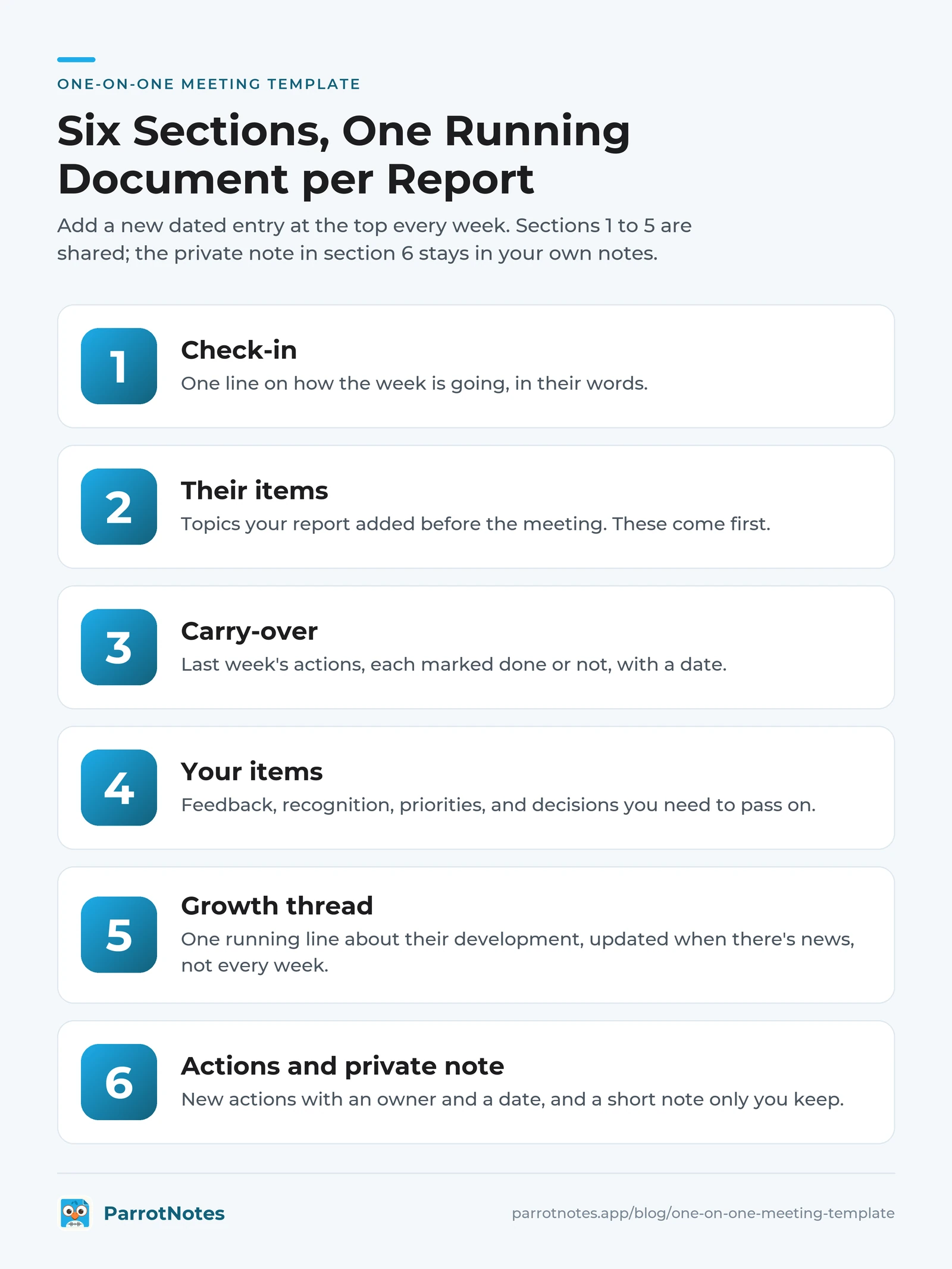
A one-on-one meeting template needs six sections:
- Check-in. One line on how the week is going, in their words.
- Their items. Topics your report added before the meeting. These come first.
- Carry-over. Last week's actions, each marked done or not, with a date.
- Your items. Feedback, recognition, priorities, and decisions you need to pass on.
- Growth thread. One running line about their development, updated when there's news, not every week.
- Actions and private note. New actions with an owner and a date, and a short note only you keep.
The shape matters as much as the sections. Keep one document per report, shared with them, and add a new dated entry at the top every week. Sections 1 to 5 belong to both of you; either of you can write in them before the meeting. Section 6 splits: the actions are shared, and the private note lives in your own notes, never in the shared document.
That split is the part most templates skip. A shared document that also holds your private observations either stops being honest or stops being shared. Keep them apart from the first week.
The one-on-one meeting template (copy and fill)
Copy this into whatever you and your report both use: a shared doc, a wiki page, a note in your task tool. Put the newest week at the top so the last entry is one scroll away.
ONE-ON-ONE: [Manager] and [Report]
Cadence: weekly, [day and time], 30 minutes
Shared with: [Report]. Section 6 private note is kept separately.

=== Week of [date] ===

1. CHECK-IN (2 min)
   How's the week going, in one line:

2. THEIR ITEMS (10 min)  [added by the report before the meeting]
   -
   -
   -

3. CARRY-OVER (5 min)  [actions from last week]
   [ ] Action / owner / due / status

4. YOUR ITEMS (8 min)  [manager]
   Recognition:
   Feedback:
   Priorities or decisions to pass on:

5. GROWTH THREAD (5 min, when there's news)
   Current goal:
   Last step taken:
   Next step:

6. ACTIONS (shared)
   [ ] Action / owner / due
   [ ] Action / owner / due

   PRIVATE NOTE (manager only, kept outside this document)
   Pattern noticed:
   Raise next time:
   Recognition to give publicly:
Notes on each section
Check-in is one line, and it's theirs to write. "Fine" is a data point too; three "fines" in a row is a section 6 private note.
Their items go first because the meeting is theirs. If the section is empty when you sit down, don't fill it with your own topics. Ask one of these instead, and write the answer in:
- What's taking more of your time than it should?
- What decision are you waiting on from me or anyone else?
- What did you do this week that nobody noticed?
- Where are you stuck, and what have you tried?
- Is anything about how we work together getting in your way?
- What would you drop from your plate if you could?
- Who helped you this week?
- What should I know that I probably don't?
Eight is enough for a running one-on-one. Rotate through them; don't ask all eight in one sitting.
Carry-over is the section that makes this a running document rather than a weekly blank. Every action from last week's section 6 is copied here with its status before the meeting starts.
Done gets a date. Not done gets a new date or gets dropped on purpose, with a word on why. Nothing is quietly forgotten.
Your items hold what you owe them: recognition first, then feedback, then anything coming down from above. If the feedback needs a longer, separate conversation, write "separate conversation booked" here and book it.
Growth thread is one goal, the last step, and the next step. It stays the same line for weeks at a time. That's the point: when the next step hasn't moved in a month, the section says so without anyone having to remember.
Actions and private note are filled in after the meeting, not during it. The actions go into the shared document; the private note goes into your own notes under the report's name. The debrief script below covers both in three minutes.
The first one-on-one with a new employee
For the first meeting with a new report, swap two sections. Replace carry-over with working preferences (how they like to get feedback, when they do their best work, what their last manager did that helped) and replace the growth thread with what good looks like at 90 days, written together. From week two, the standard template takes over, and the 90-day line becomes the first growth thread.
The template filled in: two consecutive weeks
The two weeks below are invented to show the carry-over rule doing its job. Nadia, Ben, the team, and the numbers don't exist.
Nadia runs a customer support team of eight. Ben handles escalations. Their one-on-one is Tuesdays at 2:00 PM.
Week of September 15
1. Check-in. "Busy but fine. Escalation queue is up since the billing change." 2. Their items. Training budget for the advanced ticketing course (about $600). Whether the Friday shift swap with Priya can become permanent. 3. Carry-over. [x] Nadia to share the new escalation rubric / Nadia / Sept 9 / done Sept 10. [ ] Ben to draft the macro for billing refunds / Ben / Sept 12 / not done, queue too heavy, new date Sept 19. 4. Your items. Recognition: the way Ben handled the Monday outage thread, calm and clear, two customers replied to say thanks. Feedback: replies to internal questions in the team channel are taking a day; aim for same day, even if the answer is "not yet". Priorities: the billing change is the team's top item until the end of the month. 5. Growth thread. Current goal: lead the escalation process by Q1. Last step: shadowed Nadia on two escalation reviews. Next step: run one review alone in October. 6. Actions. [ ] Nadia to ask finance about the $600 course / Nadia / Sept 19. [ ] Ben to write up the Friday swap proposal in three lines / Ben / Sept 19. [ ] Ben to draft the billing refund macro / Ben / Sept 19. Private note (Nadia's own notes). Pattern: second week running that queue volume pushed Ben's own tasks; check whether the escalation load is fair across the team. Raise next time: the October solo review, does he want it earlier? Recognition to give publicly: outage thread, mention at Thursday's team meeting.
Week of September 22
1. Check-in. "Better. Queue is back to normal." 2. Their items. Wants to swap the October solo review for one in the last week of September, while the billing cases are fresh. 3. Carry-over. [x] Nadia to ask finance about the course / done Sept 18, approved, Ben to book it. [x] Ben's Friday swap proposal / done Sept 18, Nadia to approve, see actions. [x] Billing refund macro / done Sept 19, in review with Priya. 4. Your items. Recognition: the macro was done on the new date, and the Thursday team meeting shout-out landed. Feedback: none new; internal replies were same-day all week. Priorities: none new. 5. Growth thread. Current goal: lead the escalation process by Q1. Last step: shadowed two reviews. Next step: solo review moved to September 30 at Ben's request. 6. Actions. [ ] Ben to book the ticketing course / Ben / Sept 26. [ ] Nadia to approve the Friday swap with Priya / Nadia / Sept 24. [ ] Ben to run the September 30 escalation review alone, Nadia to observe the write-up / both / Sept 30. Private note. Pattern: Ben brought the solo-review date forward himself, which is what the growth thread was waiting for. Raise next time: what he'd want from the review write-up. Queue load: normal this week, keep watching.
Look at what the second week inherits. Three actions came in as carry-over with a status each, and the one Ben missed in week one was done on its new date instead of vanishing. The growth thread moved because Ben moved it. And the private note from week one, the question about escalation load, is still open in week two, in Nadia's notes, not in a document Ben reads.
How to run the one-on-one meeting agenda in 30 minutes
The section timings in the template add up to 30 minutes. Here's the same thing as a run sheet.
| Minutes | Section | Who leads |
|---|---|---|
| 0 to 2 | Check-in | Report |
| 2 to 12 | Their items | Report |
| 12 to 17 | Carry-over | Manager reads, report updates |
| 17 to 25 | Your items | Manager |
| 25 to 30 | Growth thread | Both, when there's news |
| After | Actions and private note | Manager, in the three minutes after |
Thirty minutes every week beats an hour every month. Gallup's advice in a great manager's most important habit is that "between 15 and 30 minutes is enough time for a meaningful conversation, but only if it happens frequently," and that "15- to 30-minute conversations have a greater impact than 30- to 60-minute conversations if they occur regularly." The same article reports that 80% of employees who say they received meaningful feedback in the past week are fully engaged, while only 16% said their last conversation with their manager was extremely meaningful. Section 4 holds recognition, feedback, and priorities for that reason: those are among the topics Gallup names as making a conversation meaningful.
Most managers already have the cadence. Lattice's 2025 State of People Strategy Report found that "most managers (78%) have daily or weekly check-ins with direct reports, and of those, 97% say they feel somewhat or very connected to direct reports." The gap is rarely the meeting. It's what happens to the promises made in it.
When the one-on-one turns into a status update
Picture Rowan, who manages a marketing team of five. His one-on-ones run 30 minutes, and 25 of them are the report reading out what they did this week, which he already knows from the project board.
The fix is in section 2. Status is not an item. If a report has nothing but status to bring, ask one of the eight questions and write the answer in as their item. Within a few weeks the section fills itself, because they know it's the part of the week where the manager listens.
When you have to cancel
Elena runs a team of nine and had a launch week. She cancelled four one-on-ones on Monday morning, meaning to catch up. Two weeks later, three reports had carry-over actions nobody had looked at, and one had a growth thread whose next step had passed.
Move a one-on-one; don't cancel it. If it has to go, spend three minutes on the running document anyway: update the carry-over and send one line: "Moved to Thursday. Your items from last week are still on top; add anything new." The document keeps the thread when the calendar can't.
Sales managers coaching field reps have a variant of this meeting, run from meeting records rather than self-report; the 30-minute agenda for that is in our guide to AI sales coaching. Nurse managers running one-on-ones without patient data will find a 30-question bank in our nurse manager guide.
Keep private notes private
The private note is the part of the template that earns its keep over months. It is also the part that needs rules.
What belongs in it:
- Patterns across weeks ("third week that the queue ate their own tasks")
- Coaching threads you're working on and haven't raised yet
- Recognition to give publicly, so it doesn't stay in the room
- Questions for your own manager that came out of the conversation
- What to raise next time, so section 4 is ready before you open the document
What never belongs in it: anything your report told you about their health, family, or personal life beyond what you need to do your job; anything relating to a formal HR process, which has its own record and rules; and anything you wouldn't be comfortable with the report reading, because notes get forwarded and found. Your company's policy decides what a manager may keep and where. If in doubt, keep less.
Keep the private note in your own notes, under the report's name, one entry per week. If you keep it in ParrotNotes, it sits in your own account; you can read how we protect your data before you do.
Fill the last two sections in three minutes
Section 6 is where one-on-ones fail. The meeting ends at 2:30, the next one starts at 2:30, and the actions live in your head until 6:00 PM, when two of the four are gone. Nadia's forgotten training-budget question was a section 6 that never got written.
So don't write it. Say it. Before you open the next meeting, stay in the room (or step into the corridor), open ParrotNotes, hit record, and talk through the last two sections in this order:
1. One-on-one with [name], [date]. 2. Actions for them: [action, due date], [action, due date]. 3. Actions for me: [action, due date]. 4. Growth thread: [changed / unchanged], next step is [step]. 5. Private note: pattern [what you noticed], raise next time [topic], recognise publicly [what]. 6. Anything I promised to find out: [item].
Three minutes, six lines. When you stop, you get a transcript, an AI summary, and the action items pulled out as a list with owners and dates, so the shared actions paste into the running document and the private note stays in your own notes. Recording keeps going with the screen locked, so the phone can sit in your pocket while you walk to the next room.
Recording the one-on-one itself is a different matter, and it isn't the default. A one-on-one is a private conversation. Only record it if your report clearly wants a record too, for example to capture a career conversation they've asked for, and never for a feedback or HR conversation. Ask before you press record, every time, and drop it if they hesitate.
In the United States, federal law permits recording a conversation you're part of (18 U.S.C. § 2511(2)(d)), but some states and countries require everyone's consent, and your company may have its own policy. This isn't legal advice. The three-minute debrief you dictate alone needs none of it.
Want to try it on Monday's one-on-ones? Download ParrotNotes free. The free plan gives you 100 minutes of recording a month, up to 30 minutes per recording, with an AI summary on every recording and AI insights on five recordings a month, which covers a week of three-minute debriefs. Pro is $19.99 a month, or $14.99 a month billed annually, with 3,000 minutes a month, recordings up to 3 hours, and AI chat for asking "what did I promise Ben in September?" in December.
For team meetings with several people in the room, the shorthand key and the tidy-and-send routine in our meeting notes template guide do the same job the debrief does here.
One-on-one mistakes the template prevents
Picture the same two weeks with a blank page each time. Every manager will recognise the list.
- The promise without a home. "I'll ask finance" is said, not written, and the report asks about it two weeks running.
- The action that vanishes. It was missed in week one, and there's no carry-over section to make it reappear in week two, so it's gone.
- The growth conversation that happens once a year. Without a running thread, development comes up in the review and nowhere else.
- The shared document that stops being honest. The manager's observations sit where the report can read them, so the manager stops writing them.
None of these is a management mistake. They're record mistakes, and the record takes three minutes.
Copy the one-on-one meeting template before Monday
A one-on-one is the meeting where the small promises live, and small promises are the ones that get dropped. The template above is built so nothing said on Tuesday has to be remembered on Thursday.
The short version:
- Keep one running document per report, newest week on top, shared with them
- Six sections: check-in, their items, carry-over, your items, growth thread, actions
- Their items come first; status is not an item
- Carry-over gives every missed action a second life with a new date
- Keep your private note in your own notes, never in the shared document
- Fill section 6 by saying it, in three minutes, before the next meeting starts
Think back to Nadia at 4:30 on Thursday, opening with an apology about a question she never asked. With the template, "ask finance about the course" was an action with her name and a date, dictated in the corridor at 2:31 the Tuesday before. Download ParrotNotes free, copy the six sections into a document for each of your reports, and dictate your first debrief after Monday's one-on-one.
Frequently Asked Questions
What should a one-on-one meeting template include?
Six sections: a one-line check-in, the report's own items (first), carry-over of last week's actions with a status each, the manager's items (recognition, feedback, priorities), a running growth thread, and new actions with an owner and date. Keep it as one running document per report, newest week on top, and keep the manager's private notes outside the shared document.
How long should a one-on-one meeting be?
Thirty minutes a week works for most manager and report pairs. Gallup's guidance is that 15 to 30 minutes is enough for a meaningful conversation if it happens frequently, and that shorter regular conversations have more impact than longer occasional ones. If you meet every two weeks instead, allow 45 minutes, and keep the running document so the carry-over is not lost between meetings.
Who sets the agenda for a one-on-one meeting?
The report does, first. Their items come before the manager's in the template, and they add them to the shared document before the meeting. The manager brings recognition, feedback, and priorities in their own section, and reads the carry-over. If the report's section is empty, the manager asks one open question and writes the answer in rather than filling the time with status.
How do I prepare for a one-on-one with my manager?
Use the same template from your side. Add two or three items to your section before the meeting: a decision you're waiting on, something that's taking too much time, or something you did that nobody saw. Check the carry-over and update the status of your own actions. Bring the growth thread up yourself if it hasn't moved in a month; a good manager will thank you for it.
Should you record a one-on-one meeting?
Not by default. A one-on-one is a private conversation, so only record it if your report clearly wants a record too, ask first every time, and never record a feedback or HR conversation. Laws on recording vary by state and country, and your company may have its own policy. The easier habit is to dictate a three-minute debrief alone after the meeting, which captures the actions and your private note without recording anyone.
Related Posts
What Is B2B Sales? A Plain Guide for New Reps
What is B2B sales? A plain-English guide for new reps: B2B vs B2C, the seven-stage cycle, who does what, a first-30-days checklist and a jargon decoder.
Solar Sales: How Closers Keep Track of Every Household
What solar sales is, how closers work, and an eight-field household record for every in-home consultation, plus the follow-up and referral rhythm. Copy it.

Sales Pitch Examples for In-Person Meetings
Eight sales pitch examples written for meetings in the room: structure, filled-in script, when each works, and a 90-second debrief to capture the reaction.