
MEDDIC Sales Process: A Step-by-Step Guide for Field Teams

Sarah Johnson
Writes about field sales, meeting notes and voice-first workflows at ParrotNotes. Every article is reviewed by the ParrotNotes product team before it goes live.

Table of Contents
- 1.What is the MEDDIC sales process?
- 2.Why MEDDIC works better as a process than a checklist
- 3.The MEDDIC sales process in five stages
- 4.What counts as evidence for each MEDDIC letter
- 5.Running a weekly MEDDIC deal review
- 6.How field reps keep the MEDDIC process up to date between visits
- 7.Run your next deal through the stages
Renee runs a field team of nine. On Thursday she opens the CRM for her weekly deal review and finds the same thing she found last month: every big deal has all six MEDDIC boxes ticked. Metrics, yes. Economic buyer, yes. Champion, yes.
Two of those deals haven't moved in seven weeks.
The boxes answer the wrong question. A ticked box says a rep heard something about a letter. It doesn't say from whom, or whether the deal has earned the next stage.
That's the difference between knowing MEDDIC and running a MEDDIC sales process. The acronym tells you what to find out. The process tells you which meeting should find it, what counts as proof, and what must be true before a deal moves on.
This guide is the process, built for reps who sell in person and managers who rarely ride along: a five-stage map, an evidence table for all six letters, and a 10-minute deal-review script, with one field deal running through all of it.
If you already debrief after visits, try ParrotNotes free: talk through the meeting in the car and you'll have a transcript and summary before the next stop.
What is the MEDDIC sales process?
The MEDDIC sales process is a way of qualifying and advancing complex B2B deals by collecting evidence on six elements, stage by stage, until the deal is either proven or dropped. The six elements are Metrics, Economic buyer, Decision criteria, Decision process, Identify pain and Champion.
Here they are in one line each. For every letter explained on a worked deal, see our MEDDPICC guide.
| Letter | Element | The question in one line |
|---|---|---|
| M | Metrics | What number will this change, and by how much? |
| E | Economic buyer | Who can say yes to the money? |
| D | Decision criteria | What will they judge every option against? |
| D | Decision process | What steps turn "we like it" into a decision? |
| I | Identify pain | What's the problem, and what does it cost to leave it? |
| C | Champion | Who sells for you when you're not in the room? |
MEDDIC came out of the software company PTC in the 1990s. The training company MEDDICC's account of who created MEDDIC says it "was created in 1996 inside PTC by Dick Dunkel, working under SVP John McMahon alongside teammate Jack Napoli." Other accounts give a different year.
For screening a first call, a lighter method like BANT qualification does the job. MEDDIC earns its place once several people, real money and a formal purchase are involved.
Why MEDDIC works better as a process than a checklist
Most guides say the six letters aren't sequential. That's true of the framework, not of your calendar. In a field deal, the letters arrive in a fairly steady order, because different people answer at different meetings.
Pain comes first, from the person who lives with it. Metrics follow once someone trusts you with numbers. The economic buyer's name often comes from one well-placed question. Criteria sharpen after a demo or trial. The decision process only becomes clear near the proposal.
A checklist treats all six as equal on day one. A process asks which letters should be solid at this stage, and which can still be thin. A deal in proposal with no economic buyer isn't in proposal, whatever the CRM says.
The MEDDIC sales process in five stages
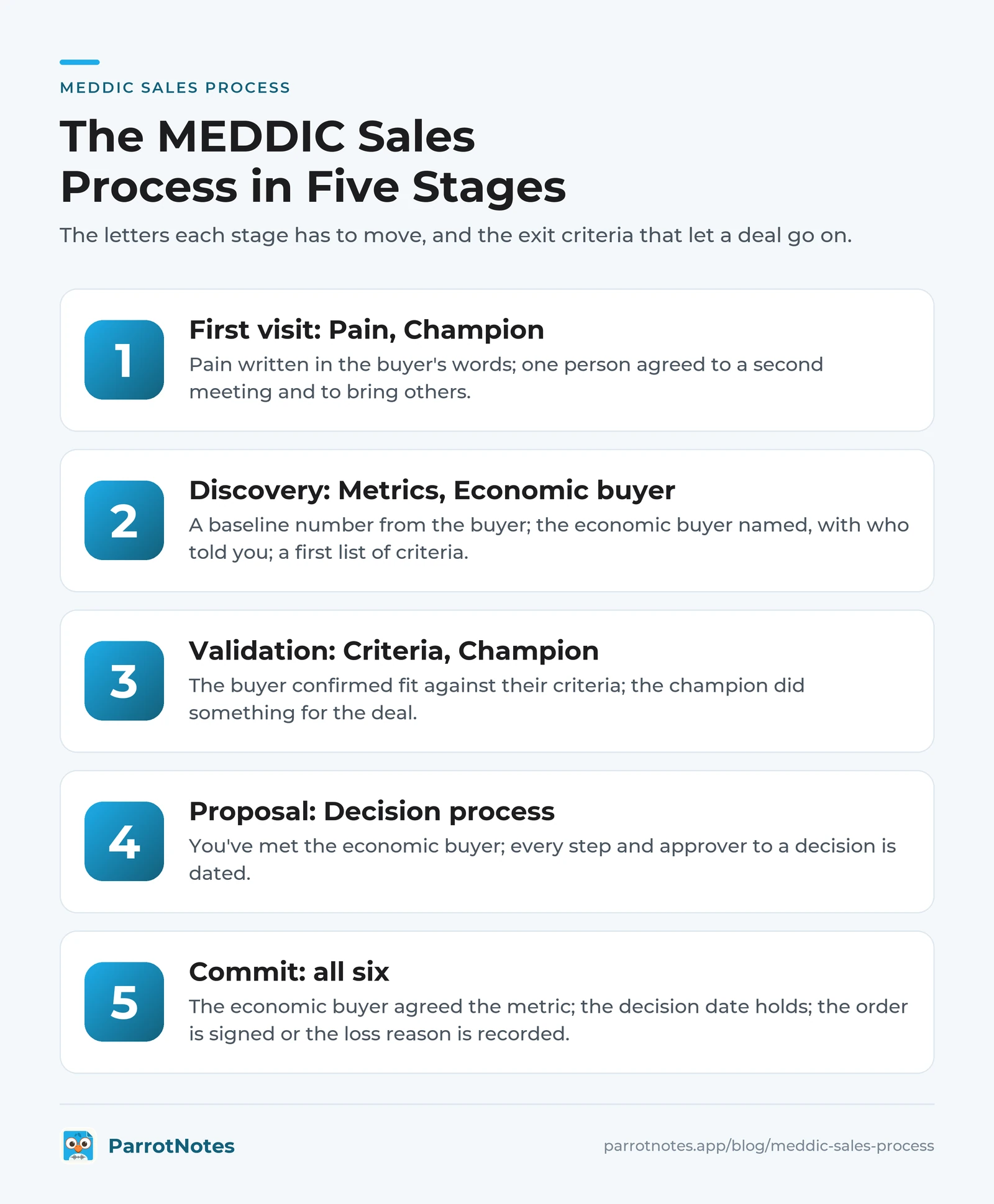
Here's the stage map: the letters each stage has to move, and the exit criteria that let a deal go on. Rename the stages to match your CRM; keep the exit criteria.
| Stage | Letters to fill | Exit criteria (all must be true) |
|---|---|---|
| 1. First visit | Identify pain, Champion (candidate) | Pain written in the buyer's words; one person agreed to a second meeting and to bring others |
| 2. Discovery | Metrics, Economic buyer, Decision criteria | A baseline number from the buyer; the economic buyer named, with who told you; a first list of criteria |
| 3. Validation | Decision criteria, Champion, Metrics | The buyer confirmed fit against their criteria; the champion did something for the deal |
| 4. Proposal | Economic buyer, Decision process | You've met the economic buyer; every step and approver to a decision is dated |
| 5. Commit | All six | The economic buyer agreed the metric; the decision date holds; the order is signed or the loss reason is recorded |
For generic stage design, see our guide to sales pipeline stages.
The deal we'll follow
Luis is a territory rep for a maker of commercial floor-cleaning machines. His prospect is a 14-store grocery chain we'll call Harvest Lane, whose night crews use old walk-behind scrubbers. He's proposing a fleet of ride-on scrubbers, about $290,000 all in. Harvest Lane, Luis and every number below are an illustration, not a real account.
Stage 1: First visit
Letters to fill: Identify pain, and a champion candidate.
Luis meets Kim, the chain's facilities manager, at the busiest store at 6 a.m. She shows him a floor that's still wet when the doors open. "The night crew runs out of time before they finish the back aisles," she says.
That sentence is the pain. Kim is a champion candidate, not a champion. She hasn't done anything for the deal yet.
Exit criteria: the pain written down as Kim said it, and Kim agreeing to a second meeting with the store operations lead.
Stage 2: Discovery
Letters to fill: Metrics, Economic buyer, Decision criteria.
Discovery stalls when reps ask about features instead of numbers and people. Our guide to running a discovery call in person covers the conversation. For MEDDIC, three questions carry the stage:
- "How many labor hours does the night crew spend on floors each week?"
- "The last time the chain bought equipment at this price, who signed off?"
- "If you compared three machines side by side, what would decide it?"
Kim's answers: roughly 40 crew hours per store per week on floors, and anything over $100,000 goes to Marcus, the VP of operations. Her criteria: run time on one charge, turning radius for narrow aisles, and next-day service.
Exit criteria: a baseline metric from the buyer, the economic buyer named with its source (Kim, second visit), and a written criteria list.
Stage 3: Validation
Letters to fill: Decision criteria, Champion, Metrics.
Validation is a demo, a trial or a site visit. The point is to test your fit against the buyer's criteria and to see whether your champion will act.
Luis runs a two-week trial at one store. The crew finishes the floors in 26 hours instead of 40. Kim emails both results to Marcus and asks Luis to present them. That email is the champion test: a real champion spends their own credibility on your deal.
Exit criteria: fit confirmed against the buyer's criteria, the metric measured on site (14 hours saved per store per week), and a champion action that cost Kim something.
Stage 4: Proposal
Letters to fill: Economic buyer, Decision process.
Luis meets Marcus for 25 minutes. Marcus cares less about floors than about the labor budget. Luis asks, "What has to happen between today and a signed order?" Marcus lists it: a finance review of the payback, a store managers' meeting on October 20, then his signature, with machines in before the holidays.
Luis writes each step down with its owner and date. With more than two approvers, a mutual action plan makes this map shared rather than private.
Exit criteria: you've met the economic buyer, and every step and approver between today and a decision is named and dated.
Stage 5: Commit
Letters to fill: all six, at full strength.
Marcus agrees the 14-hour figure after finance checks it. The store managers' meeting happens on the date. Harvest Lane signs for 14 machines on November 3.
Exit criteria: a signed order, or a lost reason in the buyer's words. Both count. A deal stuck in commit for weeks is a stage-4 deal wearing the wrong label.
When to add Paper process and Competition
Many teams run MEDDPICC, which adds two letters: Paper process (supplier setup, legal review, purchase order) and Competition, including doing nothing. Both slot into the stage map without changing its shape. Competition sits in discovery and validation, next to decision criteria. Paper process sits in proposal, next to decision process, because it's the part of the timeline that sinks deals nobody saw coming.
Our MEDDPICC guide walks through both on a worked deal, and a stakeholder map shows who owns each paper step.
What counts as evidence for each MEDDIC letter
A letter counts only when you can say who told you and when. The next step is grading that evidence: "Kim mentioned Marcus" and "Marcus confirmed he signs" are both sourced, but not equally strong.
Use three levels. Heard means one person told you. Confirmed means a second source or a document backs it up. Proven means the buyer acted on it.
| Letter | Heard | Confirmed | Proven |
|---|---|---|---|
| Metrics | The buyer gave an estimate | The buyer shared their own report or data | The buyer measured it in a trial and agreed the number |
| Economic buyer | Someone named the person who signs | A second person or a policy document confirms it | You've met them and they discussed budget with you |
| Decision criteria | A contact listed what matters | The list is written down and shared by the buyer | The buyer scored you against it after a demo or trial |
| Decision process | A contact described the steps | Steps have owners and dates | The buyer is hitting the dates |
| Identify pain | One person described the problem | The cost of the problem is quantified | The economic buyer names the pain as a priority |
| Champion | Someone is friendly and responsive | They give you information you couldn't get elsewhere | They act for you: arrange meetings, share documents, sell internally |
Now the stage map gets sharper. At stage 2, "heard" is fine for the economic buyer. By stage 4, it has to be proven. A deal where the champion is still at "heard" in stage 3 has a friendly contact, not a champion.
To see whether stricter stages change your results, the free win rate calculator turns won and lost counts into a rate you can track.
Running a weekly MEDDIC deal review
The MEDDIC process only works if someone checks it. For field teams, that's a weekly deal review about meetings the manager didn't attend. Here's a 10-minute script per deal.
- What changed since last week, by letter (2 minutes). The rep names only the letters that moved, with the source and the date. "Nothing new on decision process" is a fine answer.
- The weakest letter (2 minutes). Which letter has the lowest evidence level for this stage? That's the deal's real status.
- Stage check (2 minutes). Does the deal meet every exit criterion for the stage it's in? If not, move it back. No debate, no blame.
- Next step with the buyer (2 minutes). A dated meeting or action on the buyer's side. "I'll follow up" isn't a next step.
- Keep or drop (2 minutes). Look at the red flags below. Two or more means a hard conversation about whether to keep investing.
Red flags to watch:
- The economic buyer is still at "heard" after the proposal went out
- The only champion has never done anything the rep asked
- The metric came from the rep, not the buyer
- The decision date moved twice
- No one on the buyer's side can describe the steps to a decision
Here's the script in action. Renee reviews a $180,000 deal from Dev, one of her reps, sitting in proposal. On the weakest-letter question, Dev admits the economic buyer is a name from one conversation in August. Renee moves it back to discovery and asks for one thing by next Thursday: ask the champion who signed the last purchase this size.
Dev asks on Tuesday. The answer is a CFO who's never heard of the project. The deal isn't dead, but the forecast is honest. Our guide to improving sales forecast accuracy sets out the wider review cadence.
How field reps keep the MEDDIC process up to date between visits
The weekly review is only as good as the notes behind it. For reps who sell in person, the metric comes out on the shop floor, the economic buyer's name in a corridor, the decision process over lunch. By Friday, the detail is gone.
Salesforce's State of Sales research reports that sales reps spend 60% of their time on non-selling tasks. Rebuilding six letters from memory on Friday is some of the least useful of that time.
The fix is a two-minute spoken debrief in the car. Name the stage, then each letter it needs, with who said it: "Stage 2. Metrics: Kim says 40 crew hours per store per week. Economic buyer: Kim says Marcus signs anything over $100,000."
This is where ParrotNotes fits. Hit record in the car and talk. You get a transcript, an AI summary and your action items, plus a drafted follow-up email. ParrotNotes also includes sales frameworks, MEDDIC among them: apply MEDDIC to a recording and the insights are laid out against the six elements, so a thin letter stands out before the deal review. Frameworks work on five AI-powered recordings a month free, and without limit on Pro.
Want your next debrief laid out by letter? Download ParrotNotes free. The free plan gives you 100 minutes a month and an AI summary on every recording.
Before the store managers' meeting, Luis searches his notes for "finance" and finds what Marcus said about the payback review. On Pro, AI semantic search finds it even when he's forgotten the exact word.
Recording the customer meeting itself, rather than your own debrief? Ask everyone's permission first; the rules vary by state and country.
Run your next deal through the stages
The MEDDIC sales process isn't six boxes. It's a rule for when a deal has earned the next stage:
- Fill the letters in the order your meetings reveal them: pain first, the decision process last
- Move a deal forward only when every exit criterion for its stage is met
- Grade each letter as heard, confirmed or proven, and expect proven by proposal
- Debrief out loud in the car, while the names and numbers are fresh
Back at Renee's Thursday review, the two stuck deals no longer hide behind ticked boxes. They show up as stage-2 deals with a never-met economic buyer, and the next visit has a clear job.
Pick your biggest open deal, place it on the stage map, and find its weakest letter. Then download ParrotNotes free and dictate the debrief after your next visit, before you pull out of the parking lot.
Frequently Asked Questions
What is the MEDDIC sales process?
It's a way to qualify and advance complex B2B deals by gathering evidence on six elements: Metrics, Economic buyer, Decision criteria, Decision process, Identify pain and Champion. You fill specific letters at each stage and move a deal forward only when that stage's exit criteria are met with evidence from the buyer.
What are the stages of MEDDIC?
The framework has no official stages; the letters are elements, not steps. Field teams map them onto their pipeline, for example in five stages: first visit (pain and a champion candidate), discovery (metrics, economic buyer, criteria), validation (criteria and champion tested), proposal (economic buyer met, decision process dated), and commit (all six proven).
Who created MEDDIC?
MEDDIC came from the sales organization at the software company PTC in the 1990s. The training company MEDDICC says it was created in 1996 by Dick Dunkel, working under SVP John McMahon with teammate Jack Napoli. Other accounts give a slightly earlier date and credit a wider PTC leadership team, but all agree on PTC and the decade.
How do you run a MEDDIC deal review?
Give each deal about 10 minutes. Ask what changed by letter, which letter has the weakest evidence, whether the deal meets its stage's exit criteria, what the next dated step on the buyer's side is, and whether red flags suggest dropping it. When evidence is missing, move the deal back a stage instead of debating it.
What's the difference between MEDDIC and MEDDPICC?
MEDDIC is the original six-letter framework. MEDDPICC adds Paper process, the steps between a decision and a signed order, and Competition, which includes doing nothing. Both run on the same stage-by-stage process. Teams selling into companies with procurement and legal review usually get more from the longer version.
Related Posts

Voice Journal App: How to Keep a Spoken Work Journal
Use a voice journal app to keep a spoken work journal: a 3-minute daily prompt set, a 20-minute weekly review, and what to look for in the app. Start today.

Sales Territory Management: A Field Rep's Playbook
Sales territory management for the rep who runs one: a one-row-per-account ledger, visit cadence by tier, and a 40-minute Friday review. Get the template.
Sales KPIs: What to Track and What to Ignore
Sales KPIs sorted into leading and lagging, with formulas, the vanity metrics to drop, and a one-page KPI scorecard for field teams. Build yours this week.