
Factory Acceptance Test (FAT): Checklist and What Sales Should Know

Sarah Johnson
Writes about field sales, meeting notes and voice-first workflows at ParrotNotes. Every article is reviewed by the ParrotNotes product team before it goes live.
Table of Contents
- 1.What is a factory acceptance test?
- 2.FAT vs SAT: what each test proves
- 3.What the sales engineer owns in a factory acceptance test
- 4.Put the FAT scope in the quote: ten lines
- 5.Factory acceptance test checklist
- 6.Notes during the witness test
- 7.The FAT punch list: pass, conditional pass or fail
- 8.Run the test before the test
Three people from a snack maker fly in to watch their new case packer run. Ten minutes into the test, their plant engineer asks to see the 24-count case. The builder only has 12-count parts on the floor.
Priya, the sales engineer, opens her quote. Both formats are in the spec. The only line about testing says "FAT included." Nobody wrote down which formats would run, so the customer's team goes home unhappy, a second trip gets booked, and the ship date slips three weeks. (Priya and the job are invented, to show the pattern.)
A factory acceptance test is usually run by your engineers, and that's why it's easy for sales to treat it as somebody else's job. But a FAT argument often starts in the quote, and it ends in whatever notes someone kept during the test.
This guide gives you a plain definition, the FAT vs SAT difference, a checklist, and the parts other guides skip: the ten lines to put in your quote, what the sales engineer owns, and a note template for witness days. If you'd rather talk those notes into your phone in the parking lot than rebuild them on the flight home, try ParrotNotes free.
What is a factory acceptance test?
A factory acceptance test (FAT) is a planned test of new equipment at the builder's factory, before it ships, to show that it meets the agreed specification. The buyer's team usually comes to watch, which is why you'll hear it called a witness test.
As ISPE guidance puts it, quoted by PQE Group, after the FAT "the owner representative agrees with the vendor whether the system is ready to be shipped or if pre-conditions for shipping have been met."
How long it takes depends on the machine. Vista Projects says an instrumented skid might take a day or two, control system packages often need several days, and complex integrated systems can run a week or more.
For automation systems in the process industry, there's a formal standard. IEC 62381:2024 sets out requirements and checklists for these tests, and aims to help owner, buyer and vendor agree on scope and responsibilities. Many other machines just follow whatever the contract says, so the contract had better say it.
FAT vs SAT: what each test proves
The short version of FAT vs SAT: the factory acceptance test proves the machine was built right, and the site acceptance test (SAT) proves it still works in the buyer's plant. You usually need both, because they catch different problems.
| Factory acceptance test (FAT) | Site acceptance test (SAT) | |
|---|---|---|
| Where | Builder's factory | Buyer's plant |
| When | Before shipment | After installation |
| Proves | Built to spec; functions and safety work | Arrived undamaged; works on real utilities and with connected systems |
| Utilities and product | Often simulated or borrowed | The real thing |
| Who runs it | Builder, buyer watching | Builder and buyer together |
| Usually decides | Whether it ships | Whether it's accepted, and sometimes the last payment |
The utilities row causes the most trouble. PQE Group notes that real conditions for utilities such as compressed air or steam could only be provided during the SAT at the owner's site. So promise only what the factory can actually show, and move the rest to the SAT in writing.
What the sales engineer owns in a factory acceptance test
In a small shop you may do all of this; in a bigger one a project manager takes over at the order. Treat this split as a starting point, not a standard.
| Stage | Sales engineer owns | Someone else owns |
|---|---|---|
| Quote | FAT scope lines, witness days, costs, retest terms | Estimating test hours |
| Order handoff | Walking the project manager through every promise | Project schedule |
| Weeks before | Customer attendee list, travel, what they expect to see | Test protocol, pre-test run |
| Witness days | Customer relationship, notes, spotting out-of-scope asks | Running the machine, recording results |
| Close-out | Same-day recap, change orders for new scope | Fixing the punch list |
| Site | Handing the record to the install team | SAT and commissioning |
As our sales engineer guide explains, you carry the promises between the customer and the people who build. In a long capital equipment sales deal, the FAT can come more than a year after the first conversation, so those promises need to be on paper.
Put the FAT scope in the quote: ten lines
"FAT included" is a promise with no edges. Add these ten lines to the quote, or attach them as a one-page statement of work. It's a starting list, not legal advice, so run it past whoever reviews your contracts.
- Place and length: which factory, and how many days are planned
- Protocol: who writes it, and how far ahead the customer approves it
- What runs: every format, speed and mode, by spec line
- Pass or fail: the measurement, the target and how long the run lasts
- Material: who supplies test product, how much and by when
- Not tested here: anything that waits for the SAT, like real utilities or connected lines
- Witnesses: how many seats and how much notice
- Costs: who pays for the test, and who pays for travel
- Retests: how many are included, and who pays for extras
- What a pass unlocks: shipment release, any payment, and who can sign
Lines 7, 8 and 10 are where real contracts get specific. Sample FAT clauses on Law Insider show notice of 20 working days in one and four weeks in another. One has the supplier paying for the test and the purchaser paying its own travel, boarding and lodging, a split Fabrico also calls typical.
Payment is worth a careful look too. In one published milestone schedule for a large valve package, 20% falls due "upon successful FAT and documentation approval." That's one example, not a norm, but a vague pass definition can hold up real money.
Selling smaller machines? The same idea applies at a lighter weight. The demo-cut agreement in our machine tool sales guide fixes the part, target and judge before anyone cuts metal. Selling parts rather than machines? The matching promise there is a first article inspection.
Factory acceptance test checklist
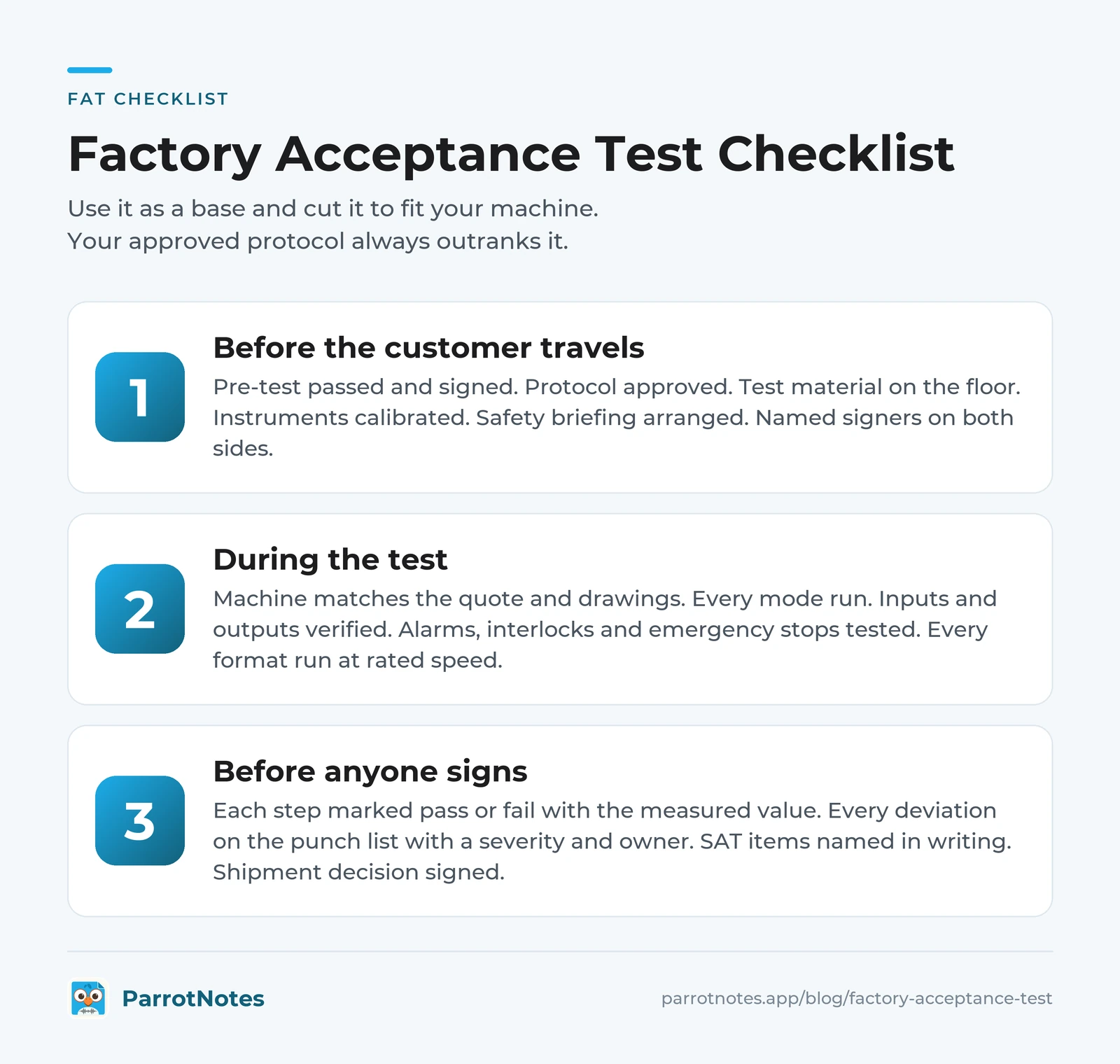
Use this factory acceptance test checklist as a base and cut it to fit your machine. The items draw on what PQE Group and Vista Projects list. Your approved protocol always outranks it.
Before the customer travels
- Builder's own pre-test passed and signed
- Protocol approved, with latest drawings and spec revision
- Test material and spare parts on the floor
- Instruments calibrated, with certificates ready
- Safety briefing and PPE arranged for visitors
- Named signers on both sides
During the test
- Machine and options match the quote and drawings
- Workmanship, labels and nameplates checked
- Startup, shutdown and every operating mode run
- Inputs and outputs verified
- Alarms, interlocks and emergency stops tested
- Screens, access levels and recipes checked
- Every format run at rated speed for the agreed time
- Recovery from a jam or fault shown
Before anyone signs
- Each protocol step marked pass or fail, with the measured value
- Manuals, certificates and spare parts list reviewed
- Every deviation on the punch list with a severity and owner
- Items moved to the SAT named in writing
- Shipment decision recorded and signed
Notes during the witness test
Your test engineer records the results. Nobody records the conversation, and the conversation is where the deals get changed: "we can live with that," "could it also run the smaller carton," "don't worry about that for now."
Say the customer's second visit goes well. On day two the customer's maintenance lead, Tom, says the Spanish screens can wait if the language file arrives before go-live. Six months later, the site engineer calls it a missed requirement.
Priya has a dated note with Tom's words and the recap he replied to, and it's settled in one email. Without them, it's her word against a spec.
Use one note per day, in this shape:
FAT witness note: [job], [machine], day [n], [date]
Present:
Protocol step or spec line:
Result (measured vs required):
Customer said (their words):
We promised (owner, date):
Outside scope? Change order needed?
For tonight's recap:
Then send the recap the same day, so the customer's team can correct it while they still remember. Anything new goes on a change order instead of a handshake.
You don't need to write this on the floor. Many plants limit phones, and you should always ask before recording anyone, because consent rules vary by place. The easy route is a debrief: walk out at the end of the day, open ParrotNotes and talk through the template for three minutes.
You get a transcript, a summary and action items, and recording works without signal, with transcription running once you're back in coverage. As of November 2026, the free plan gives you 100 minutes a month, up to 30 minutes per recording, which covers plenty of debriefs. Pro is $19.99 a month, or $14.99 a month billed annually, with 3,000 minutes a month. Download ParrotNotes free before your next witness day.
The FAT punch list: pass, conditional pass or fail
A punch list is the running list of what's still open, and at a FAT it decides whether the machine ships. Vista Projects uses three severity levels: critical items block shipment, major items must be solved before commissioning and might allow a conditional shipment, and minor items are tracked without any delay.
Here's a sample from the invented case packer job. The free punch list template has similar columns if you want a blank one.
| # | Item | Severity | Owner | Due | Check |
|---|---|---|---|---|---|
| 1 | Guard door interlock fails on retest | Critical | Controls lead | Before ship | Retest, customer on video |
| 2 | 24-count case misses rate by 4 cases a minute | Major | Test engineer | Before ship | Re-run at agreed rate |
| 3 | Spanish screens missing | Major | Software | Before go-live | Check at SAT |
| 4 | Spare parts list out of date | Minor | Project manager | Ship date | Emailed copy |
| 5 | Scuffed side panel | Minor | Assembly | Before crating | Photo |
Be wary of items that drift to "site." Vista's warning is the one to remember: "'We'll fix it at the site' often means 'we'll argue about it at the site.'" Give every item an owner, a date and a way to check it's done, then get it signed.
That signature protects you as well as the customer. Vista notes that signed FAT documents can decide whether a later failure is a warranty claim or a change order. Still, don't oversell a pass: one sample clause says plainly that "The FAT results will not be exempt from the Supplier's responsibilities."
Run the test before the test
A factory acceptance test goes well when the argument has already been had on paper. So write the ten lines into the quote, split the jobs before the order lands, and bring the checklist. On witness days, keep a daily note, send a same-day recap and put every open item on a signed punch list with an owner.
Do that and Priya's opening scene never happens: the 24-count parts are on the floor because line three of the quote said they would be. Keep the record growing with a short voice debrief after each day of a factory acceptance test; ParrotNotes is free to start.
Frequently Asked Questions
What is a factory acceptance test?
A factory acceptance test (FAT) is a planned test of new equipment at the builder's factory before it ships. It shows the machine meets the agreed specification. The buyer's team usually watches, and the result helps decide whether the machine is ready to ship.
What is the difference between FAT and SAT?
A FAT happens at the builder's factory before shipment and shows the machine was built to spec. A site acceptance test (SAT) happens at the buyer's plant after installation and shows it arrived undamaged and works on real utilities with connected systems.
Who attends a factory acceptance test?
The builder's test engineer and project team run it. The buyer often sends engineering, quality and operations or maintenance people. The sales engineer should attend too, or at least join the opening and closing meetings, to keep the record of what was promised.
Who pays for a factory acceptance test?
The contract decides. A common split has the builder paying for the test and hosting while the buyer pays its own travel. Agree in the quote who pays for retests, because that's the cost most often left unsaid.
Does passing a FAT mean final acceptance?
Not normally. A FAT usually works as a pre-shipment checkpoint, and final acceptance tends to come after the SAT. Check your contract, because some tie a payment to the FAT, and a pass doesn't usually end the supplier's obligations.
Related Posts

Best Talk to Text App for iPhone and Android
The best talk to text app for your phone: Apple Dictation and Siri on iPhone, Gboard and Gemini on Android, with free plans compared and a voice phrase sheet.

How to Use Speech to Text on iPhone
Turn on speech to text on iPhone in 3 steps, dictate in any app, switch languages, turn it off, and record when the mic stops. Checked on iOS 27, Nov 2026.

How to Record Calls on Samsung
Samsung call recording, step by step: record or auto record calls, find the files, get Galaxy AI transcripts, or turn it all off. Checked November 2026.