
First Article Inspection (FAI): What It Is and What Sales Should Know

Sarah Johnson
Writes about field sales, meeting notes and voice-first workflows at ParrotNotes. Every article is reviewed by the ParrotNotes product team before it goes live.
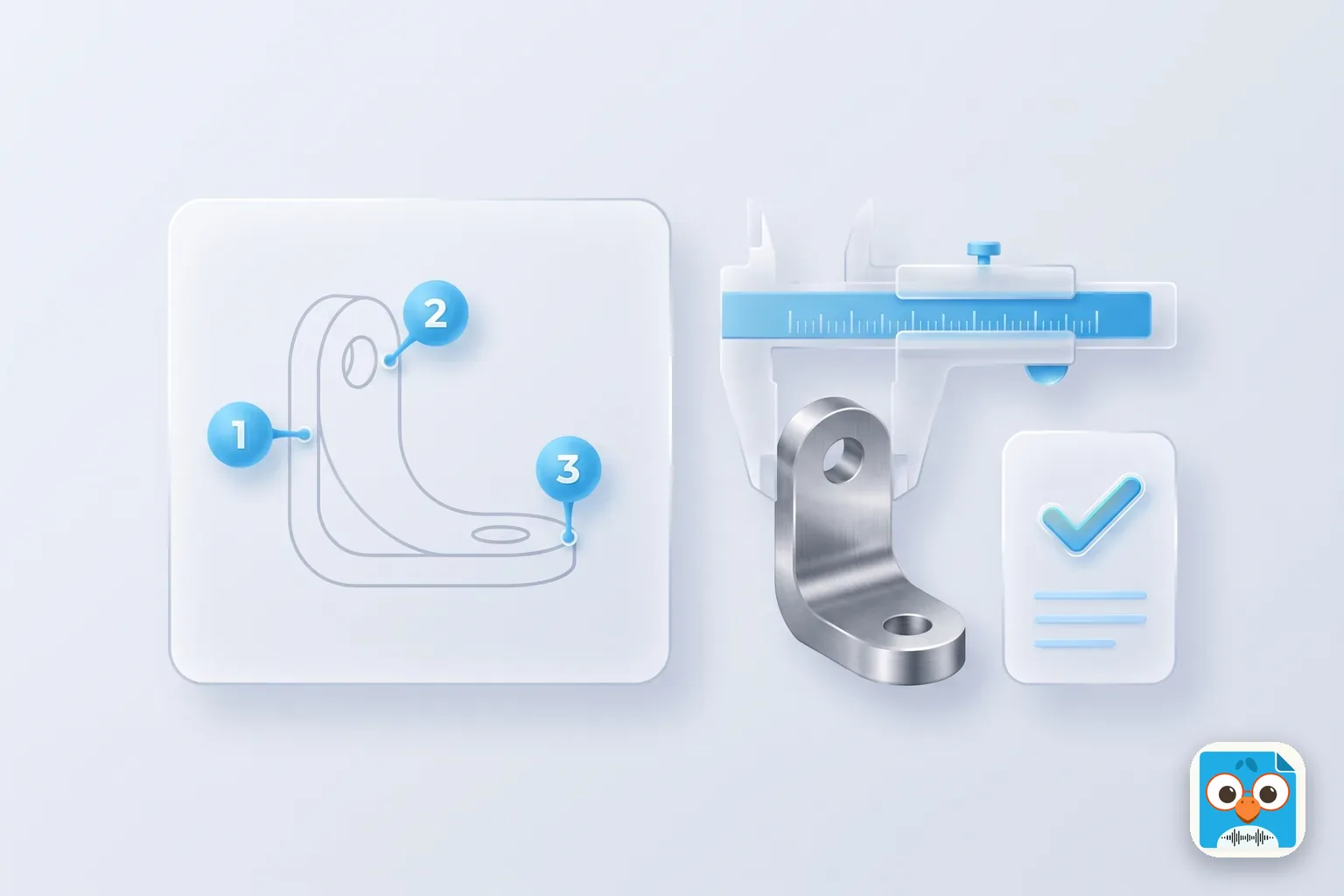
Table of Contents
- 1.What is first article inspection?
- 2.First article inspection vs PPAP, FAT and first piece
- 3.What's in a first article inspection report
- 4.When a new first article inspection is due
- 5.What to promise in a quote: eight lines
- 6.Questions to ask on the RFQ call
- 7.Keep the record of what you promised
- 8.Know what your quote just promised
Marcus wants to win back a bracket program, so he tells the buyer the good news on a plant visit: "We're moving that job to our second plant, and it'll cut your lead time by a week. Nothing else changes." The buyer writes it down. Two weeks later, her quality team asks for a new first article inspection, and that week he promised is gone. (Marcus and the job are invented, to show the pattern.)
Your quality team runs the inspection, so it's easy to treat FAI as somebody else's paperwork. But the promise that makes it late or unpaid often starts with sales: a quote that doesn't mention it, or a change agreed on a site visit.
This guide explains what a first article inspection is and what AS9102 asks for. It also gives you what the quality guides skip: eight lines for your quote and a table of the sales conversations that trigger a new FAI. If you'd rather talk those commitments into your phone after the visit, try ParrotNotes free.
What is first article inspection?
A first article inspection (FAI) is a full check of a part from the first production run against every requirement on its drawing and purchase order, written up as a report. It shows that your process, tooling and paperwork can make that part correctly, not just that one part came out fine.
Textron Systems' supplier instruction puts the purpose this way: "objective evidence that all engineering, design and specification requirements are correctly understood, accounted for, verified, and recorded."
The same document sets out two details that matter to you. The part must be "representative of the first production run," so a prototype built a different way may not count. And the first article inspection applies when the contract calls for it. Ideagen's FAI guide agrees that customer requirements are the most common reason a shop does one.
AS9102: where the rules come from
AS9102 is the aerospace standard for first article inspection, published by SAE. Revision C came out in June 2023. It's a paid document, so we haven't quoted it here. The rules below come from what aerospace companies publish for their own suppliers, which is closer to what a customer will hold you to anyway.
Outside aerospace, "first article" is looser. Shanghai Optics, for example, offers it as an order option: in its example, at least five units of a 100-unit order ship first, the buyer gets 30 days to test, and the design must be frozen. So when a request for quote (RFQ) says "first article required," ask which kind it means.
First article inspection vs PPAP, FAT and first piece
These terms get mixed up in meetings, but each one is a different promise.
| Term | What it proves | Where you'll meet it |
|---|---|---|
| First article inspection | This part meets every drawing requirement | Aerospace, defense, build-to-print |
| Production Part Approval Process (PPAP) | The process will keep making good parts | Automotive and other OEM programs |
| Factory acceptance test (FAT) | A finished machine works before it ships | Capital equipment |
| First piece check | Today's setup is right before the run | Any shop floor, every setup |
| First article test (government) | The contractor can meet contract requirements | US federal contracts |
Fabrico sums up the second row neatly: "FAI verifies the part; PPAP verifies the process that makes the part." Our OEM sales guide covers PPAP from the rep's side, and our factory acceptance test guide covers witness days and punch lists.
The first piece row causes the most confusion. On the Elsmar quality forum, practitioners separate the two, though one notes that outside aerospace the terms are generally interchangeable. The government version is its own process, set out in FAR 9.302.
What's in a first article inspection report
The report is called a FAIR. AS9102 uses three forms, and each one answers a question your customer's quality team will ask.
| Form | Name | What it answers |
|---|---|---|
| Form 1 | Part number accountability | Which part, which revision, which lower-level parts? |
| Form 2 | Product accountability | Which materials and special processes, with what certs? |
| Form 3 | Characteristic accountability | Did every drawing characteristic measure in spec? |
The forms aren't the whole package. The FAIR clause from General Dynamics Ordnance and Tactical Systems (GD-OTS) also asks for a ballooned drawing tied to the recorded data, material and special process certifications, test reports, and certificates of conformance. A ballooned drawing is simply a print with a numbered bubble beside each requirement.
That's why a simple part can take longer than sales expects. Your outside anodizer's cert and your steel supplier's cert may both need to be in the package, and subassemblies generally need their own reports. Catalog hardware is commonly exempt, as in Textron's instruction, unless the buyer says otherwise.
Small errors send reports back. GKN Aerospace's list of common mistakes, written for Revision B, includes unaddressed drawing notes and partial reports with no detailed reason. Rev C made the reason a required field for every FAI, full or partial.
Picture Hannah, a sales engineer at an invented machine shop, quoting 40 housings. Her quote said "AS9102 FAIR included." It didn't say when, so the buyer assumed the report would ship with the first parts on day 20.
Nobody had planned for an outside coating cert that took eight days to arrive. The parts sat finished on a shelf for a week while Hannah explained why.
When a new first article inspection is due
A first article inspection isn't always a one-time event. Once a customer invokes it, certain changes reopen it, and many of them pass through a sales conversation first. This table uses the triggers listed by Textron and GKN. The right-hand columns are our own translation into sales language.
| Trigger | What it sounds like in sales | What to say |
|---|---|---|
| Design change affecting fit, form or function | "Engineering's sending a new revision" | "Let me check whether that reopens the FAI before I confirm dates." |
| New manufacturing source or location | "We can move it to our other plant" | "It's faster, but it may need a new FAI. I'll confirm the impact." |
| New process, tooling or inspection method | "We'll switch vendors to save you 8%" | "The saving is real. Here's the FAI cost and time beside it." |
| New material | "Can you use the alternate alloy?" | "Only with approval, and it may mean a partial FAI." |
| Numerical control (NC) program change | "We reprogrammed it to run faster" | "Ask quality before you mention this as a win." |
| Disruptive event (fire, flood, equipment loss) | "We're back up after the outage" | "Let's check with your quality team what they need." |
| Two-year production lapse | "We haven't run that since 2024" | "Reorders after this long may need a new FAI, so I'll quote it." |
Marcus's plant move sits on the second row. One extra sentence would have kept his credibility, even if he lost the week.
Full vs partial (delta) FAI
A full FAI covers every characteristic. A partial FAI, often called a delta FAI, covers only what the change affects. Textron allows either "for the affected characteristics" when a trigger hits.
Customers don't all draw the line in the same place, and that's why you shouldn't promise a partial from memory. GD-OTS's table asks for a partial after a revision letter change, but a full after a two-year lapse or a move in manufacturing source (it may allow a partial there, if you ask its quality engineer and buyer). Read the customer's clause, because the clause wins.
What to promise in a quote: eight lines
"FAI included" has the same problem as "FAT included": it's a promise with no edges. Use these eight lines in your quote, adjusted with your quality lead. It's a starting list, not legal advice, so run it past whoever reviews your contracts.
- Standard and revision: "FAIR per AS9102 Rev C, or the customer's clause [number]." Name the one you priced.
- Drawing revision: the exact revision quoted. A later revision is a new quote line.
- Type: full or partial, and at which level (detail part, subassembly, assembly).
- Quantity and source: how many parts get inspected, and whether they come from the first production lot.
- Price: a separate FAI line, or a stated "included."
- Timing: when the report goes in, and whether parts ship with it or wait for approval.
- Witness and approval: who signs, and how much notice a customer visit takes.
- Reopeners: what a change costs, in one sentence, including customer-directed revisions.
Line 7 deserves real dates. For its buyer validation, L3Harris asks suppliers for "at least 3 weeks prior" notice, and then the completed report ships with the product. Three weeks can swallow a schedule if nobody planned for it, so add it to your lead time calculation.
Line 5 needs a number from your own shop. We looked and found no reliable public benchmark for what an FAI costs or how long it takes. Ask your quality lead for a figure per part family, or the factory if you sell for a principal. On technical jobs, a sales engineer is often the right person to carry that number between the customer and the shop.
Questions to ask on the RFQ call
Many FAI surprises are visible in the RFQ if you read the quality clauses, not only the price lines. Our guide to what an RFQ is covers the response process, and these questions belong in your clarifying round:
- Does the purchase order flow down AS9102, your own clause, or a looser "first article" request?
- Do you already hold an approved FAI for this part from another source?
- Will you witness it or review the report at our site, or do we submit it?
- Do you require approved sources for special processes, and sub-tier reports?
An RFQ template with a quality line makes these hard to skip.
Keep the record of what you promised
A customer mentions a revision in the hallway, and three weeks later no one remembers whether you agreed to anything.
Picture Elena, an invented rep for a contract manufacturer. Walking out of a customer's plant, she opens ParrotNotes and talks for two minutes: revision D is coming, buyer wants the FAIR with first parts, quality lead Tom will witness. ParrotNotes gives her a transcript, a summary and action items, so when revision D lands a month later, she can raise the FAI question before the buyer does.
Two cautions. Ask before recording anyone, because consent rules vary by place. And if a program is export-controlled or under an NDA, check your company's rules before putting technical details into any app, including this one. A debrief of dates and commitments often says all you need. Download ParrotNotes and try it on your next plant visit.
Know what your quote just promised
You don't need to read a coordinate measuring machine report to sell well here. Remember that the contract decides how first article inspection applies, that plant moves, vendor swaps, new revisions and long gaps can reopen it, and that a quote should name the revision, type, price, timing and approval path.
Take the eight lines to your quality lead this week and fill in your real numbers. The next time someone says "nothing else changes," you'll know which question to ask first.
Frequently Asked Questions
What is a first article inspection?
A first article inspection (FAI) is a full check of a part from the first production run against every drawing and purchase order requirement, recorded in a report. It shows that the process, tooling and paperwork can produce the part correctly.
What is a first article inspection report?
A first article inspection report (FAIR) is the record of the inspection. Under AS9102 it uses three forms, covering the part, its materials and processes, and its characteristics. Customers often want ballooned drawings and certifications with it.
What is AS9102?
AS9102 is the SAE aerospace standard for first article inspection. Revision C came out in June 2023. Customers usually make it binding through a purchase order or their own supplier clause.
What is a delta FAI?
A delta FAI, or partial FAI, inspects only the characteristics affected by a change, such as a revision or a process change. Customers differ on when they accept one, so check the clause before you promise it.
What is the difference between PPAP and FAI?
FAI verifies that a part meets every drawing requirement, and PPAP gives broader evidence that the process will keep making good parts. FAI is common in aerospace and PPAP in automotive, and a customer's requirements decide which you need.
When is a new first article inspection required?
Published supplier requirements list a design change affecting fit, form or function, a new source, location, process, tooling or material, an NC program change, a disruptive event, and a two-year lapse in production. Your customer's clause has the final say.
Related Posts

Best Talk to Text App for iPhone and Android
The best talk to text app for your phone: Apple Dictation and Siri on iPhone, Gboard and Gemini on Android, with free plans compared and a voice phrase sheet.

How to Use Speech to Text on iPhone
Turn on speech to text on iPhone in 3 steps, dictate in any app, switch languages, turn it off, and record when the mic stops. Checked on iOS 27, Nov 2026.

How to Record Calls on Samsung
Samsung call recording, step by step: record or auto record calls, find the files, get Galaxy AI transcripts, or turn it all off. Checked November 2026.