
Machine Tool Sales: Selling CNC Equipment to Shop Owners

Sarah Johnson
Writes about field sales, meeting notes and voice-first workflows at ParrotNotes. Every article is reviewed by the ParrotNotes product team before it goes live.

Table of Contents
- 1.What machine tool sales looks like in 2026
- 2.How a job shop owner decides to buy a CNC machine
- 3.The machine tool sales visit: what to look at and ask
- 4.The spindle-hour conversation
- 5.Demo cuts that close the deal
- 6.Machine tool sales quotes, financing and follow-up
- 7.Keep the record from the shop floor
- 8.Selling the hours, not the machine
Dale had the owner's attention for a full hour. They walked the floor of a 14-person job shop and stopped beside two aging vertical mills. Dale talked through a 5-axis machine that could run the shop's best part in one setup instead of two. The owner nodded the whole way. Then, at the door: "Send me a quote. I'll think about it."
Three weeks later the quote was still "being looked at." Dale had given the owner a price. He hadn't given him a reason that fit how a shop owner thinks about money. (Dale is a composite, not a real person.)
That gap is where most machine tool sales stall. You probably know your machines cold: spindle speeds, axis travel, control options.
This guide covers the other half of selling CNC machines: the owner's side. You'll get the shop-visit questions, the spindle-hour math, a demo-cut agreement, and a follow-up rhythm that doesn't nag. If your shop visits end with notes you can't read later, try ParrotNotes free and dictate the visit before you leave the parking lot.
What machine tool sales looks like in 2026
Machine tool sales is the business of selling metal-cutting and metal-forming machines, such as CNC mills, lathes, grinders and 5-axis machining centers, to the shops and plants that make parts. In the US, many new machines reach small and mid-size shops through regional distributors, or dealers, who carry one or more builders' lines. Some builders sell direct, and a separate trade deals in used machines.
The biggest customers are job shops. US orders for new metalworking machines reached $5.74 billion in 2025, and "demand for new machines by contract machine shops (i.e., job shops) increased 19.1%," according to AMT's order data (American Machinist). AMT tied the rise in order value to "more (and more valuable) automation functions paired with new machine units."
So you're rarely selling a bare machine now. You're selling a cell: machine, probing, pallet changer or robot, and tooling. That makes the owner's math matter more, not less.
How a job shop owner decides to buy a CNC machine
In a plant, a capital purchase goes through a committee and a written request; our guide to capital equipment sales covers that 18-month process. A job shop is different. The owner is often the estimator, the Saturday programmer, and the person who signs the loan. The decision is personal.
Owners usually buy for one of four reasons:
- A job they've won or are about to win that their current machines can't hold to tolerance or can't run fast enough
- A bottleneck, one machine with a three-week queue while others wait
- An old machine that's costing them in downtime, scrap or parts they can't find
- People, because they can't hire another machinist and need one operator to run more spindles
Your first job is to find out which one is real. A shop that buys for a won job moves fast. A shop that's "looking at options" with no trigger can take a year, or never buy.
The machine tool sales visit: what to look at and ask
Walk the floor before you sit down. Look at what's running, what's idle, what's waiting in the queue, and how parts move between machines. Count the setups on a typical part. Notice the controls on the floor, because a shop full of one control brand has trained people and posted programs they won't want to lose.
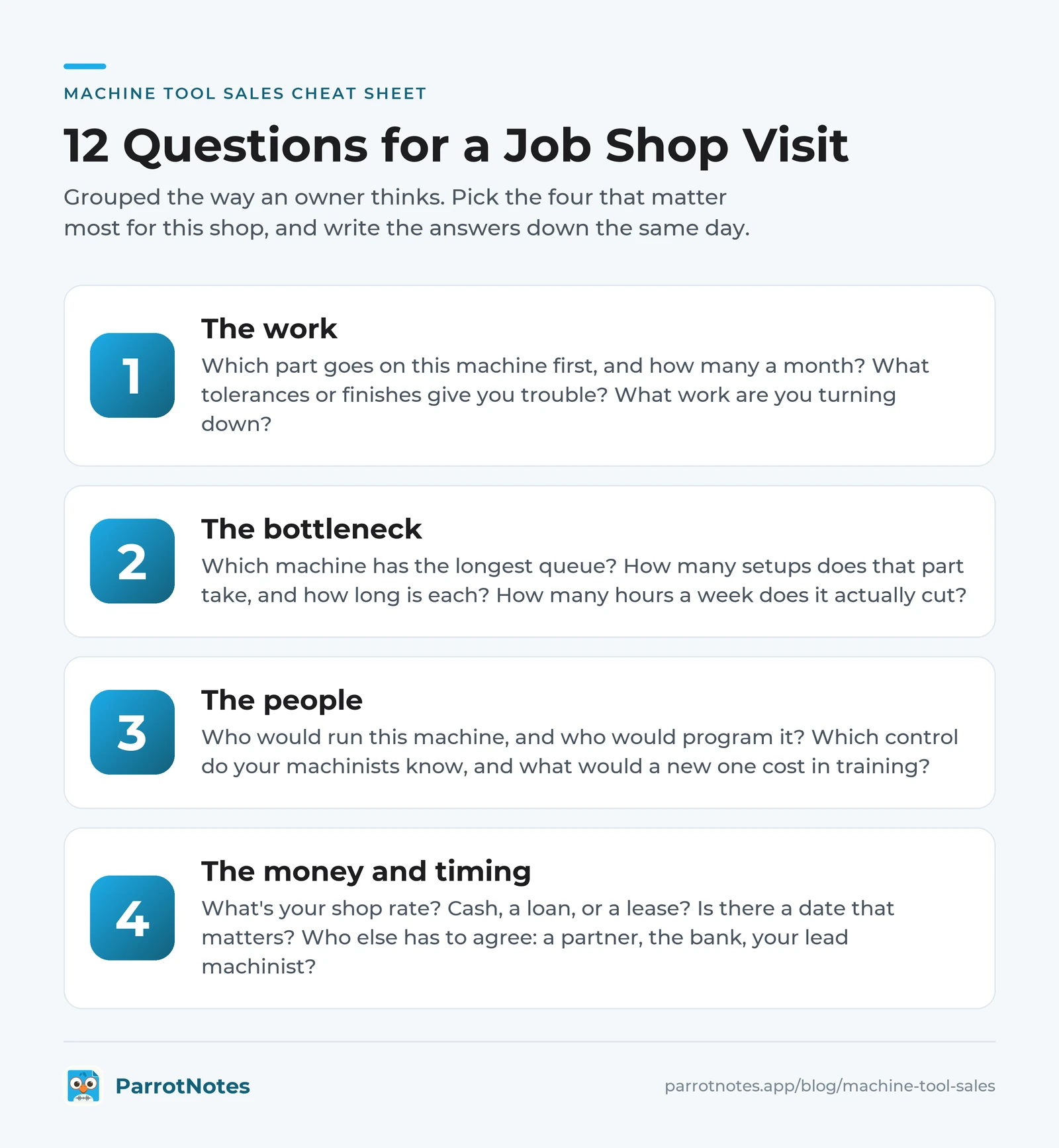
Then ask. This question bank is grouped the way an owner thinks:
The work
- Which part or family would go on this machine first, and how many a month?
- What tolerances or finishes give you trouble today?
- What work are you turning down or quoting with long lead times?
The bottleneck 4. Which machine has the longest queue, and how long is it? 5. How many setups does that part take now, and how long is each one? 6. How many hours a week does that machine actually cut?
The people 7. Who would run this machine, and who would program it? 8. Which control do your machinists know, and what would a new one cost you in training?
The money and timing 9. What's your shop rate on this kind of work? 10. How would you pay: cash, a loan, or a lease? 11. Is there a date that matters, such as a customer's start of production or the tax year? 12. Who else has to agree: a partner, the bank, your lead machinist?
Don't try all twelve in one visit; pick the four that matter most for this shop. Write the answers down the same day, because questions 6 and 9 drive everything that follows.
The spindle-hour conversation
Owners don't buy horsepower. They buy hours. Every new machine has to answer one question: will the hours it frees or adds pay for the machine?
Be careful with "hours." Shops often believe their machines are busier than they are. MachineMetrics, a machine-monitoring company, says "the average manufacturer has a utilization rate of just 28%," measured as run hours against scheduled hours (MachineMetrics). If the owner's machines sit idle most of the shift, freed hours alone won't sell a machine. The case has to rest on a real bottleneck or real work waiting.
A worked spindle-hour example
These numbers are invented to show the math, not to describe a real shop. The part is an aluminum housing, 400 a month, run today in two operations on two 3-axis vertical mills. The proposal moves it to one setup on a 5-axis machine.
| Line | Two 3-axis setups today | One 5-axis setup |
|---|---|---|
| Cutting time per part | 36 min (19 + 17) | 24 min |
| Cutting hours a month (400 parts) | 240 | 160 |
| Setups a month | 8 (4 batches × 2 ops), 1.5 h each = 12 h | 4, 2 h each = 8 h |
| Machine hours this job uses | 252 | 168 |
The 5-axis machine runs the job in 84 fewer hours. More important, it hands 252 hours on the two vertical mills back to the shop for other work.
Now the money. Say the full installed cost, with the tooling package, workholding and rigging, is $380,000, financed over 60 months at 8%. That's a payment of about $7,700 a month. At a shop rate of $95 an hour:
- Hours of new work needed to cover the payment: $7,700 ÷ $95 = about 81 hours a month, or under 4 hours a working day
- Hours the move frees on the vertical mills: 252 a month
- Payment per hour of running this job on the new machine: $7,700 ÷ 168 = about $46, against a $95 shop rate
So the question for the owner isn't "Can you afford $380,000?" It's "Do you have 81 hours a month of work you're turning away or quoting late?" If the answer to question 3 on your list was yes, you have a case. If it was no, you need a different reason, such as a tolerance the old machines can't hold or an operator they can't hire.
Two cautions. Use the owner's cycle times and shop rate, and let the owner check the arithmetic. And never promise a cycle time until you've cut the part. The free feeds and speeds calculator gives starting cutting data for a part you haven't run. The TCO calculator compares two machines over their whole life.
Demo cuts that close the deal
A demo cut at your tech center is the most expensive afternoon in machine tool sales. It's also the most often wasted, because nobody agreed what it should prove.
John Miller, writing in Modern Machine Shop, puts it well: test cuts are "for specific risks, not generic capability," and "the math comes first, the test cut comes last" (Modern Machine Shop). Do the spindle-hour math first. Then use the cut to settle the one thing the math depends on.
Rosa, a distributor rep in Wisconsin, learned this on a turning center demo. The owner's lead machinist watched the part come off, liked the finish, and said nothing about cycle time. Back at the shop he told the owner it "felt slow." Rosa had no written target, so it became her word against his. On the next demo she sent a one-page agreement first, and the cycle time was measured with both of them watching. (Rosa is an illustrative example.)
A demo-cut agreement template
Send this to the owner a week before the cut and get a yes on every line:
DEMO CUT AGREEMENT
Shop: ______________   Date of cut: ________   Location: ____________
Part and drawing rev: ______________   Quantity to cut: ____
Material supplied by: shop / us        Tooling: shop's / ours (list)
Workholding: ______________            Program written by: ________
What we will measure:
  - Cycle time, door close to door open: target ____ min
  - Features and tolerances to check: ________________________
  - Surface finish (Ra): target ____
Who measures, and with what: ______________
Who attends from the shop: owner / lead machinist / programmer
If the targets are met: quote valid until ________,
  decision expected by ________
The last line is the one reps skip. It turns a successful demo into a dated next step instead of "Nice, send me the numbers." For running the day itself, our guide to an in-person product demonstration has a 60-minute run sheet.
Machine tool sales quotes, financing and follow-up
A quote that lists only the machine is short by the time it reaches the owner's banker. Spell out every line so there's no surprise at delivery:
- Machine and control options
- Tooling package, holders and workholding
- Probing, chip conveyor, coolant-through-spindle, automation
- Freight, rigging and any foundation or electrical work
- Installation, training, and the warranty terms
- Trade-in value for the machine it replaces, if any
- Lead time and the earliest date it can be cutting parts
Bring financing options with a monthly payment on each, because the owner will compare your quote to the payment, not the price. If the owner mentions year-end taxes, the Section 179 limits and the "placed in service" test are covered in our capital equipment sales guide; leave the tax advice to their accountant.
Then follow up on a rhythm. Send the quote with a short note that restates the owner's own numbers: the part, the hours, the date that matters. Two or three days later, call to walk through it. After that, bring something new each time: a demo-cut result, a lead-time change, a financing rate. Never "just checking in." Our quote follow-up email guide has templates for each touch.
Keep the record from the shop floor
Machine tool sales runs on details: the cycle time the owner quoted, the tolerance that's scrapping parts, the partner who has to agree, the customer's start date. They come out on a noisy shop floor, where you can't write.
Marcus sells for a machine tool distributor and covers 60 shops across two states. After each visit he sits in the truck and talks for two minutes into his phone: the part, the hours, the four answers he got, and what he promised. With ParrotNotes, he gets a transcript, a summary and the action items, such as "send demo agreement by Thursday," plus a follow-up email draft he edits and sends before the next stop. Four months later, when the owner calls back because the job finally landed, Marcus searches the shop's name and has the whole history. (Marcus is an illustrative example.)
A few habits make it work:
- Dictate the recap in the truck, not on the floor. The floor is loud, and the owner didn't agree to be recorded.
- Record a meeting only with consent, and follow the recording laws where you are.
- Label each note with the shop's name so a year of visits sits together.
The Free plan gives you 100 minutes of recording a month with an AI summary on every recording. Pro is $19.99 a month, or $14.99 a month billed annually, with 3,000 minutes a month. If you work with an applications engineer on technical visits, our guide for the sales engineer role covers documenting those meetings.
Selling the hours, not the machine
Machine tool sales comes down to the owner's hours and the owner's money. Find the real trigger: a won job, a bottleneck, an old machine or a hiring problem.
Ask the questions that give you the shop rate and the real cutting hours. Run the spindle-hour math with the owner's numbers, then use a written demo-cut agreement to settle the one thing the math depends on. Quote every line, show the monthly payment, and follow up with something new each time.
In machine tool sales, that's the difference between "I'll think about it" and a date. Dale's next quote went out with one extra page: the owner's part, the hours it would free, and the 81 hours of work that would cover the payment. That's the page owners read. Download ParrotNotes free and capture your next shop visit before you pull out of the lot.
Frequently Asked Questions
What is machine tool sales?
Machine tool sales is selling CNC mills, lathes, grinders, machining centers and other metalworking machines to job shops and manufacturing plants. Many salespeople work for a regional distributor that carries one or more builders' lines, and they handle shop visits, demo cuts, quotes and financing options.
Who buys the most new machine tools in the US?
Contract machine shops, or job shops, are the largest customer group in AMT's US Manufacturing Technology Orders report. Their orders for new machines rose 19.1% in 2025, when total US orders reached $5.74 billion.
What does a machine tool sales engineer do?
A machine tool sales engineer, sometimes called a CNC sales engineer, manages a territory, visits shops to understand their parts and bottlenecks, proposes machines and automation for specific applications, runs or arranges demo cuts, and prepares quotes. Many work with applications engineers and service technicians at the distributor.
How do you calculate whether a CNC machine will pay for itself?
Divide the monthly payment by the shop's hourly rate. That gives the hours of new work needed each month. Then check those hours against the work the shop is turning down and the hours the new machine frees on older machines. Use the owner's cycle times, not brochure numbers.
What should a demo cut prove?
A demo cut should settle a specific risk, such as a cycle time, a tolerance or a surface finish, using the shop's part, drawing and material. Agree the targets, who measures, and the decision date in writing before the cut, so a good result leads straight to a decision.
Related Posts

Sales Ramp Time: How Long New Reps Take and How to Shorten It
Sales ramp time: how long new reps take to reach full productivity. Get 2026 benchmarks, the formula, a worked example and a six-month plan to shorten it.

Rev Transcription Review: Accuracy, Pricing and Turnaround
Rev transcription review from Rev's own pages, checked Oct 27, 2026: plans, per-minute prices, add-ons, accuracy and turnaround. Try ParrotNotes free.
Product Spec Sheet: Format, Example and What Buyers Look For
Copy a product spec sheet format, see a filled-in example, and learn what engineers, purchasing and quality check first. Free template and checklist inside.