
What Is a Punch List? How to Run a Punch List Walk

Sarah Johnson
Writes about field sales, meeting notes and voice-first workflows at ParrotNotes. Every article is reviewed by the ParrotNotes product team before it goes live.

Table of Contents
Every construction job ends the same way: someone walks the building with a flashlight, a tape measure and a growing list of things that aren't right yet. That list is the punch list. In plain terms, a punch list is the document made near the end of a construction project that names every item still unfinished or not up to the contract, so each one gets fixed before the owner makes final payment.
Picture Dana, a project manager closing out a 9,000-square-foot office fit-out on a Thursday afternoon. She walks with the architect and the owner's rep for two hours. By the end, she has notes on the back of a door schedule, 140 photos with no labels, and a vague memory that "something was off with the light in the corner office." Friday morning, half her list is guesswork. (Dana is an illustrative example, not a real person.)
You already know the punch list matters: it's the last thing standing between the job and the final check. This guide gives you the punch list meaning in one paragraph, who makes it and when, what goes on it, a 12-item sample punch list, and a way to run the walk that keeps your hands free. If you already talk your way through site walks, try ParrotNotes free and let the talking become the list.
What is a punch list?
A punch list (also called a punchlist or, in the UK, a snag list) is a list of work that is incomplete, damaged or doesn't meet the contract documents, prepared near the end of a construction project. The contractor has to finish or correct every item before final payment.
The punch list meaning is the same whether the job is a house remodel or a hospital wing. It isn't a list of new work. Anything the owner wants that wasn't in the contract is a change order, not a punch item. The list only covers what the contract already required.
Typical items are small: a paint touch-up, a cracked tile, a cabinet door that won't close, a light fixture that was never wired. But on a big commercial job, a construction punch list can run to hundreds of items across every trade.
Why is it called a punch list?
Nobody knows for sure. Wikipedia's entry on the punch list gives one hypothesis: the name comes from punching a hole in the margin next to each item, with two copies punched together so the architect and the contractor kept identical records. Treat that as a likely story, not a proven fact.
Punch list or punchlist?
Both spellings are in use. This guide uses two words, "punch list," the same form as the Wikipedia entry above. Whichever you pick, use it consistently in your own documents.
Who makes the punch list, and when
On most American commercial jobs, the order is set by the contract. The standard general conditions, AIA Document A201, put the first move on the contractor. In the 2007 edition, §9.8.2 says that when the contractor considers the work substantially complete, it "shall prepare and submit to the architect a comprehensive list of items to be completed or corrected prior to final payment" (Cox Castle & Nicholson, 2018).
From there, the sequence usually looks like this:
- Pre-punch. The general contractor (GC) and its superintendent walk the job and have the subs fix what they find, before anyone else sees it.
- Contractor's list. The GC submits its list and asks for an inspection.
- Architect's walk. The architect inspects and can add items to the list (§9.8.3).
- Certificate of substantial completion. The final list is attached to the certificate, ideally with a deadline for finishing every item (§9.8.4).
- Back-punch. The GC verifies each fix, and the architect or owner signs off.
Subcontractors get their own trade's items. Building-product reps often get pulled in too. If three of the windows on the list have failed seals, the window rep is the one who has to explain whether it's a product claim or an installation issue. That's why a rep who sold the job through a careful construction submittal process still shows up at closeout.
Residential jobs are looser. A homeowner and a remodeler might simply walk the house together with a notepad. The idea is the same: one agreed list, and the final payment waits on it.
What goes on a punch list
Most items fall into a few groups:
- Damaged work: a scratched countertop, a dented door frame, a stained ceiling tile.
- Incomplete work: a missing outlet cover, an unconnected faucet, trim not installed.
- Work that doesn't match the documents: the wrong paint color, a fixture that isn't the one specified.
- Systems not proven yet: equipment not tested, an alarm not commissioned, a permit or inspection still open.
- Cleanup: debris above the ceiling, overspray on glass, labels left on fixtures.
An item is only useful if someone else can find it and fix it without asking you. Every item needs these fields:
| Field | Example |
|---|---|
| Item number | 3-07 |
| Location | Suite 300, Office 3, north wall |
| Trade | Drywall |
| Description | Nail pop and seam crack, 4 ft above floor, left of window |
| Photo or tag | Photo of tag 3-07 |
| Responsible party | ABC Drywall |
| Due date | Nov 14 |
| Status | Open / Fixed / Verified |
"Fix wall" isn't an item. "Office 3, north wall, nail pop 4 ft up, left of window" is.
Sample punch list
Here's a sample punch list for an illustrative office fit-out. The project, companies and dates are made up, but the format works on any job.
Project: Suite 300 tenant fit-out | Walk date: Nov 6 | Walked by: GC PM, architect, owner's rep
| # | Location | Trade | Item | Owner | Due | Status |
|---|---|---|---|---|---|---|
| 1-01 | Reception | Painting | Touch up scuffs on wall behind desk, 3 spots | Painter | Nov 10 | Open |
| 1-02 | Reception | Flooring | Carpet seam lifting at entry door | Flooring sub | Nov 10 | Open |
| 2-01 | Conference room | Electrical | Dimmer doesn't control the pendant over the table | Electrician | Nov 12 | Open |
| 2-02 | Conference room | Glazing | Scratch on interior glass panel, lower left | Glazing sub | Nov 14 | Open |
| 3-01 | Office 3 | Drywall | Nail pop and seam crack, north wall, left of window | Drywall sub | Nov 12 | Open |
| 3-02 | Office 3 | Electrical | Corner light fixture not working | Electrician | Nov 12 | Open |
| 3-03 | Office 3 | Doors and hardware | Door closer slams, adjust closing speed | Hardware sub | Nov 10 | Open |
| 4-01 | Break room | Millwork | Upper cabinet door out of alignment, sink side | Millwork sub | Nov 12 | Open |
| 4-02 | Break room | Plumbing | Slow drip at sink faucet | Plumber | Nov 10 | Open |
| 5-01 | Restroom | Accessories | Paper towel dispenser not installed | GC | Nov 10 | Open |
| 6-01 | Open office | Ceiling | Two stained ceiling tiles near column C-4 | Ceiling sub | Nov 12 | Open |
| 6-02 | Whole suite | Cleaning | Remove labels and overspray from all window glass | GC | Nov 14 | Open |
Notice the numbering: the first digit is the room, the second is the item, and the same number goes on the tape and in the photo. When the electrician calls about "3-02," everyone knows it's the corner light in Office 3. If you'd rather not build the table yourself, our free punch list template tracks location, trade, priority and status for every item, and exports to CSV or prints.
How to run a punch list walk
The walk is where most lists go wrong. Your hands are full, the building is noisy, and you're writing on your knee. Here's a method that keeps up with you.
Before the walk
- Agree the route with everyone walking: room by room, same order every time.
- Bring blue painter's tape and a marker. Many crews mark each defect with tape; adding the item number makes the photo self-explaining.
- Set up your numbering (room-item) and decide who's responsible for keeping the master list.
During the walk
- Tag the defect, write the number on the tape, take one photo with the tape in the frame.
- Speak the item into your phone before you move on.
- At the end of each room, say "end of Office 3" so the notes split cleanly.
After the walk
- Turn the notes into the typed list the same day, while you still remember the corner light.
- Send each trade its own items with due dates.
- Re-walk for the back-punch, and mark items verified, not just "fixed."
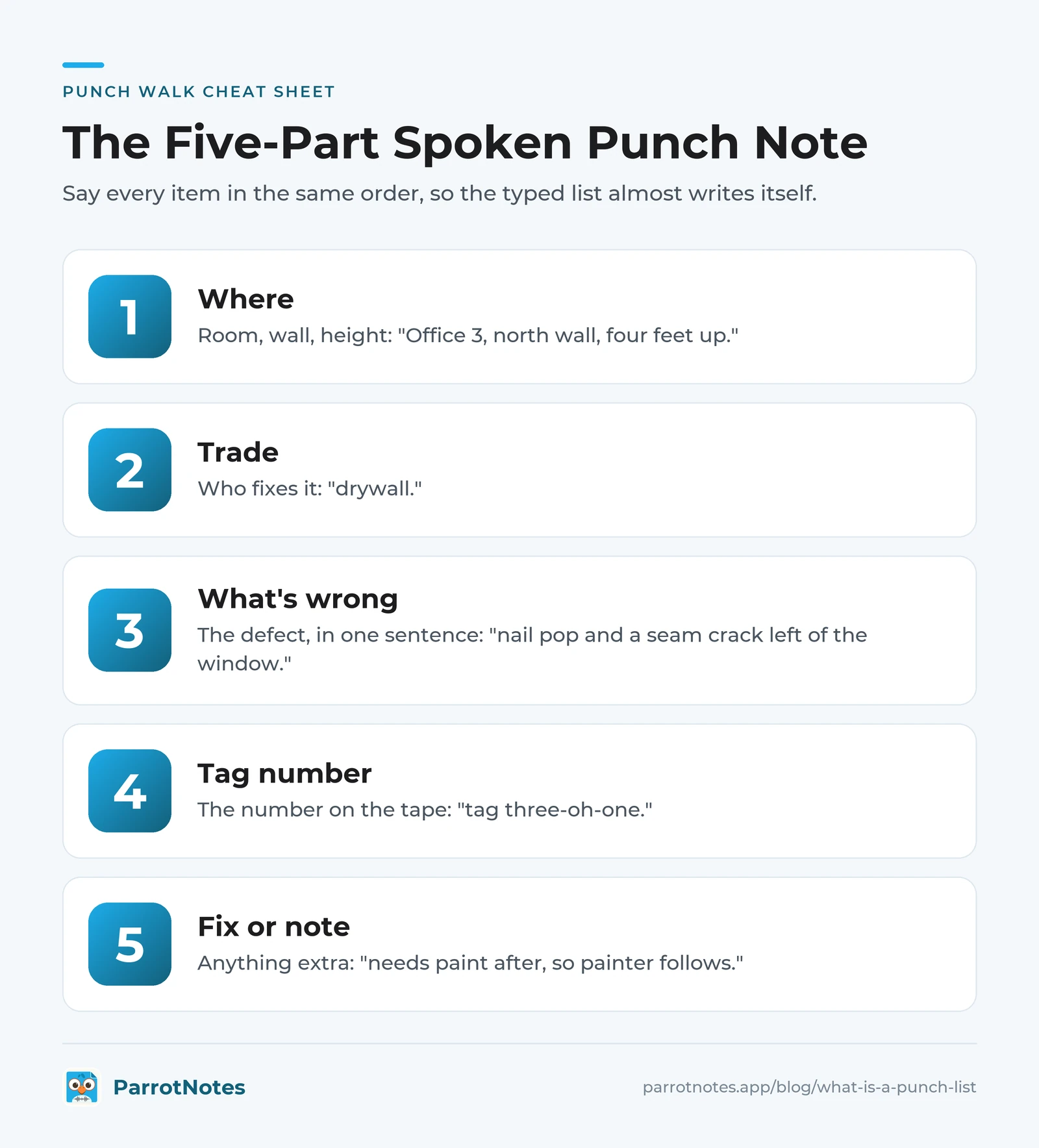
The five-part spoken note
Say every item in the same order, so the typed list almost writes itself:
- Where: room, wall, height ("Office 3, north wall, four feet up")
- Trade: who fixes it ("drywall")
- What's wrong: the defect, in one sentence ("nail pop and a seam crack left of the window")
- Tag number: the number on the tape ("tag three-oh-one")
- Fix or note: anything extra ("needs paint after, so painter follows")
It takes about ten seconds per item. A spoken note is also more detailed than a scribble, because talking is faster than writing with gloves on.
One room, spoken then typed
Here's what Office 3 sounds like when you walk it with the five-part note:
"Office 3. Tag three-oh-one, north wall, about four feet up, left of the window: nail pop and seam crack, drywall, painter to follow. Tag three-oh-two, corner light fixture by the window doesn't come on, electrical. Tag three-oh-three, door closer slams, hardware, needs the closing speed adjusted. End of Office 3."
And here's the same thing typed, ready for the list:
| # | Location | Trade | Item | Note |
|---|---|---|---|---|
| 3-01 | Office 3, north wall, 4 ft up, left of window | Drywall | Nail pop and seam crack | Painter follows |
| 3-02 | Office 3, corner by window | Electrical | Light fixture not working | |
| 3-03 | Office 3, door | Doors and hardware | Door closer slams | Adjust closing speed |
This is where an app earns its place. With ParrotNotes, you press record at the start of the walk and lock the screen; recording keeps going while the phone is in your pocket. When you stop, the app transcribes the walk, writes a summary and can pull out the action items, so each tag number lands as its own line. You copy those lines into the punch list template or your spreadsheet, and attach the photos by tag number.
Two practical points. The Free plan allows recordings of up to 30 minutes, so on a big job record one note per floor or per area. And if you also want to record the architect or owner talking, ask them first; your own spoken notes need nobody's permission.
Back to Dana. On her next fit-out, she tags each item with blue tape, says the five parts into her phone, and records one note per area. The typed list goes out the same evening, sorted by trade, and the electrician has "3-02" on his phone before he leaves for the day. (Still an illustration, but the method is the point.)
Closing out: substantial completion and retainage
The list is tied to money, which is why it deserves care.
Substantial completion. Most contracts define it as the point when the owner can occupy and use the project for its intended purpose. As construction lawyer Robert G. Campbell explains in the Cox Castle & Nicholson article, punch list items don't prevent substantial completion. Under A201 (2007), the payment of retainage is adjusted to reflect the cost of incomplete items (§9.8.5).
Retainage. Retainage is the share of each payment the owner holds back until the end of the job. Campbell notes that final completion and the release of retainage usually require all punch work to be done, or let the owner keep the estimated cost of unfinished items. Open punch items, in other words, keep money tied up.
Completion and deadlines. The same article warns that in some states, including California, what counts as "completion" can affect lien and claim deadlines, and courts have looked at punch lists to decide it. Contracts and state laws differ, so check yours with your own counsel. This guide isn't legal advice.
Keep the daily paper trail going during closeout, too. Your construction daily report should note the walk date, who attended, and when each trade came back to fix its items. If punch items come up in weekly owner meetings, log them in your construction meeting minutes by number, and keep the detail on the list itself.
The punch list in short
A punch list is the contract's last checklist: every item still incomplete or not up to spec, written down so it gets fixed before final payment. The contractor drafts it, the architect adds to it, and retainage usually waits on it.
A good list comes from a good walk:
- Walk room by room, in the same order.
- Tag each defect and photograph the tag.
- Speak each item in five parts: where, trade, what's wrong, tag number, fix.
- Type the list the same day and send each trade its own items.
- Verify every fix before you close an item.
Building-product reps can use the same habit when they're called to a site walk about their product. It's the same field-note discipline we describe in our building materials sales guide. Download ParrotNotes free and speak your next punch walk instead of writing it on your knee. As of October 2026, the Free plan includes 100 minutes of recording a month with a summary on every recording; Pro is $19.99 a month, or $14.99 a month billed annually, for 3,000 minutes.
Frequently Asked Questions
What is a punch list in construction?
A punch list is a document prepared near the end of a construction project that lists work still incomplete, damaged or not matching the contract documents. The contractor must finish or correct every item before final payment. It's also called a punchlist or, in the UK, a snag list.
What is the meaning of punch list?
The punch list meaning is simple: it's the final to-do list on a building project. It only covers work the contract already required, such as paint touch-ups, a missing outlet cover or an untested system. New work the owner wants is a change order, not a punch item.
Who creates the punch list?
Under AIA A201, the contractor prepares the first list when it considers the work substantially complete. The architect then inspects and can add items. In practice, the GC's superintendent often runs a pre-punch with the subcontractors first, so the official list is shorter.
How do you do a punch walk?
Walk room by room in a fixed order with the contractor, architect and owner's rep. Mark each defect with numbered tape, photograph it, and record where it is, which trade fixes it and what's wrong. Type the list the same day and send each trade its own items with due dates.
Does a punch list affect final payment?
Usually, yes. Many contracts hold back retainage until punch items are finished, or let the owner keep the estimated cost of unfinished items. Under AIA A201 (2007), retainage is adjusted to reflect incomplete items. Check your own contract, because terms and state laws differ.
Related Posts

Real Estate Listing Presentation: What to Include and How to Run It
A listing presentation outline you can copy: what to include, how to run the appointment in the seller's home, how to discuss commission and what to note after.

Pipeline Coverage Ratio: How to Calculate It and What Good Looks Like
Pipeline coverage ratio explained: the formula, a worked example, why 3x depends on win rate and cycle length, and how to fix low coverage. Try it free.

What Is a Nut Graf? How to Write One, With Examples
A nut graf tells readers what a story is about and why it matters now. See where it goes, how to write one, examples and mistakes. Try ParrotNotes free.