
Site Acceptance Test (SAT): Checklist and How It Differs From a FAT

Sarah Johnson
Writes about field sales, meeting notes and voice-first workflows at ParrotNotes. Every article is reviewed by the ParrotNotes product team before it goes live.
Table of Contents
The palletizer passed its factory test in June. It reached the bottling plant on a Monday in August, and two of the builder's technicians flew in for the site acceptance test.
By Wednesday they still hadn't run a single case. The plant's air supply sat below what the machine needed, and the conveyor feeding it was a week behind. Marco, the sales engineer, got the call from his boss: who pays for three days of two technicians sitting in a break room? (Marco and the job are invented, to show the pattern.)
You already know the SAT is where the machine meets the real plant. What's easy to miss is that most SAT trouble isn't about the machine at all. It's about readiness, items left open at the factory, and what the signature actually releases.
This guide covers what a site acceptance test is, how it differs from a FAT in one table, a readiness split between buyer and builder, a three-stage checklist, a carry-over sheet for open items and a note template for site days. If you want those notes without typing on a plant floor, try ParrotNotes free and talk them into your phone after each day.
What is a site acceptance test?
A site acceptance test (SAT) is a planned test of new equipment at the buyer's plant, after delivery and installation, to show it arrived undamaged and works on the real utilities, product and connected systems. A signed SAT is usually what turns "delivered" into "accepted."
PQE Group puts it this way: "The SAT provides documented evidence that the equipment/system has been delivered in good condition." Its list of typical SAT checks includes instrument calibration, input and output verification, drawing checks, startup procedures and punch list points.
For machine builders, the site acceptance test is also a money event. Automationnth, a custom automation builder, says plainly: "The Site Acceptance Test is typically the final billing milestone for the builder." It adds that the final run on site usually repeats the same acceptance criteria used at the factory runoff.
In process automation there's a standard for this. IEC 62381:2024 sets out requirements and checklists for the FAT, the SAT and the site integration test (SIT), the step where the new system is proven with the plant's other systems.
SAT vs FAT: the short version
If you need the full factory side, read our factory acceptance test guide. Here's the short version of FAT vs SAT, from the site's point of view:
| FAT | SAT | |
|---|---|---|
| Where | Builder's factory | Buyer's plant |
| Proves | Built to spec | Still works after shipping, on real utilities and lines |
| Who must be ready | Mostly the builder | Builder and buyer |
| Open items | Started on the FAT punch list | Closed, or moved to warranty |
| Usually releases | Shipment | Acceptance, final payment, warranty clock |
Two other terms get mixed up with the SAT. Commissioning is the wider job of getting the equipment installed, connected and running; the SAT is the formal, signed test inside it.
In regulated plants such as pharma, EU GMP Annex 15 (as quoted by PQE Group) allows a FAT to be supplemented by a SAT after the equipment arrives, and well-documented FAT and SAT work can support installation and operational qualification (IQ and OQ), so nobody repeats tests for no reason.
Selling parts rather than machines? The matching checkpoint there is a first article inspection, which proves the first production part meets the drawing.
Site readiness: who has to be ready for the SAT
Marco's lost three days came from one missing list. A FAT mostly depends on the builder. A site acceptance test depends on both sides, and the buyer's half is the one most quotes never write down.
Treat this split as a starting point. Your contract and the installation scope decide the real one.
| Ready before day one | Buyer | Builder |
|---|---|---|
| Foundation, floor space and access route | ✓ | |
| Power, compressed air, water or steam at the agreed values | ✓ | |
| Upstream and downstream equipment installed and running | ✓ | |
| Network, signals and control system tie-ins | ✓ | ✓ |
| Test product and packaging in the agreed amount | ✓ | |
| Installation finished, machine leveled and anchored | ✓ | |
| SAT protocol approved by both sides | ✓ | ✓ |
| Technicians, tools and spare parts on site | ✓ | |
| Operators and maintenance staff free for training | ✓ | |
| Named signers present on the last day | ✓ | ✓ |
Put the buyer's lines in the quote as conditions for starting the SAT, with a simple rule for waiting time: if the site isn't ready on the agreed date, extra days are billed at a stated rate. That one sentence would have answered Marco's boss.
A good moment to confirm it is the handoff from sales to the project team. Our sales handover template has room for exactly these promises.
Site acceptance test checklist
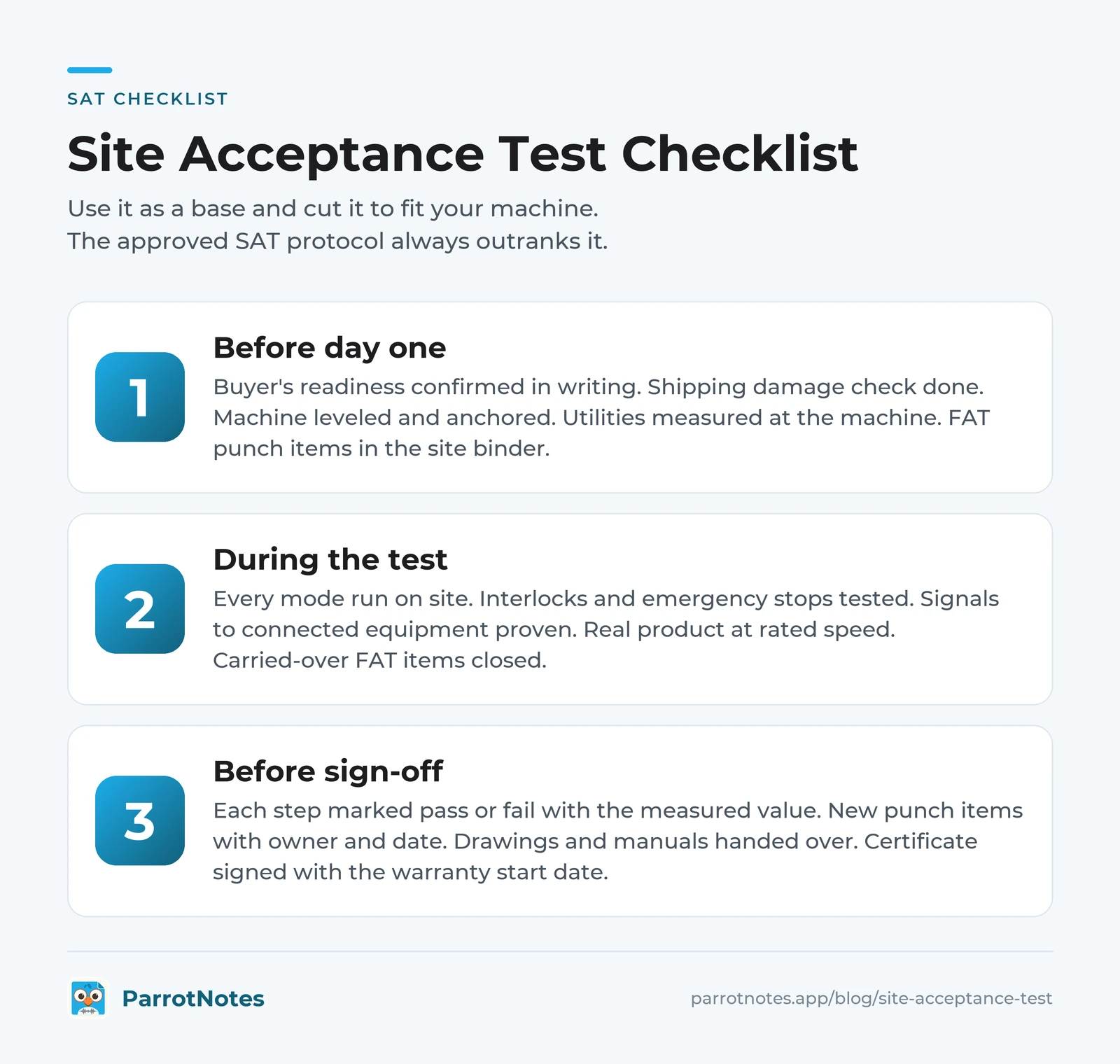
Use this site acceptance test checklist as a base and cut it to fit your machine. The approved SAT protocol always outranks it.
Before day one
- Buyer's readiness items confirmed in writing, with photos where possible
- Shipping damage check done on arrival, with photos
- Machine installed, leveled and anchored to the drawings
- Utilities measured at the machine, not just at the source
- FAT report and open punch items in the site binder
- Instruments calibrated, certificates on site
- Site safety induction booked for the builder's team
During the test
- Startup, shutdown and every operating mode run on site
- Inputs and outputs and calibration checked again after shipping
- Alarms, interlocks, guarding and emergency stops tested on site
- Signals to and from upstream and downstream equipment proven
- Every format run with real product at rated speed for the agreed time
- Each carried-over FAT item tested and marked closed or open
- Operator and maintenance training given, with an attendance list
Before sign-off
- Every protocol step marked pass or fail, with the measured value
- New site punch items listed with severity, owner and date
- As-built drawings, manuals and spare parts list handed over
- Acceptance certificate signed, with any open items attached
- Warranty start date written on the certificate
Want a blank list for the open items? The free punch list template has columns for owner, date and status.
Carry FAT punch items over to the SAT
At most factory tests, a few items get moved "to site." The punch list from the FAT says so, and then nobody looks at it again until the customer's engineer brings it up on SAT day two.
A carry-over sheet stops that. It takes each item deferred at the FAT and gives it a SAT step, a test and an owner, so it gets closed in front of the customer instead of discovered by them.
Here's a sample from the invented palletizer job:
| FAT item | Why it waited | SAT step | How it's checked | Owner |
|---|---|---|---|---|
| Layer pattern 4 not shown | No 1-liter cases at the factory | Run 30 min with real cases | Rate and pattern vs spec | Test engineer |
| Line-full signal from conveyor | Conveyor not at the factory | Signal test with live conveyor | Stops and restarts on signal | Controls lead |
| Air use at rated speed | Shop air only | Measure at the machine | Within the spec value | Service tech |
| Spanish screens | Language file pending | Screen review with operators | All screens translated | Software |
Take the line-full signal. At the factory it was tested with a switch on a bench, which proves the input works. On site it has to stop the palletizer when the real conveyor backs up, and restart cleanly. If that row isn't on the sheet, the first time anyone tests it might be the first jam on a night shift.
Anything new the customer asks for on site, like a pattern that was never in the spec, goes on a change order, not on the punch list.
What a signed SAT unlocks
The SAT signature tends to release three things at once: acceptance, the last payment and the warranty clock. That's why the terms around it belong in the quote, not in an email on the last day. This is general information, not legal advice, so run your wording past whoever reviews your contracts.
Published sample clauses on Law Insider show the kinds of terms to settle:
- When the test starts. One clause has the buyer running the SAT "within 14 working days" of the supplier's notice.
- What if the buyer delays. Another says that if the client fails to make the SAT possible in time, "the Product will be deemed accepted."
- When the warranty starts. One reads simply: "The warranty period will begin at Acceptance."
- How retests work. Another sets repeat tests "not later than 5 business days" after the fix.
There's one more way acceptance can happen without a signature. Automationnth warns that if the buyer starts "producing sellable product on the equipment, then they have accepted the equipment." Contracts differ on this, so if yours says it, point it out to the customer before the line starts making product.
Picture the other side of it. A buyer's plant runs the new machine on real orders for six weeks while one minor item stays open, and the final invoice sits unpaid. Clear wording on deemed acceptance and on minor items turns that into a short email instead of a long dispute. In a long capital equipment sales cycle, the final payment can be the margin, so this matters.
Notes on SAT days
The protocol records results. It doesn't record the conversations around the machine: "we'll live with that until the next shutdown," "can it also run the half-pallet," "the training can wait for the night crew." Those sentences decide what was accepted.
Use one short note per site day, in this shape:
SAT note: [job], [machine], [site], day [n], [date]
Present (buyer / builder):
Site ready? (anything missing, and since when):
Protocol steps run and results:
Carried-over FAT items closed / still open:
Customer said (their words):
We promised (owner, date):
New request? Change order needed?
For tonight's recap:
Then send the recap the same day, so the customer's team can correct it while they remember. It's the same habit our sales engineer guide recommends for technical meetings.
You don't have to write it on the plant floor. Many plants limit phones, and you should always ask before recording anyone, because consent rules vary by place. The easy route is a debrief in the parking lot: open ParrotNotes and talk through the template for a few minutes.
You get a transcript, a summary and action items. Recording works without signal, and transcription runs once you're back in coverage.
As of November 2026, the free plan gives you 100 minutes a month, up to 30 minutes per recording. Pro is $19.99 a month, or $14.99 a month billed annually, with 3,000 minutes a month. Download ParrotNotes free before your next site visit.
Make the SAT boring
A good site acceptance test is a dull one, because every argument was settled earlier. Write the buyer's readiness items and the waiting-time rule into the quote. Carry every deferred FAT item onto a sheet with a SAT step and an owner. Agree what the signature releases, including deemed acceptance and the warranty start.
Then keep a short note each day and send the recap before you leave. Marco's palletizer would have run on Monday afternoon, with the air checked and the conveyor live. For your next site acceptance test, start with ParrotNotes free and keep the record as you go.
Frequently Asked Questions
What is a site acceptance test?
A site acceptance test (SAT) is a planned test of new equipment at the buyer's plant after delivery and installation. It shows the equipment arrived undamaged and works on real utilities, product and connected systems. A signed SAT usually marks acceptance and often releases the final payment.
What is the difference between FAT and SAT?
A FAT happens at the builder's factory before shipment and proves the equipment was built to spec. A SAT happens at the buyer's site after installation and proves it still works with real utilities and connected lines. The FAT usually releases shipment; the SAT usually releases acceptance.
Is a site acceptance test the same as commissioning?
Not quite. Commissioning is the wider job of installing, connecting and starting up the equipment. The SAT is the formal, signed test inside that job, run against an agreed protocol, that the buyer uses to accept the equipment.
Who signs a site acceptance test?
Usually named people from both sides: the builder's project or test lead and the buyer's engineering or operations lead. Name the signers in the protocol before day one, so the test doesn't end with nobody able to sign.
What happens if a site acceptance test fails?
The failed items go on a punch list, get fixed and are retested under the contract's retest terms. Minor items are often accepted as open with a date to close them. Check your contract for retest windows and for when acceptance can be deemed.
Related Posts

Best Wispr Flow Alternatives for iPhone, Android and Mac
The best Wispr Flow alternative for iPhone, Android, Mac and Windows, with each free plan and price checked November 2026. Try ParrotNotes free for voice notes.

Where Are Voice Memos Stored on iPhone and Mac?
Where are voice memos stored on iPhone and Mac? iCloud, Files, the Mac folder path and Recently Deleted, with sources for each macOS version. Find yours now.

VOMO AI Review: Features, Free Plan and Limits
VOMO AI review from its own pages, checked November 2026: the one-time free minutes, the $99.99 Pro, iPhone, Android, limits, safety. Try ParrotNotes free.