
Capability Statement: What to Include, With a Template and Example

Sarah Johnson
Writes about field sales, meeting notes and voice-first workflows at ParrotNotes. Every article is reviewed by the ParrotNotes product team before it goes live.

Table of Contents
- 1.What is a capability statement?
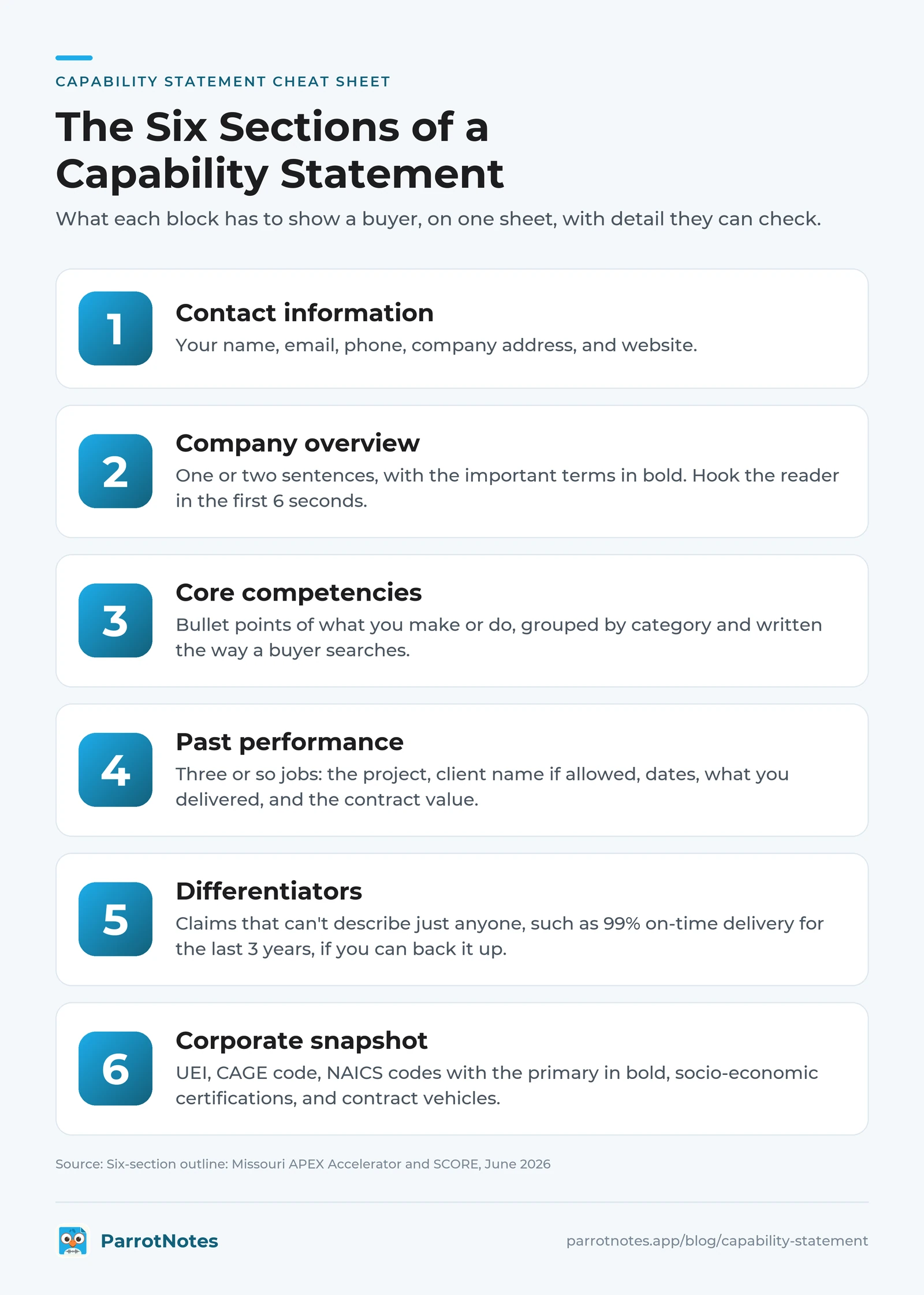
- 2.What to include in a capability statement: the six sections
- 3.Capability statement template for small manufacturers
- 4.Capability statement example: a fictional machine shop
- 5.How to change a capability statement for an OEM or prime buyer
- 6.When a pre-written capability statement isn't enough
- 7.Capability statement format, length, and free review
- 8.Keep your capability statement current with a tailoring log
- 9.Conclusion
Dana owns a 38-person machine shop, and she has 90 seconds with a small business specialist at an outreach event. She hands him the company brochure.
He turns it over looking for a NAICS code and a CAGE code, finds a photo of her father's first lathe, and thanks her politely. Nobody calls. (Dana is a composite, not a real owner.)
You know your shop can do the work. A buyer who has never heard of you needs proof on one sheet of paper. That sheet is a capability statement, and for small manufacturers it opens doors with government buyers, prime contractors, and OEM purchasing teams.
This guide covers the six sections APEX Accelerator counselors teach, a template you can copy, and one fictional shop's statement in two versions: federal and OEM. What a buyer tells you in a meeting should also change the next version, so if you'd rather talk those notes into your phone than type them up, try ParrotNotes free.
What is a capability statement?
A capability statement is a short document, one sheet at most, that tells a buyer what your company sells, who you've sold it to, and why you're different. The Missouri APEX Accelerator calls it a "1-2 page business resume" that focuses on the value you provide. Puerto Rico's APEX center calls it a communication and marketing tool that represents you when you aren't in the room.
The term comes mostly from US government contracting, where it's sometimes called a statement of capability or a "cap statement." Government buyers read it, and so do firms looking for teaming partners. Federal rules also ask agencies to find out, through market research, whether small businesses can meet a need, which is why a statement on file can matter before a bid exists.
Outside the US, the idea travels under other names, such as company profile or business profile. Australia uses the same term: Western Australia's small business agency notes that many tender applications require a capability statement.
Here's how it differs from the other paper you already carry:
| Document | What it answers | When you use it |
|---|---|---|
| Capability statement | Can this company do work like ours? | First contact, outreach events, teaming, vendor lists |
| Manufacturer line card | Which lines can this agency or distributor supply? | Rep and distributor visits |
| Product spec sheet | Does this one product fit my application? | Engineering and purchasing review |
| Quote or proposal | What will this job cost, and how will you do it? | Answering an RFQ or RFP |
What to include in a capability statement: the six sections
We found no official SBA form or required federal layout, and counselors' advice differs on small details. The most complete outline we read is the Missouri APEX deck from June 2026, which uses six sections. If a notice or solicitation states its own format, follow that instead.
1. Contact information
Your name, email, phone, company address, and website. A reader who wants to call shouldn't have to hunt.
2. Company overview
One or two sentences, with the important terms in bold. The deck's advice is to hook the reader "in the first 6 seconds." Compare "innovative solutions for industry" with "CNC turning and milling of stainless and titanium parts, prototype to 5,000 pieces." Only the second tells a buyer whether to keep reading.
3. Core competencies
Bullet points of what you make or do, grouped by category and written the way a buyer searches. "Precision machining" is vague. "5-axis milling, Swiss turning, wire EDM" can be matched to a requirement.
4. Past performance
Three or so jobs, each with the project, client name (only if you're allowed to share it), dates, what you delivered, and the contract value, which shows scale. If your business is new, the deck suggests renaming this section "Key Personnel Experience" and listing what your people did at earlier employers.
Pick the jobs closest to this buyer's work. Winvale, a government contracting consultancy, advises confirming each reference is willing to be contacted before you list them.
5. Differentiators
These are the hardest, and they fail when they could describe anyone. "On-time delivery" isn't a differentiator. "99% on-time delivery for the last 3 years" is, as long as you can back it up. Technical licenses and quality certifications such as ISO 9001 belong here too.
6. Corporate snapshot
The identifiers a federal buyer uses to look you up and sort you:
- UEI: the 12-character identifier you receive when you register at SAM.gov
- CAGE code: a five-character code tied to your registration
- NAICS codes, with the primary in bold
- Socio-economic certifications, such as 8(a), HUBZone, WOSB, or SDVOSB, named exactly ("SBA Certified WOSB," not "woman-owned")
- Contract vehicles you hold, such as a GSA Schedule
Size status belongs here as well. Standards vary by industry, but SBA says most manufacturers with 500 employees or fewer generally qualify as small, so check the standard for your code.
Capability statement template for small manufacturers
Copy this into Word or Google Docs. A two-column layout works well, with the snapshot in a narrow side column. Delete any line you can't back up.
[COMPANY NAME] | CAPABILITY STATEMENT
[Name, title] | [Phone] | [Email] | [Website] | [City, State]

COMPANY OVERVIEW
[What you make] for [who buys it], from [smallest job] to [largest job].
[One number that proves it.]

CORE COMPETENCIES
[Process group]: [process], [process], [process]
[Material group]: [materials you run every week]
[Capacity]: [work envelope, tolerance you hold, annual volume]
[Finishing and inspection]: [in-house or qualified vendors]

PAST PERFORMANCE
[Customer or type] | [Dates] | [Contract value] | [Prime or sub]
[What you delivered, in numbers, and how it turned out]
(Repeat for two more jobs closest to this buyer's work)

DIFFERENTIATORS
[Measured result, with period]
[Quality certificate and scope]
[Something a competitor can't claim, with proof]

CORPORATE SNAPSHOT
UEI: [12 characters] | CAGE: [5 characters]
NAICS: [primary in bold], [others]
Size: [small under primary NAICS, employee count]
Certifications: [exact program names]
Contract vehicles: [if any]
Capability statement example: a fictional machine shop
Everything in this example is invented, including the company, numbers, contracts, and identifiers. The phone number and web address are reserved for examples. Don't copy the claims; copy the level of detail.
TALLGRASS EXAMPLE MACHINE WORKS | CAPABILITY STATEMENT
Dana Example, President | (555) 555-0100 | dana@example.com | example.com | Anytown, OH
Company overview: CNC-machined stainless and titanium parts for maintenance depots and equipment builders, from 10-piece prototypes to 5,000-piece runs. 97% on-time delivery over the last 24 months.
Core competencies
- Machining: 5-axis milling, Swiss turning, wire EDM
- Materials: 304 and 316 stainless, 6061 aluminum, Grade 5 titanium
- Capacity: parts up to 30 x 16 x 20 in., tolerances to ±0.001 in.
- Inspection: in-house CMM, first article reports
Past performance
- Federal maintenance depot | 03/2025 to 02/2026 | $184,000 | Prime. 1,200 stainless brackets and bushings, all delivered on schedule.
- Prime contractor, ground vehicles | 2024 to present | $310,000 | Sub. Machined titanium housings; 0.4% reject rate.
- Regional transit authority | 2024 | $62,000 | Prime. Replacement pump parts with a four-week turnaround.
Differentiators
- ISO 9001 certified, scope includes CNC machining and inspection
- 97% on-time delivery over 24 months, tracked by purchase order
- Same-week response to first article questions
Corporate snapshot
- UEI: XXXXXXXXXXXX | CAGE: XXXXX
- NAICS: 332710, 332721
- Size: small business, 38 employees
- Certifications: SBA Certified WOSB
- Registered for access to controlled technical data through the Joint Certification Program (DD 2345)
If you want to see what real ones look like, the Missouri deck points to SBA's Small Business Search, where you can look up firms in your industry and read their statements. HHS also posts a sample capability statement, written for a consulting firm. Be careful with results for "capability statement template": many of the pages we hit were low-quality copies of one another.
How to change a capability statement for an OEM or prime buyer
Luis, a sales manager at a stamping plant, sent his federal version to an automotive supplier's purchasing team. The reply was one line: "What are your press tonnages, and do you hold IATF 16949?" Neither was on the sheet, and half the page was codes the buyer had no use for. (Luis is a composite too.)
An OEM buyer isn't sorting you by set-aside. They want to know whether you'd survive their supplier qualification. Here's what changes for Tallgrass (our guidance, not an official rule):
| Block | Federal version | OEM version |
|---|---|---|
| Overview | CNC parts for maintenance depots, 10 to 5,000 pieces | CNC parts for equipment builders, about 40,000 parts a year |
| Competencies | 5-axis milling, Swiss turning, wire EDM, materials | The same, plus a machine list and ±0.001 in. tolerance held |
| Past performance | Federal depot, 03/2025 to 02/2026, $184,000, prime | Ground vehicle housings in titanium, 0.4% reject rate, customer name withheld |
| Differentiators | 97% on-time, ISO 9001 | 4,000 PPM rejects, 97% on-time, ISO 9001 scope, first article reports |
| Snapshot | UEI, CAGE, NAICS 332710, SBA Certified WOSB | Anytown, OH plant, 38 employees, four-week lead time, WOSB for supplier diversity programs |
Once you're past the first look, purchasing usually sends its own supplier questionnaire. Our guide to selling to procurement covers that meeting, and a manufacturers' rep can hand this version over along with the line card.
When a pre-written capability statement isn't enough
Priya, a business development lead, replies to every federal sources sought notice with the same PDF. Six months in, she has no callbacks to show for it. (Priya is a composite as well.) A DOE contracting officer's 2019 small business forum presentation suggests why.
A sources sought notice is market research, not a solicitation. The agency is asking who could do the work. That same presentation lists "Capability Statements on file" as one way agencies do research, then gives this advice for replying: "answer the mail" exactly, and "Do NOT attach a pre-written Capability Statement."
Use your statement for introductions, events, and vendor lists. For a notice, answer each question in the order asked, and tailor anything you attach. That's one officer's view, not a rule.
Capability statement format, length, and free review
- Length: one sheet. Puerto Rico's center says 1 or 2 pages, one sheet.
- File type: a PDF when you email it, not a Word file. Missouri adds that the text should be selectable.
- File name: "Capability Statement_Company_Industry," so it can be found again after it's forwarded.
- Versions: keep one master copy and adapt it for each customer.
- What to cut: long company history and any adjective you can't prove.
APEX Accelerators, formerly called PTACs, can review it with you. The Missouri center describes its guidance as no-cost and confidential, with 90+ Accelerators in 300+ offices nationwide, funded in part by the Department of Defense.
Keep your capability statement current with a tailoring log
Most statements go stale because nobody writes down what buyers ask. Keep one row per conversation:
Tailoring log
| Buyer | What they asked about | Block to change | Proof you can show | Version sent |
|---|---|---|---|---|
| Purchasing lead, equipment builder (example) | Titanium volume, PPAP | Competencies, Differentiators | Run history, sample PPAP package | OEM, rev. 3, next day |
Nobody fills in a five-column table in a parking lot, so talk it instead. Open ParrotNotes in the truck and say it: "Purchasing lead at the equipment builder, asked about titanium volume and PPAP, send the OEM version tomorrow." You get a transcript and an AI summary, and ParrotNotes pulls out the action items (on every Pro recording, and on five recordings a month on Free). Keep the debrief to plain business terms, and leave out controlled drawings and export-controlled technical data.
If the buyer agrees to a recording, you can capture the meeting itself with no meeting bot. As of November 2026, the Free plan includes 100 minutes a month, and Pro is $19.99 a month, or $14.99 a month billed annually, with 3,000 minutes.
Conclusion
A good capability statement shows what you make, proves you've done it, and makes you easy to look up. This week:
- Fill in the six sections and cut any claim you can't prove.
- Make a federal version and an OEM version from the same master.
- Ask your local APEX Accelerator to mark it up.
Dana's brochure never told that specialist what he needed, but her next version can. Download ParrotNotes free and log what the next buyer asks before you leave the lot.
Frequently Asked Questions
What is a capability statement?
A capability statement is a short document, one sheet at most, that tells a buyer what your company sells, who you've sold it to, and what makes you different. Small businesses use it mainly in US government contracting, and also with prime contractors and corporate buyers.
What should a capability statement include?
APEX Accelerator counselors teach six sections: contact information, company overview, core competencies, past performance, differentiators, and a corporate snapshot with your UEI, CAGE code, NAICS codes, and certifications.
How long should a capability statement be?
Keep it to one sheet, front and back at most. Missouri's APEX Accelerator describes it as a one- to two-page document, and Puerto Rico's center says one or two pages on one sheet.
Does SBA have a capability statement template?
We found no official SBA form or required federal layout. APEX Accelerators and agency small business offices offer outlines and samples, and a notice's own format instructions always come first.
What if my company has no past performance?
Rename the section "Key Personnel Experience" and list relevant projects your people worked on, with their job titles and timelines. That's the Missouri APEX Accelerator's suggestion for new businesses. Commercial jobs count too, as long as they resemble the buyer's work.
What is the difference between a capability statement and a proposal?
A capability statement introduces your company before there's a specific job. A proposal answers one solicitation with your approach and price. A capability statement doesn't replace a proposal, and it isn't a substitute for answering the questions in a notice.
Related Posts

What Is a Byline? Meaning, Examples and Who Gets One
The meaning of byline explained with examples: byline vs dateline, who gets one under AP and NPR rules, plus a freelancer credit email to copy. Learn more.
SDR vs BDR: What Each Role Does and Why Companies Mix Them Up
SDR vs BDR compared: what each role does, the pay employers state and why titles get mixed up, from 154 live job ads. Try ParrotNotes free for hand-off notes.

Sales Email Subject Lines: Examples by Situation and What to Avoid
Sales email subject lines for every situation: 40 short examples, what to avoid, and a five-question check. Build yours from your meeting notes. Try it free.