
Product Spec Sheet: Format, Example and What Buyers Look For

Sarah Johnson
Writes about field sales, meeting notes and voice-first workflows at ParrotNotes. Every article is reviewed by the ParrotNotes product team before it goes live.
Table of Contents
- 1.What is a product spec sheet?
- 2.What buyers look for in a product spec sheet
- 3.Product spec sheet format: 10 blocks to copy
- 4.Product spec sheet example: a 2-inch stainless ball valve
- 5.Before you send it: an 8-point check for reps
- 6.Turn buyer questions into the next revision
- 7.Spec sheet mistakes that cost the spec
- 8.Make the spec sheet do the selling
Marco's product spec sheet said "1,000 psi." That was true, at room temperature. The process engineer he sent it to was running hot oil at 350 °F, and she knew the seats in that valve lose pressure rating as the temperature climbs. The sheet didn't say how much. So she didn't call Marco to ask. She specified the competitor whose sheet had a pressure-temperature chart on page one. (Marco is a composite, not a real rep.)
You already know engineers don't buy from adjectives. They buy from numbers they can check, under conditions they can match to their own job. A product spec sheet is where those numbers live, and for a lot of buyers it's the only part of your pitch they'll read twice.
This guide covers what a product spec sheet is (and how it differs from a data sheet, a cut sheet and a submittal), what each buyer looks for first, a 10-block spec sheet format you can copy, a filled-in example for an industrial valve, and an 8-point check to run before you hit send.
Most of what goes wrong with a spec sheet shows up as a question in a meeting. If you'd rather talk those questions into your phone than scribble them in the truck, try ParrotNotes free.
What is a product spec sheet?
A product spec sheet is a short document, usually one or two pages, that lists the measurable facts about a product: what it is, what it's made of, how big it is, what it's rated for and under which conditions, which standards it meets, and how to order it. Buyers use it to decide whether the product fits their application before anyone talks price.
The names overlap, so here's how they're usually used in manufacturing and industrial sales:
| Document | What it is | Who usually asks for it |
|---|---|---|
| Product spec sheet | One or two pages of key specs, options and ordering info | Engineers, buyers, distributors |
| Data sheet | The full technical reference: every rating, curve and test condition | Design engineers |
| Cut sheet | Construction term for a one-page product spec sheet | Architects, contractors, specifiers |
| Submittal | A package of cut sheets, drawings and samples sent for approval on a project | General contractor, architect, engineer of record |
| Product requirements spec (PRD) | What a product should do, written before it's built | Your own product and engineering team |
If you sell building products, the cut sheet usually ends up inside a submittal, and our guide on what a submittal is covers that package. The rest of this post is about the spec sheet itself.
What buyers look for in a product spec sheet
A spec sheet gets read by several people, and each one reads it for a different reason. A design engineer and a purchasing agent can look at the same page and see two different documents.
| Reader | What they check first | What makes them stop reading |
|---|---|---|
| Design or process engineer | Ratings with conditions, dimensions, materials, curves | A number with no test condition or no unit |
| Purchasing | Part number, ordering code, lead time, pack size, revision date | Can't tell which part number matches the quote |
| Quality | Standards, certifications, material certs, traceability | "Meets industry standards" with no standard named |
| Maintenance | Spare parts, service intervals, installation notes | No replacement kit listed |
| Contractor or specifier | Fit to the spec section, approvals, finish and size options | Options not marked for the job |
Three things matter to almost every technical reader.
Guaranteed limits, not just typical values. Engineers design to the minimum and maximum, not to the average. A Texas Instruments op-amp data sheet, quoted by The Ganssle Group, put it plainly: typical values "are not tested and are not guaranteed on shipped production material." If your sheet only shows typical numbers, say so, and say where the guaranteed limits are.
Conditions next to every rating. "1,000 psi" means little without the temperature. "IP66" means little without saying which part of the product it covers. A rating without its conditions is the fastest way to lose a careful engineer.
Units written so nobody has to guess. The NIST guide to the SI says to put a unit after each value ("51 mm × 51 mm × 25 mm", not "51 × 51 × 25 mm") and to write ranges as "0 V to 5 V". On a sheet that mixes inches and millimeters, that habit prevents expensive mistakes.
Buyers also notice what's missing. If your sheet leaves out the one function the spec requires, the "or equal" product only has to look similar on paper, which is how a spec gets value-engineered away from you.
Product spec sheet format: 10 blocks to copy
This spec sheet format works for most industrial and manufactured products. Copy the block below into your own spec sheet template and keep the result to two pages. Anything longer belongs in the full data sheet, with a link.
PRODUCT SPEC SHEET
1. Header
   Manufacturer | Product name and model | Part number(s)
   Revision: [letter or number] | Date: [YYYY-MM-DD]

2. What it is and where it fits (one or two sentences)
   [Product] for [application], rated for [key limit] at [condition].

3. Key specifications (table)
   Parameter | Min | Typical | Max | Unit | Test condition
   [Only the 6-10 numbers a buyer uses to decide]

4. Dimensions and weight
   [Drawing or table, each value with its unit; tolerances where they matter]

5. Materials and finishes
   [Body, wetted or contact parts, seals, coatings; grades named]

6. Ratings, standards and certifications
   [Each standard named with its number; certificate available on request?]

7. Options and ordering code
   [Code breakdown: series-size-material-end-option, with one full example]

8. Installation and compatibility
   [Mounting, connections, what it replaces, what it must not be used with]

9. Documents and support
   [Full data sheet, CAD model, manual, material certs, warranty; where to get them]

10. Revision history and contact
   [Rev | Date | What changed] | Rep or distributor contact
A few rules make the format work:
- Put the decision numbers in block 3, not scattered across the page
- Name every standard with its number, or leave it off
- Show one full ordering code as an example, so purchasing can check the quote against it
- Change the revision letter every time a number changes, and log what changed
That last rule isn't unique to industrial products. PartnerSlate's guide for food manufacturers puts a revision date at the top of the sheet and a dated revision history at the bottom, for the same reason.
Product spec sheet example: a 2-inch stainless ball valve
Here's the format filled in for a fictional valve, as a spec sheet sample to compare yours against. Every number below is illustrative, picked to show the layout and is not data for a real product. Use your principal's published numbers on a real sheet.
PRODUCT SPEC SHEET
1. Example Valve Co. | BV-200 two-piece ball valve | Part no. BV200-2-SS-NPT
   Revision: C | Date: 2026-10-27

2. Full-port 2 in. stainless steel ball valve for process water, oils
   and mild chemicals, rated 1,000 psi at 100 °F.

3. Key specifications
   Parameter              Min    Typ    Max      Unit     Condition
   Working pressure       -      -      1,000    psi      at 100 °F
   Working pressure       -      -      600      psi      at 300 °F
   Working pressure       -      -      400      psi      at 400 °F
   Temperature            -20    -      400      °F       RTFE seats
   Flow coefficient (Cv)  -      320    -        -        fully open
   Operating torque       -      30     45       lbf·in   at rated pressure

4. Dimensions: end to end 4.1 in. | height 3.6 in. | handle 8.0 in.
   Weight 6.2 lb

5. Materials: body and ball CF8M (cast 316 stainless) | stem 316 |
   seats reinforced PTFE (RTFE) | handle 304 stainless with vinyl grip

6. Standards: MSS SP-110 design | NPT ends to ASME B1.20.1
   Material test reports available per order

7. Ordering code: BV200 - [size: 1, 1.5, 2] - [SS] - [NPT or SW]
   Example: BV200-2-SS-NPT

8. Installation: either flow direction | lockable handle |
   ISO 5211 pad for actuator mounting | not for steam service

9. Documents: full data sheet with pressure-temperature curve, CAD model,
   installation manual, MTRs | from your rep or distributor

10. Rev C (2026-10-27): added 300 °F and 400 °F ratings
    Rev B (2026-03-02): added NPT/SW ordering option
Look at revision C. The only change is two lines in block 3, and those two lines answer the exact question that cost Marco his spec. That's the pattern you want: the sheet gets better every time a buyer asks something it didn't cover.
Notice what isn't there, too. No mission statement, no "industry-leading quality," no photos of the factory. Each line is something an engineer, buyer or inspector can check.
Before you send it: an 8-point check for reps
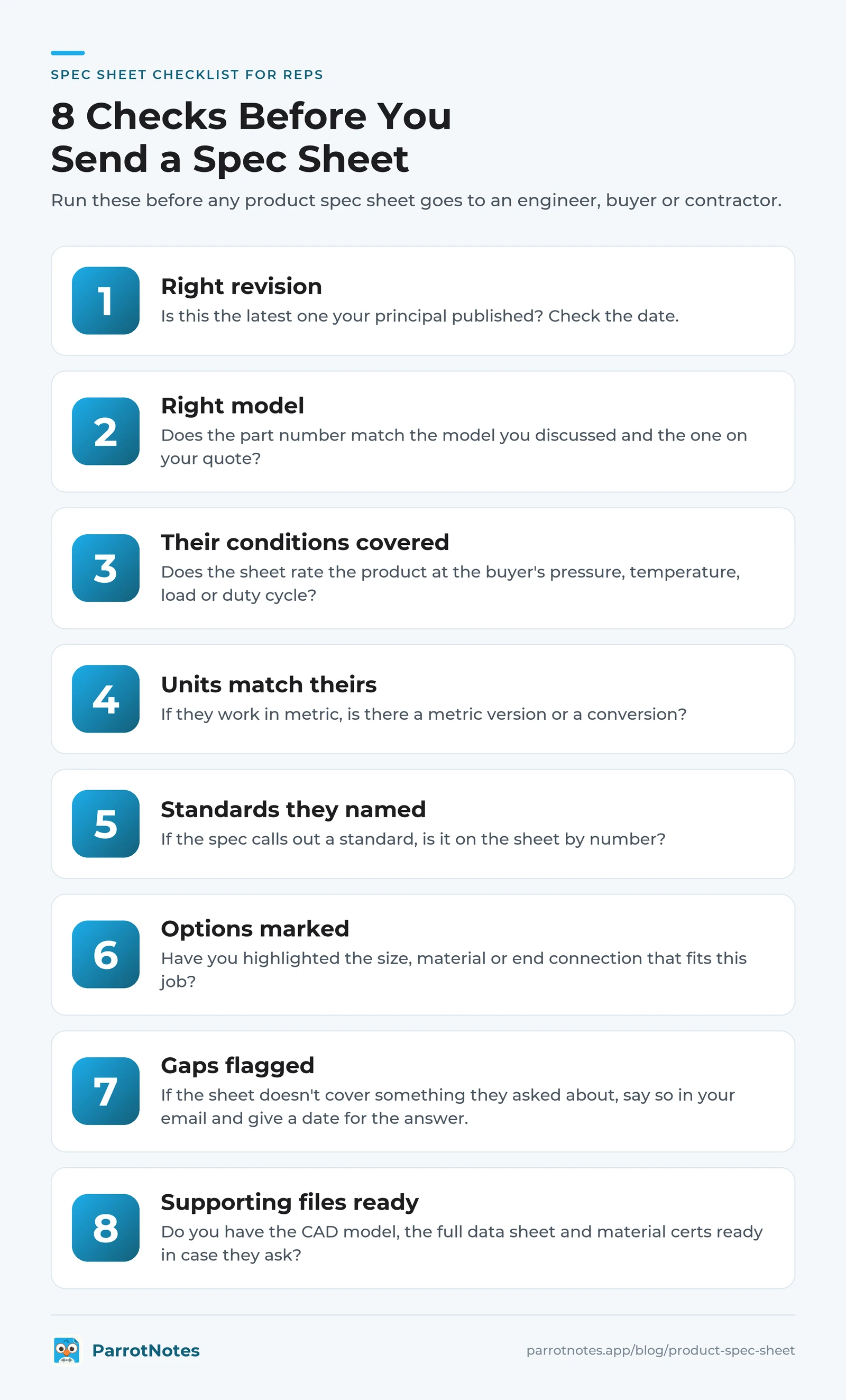
As a manufacturers' rep, you usually don't write the spec sheet. Your principal does. But you choose which sheet goes to which buyer, and you're the one who hears what's wrong with it. Run these eight checks before you send:
- Right revision. Is this the latest one your principal published? Check the date.
- Right model. Does the part number match the model you discussed and the one on your quote?
- Their conditions covered. Does the sheet rate the product at the buyer's pressure, temperature, load or duty cycle?
- Units match theirs. If they work in metric, is there a metric version or a conversion?
- Standards they named. If the spec calls out a standard, is it on the sheet by number?
- Options marked. Have you highlighted the size, material or end connection that fits this job?
- Gaps flagged. If the sheet doesn't cover something they asked about, say so in your email and give a date for the answer.
- Supporting files ready. Do you have the CAD model, the full data sheet and material certs ready in case they ask?
Point 7 is the one most reps skip. Engineers don't mind a gap you've flagged. They mind finding it themselves. Our guide to selling to engineers covers how to follow up with data rather than adjectives.
Turn buyer questions into the next revision
Your principal's engineers wrote the sheet from the lab. You hear how it reads in the field. That makes you the best source of the next revision, as long as the questions don't vanish between the meeting and the windshield.
Priya is a sales engineer for a pump maker who covers about 40 accounts in the Midwest. (She's a composite, used to show the method.) After every technical meeting she spends two minutes in the parking lot recording what the engineer asked that the spec sheet didn't answer. At the end of the month she copies those questions into a simple log:
| Date | Account | Question the sheet didn't answer | Model and revision | Answered by | Add to sheet? |
|---|---|---|---|---|---|
| Oct 3 | Food plant | Max solids size at full speed? | P-40, rev B | Factory, Oct 6 | Yes |
| Oct 11 | OEM skid builder | Metric flange option? | P-40, rev B | Factory, Oct 14 | Yes |
| Oct 19 | Chemical plant | Seal material for 30% caustic? | P-40, rev B | Pending | Check |
When three different engineers ask the same question in a quarter, that's not a sales objection. It's a missing row on the sheet. Priya sends the log to her principal with that recommendation, and the next revision answers it before the next engineer has to ask.
This is where a voice recorder earns its keep. Record the debrief after the meeting (park first, never while driving), and ParrotNotes gives you a transcript, an AI summary and, on your AI-powered recordings, the action items, so the questions are written down before the next stop. Search your notes for "spec sheet" at month end and the log almost fills itself. The technical meeting record in our sales engineer guide works the same way.
Want the questions to stop disappearing? Download ParrotNotes free and record your next post-meeting debrief. The free plan includes 100 minutes a month.
Spec sheet mistakes that cost the spec
Most spec sheets don't fail because a number is wrong. They fail because a number is incomplete or hard to find.
- Ratings without conditions. "Rated to 1,000 psi" with no temperature, or "IP66" with no note on what it covers.
- Only typical values. Engineers can't design to a typical value. Show limits, or say where they are.
- Marketing copy in the spec table. "Superior durability" isn't a parameter. Move it to the brochure.
- No revision date. A buyer holding rev A and a quote built on rev C will find the gap at the worst moment.
- Ordering code without an example. Purchasing has to guess, and the wrong part ships.
- Standards implied, not named. "Meets industry standards" tells quality nothing.
Tom, a building-products distributor rep (also a composite), learned the last one the hard way. His contractor's spec section required a named test standard, and his sheet just said "tested to industry standards." The architect's reviewer rejected the package, and it took 12 days to get a certificate from the factory. A missing line on one page cost him two weeks of the schedule. If you quote from customer specs often, our RFQ template includes a clarifications block for exactly these gaps.
Make the spec sheet do the selling
A good product spec sheet is short, specific and honest about its limits. To recap:
- Put the 6 to 10 decision numbers in one table, each with its unit and test condition
- Show guaranteed limits, not only typical values
- Name every standard by number and show a full ordering code example
- Date and revise the sheet every time a number changes
- Log every question it didn't answer and send the log to your principal
You won't always control what's on the sheet. You do control which sheet you send, what you flag, and what you feed back. Do those three things and engineers start trusting your paperwork before they've met you twice.
When you walk a buyer through your lines, the manufacturer line card gets you into the conversation. The spec sheet keeps you in the spec. To catch every question it raises, try ParrotNotes free on your next plant visit.
Frequently Asked Questions
What is a product spec sheet?
A product spec sheet is a one- or two-page document that lists a product's measurable facts: what it is, dimensions, materials, ratings with their test conditions, standards met and how to order it. Engineers and buyers use it to check fit before they ask for a quote.
What should be included in a spec sheet?
Most spec sheets include a header with model, part number and revision date, a one-line description, a key specifications table with units and conditions, dimensions, materials, standards and certifications, options and an ordering code, installation notes, a list of supporting documents, and a revision history.
What is the difference between a spec sheet and a data sheet?
A spec sheet is the short version: the numbers a buyer needs to decide. A data sheet is the full technical reference, with every rating, curve, test condition and note. Many manufacturers publish both and link the data sheet from the spec sheet.
How long should a product spec sheet be?
One or two pages. If the product needs more, keep the decision numbers on the spec sheet and move curves, test methods and detailed drawings to the full data sheet or manual.
Who writes the product spec sheet?
Usually the manufacturer's product or engineering team writes it, often with marketing on layout. Reps and distributors rarely author it, but they should feed back the questions buyers ask that the sheet doesn't answer, so the next revision covers them.
What is a spec sheet in construction?
In construction it's usually called a cut sheet or product data sheet. Contractors include it in a submittal package so the architect or engineer can confirm the product meets the project specification before it's ordered and installed.
Related Posts

Sales Ramp Time: How Long New Reps Take and How to Shorten It
Sales ramp time: how long new reps take to reach full productivity. Get 2026 benchmarks, the formula, a worked example and a six-month plan to shorten it.

Rev Transcription Review: Accuracy, Pricing and Turnaround
Rev transcription review from Rev's own pages, checked Oct 27, 2026: plans, per-minute prices, add-ons, accuracy and turnaround. Try ParrotNotes free.
Podcast Transcript Format: Example and Template
Podcast transcript format explained: one exchange in five formats (page, Docs, VTT, SRT, JSON), the layout rules, and a copy-ready episode page template.