
Telecom Sales: Selling Business Phone and Internet Face to Face

Sarah Johnson
Writes about field sales, meeting notes and voice-first workflows at ParrotNotes. Every article is reviewed by the ParrotNotes product team before it goes live.

Table of Contents
- 1.What is telecom sales?
- 2.The first visit: earn the bill and the contract date
- 3.How to read a business telecom bill with the owner
- 4.The site survey: what to check before you quote
- 5.Telecom sales discovery questions for the second visit
- 6.Telecom sales objections: contracts, downtime and price
- 7.Switching honestly: the checklist before anyone signs
- 8.The telecom sales visit note
- 9.Sell the walk-through, not the speed
Tasha walked into a four-chair dental office at 12:15, while the front desk was quiet, and asked for whoever pays the phone bill. The office manager, Renee, didn't look up. "We're with the cable company. We're fine."
Tasha didn't argue. She asked one question: "Do you know when your contract ends, and what the bill becomes after the promo?" Renee didn't. Ten minutes later Tasha left with a photo of last month's bill and a Thursday appointment. (Tasha and Renee are composites, not real people.)
That's how most telecom sales are won in the field. Not with a speed test or a price sheet at the counter, but by being the rep who explains the bill nobody reads and checks the wiring nobody remembers.
This telecom sales guide is for outside reps and agents who sell business phone, internet, and connectivity to small and mid-size businesses in person. You'll get the first visit, a worked bill review, a site-survey checklist, 12 discovery questions, honest answers to objections, a switching checklist, and a visit note template.
What is telecom sales?
Telecom sales is selling communication services to businesses or households: internet, phone lines, cloud phone systems, mobile lines, and backup connections. In business-to-business telecom sales, reps work for a carrier, an authorized agent, or a reseller and usually sell in person over two or three visits, because the proposal depends on the customer's current bill and site.
A telecom sales representative in the field usually runs a three-visit rhythm:
- The walk-in. Earn a copy of the bill and the contract end date.
- The review and site survey. Read the bill with the owner and look at the equipment closet.
- The proposal and switch plan. Pricing in writing, a port date for the numbers, and an install window.
Anything you quote before visit two is a guess. If you're new to cold walk-ins, our guide to door-to-door sales covers the knock itself; this article stays inside the telecom conversation.
Ten or fifteen stops a day blur together by 5 PM. Try ParrotNotes free and dictate each stop in the car before you pull out.
The first visit: earn the bill and the contract date
Timing beats any opener. Walk in when someone can talk: after the lunch rush at restaurants, mid-morning at offices, never when the phones are ringing. Keep the first sentence about them.
An opener that works: "I help offices like yours check what phone and internet really cost, all fees in. If you let me look at one bill, I'll tell you your number and when your contract ends, even if you never switch."
First-visit questions (1 to 6)
- "Who handles the phone and internet bill, you or someone else?"
- "Who's your provider now, and how long have you been with them?"
- "Do you know when your contract ends, or if you're month to month?"
- "How many people use a desk phone, and how many just use their cell?"
- "Has anything bugged you lately: dropped calls, slow internet, support?"
- "Could I take a photo of last month's bill, or come back when you have it?"
Write the answers down before the next door. Question 3 decides whether there's a deal this quarter or next year.
How to read a business telecom bill with the owner
Sit next to the owner, not across the desk, and walk through the bill in three steps. The numbers below are illustrative, made up for this example; every carrier's bill looks different.
A worked example: a four-chair dental office, one month
| Line on the bill | Illustrative amount |
|---|---|
| Business internet, 500 Mbps | $149.99 |
| Promotional credit (ends in 2 months) | -$40.00 |
| Static IP address | $14.95 |
| Modem and router rental | $15.00 |
| 8 phone lines at $34.95 | $279.60 |
| Analog line (alarm panel) | $54.95 |
| Analog line (fax) | $54.95 |
| Surcharges and fees | $47.31 |
| Taxes | $38.20 |
| Total this month | $614.95 |
Step 1: the real monthly number. The total is $614.95 today. When the $40 credit ends, it becomes $654.95. Most owners remember the promo price, not the bill they'll pay in two months.
Step 2: cost per line in use. The office pays for 8 lines, but question 4 told you only 5 people use a desk phone. That's three lines, about $105 a month, that may be doing nothing. Ask before you assume: one may be a door phone or a backup.
Step 3: circle three lines. The equipment rental, the fax line, and the alarm line. Ask the owner what each one is for. Often they don't know, and that's your opening. But never quote a saving on the alarm line until you've spoken to the alarm company (more on that below).
Compare totals all in, taxes and fees included, because fee names differ by carrier and state. The same discipline works in card processing; our guide to merchant services sales walks through it on a processing statement.
The site survey: what to check before you quote
Marco sold business internet and phone to an auto parts store and quoted a clean switch to cloud phones. On install day, the alarm company called: the panel dialed out over one of the copper lines he'd planned to cancel. The install slipped two weeks and the owner nearly walked. (Marco is a composite, not a real person.)
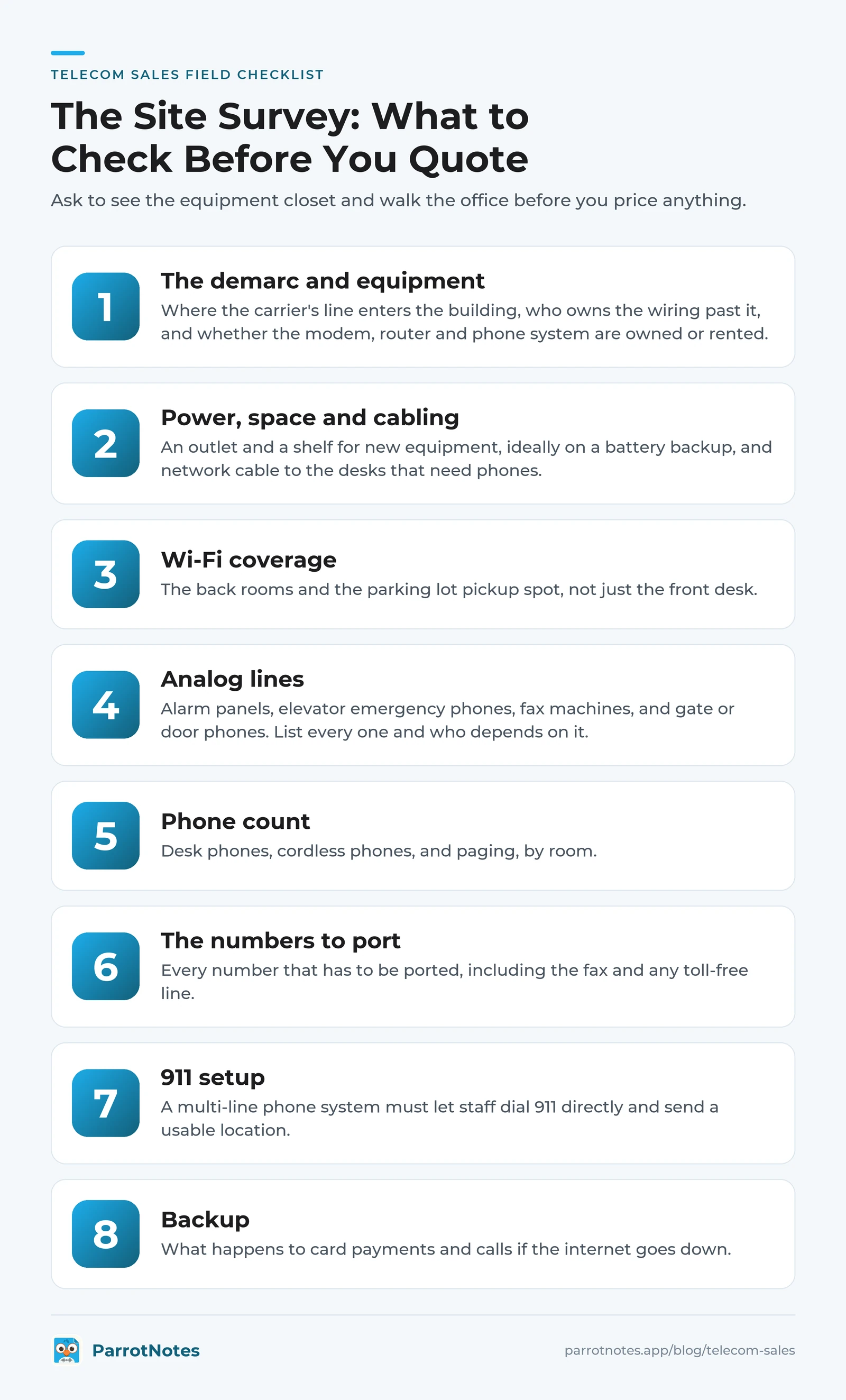
A 15-minute walk prevents that. Ask to see the equipment closet and check:
- The demarc: where the carrier's line enters the building and who owns the wiring past it.
- The equipment: modem, router, phone system box, and whether each is owned or rented.
- Power and space: an outlet and a shelf for new equipment, ideally on a battery backup.
- Analog lines: alarm panels, elevator emergency phones, fax machines, and gate or door phones often still use them. List every one and who depends on it.
- Phone count: desk phones, cordless phones, and paging, by room.
- Cabling: whether network cable reaches the desks that need phones.
- Wi-Fi coverage: the back rooms and the parking lot pickup spot, not just the front desk.
- The numbers: every number that has to be ported, including the fax and any toll-free line.
- 911 setup: any multi-line phone system you propose must let staff dial 911 directly and send a usable location.
- Backup: what happens to card payments and calls if the internet goes down.
Point 9 isn't optional. Under federal rules (47 CFR 9.16), a multi-line phone system must let a user call 911 "without dialing any additional digit, code, prefix, or post-fix, including any trunk-access code such as the digit 9."
The same rules call for a 911 notification "sent to a location where someone is likely to see or hear it," and a dispatchable location, such as a floor or suite, sent with the call. Check how your product handles both before you promise anything.
Telecom sales discovery questions for the second visit
The review visit is discovery, not a pitch. These six questions complete the bank. For a wider set, see our discovery questions in sales.
- "What did you think you were paying, before we added it up?"
- "Is there an early termination fee, and what is it in dollars?"
- "Which lines would hurt most if they went down for an afternoon?"
- "Who else needs to agree: a partner, an office manager, an IT person?"
- "What's your busiest day? We'll schedule the switch away from it."
- "If the numbers made sense, what would make switching a hassle?"
Question 12 surfaces the real objection early. The answer is rarely price. It's usually the fear of losing the main number or the phones going dead on a Monday.
Download ParrotNotes free and record the review with the owner's OK, so lines, dates, and names come back exactly as they said them.
Telecom sales objections: contracts, downtime and price
Most telecom objections come from a bad switch the owner has lived through before. Answer them with facts from their own bill and site.
| The owner says | What's behind it | Your honest answer |
|---|---|---|
| "We're happy with our provider." | Switching feels risky, and nothing is broken today. | "Good. I'm not asking you to switch today. I'll show you the bill after the promo and you decide if it's worth a talk." |
| "We're in a contract." | An early termination fee, real or feared. | "Let's find the end date and fee together. If the fee is bigger than what you'd save before it ends, wait, and I'll come back then." |
| "Last time we switched, the phones were down for two days." | A failed port or a rushed install. | "That's why I do the closet walk first and schedule the port for your quietest day, with your old service live until the new one is tested." |
| "We'll lose our number." | The main number is the business. | "In most cases your numbers move with you. We need a recent bill and a signed authorization, and I'll confirm the port date in writing." |
| "Your price is the same as everyone's." | You led with a rate, not their number. | "Maybe on the internet line. The difference is the three lines we circled and the rental. Here's my total, all in, in writing." |
When the objection is pure price, the moves in our guide to the price objection apply here too: ask what "too expensive" is being compared to before you touch your margin.
Switching honestly: the checklist before anyone signs
Carrier switching has a long history of abuse, called slamming: changing a customer's phone company without permission. Federal rules (47 CFR 64.1120) bar a carrier from submitting a change without the subscriber's authorization and verification, through a signed letter of agency, an electronic authorization, or an independent third-party check. The same section is blunt: "Material misrepresentation on the sales call is prohibited."
Owners have heard the stories, so the careful rep wins in telecom sales. Before any signature:
- Say who you work for in your first sentence, every visit. Never imply you're from their current carrier.
- Show the monthly total before and after, all in, in writing.
- State the contract length, the early termination fee, and when any promo ends.
- List every analog line and what happens to each one: kept, moved, or replaced.
- Put the port date, install window, and fallback plan in writing.
- Leave a copy of everything signed, and give the owner time to read it.
The telecom sales visit note
By visit three, the owner has told you the contract date, the alarm company's name, and the busiest day, on different visits. Lose one and the install goes wrong.
Priya sells business internet and phone to medical and dental offices. After a site survey at a chiropractic clinic, she had the alarm line, the fax number to port, and the name of the partner who signs. She dictated it all in the parking lot before her next stop, and her proposal opened with the alarm plan. (Priya is a composite, not a real person.)
Copy this template:
TELECOM VISIT NOTE
Business / contact:                     Visit #:     Date:
Who handles the bill:
Current provider / contract end / termination fee:
Bill total now ___  after promo ___  (date promo ends ___)
Lines billed ___  lines in use ___  analog lines (what for):
Equipment: owned / rented (what):
Site survey: demarc / closet / power / cabling / Wi-Fi notes:
Numbers to port (incl. fax, toll-free):
911: direct dial and location plan:
Pain points (owner's words):
Other decision-makers:
Busiest day / best switch window:
Next step + date:
ParrotNotes fills most of it for you. Record the review on your phone with the owner's OK (rules vary by state; see our guide to one-party consent states), or dictate a note in the car after each visit. There's no meeting bot and nothing to set up at the front desk.
You get a transcript, a summary, action items, and a drafted follow-up email, which our follow-up email templates help you sharpen. If the owner switches to Spanish or Vietnamese halfway through, ParrotNotes Pro transcribes and translates 99+ languages.
The Free plan includes 100 minutes of recording a month, a summary on every recording, and 5 AI-powered recordings with action items and key points. Pro ($19.99/month, or $14.99/month billed annually) adds 3,000 minutes a month, every AI feature on every recording, and AI search, so "which office had a fax line on a contract ending in March?" is one search.
Sell the walk-through, not the speed
Telecom sales rewards the rep who checks, not the one who quotes. Earn the bill and the contract date on the walk-in. Read the bill with the owner: the real total after the promo, cost per line in use, and the three lines to circle. Walk the closet before you price anything, and never cancel an alarm or elevator line on a guess.
Then write it all down, because the install goes right on visit three only if you kept what you heard on visit one. Get ParrotNotes free and walk into your next bill review knowing exactly what the owner told you last time.
Frequently Asked Questions
What is telecom sales?
Telecom sales is selling communication services such as internet, phone lines, cloud phone systems, mobile lines, and backup connections. Business telecom reps work for a carrier, an agent, or a reseller and usually sell in person over two or three visits, because the proposal depends on the customer's current bill and site.
How do you sell business phone and internet to small businesses?
Walk in when the owner has time, offer to work out their real monthly cost from one bill, and come back to review it with them. Show the total after any promo ends, check the lines actually in use, walk the equipment closet, and put the price, contract terms, and port date in writing before they sign.
What should a telecom rep check on a site survey?
Check the demarc and equipment closet, owned versus rented equipment, power and cabling, Wi-Fi coverage, every analog line (alarm panels, elevator phones, fax), the numbers to port, how the phone system will handle 911, and the backup plan if the internet goes down.
Is telecom sales a good job?
It suits reps who like walking into businesses and solving practical problems. Pay plans vary by employer, so check the base, the commission split, and how renewals are paid on any offer. Expect long waits on contract end dates, which is why careful notes on each account matter.
Should telecom reps record sales conversations?
Recording a bill review or site survey helps you keep line counts, dates, and names straight across several visits, but get the owner's permission first and check the consent rules where you work. If you'd rather not record, dictate a short note straight after each visit instead.
Related Posts

Voice to Text on Mac: Built-In Dictation and the Apps Worth Using
Set up voice to text on your Mac with built-in Dictation, change the settings that matter, and find out which voice to text Mac app is worth paying for.

Status Meeting: How to Keep Project Updates Short
Run a status meeting in 20 minutes: a run sheet, a three-line RAG update card, a notes template, and when to send it in writing. Try ParrotNotes free.

Sales Manager Weekly Report Template (With a Filled-In Example)
Copy a one-page sales manager weekly report template for your VP: numbers vs plan, forecast changes, deals at risk and asks, plus a filled-in example.