
Sales Team Structure: How to Organize Reps, Managers and Territories

Sarah Johnson
Writes about field sales, meeting notes and voice-first workflows at ParrotNotes. Every article is reviewed by the ParrotNotes product team before it goes live.

Table of Contents
- 1.What is a sales team structure?
- 2.Four sales team structure models for field teams
- 3.The roles in a field sales team
- 4.Span of control: how many reps per manager?
- 5.When to add a management layer
- 6.Where territories fit in the structure
- 7.Worked example: restructuring a 14-rep field team
- 8.Keep the structure working when accounts change hands
- 9.Sales team structure in short
Marcus had 14 field reps across three states, and every one of them reported to him. He also kept six of the company's biggest accounts for himself. In a typical month he managed two ride-alongs. His newest rep, three months in, had never had one. (Marcus is a composite, not a real person.)
Nobody designed that team. It grew one hire at a time, and the sales team structure was whatever happened to be there.
You probably know the feeling: the team is selling, but the setup is starting to creak. This guide shows how to structure a sales team that meets customers in person. You'll get four models that fit field selling, the roles you need, a span-of-control check you can run in ten minutes, a table for when to add a manager layer, and Marcus's team restructured with the math shown. If your coaching already happens in the car between visits, try ParrotNotes free to record those debriefs and get a summary and action items on your phone.
What is a sales team structure?
A sales team structure is how a company divides its selling work: how reps are split up, who they report to and which customers each person owns.
For a field team, that comes down to three decisions:
- How you split the reps: by geography, by account size, by product or by industry.
- Who manages whom: how many reps each manager leads, and when you add another layer.
- Who owns which customers: the territories and account lists each rep is answerable for.
Most articles on this topic are written for inside teams selling software. They describe SDRs booking meetings for account executives, and "pods" of specialists. Those models assume everyone sits near a screen.
A team that sells face to face has a constraint they don't: drive time. It shapes every one of the three decisions.
Four sales team structure models for field teams
| Model | How reps are split | Fits best when | Watch out for |
|---|---|---|---|
| Geographic | Each rep owns every account in an area | Products are similar across customers and travel is the main cost | Reps become generalists; big accounts get the same attention as small ones |
| Account tier (hybrid) | Key account managers own the largest accounts; territory reps own the rest of the area | A few customers bring in a large share of revenue | Arguments over which accounts count as "key" |
| Product or specialist overlay | Territory reps sell everything, with sales engineers or product specialists joining technical calls | Some products need deep expertise on the call | Specialists become a bottleneck if one covers too many reps |
| Industry or vertical | Reps specialize in one customer market, such as hospitals or contractors | Buyers in each market speak a different language and buy differently | Long drives, because one industry's accounts are spread out |
Most field teams start geographic and add the other models as layers. A common next step is the account tier hybrid: one or two key account managers take the largest customers, and territory reps keep the rest.
What about the inside sales models? The "assembly line" (one person books, another closes) does show up in field teams, usually as an inside sales coordinator who books appointments and handles quotes for two or three field reps. Our comparison of inside sales vs outside sales covers how the two roles split the work.
The roles in a field sales team
A field sales organization usually has some mix of these roles:
- Field or outside sales rep: owns a territory and meets customers in person. See what an outside sales rep does day to day.
- Key account manager: owns a short list of large customers, often across several territories.
- Inside sales coordinator: books visits, chases quotes and handles reorders so field reps can stay in the field.
- Sales engineer or product specialist: joins technical calls and spec reviews.
- First-line manager: leads the reps, rides along, coaches and runs the pipeline review. The territory sales manager title often means this job.
- Regional manager or sales director: manages the managers and owns the number for a region.
- Sales operations: owns the CRM, territory data, reports and the commission plan math.
A team of eight doesn't need all seven. The question is which role is missing when something keeps breaking, and the next two sections help you find it.
Span of control: how many reps per manager?
Span of control is the number of reps who report to one manager. It's the structure decision that most affects coaching.
The sales consultancy Alexander Group reports that the average first-line sales manager has 8.5 direct reports, with a range from 2 to 38. It notes that field models often need smaller spans than inside teams, where day-to-day in-person supervision can allow 20% to 80% more reps per manager. Player-coach managers, who also carry their own accounts, need a smaller span too.
Smaller spans may also go with better results. In a 2020 Redpoint survey of 507 go-to-market respondents, mostly from software companies, teams with more than seven reps per manager had reps finish below 50% of quota twice as often. The author is clear that this is a correlation, not proof.
An average won't tell you the right span for your team, though. A field manager's real limit is days in the car.
The field span check
Maximum span = coaching days the manager has each month ÷ coaching days each rep needs each month
Work out both numbers for your team. Here are the assumptions we use in the example below; swap in yours:
| Input | Assumed value |
|---|---|
| Working days in a month | 21 |
| Days for internal meetings, forecasting, hiring and admin | 4 |
| Days on the manager's own accounts (player-coach only) | 2 to 6 |
| A ramped rep's monthly need | 1.5 days (one ride-along day plus half a day of one-on-ones and deal reviews) |
| A new rep's monthly need (first six months) | 3 days (two ride-along days plus one day of one-on-ones, call reviews and onboarding) |
| Drive-time adjustment | Add 0.5 day per ride-along day if the region takes more than two hours to cross |
A manager with no accounts of their own has 21 − 4 = 17 coaching days. Leading ten ramped reps in a compact region takes 10 × 1.5 = 15 days. That fits.
Swap three of those reps for new hires and the need becomes 7 × 1.5 + 3 × 3 = 19.5 days. It doesn't.
That's why the same manager can run nine reps one year and struggle with seven the next. The span depends on who the reps are and how far apart they are. Our guide to field sales management covers what to do with those coaching days once you have them, including a ride-along scorecard.
Coaching from the passenger seat only works if the debrief survives. Download ParrotNotes, record the five-minute debrief after each visit, and get a summary with action items before the next stop.
When to add a management layer
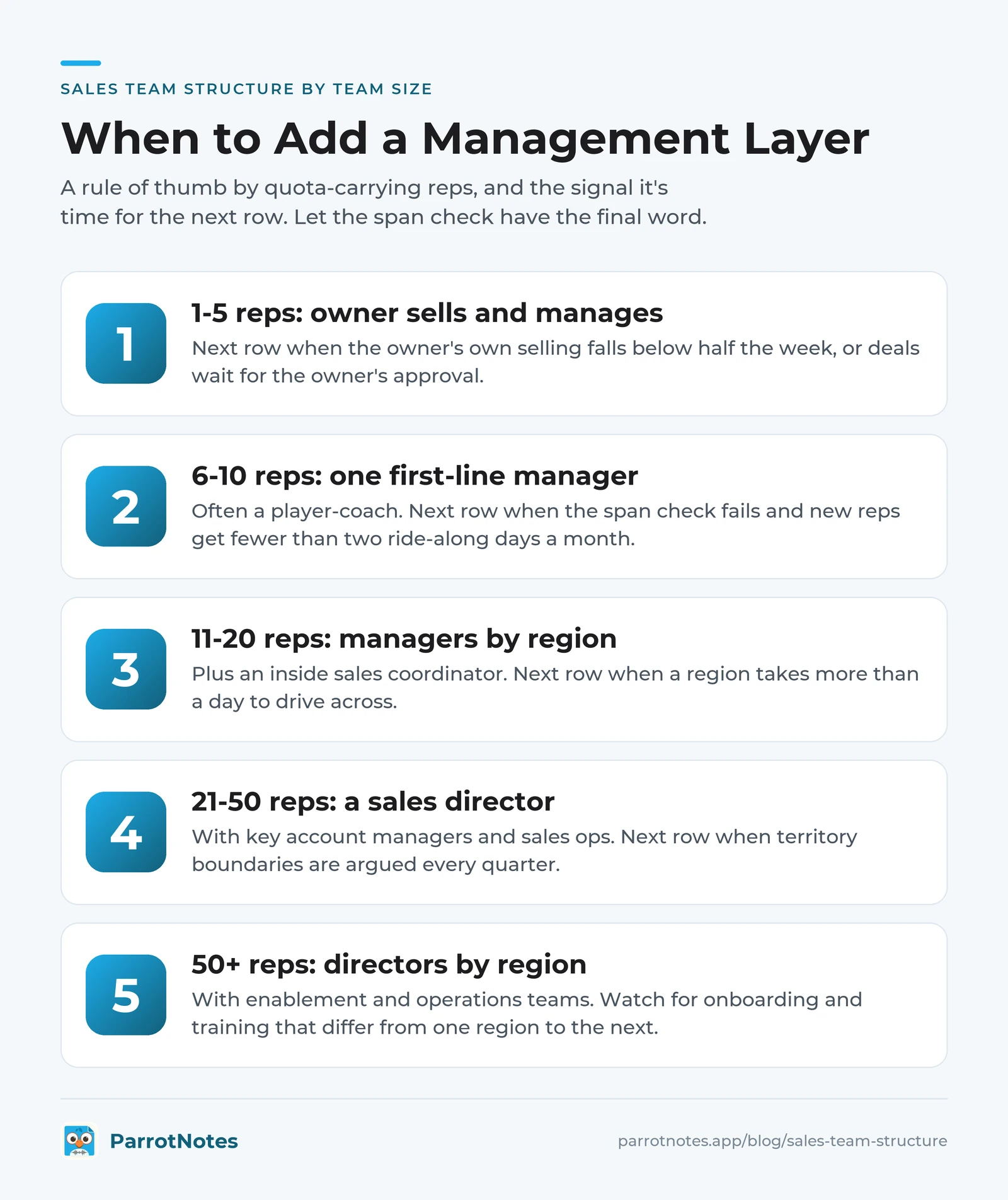
Team size alone doesn't decide the structure, but it's a good first signal. Use this table as a rule of thumb, not a law, and let the span check have the final word.
| Quota-carrying reps | Typical structure | Signal it's time for the next row |
|---|---|---|
| 1–5 | Owner or founder sells and manages directly | The owner's own selling falls below half the week, or deals wait for the owner's approval |
| 6–10 | One first-line manager, often a player-coach | The span check fails; new reps get fewer than two ride-along days a month |
| 11–20 | Two or more first-line managers by region, plus an inside sales coordinator | A region takes more than a day to drive across; the largest accounts get the same visit rhythm as small ones |
| 21–50 | Regional managers report to a sales director; dedicated key account managers; a sales ops role | Each manager builds the forecast by hand; territory boundaries are argued every quarter |
| 50+ | Directors by region or channel, with enablement and operations teams | Onboarding and training differ from one region to the next |
Before adding headcount, check that the plan pays for itself. Our guide to sales capacity planning works out how many reps a revenue target needs, including ramp time.
Where territories fit in the structure
Structure decides who owns which customers. Territory design decides where the lines go.
Draw regions for managers first, so each manager's reps can be reached in a reasonable drive. Then draw rep territories inside each region, balanced by the visits the accounts need rather than by account count. The free sales territory planner turns visit frequencies into a four-week plan, and the drive time calculator shows what a region really costs to cover.
Once territories are drawn, each rep runs theirs from an account ledger. Our guide to sales territory management shows the ledger and the visit cadence by tier, so we won't repeat it here.
Worked example: restructuring a 14-rep field team
Here's Marcus's team at Cobalt Building Supply, a composite distributor, before and after. Every number is an assumption chosen for the example.
Before: everyone reports to Marcus
- 14 field reps (11 ramped, 3 hired in the last six months) and one inside sales coordinator report to Marcus.
- Marcus also owns six key accounts, which take about six days a month.
- The territory covers three states. Ride-alongs need the drive-time adjustment.
Span check: Marcus has 21 − 4 − 6 = 11 coaching days. His team needs 11 × 1.5 + 3 × 3 = 25.5 days, plus 0.5 day for each of the 17 ride-along days (8.5 more). That's 34 days of coaching need against 11 available. The new reps were always going to lose out.
After: two regions and a key account manager
| Role | Reports to | Direct reports | Span check |
|---|---|---|---|
| Marcus, sales director | Owner | East manager, West manager, key account manager, coordinator | No rep coaching load |
| East region manager (player-coach, 2 days on own accounts) | Marcus | 7 reps: 6 ramped, 1 new, compact region | Has 15 days; needs 6 × 1.5 + 3 = 12 |
| West region manager (no own accounts) | Marcus | 6 reps: 4 ramped, 2 new, spread-out region | Has 17 days; needs 4 × 1.5 + 2 × 3 = 12, plus 0.5 × 8 ride-along days = 16 |
| Key account manager | Marcus | None; owns the 10 largest accounts | Not a manager role |
| Inside sales coordinator | Marcus | None; supports both regions | Not a manager role |
Two things stand out. The spans are uneven on purpose: the West region gets fewer reps because they're farther apart and two are new.
The key account manager also comes from inside the team. Ana, Cobalt's strongest rep, already handled most of the big distributor accounts, so she takes Marcus's six as well, and her old territory is split between two neighbours. (Ana is a composite.) Marcus now coaches the coaches.
The cost is two manager salaries. Whether that pays back depends on what the new reps sell once they get proper coaching, which is a capacity planning question, not a structure one.
Keep the structure working when accounts change hands
Every restructure moves accounts. Ana inherited six relationships that lived mostly in Marcus's head. A sales handover template gives the handover a shape: contacts, open quotes, promises made, and what each buyer cares about.
Ana and Marcus recorded each account handover on ParrotNotes, with the summary and action items ready before they'd left the parking lot. When a buyer later asked about a freight discount Marcus had mentioned in the spring, Ana searched her notes and found it in the handover in seconds.
The new West manager, Tom, uses it the same way on ride-alongs. The rep runs the visit; Tom and the rep record a five-minute debrief in the car afterwards, and the coaching points are in writing for the next one-on-one. (Tom is a composite.) Only record a conversation with the other people's consent, and check your state's recording rules.
ParrotNotes works on the phone your team already carries, with no meeting bot and no extra device. The Free plan includes 100 minutes of recording a month, an AI summary on every recording and 5 AI-powered recordings with action items. Pro ($19.99/month, or $14.99/month billed annually) adds 3,000 minutes a month, follow-up email drafts on every recording and AI search across your notes. Download ParrotNotes free before your next restructure, so the account knowledge moves with the accounts.
Sales team structure in short
- A sales team structure answers three questions: how reps are split, who manages whom, and who owns which customers.
- Field teams usually start geographic, then add key account managers, specialists or verticals as layers.
- Run the span check instead of copying an average: coaching days available divided by coaching days each rep needs, with extra time for new reps and long drives.
- Add a management layer when the span check fails, not when a headcount milestone arrives.
- Plan the account handovers before the org chart changes, so no relationship gets lost in the move.
Draw your current team on one page, run the span check for each manager, and see where the numbers don't fit. That's where the next structure change belongs.
Frequently Asked Questions
What is a sales team structure?
A sales team structure is how a company organizes its selling work. It sets how reps are split (by geography, account size, product or industry), how many reps each manager leads, and which customers and territories each person owns.
What are the main types of sales team structure?
The common models are geographic, account tier (key account managers plus territory reps), product or specialist overlay, and industry or vertical. Inside sales teams also use the island, assembly line and pod models. Field teams usually start geographic and add the others as layers.
How many reps should a sales manager have?
Alexander Group reports an average of 8.5 direct reports per first-line sales manager, with a range from 2 to 38, and smaller spans in field teams. For your own team, divide the coaching days a manager has each month by the coaching days each rep needs. New reps and long drives lower the number.
When should you add a sales manager?
Add a manager when the span check fails: the current managers can't give each rep the ride-along and one-on-one time they need. With the assumptions in this guide, a manager with no accounts of their own tops out at about 11 ramped reps (17 ÷ 1.5), and fewer if several reps are new or the region is large.
How do you structure a small sales team?
With one to five reps, the owner or founder usually sells and manages directly. From about six reps, appoint one first-line manager, often a player-coach who keeps a few accounts. Split territories by geography first and keep the largest accounts with your most experienced seller.
Related Posts

What Is a Submittal in Construction? A Guide for Product Reps
What is a submittal in construction? The types, the review process and stamps, plus a worked product-rep package and a pre-send checklist. Try ParrotNotes free.

Transcription Guidelines: Rules for Accurate, Consistent Transcripts
Transcription guidelines from Rev, GoTranscript and two universities compared rule by rule, plus a one-page house style you can copy. Try ParrotNotes free.

Tactical Empathy in Sales: Chris Voss Techniques for Real Calls
Tactical empathy for sales calls: Chris Voss's mirrors, labels and calibrated questions, a buyer-line phrasebook and a worked call. Try ParrotNotes free.