
What Is a Submittal in Construction? A Guide for Product Reps

Sarah Johnson
Writes about field sales, meeting notes and voice-first workflows at ParrotNotes. Every article is reviewed by the ParrotNotes product team before it goes live.
Table of Contents
- 1.What is a submittal in construction?
- 2.The main types of construction submittals
- 3.How the construction submittal process works
- 4.What the product rep actually prepares
- 5.Worked example: a submittal package for Section 07 46 46
- 6.Pre-send checklist for product reps
- 7.Capture the conversations around the submittal
- 8.Submittals in short
Luis sells fiber-cement siding for a manufacturer. In March, he sent a general contractor a tidy 14-page package for a library addition: data sheets, color chart, installation guide, warranty. Nine days later it came back stamped "Amend and Resubmit." The reviewer's note was one line: "Trim profile and finish not indicated. Highlight items submitted."
Nothing was wrong with the product. But ask what is a submittal in construction and the answer is proof, page by page, that the product meets the spec, and Luis's package didn't show which size and finish met which paragraph. The resubmittal took another review cycle, the siding order slipped, and the contractor's project manager now thinks of Luis as the rep whose paperwork needs chasing. (Luis is a composite, not a real person.)
If you've wondered why such a dull-sounding document can stall a sale, this guide is for you. It gives the definition in one paragraph, the main types, how review works and what each stamp means, and then a worked package from the rep's side: a compliance table, a cover sheet, a deviation letter and a checklist. If your submittal details live in phone calls with project managers, try ParrotNotes free and dictate each call into notes before you start building the package.
What is a submittal in construction?
A submittal in construction is a document or physical sample that the contractor sends to the architect or engineer to show how the specified work will be built and which products will be used, so it can be reviewed before anything is ordered, fabricated or installed.
The standard American contract, AIA A201-2017, covers submittals in §3.12. It names three core kinds: shop drawings, product data and samples. It also says that these submittals "are not Contract Documents." Their purpose, in the contract's words, is "to demonstrate how the Contractor proposes to conform to the information given and the design concept expressed in the Contract Documents" (A201 text reproduced by CSI).
Two consequences matter for anyone selling products into a project:
- A submittal can't change the contract. If your product differs from the spec, approval of the submittal doesn't quietly make the difference acceptable. Deviations have to be called out, and real changes need a change order.
- The reviewer checks the design intent, not your engineering. AIA describes the architect's review as being "for the limited purpose of checking for conformance with the project's design concept" (AIA Contract Documents). Responsibility for meeting the spec stays with the contractor, and through the contractor, with you.
The paper trail runs one way: the manufacturer or supplier prepares it, the subcontractor or general contractor (GC) reviews and stamps it, and the architect or engineer acts on it.
The main types of construction submittals
A201 defines the first three. The others come from the project's Division 01 specs, usually Section 01 33 00, Submittal Procedures.
| Type | What it is | Who usually prepares it |
|---|---|---|
| Shop drawings | Drawings, diagrams and schedules "specially prepared for the Work" | Fabricator, manufacturer, supplier or sub |
| Product data | Data sheets, performance charts, brochures and instructions for standard products | Manufacturer, sent by the rep or distributor |
| Samples | Physical pieces that "establish standards by which the Work will be judged" | Manufacturer |
| Mock-ups | A built section on site (a wall panel, a window opening) for approval | Sub, with the manufacturer's support |
| Test reports and certificates | Lab results and compliance certificates (fire rating, ASTM standards) | Manufacturer |
| Closeout submittals | Warranties, O&M manuals, maintenance data and attic stock | Manufacturer and sub, at the end of the job |
Action vs informational submittals
Most specs split submittals into two groups. Action submittals (shop drawings, product data and samples, typically) need the reviewer to respond before work goes ahead. Informational submittals (test reports, certificates and installer qualifications, typically) are recorded and can still be rejected if they don't comply. Each technical section of the spec lists which of its submittals are which, so read Part 1 of your section first.
How the construction submittal process works
Every project tweaks the details, but the sequence is close to this:
- The spec section lists the requirements. Part 1 says what to submit; Part 2 says what the product must be.
- The GC builds a submittal register (also called a submittal log) from the spec and asks each sub and supplier for their items, with due dates.
- The supplier or rep assembles the package and sends it to the sub or GC.
- The GC reviews and stamps it. Specs usually make the contractor warrant that the package is complete, coordinated and compliant, or that deviations are listed.
- The architect or engineer reviews it and returns it with a stamp and comments.
- The stamp decides what happens next: release for fabrication and ordering, or resubmit.
Stamp wording varies by project. The City of San Bruno's Section 01 33 00 (rev. August 2024) is a clear public example (San Bruno 01 33 00):
| Stamp | What it means for your order |
|---|---|
| No Exceptions Taken | Favorable review, no resubmittal. The GC can release the order. |
| Make Corrections Noted | Favorable. Make the corrections before manufacture; a partial resubmittal may be needed for missing items. |
| Amend and Resubmit | Not released. Fix the package and send it again. |
| Rejected - Resubmit | The product doesn't comply in a major way. Submit something that does. |
Other specs say "Approved," "Approved as Noted," "Furnish as Noted" or "Reviewed." Review periods vary too: San Bruno's spec builds 5 working days per review into the schedule, while other public specs allow 10 working days or more. Check the actual section on your project, and assume every resubmittal restarts the clock.
What the product rep actually prepares
The rep's job is to turn the spec into proof, much like answering an RFQ line by line. Reviewers have minutes per package, so a submittal that makes them hunt will come back. These are the four places packages usually fail:
- Nothing is marked. San Bruno's spec, like many others, requires you to highlight or mark every page of product data to show "the specific items being submitted and all options included." A full catalog with no markings is the most common resubmittal there is.
- The package is incomplete. Specs often require one submittal per complete section or assembly. Siding without trim, fasteners or the installation guide is a partial submittal.
- Deviations are hidden. If your product differs from the spec, say so in a separate letter. Reviewers find hidden deviations later, usually on site, and that's how a rep loses a contractor's trust.
- It answers last year's spec. Copying an old package means old paragraph numbers and old product names. Build every package from the current project manual.
Substitutions are a separate path. If your product isn't named in the spec, or the spec says "or approved equal," the request usually goes through Section 01 25 00, Substitution Procedures, within a deadline set early in the job. San Bruno, for example, wants proposed equivalents within 5 days of the Notice to Proceed. A regular submittal can't be used to sneak a substitution in. That's also why the spec-in work described in our building materials sales guide pays off months later: a product named in the spec skips this step.
Worked example: a submittal package for Section 07 46 46
Here's the package Luis should have sent. The project, paragraph numbers and product details are illustrative, but the format works for any building product.
The spec (fictional excerpt). Section 07 46 46, Fiber-Cement Siding, for the Maple Street Library Addition:
- 1.3.A Product Data: for each type of product, including installation instructions.
- 1.3.B Samples: for each color and texture specified.
- 2.2.A Lap siding: 5/16 in. thick, 8-1/4 in. wide, 7 in. exposure, smooth texture, complying with ASTM C1186, Type A, Grade II.
- 2.2.B Trim: 5/4 x 4 in., smooth, factory-finished to match the siding.
- 2.2.C Finish: factory-applied, color "Slate Gray."
- 1.6 Warranty: manufacturer's 30-year limited product warranty, and a finish warranty.
Step 1: the compliance table. Put this on page two of the package. It's the page reviewers read first.
| Spec paragraph | Requirement | What we submit | Page | Complies? |
|---|---|---|---|---|
| 1.3.A | Product data, with installation instructions | Data sheet, installation guide (current edition) | 3-8 | Yes |
| 1.3.B | Samples, each color and texture | Two 6 in. samples, smooth, Slate Gray (sent separately) | - | Yes |
| 2.2.A | 5/16 in., 8-1/4 in. wide, 7 in. exposure, smooth, ASTM C1186 Type A Grade II | Lap siding, 8-1/4 in., smooth; ASTM C1186 compliance on data sheet | 4 | Yes |
| 2.2.B | Trim 5/4 x 4 in., factory-finished | 5/4 x 4 in. trim, smooth, primed only in this width | 6 | Deviation, see letter |
| 2.2.C | Factory finish, Slate Gray | Factory finish, Slate Gray | 5 | Yes |
| 1.6 | 30-year product warranty, finish warranty | Sample warranty documents | 9-12 | Yes |
Step 2: the cover sheet. Most GCs have their own transmittal form; fill theirs in if they do. If not, include these fields:
SUBMITTAL COVER SHEET
Project: Maple Street Library Addition    Project no.: 2026-114
Submittal no.: 07 46 46-001    Revision: 0    Date: [date]
Spec section: 07 46 46 Fiber-Cement Siding    Paragraphs: 1.3.A, 1.3.B, 2.2, 1.6
Type: Product Data + Samples (action submittal)
Prepared by: [Manufacturer], [rep name, phone, email]
Submitted through: [Siding sub] to [GC], attn. [PM name]
Contents: compliance table (p. 2), data sheets (p. 3-6), installation guide (p. 7-8), warranties (p. 9-12)
Deviations: YES, 1 (see attached letter, para. 2.2.B)
Lead time after release: [x] weeks
Step 3: the deviation letter. Keep it short and specific. Specs like San Bruno's ask for the paragraph, the alternative, its advantages and disadvantages, and any price reduction offered:
Re: Submittal 07 46 46-001, Paragraph 2.2.B, Trim. The specification calls for 5/4 x 4 in. trim, factory-finished to match the siding. In this width, our trim is available primed only.
We propose primed trim, field-painted by the siding subcontractor with the manufacturer's matching touch-up color, Slate Gray.
Advantage: no change to profile or lead time. Disadvantage: the trim finish is field-applied and not covered by the factory finish warranty. Alternative: factory-finished 5/4 x 3-1/2 in. trim, which changes the reveal at corners. No change to the contract price is proposed.
Now the reviewer can make a decision in one read. Whether the answer is "accept primed" or "use the narrower trim," the package comes back "Make Corrections Noted" instead of "Amend and Resubmit," and the order can move.
Pre-send checklist for product reps
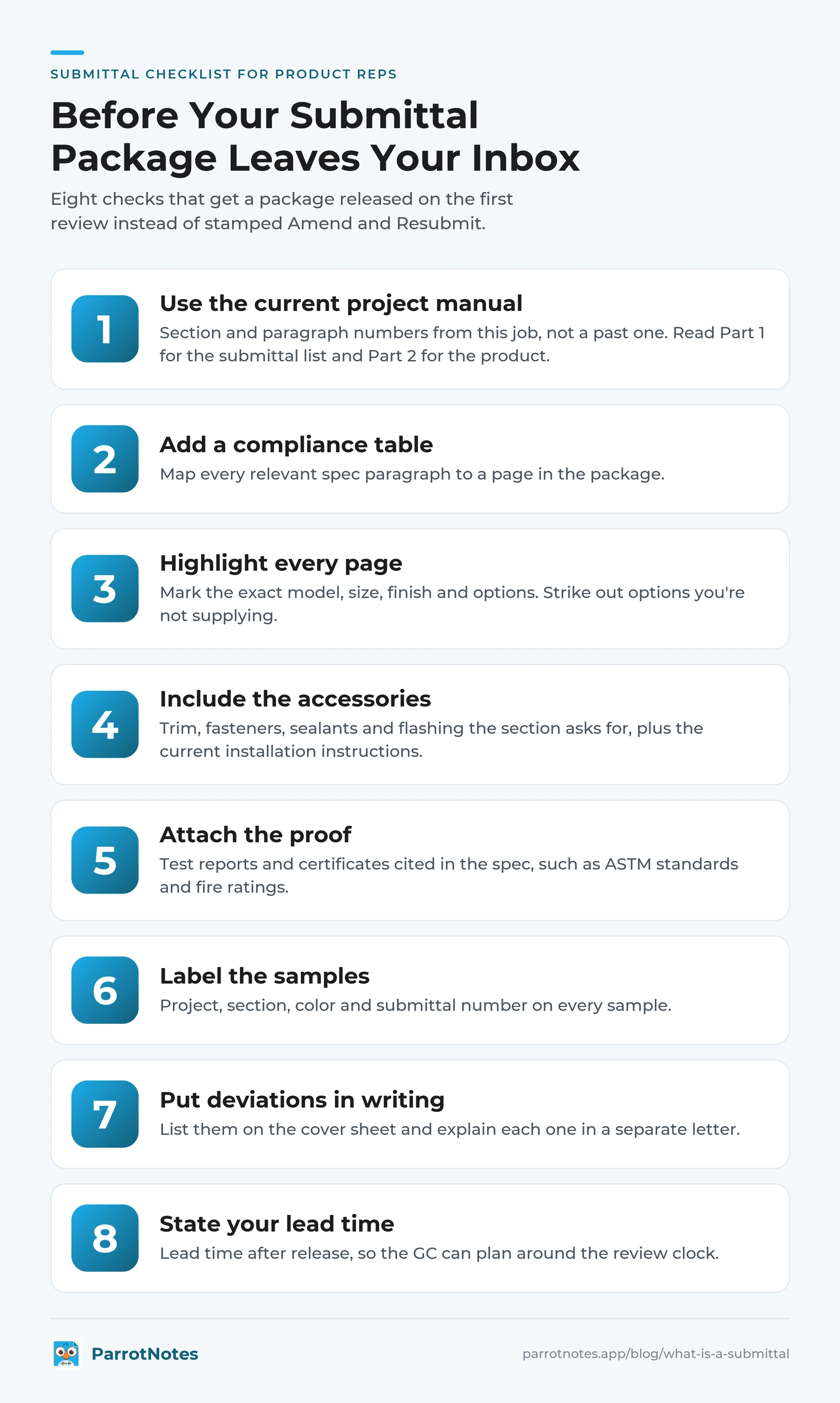
Run this before every package leaves your inbox:
- Spec section and paragraph numbers are from the current project manual, not a past job.
- You've read Part 1 of the section for the submittal list, and Part 2 for the product requirements.
- A compliance table maps every relevant paragraph to a page.
- Every page of product data is highlighted to show the exact model, size, finish and options.
- Options you're not supplying are struck out.
- Accessories are included: trim, fasteners, sealants and flashing the section asks for.
- Installation instructions are the current edition.
- Test reports and certificates cited in the spec are attached (ASTM, fire ratings).
- Samples are labelled with project, section, color and submittal number.
- Deviations are listed on the cover sheet and explained in a separate letter.
- Warranty and closeout items are included if the section asks for them now.
- Lead time after release is stated, so the GC can plan around the review clock.
Capture the conversations around the submittal
Most of what goes wrong in a submittal starts in a conversation. Before you build the package, call the PM or the sub's project manager and ask which spec revision applies, whether any addenda touched your section, which transmittal form they want, when the submittal is due on their register, and whether the architect has preferences you should know about.
After a rejection, get on a call with whoever reviewed it and ask what exactly they need to see.
Those calls are full of the details that go into the package: paragraph numbers, colors, widths and dates. Write them down while they're fresh.
A practical habit is a one-minute spoken recap in the truck straight after the call. With ParrotNotes, you speak the recap, and the app transcribes it, summarizes it and pulls out the action items, such as "resubmit trim deviation by Friday," with a follow-up email draft you can edit and send to the PM. If both sides agree and local consent rules allow it, you can record the call itself.
Picture Priya, a rep for a roofing membrane manufacturer, on a kickoff call where the PM mentions in passing that Addendum 2 changed the membrane thickness. Her recap note catches it, and her package answers the revised paragraph instead of the original. That's one review cycle saved, on a roof that's waiting for its membrane. (Priya is an illustrative example.)
The same notes help later. When the GC asks in an OAC meeting why the siding is late, you can point to the submittal number, the date it went in and the date it came back. If you sit in those meetings, see how submittals are logged in our construction meeting minutes template.
Submittals in short
A submittal in construction is the contractor's proof, reviewed before ordering, that the work will match the drawings and specs. For a product rep, it's also a sales document: a clean package gets released on the first review, and the contractor remembers who made their job easier.
Answer the current spec paragraph by paragraph, highlight exactly what you're supplying, put deviations in writing, and state your lead time. If you work as an independent agent for several principals, our guide to the manufacturers' rep model covers the reporting side. Download ParrotNotes free and capture your next PM call before you build the package.
Frequently Asked Questions
What is a submittal in construction in simple terms?
A submittal is the paperwork or physical sample a contractor sends to the architect or engineer to show what will be built and with which products. Typical submittals are shop drawings, product data sheets and samples. They're reviewed before anything is ordered or installed.
What are the three main types of submittals?
Under AIA A201-2017 §3.12, the three core types are shop drawings, product data and samples. Specs also call for mock-ups, test reports, certificates and closeout submittals such as warranties and operation and maintenance manuals.
Who prepares construction submittals?
The general contractor is responsible for them, but the content usually comes from subcontractors, fabricators, manufacturers and their sales reps. The contractor reviews and stamps the package before sending it to the architect or engineer for review.
What is the difference between a submittal and an RFI?
A submittal shows how the contractor will meet the contract documents, and the reviewer approves or returns it. A request for information (RFI) asks the design team a question when the documents are unclear or conflict. An RFI answer can lead to a revised submittal.
Does an approved submittal change the contract?
No. AIA A201 states that submittals are not Contract Documents, so an approved submittal doesn't change the specs. If your product differs from the spec, list the deviation in a separate letter, and expect any real change to go through a change order.
Related Posts

Transcription Guidelines: Rules for Accurate, Consistent Transcripts
Transcription guidelines from Rev, GoTranscript and two universities compared rule by rule, plus a one-page house style you can copy. Try ParrotNotes free.

Tactical Empathy in Sales: Chris Voss Techniques for Real Calls
Tactical empathy for sales calls: Chris Voss's mirrors, labels and calibrated questions, a buyer-line phrasebook and a worked call. Try ParrotNotes free.
Strategy Meeting: Agenda, Prep and Follow-Up
Run a strategy meeting that ends in decisions: a 90-minute agenda, a one-page pre-read, a worked example and a follow-up record. Free templates inside.