
Tactical Empathy in Sales: Chris Voss Techniques for Real Calls

Sarah Johnson
Writes about field sales, meeting notes and voice-first workflows at ParrotNotes. Every article is reviewed by the ParrotNotes product team before it goes live.

Table of Contents
- 1.What tactical empathy is (and what it isn't)
- 2.Where it comes from: Chris Voss and the FBI
- 3.Six tactical empathy techniques for sales calls
- 4.The tactical empathy phrasebook for sales calls
- 5.A worked call: tactical empathy in action
- 6.What to write down after a tactical empathy call
- 7.Tactical empathy mistakes that backfire
- 8.Make tactical empathy a habit
"We're happy with our current supplier." Dana has heard that line four times this week, and four times she's answered it the same way: with a list of reasons her product is better. Four times the buyer has nodded politely and walked her to the door.
The problem usually isn't the pitch. The buyer doesn't feel understood yet, so they hide behind a stock answer.
That's the gap tactical empathy closes. It's the core idea in Chris Voss's negotiation book Never Split the Difference: understand the other person's feelings and point of view, then say that understanding out loud so they relax and talk. You don't have to agree with them. You have to show them you get it.
Below: what it is, six techniques for sales calls, a phrasebook for the lines buyers say most, a worked call, and what to write down afterwards.
What tactical empathy is (and what it isn't)
Tactical empathy is deliberately understanding a buyer's emotions and perspective, then proving it by naming them out loud. It's empathy with a purpose: lower the buyer's guard so they tell you the real objection, decision process, and timeline.
Three things it isn't:
- Sympathy. Sympathy is feeling sorry for someone. Tactical empathy is understanding them, which you can do without sharing the feeling.
- Agreement. "It sounds like the price feels high" doesn't concede the price is too high. It acknowledges how the buyer sees it.
- Being nice. You understand a tough counterpart so you can hold your position with less friction.
In sales terms, tactical empathy sits between active listening and negotiation. Listening collects what the buyer says. Tactical empathy shows them you heard the part they didn't say.
Where it comes from: Chris Voss and the FBI
Chris Voss spent 24 years in the FBI, and from 2003 to 2007 he was its chief international hostage and kidnapping negotiator, according to his Wikipedia biography. After retiring in 2007 he founded The Black Swan Group, a negotiation training firm, and in 2016 published Never Split the Difference: Negotiating As If Your Life Depended On It, co-written with journalist Tahl Raz.
The book argues that people decide emotionally first and justify it with logic later, so handling the emotions gets further than arguing the facts. Black Swan still describes its method as "designed to demonstrate tactical empathy," and its core course teaches nine skills: labels, mirrors, dynamic silence, paraphrase, summary, calibrated questions, "I" messages, encouragers, and tone.
There's research behind the labeling part. A 2007 UCLA brain-imaging study by Matthew Lieberman and colleagues, published in Psychological Science, found that putting a feeling into words dampened the amygdala's response to emotional images. Naming an emotion tends to calm it, which is what you want with a defensive buyer.
Six tactical empathy techniques for sales calls
You don't need all six on every call. Most good calls use two or three, at the moments the buyer gets guarded.
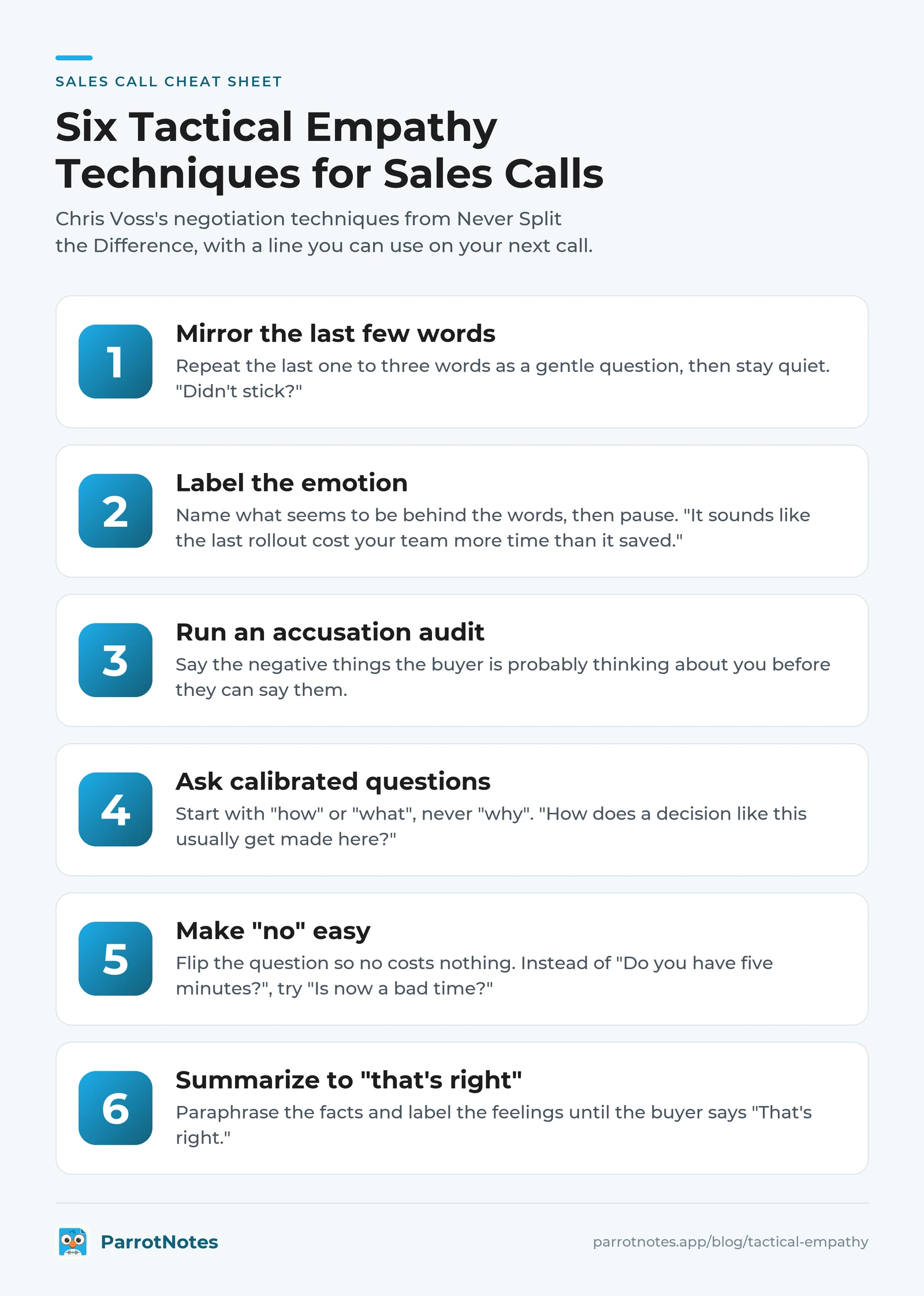
1. Mirror the last few words
A mirror repeats the last one to three words the buyer said, as a gentle question. Then you stay quiet.
Buyer: "We tried something like this last year and it didn't stick."
Rep: "Didn't stick?"
The buyer almost always keeps talking, and the explanation is usually the real objection. Mirrors work best on vague words: "not a priority," "complicated," "too much."
2. Label the emotion or the situation
A label names what seems to be behind the words. Black Swan's guidance on labeling recommends starting with "It seems like...", "It sounds like..." or "It looks like...", then leaving silence after the label so the buyer has room to answer.
"It sounds like the last rollout cost your team more time than it saved."
Say "it sounds like," not "I understand how you feel." The first invites a correction; the second is a claim the buyer can reject. Label wrong and the buyer corrects you, often with the most useful thing you'll hear all meeting.
3. Run an accusation audit before the hard part
An accusation audit means saying the negative things the buyer is probably thinking about you before they can say them. It takes the sting out.
"You're probably expecting another rep who'll talk for 40 minutes and leave you a brochure. You might also be thinking this'll mean retraining your whole crew."
Buyers typically respond by softening: "No, it's not that bad." Use it at the start of a cold meeting, before a price, or when you're delivering bad news like a delayed shipment.
4. Ask calibrated questions
Calibrated questions start with "how" or "what" and can't be answered with yes or no. They hand the buyer the problem to solve and leave them feeling in control.
- "What would need to be true for this to work for your team?"
- "How does a decision like this usually get made here?"
- "What's the biggest challenge you face with the current setup?"
The best-known calibrated question in the book is a version of "How am I supposed to do that?", a polite way to say no to an unreasonable demand. In sales, it fits a buyer who asks for a 30% discount: "How am I supposed to get that past my pricing team?"
Avoid "why." It sounds like an accusation, even when you don't mean it.
5. Ask questions that make "no" easy
Voss argues that people feel pressured by questions built to extract a "yes," and safer when they can say "no." So flip the question.
- Instead of "Do you have five minutes?", try "Is now a bad time?"
- Instead of "Are you ready to move forward?", try "Would it be a terrible idea to get your operations lead on a call next week?"
6. Summarize until you hear "that's right"
A summary combines a paraphrase of the facts with a label of the feelings. When it's accurate, the buyer says something like "That's right." Voss treats that phrase as a breakthrough: it means the buyer feels fully understood. "You're right," by contrast, often means "please stop talking."
"So you've got three crews, the old system took a month to set up, and the thing you can't afford again is your foremen losing a week to training. That's what's at stake here."
Tone and silence hold it together
Use a calm, slow, downward tone for anything firm (Voss calls it the late-night FM DJ voice), and a warmer tone the rest of the time. After every mirror or label, stop talking for a few seconds. The silence is where the buyer fills in the gaps.
Want the buyer's exact words without scribbling? Record your next call with ParrotNotes (with the buyer's permission) and get the transcript and summary before you reach the car.
The tactical empathy phrasebook for sales calls
Eight lines buyers say in every territory, each with a mirror, a label and a calibrated question. Pick one per line.
| Buyer says | Mirror | Label | Calibrated question |
|---|---|---|---|
| "We're happy with our current supplier." | "Happy with them?" | "It sounds like switching would have to be worth a lot of hassle." | "What would a new supplier have to do better for it to be worth a look?" |
| "Your price is too high." | "Too high?" | "It seems like you've been burned paying a premium before." | "How are you comparing us against the other quotes?" |
| "Just send me some information." | "Some information?" | "It sounds like you've had a lot of reps eat your time this month." | "What would you need to see to know whether this is worth a second meeting?" |
| "Now's not a good time." | "Not a good time?" | "It looks like you've got a lot landing at once right now." | "What does next quarter look like for a project like this?" |
| "I need to run it by my boss." | "Your boss?" | "It seems like they'll have questions you'd rather be ready for." | "How can I help you make the case to them?" |
| "We tried something like this before." | "Tried it before?" | "It sounds like it cost more than it saved last time." | "What went wrong, and what would have to be different this time?" |
| "We don't have the budget." | "Don't have the budget?" | "It seems like spending is being watched closely this year." | "How do new purchases usually get approved when budgets are tight?" |
| "Your competitor offered us a better deal." | "A better deal?" | "It sounds like you want to make sure you're not leaving money on the table." | "What's in their offer that matters most to you?" |
Once you've uncovered the real objection, answer it with our objection handling guide and the price objection playbook.
A worked call: tactical empathy in action
This is an illustration, not a real call. Marcus sells commercial flooring to facility managers. He's meeting Priya, who runs facilities for a 12-site clinic group, and she opens cold.
Minute 1. Accusation audit.
Marcus: "You probably get a flooring rep every month who promises the moon and disappears after the install. You might be bracing for that now."
Priya: "Ha. Honestly, a little."
Minute 4. Mirror.
Priya: "Our current vendor is fine. The installs are just disruptive."
Marcus: "Disruptive?"
Priya: "We had to close two exam rooms for three days at our Westside site. The doctors were furious."
Minute 5. Label, then silence.
Marcus: "It sounds like you took the heat for that one." (Pause.)
Priya: "I did. The medical director still brings it up."
Minute 9. Calibrated question.
Marcus: "What would an install have to look like for the doctors not to notice it?"
Priya: "Nights and weekends. And one room at a time, never two."
Minute 14. No-oriented question.
Marcus: "Would it be a bad idea to walk the Westside site with your maintenance lead next Tuesday evening?"
Priya: "No, that's fine. Make it after 6."
Minute 16. Summary.
Marcus: "So the floors aren't really the issue. It's that the last install shut down rooms, you got the blame, and anything new has to happen after hours, one room at a time."
Priya: "That's right."
Marcus didn't argue with "our current vendor is fine" once. The objection was never about the vendor; it was about the doctors. He got there in four questions.
What to write down after a tactical empathy call
Tactical empathy produces information, so the notes matter as much as the technique. The buyer's exact words and corrections go into your proposal and follow-up. Fill this in straight after the meeting, or dictate it in the car:
Account / contact:
Opening stance (their words):
Mirrors that opened something up:
  - Word mirrored → what they said next
Labels offered → their response or correction:
  - "It sounds like..." → "Not exactly, it's..."
Real objection under the stated one:
Emotion words they used (in quotes):
Calibrated questions and answers:
"That's right" moment (what the summary said):
Conditions they named (time, people, process):
Next step, in their words, with date:
In Marcus's case, the gold is in two lines: "the doctors were furious" and "nights and weekends, one room at a time." Those go straight into his proposal. Feed them into your discovery questions for the next meeting too.
If you record the call (tell the buyer first, and follow your local consent rules), ParrotNotes gives you the transcript, an AI summary, and action items, so you copy the buyer's lines instead of reconstructing them. Every free recording gets an AI summary, and the Free plan includes 5 AI-powered recordings a month with action items and sales frameworks.
Tactical empathy mistakes that backfire
- Mirroring everything. Two or three mirrors per meeting is plenty. Ten sounds like a parrot (the bad kind).
- "I understand." It's a claim, not a label, and buyers push back on it. Name the specific feeling instead.
- Talking after the label. If you add a justification, you've stepped on it. Wait.
- Labeling to manipulate. Buyers spot it fast. Tactical empathy only works when you actually want to know the answer.
- Asking "why." "Why did you pick them?" puts the buyer on the defensive. "What made them the right fit at the time?" gets the same answer.
- Not writing it down. A label that unlocked the real objection is useless if you've forgotten the exact words by Friday.
Make tactical empathy a habit
Tactical empathy isn't a script. It's a handful of small moves: mirror the vague word, label the feeling, say the accusation first, ask "how" and "what," let the buyer say no, and summarize until you hear "that's right." Start with one technique on your next call (mirroring is the easiest) and add another the week after.
Then capture what it uncovers. The buyer's exact words are your best proposal copy and your best follow-up email.
Try it on your next call. Download ParrotNotes free and get the transcript, summary and action items from your meeting before your next stop.
Frequently Asked Questions
What is tactical empathy?
Tactical empathy is understanding another person's feelings and point of view and then naming them out loud, so they relax and share more. Chris Voss, a former FBI hostage negotiator, made it the central idea of his book Never Split the Difference. It means understanding, not agreeing.
What are examples of tactical empathy?
A label like "It sounds like the last install was disruptive," a mirror that repeats the buyer's last words as a question ("Disruptive?"), an accusation audit that names their likely worries first, and a summary of their situation that gets them to say "That's right."
What is mirroring in sales?
Mirroring is repeating the last one to three words the buyer said, with a curious tone, then staying quiet. It prompts them to explain, which often surfaces the real objection.
What is labeling in sales?
Labeling is naming the emotion or situation behind what the buyer says, usually starting with "It seems like," "It sounds like," or "It looks like," and then pausing. If the label is wrong, the buyer corrects you, which gives you useful information either way.
Is tactical empathy manipulative?
It can be if you use it to trick someone. Used honestly, it is just careful listening made visible: you are checking that you understood. Reciting techniques without caring about the answer backfires.
Related Posts

What Is a Submittal in Construction? A Guide for Product Reps
What is a submittal in construction? The types, the review process and stamps, plus a worked product-rep package and a pre-send checklist. Try ParrotNotes free.
Transcription Guidelines: Rules for Accurate, Consistent Transcripts
Transcription guidelines from Rev, GoTranscript and two universities compared rule by rule, plus a one-page house style you can copy. Try ParrotNotes free.
Strategy Meeting: Agenda, Prep and Follow-Up
Run a strategy meeting that ends in decisions: a 90-minute agenda, a one-page pre-read, a worked example and a follow-up record. Free templates inside.