
Meeting Agenda Template: 5 Formats and Examples

Sarah Johnson
Product Manager at ParrotNotes with 5+ years of experience in productivity tools and AI technology.
Table of Contents
- 1.Which meeting agenda template fits your meeting?
- 2.Meeting agenda template 1: the simple weekly staff meeting
- 3.Meeting agenda template 2: the timed team meeting
- 4.Template 3: the decision meeting agenda
- 5.Template 4: the project kickoff agenda
- 6.Template 5: the formal committee or board agenda
- 7.How to write a meeting agenda in six steps
- 8.Make your agenda record-ready: let the recording fill it in
- 9.Pick a meeting agenda template and send it today
Picture Priya, the office manager at a 40-person architecture firm. It's 8:52 on a Monday, and the staff meeting starts at 9:00.
She types the agenda into the calendar invite: "Updates. Budget. Website. AOB."
The meeting runs 25 minutes over. "Website" turns out to be a decision about which agency to hire, and nobody came ready to make it. "Budget" was only an update. Priya spends the hour chairing, keeping time and scribbling notes, and by Tuesday two people remember the agency decision differently.
You already know a meeting needs an agenda. What's harder is finding a meeting agenda template that fits the meeting you're running this week. A 30-minute staff catch-up, a vendor decision and a board meeting need three different formats.
This guide gives you five copy-ready formats, each with a filled-in example. After the templates come six steps for writing your own, and a way to let a recording fill in the outcome of every agenda item.
Which meeting agenda template fits your meeting?
Pick the format by what the meeting has to produce, not by what the calendar calls it. Here's the short version.
| Your meeting | What it must produce | Use this format | Length |
|---|---|---|---|
| Recurring staff or department catch-up | Shared priorities for the week | 1. Simple weekly staff meeting | 30 min |
| Team meeting with 3 to 5 real topics | Input, answers and a few decisions | 2. Timed team meeting | 60 min |
| One choice that's been dragging on | A decision with an owner | 3. Decision meeting | 45 min |
| The first meeting of a new project | Agreed scope, roles and first deadline | 4. Project kickoff | 60 min |
| Board, committee or association meeting | Votes and an official record | 5. Formal order of business | 60 to 120 min |
Whichever meeting agenda format you choose, every meeting agenda template below starts with the same header block. Copy it once and reuse it.
MEETING:
Date and time:
Room:
Chair:
Note-taker:
Attendees:
Goal (one sentence: what will be true when we leave the room?):
Pre-read (what to read, and by when):
Under the header sits a list of timed items. Each one names the person leading it and says whether it's there to inform, to gather input or to reach a decision. The last item is always a recap of decisions, owners and due dates.
That last line is where meetings leak. In Microsoft's 2023 Work Trend Index survey of 31,000 workers, people named inefficient meetings as their number one productivity disruptor. In the same survey, 55% said next steps at the end of a meeting are unclear, and 56% said it's hard to summarize what happened.
A good agenda fixes the first half of that problem. A record of what was said fixes the second half.
Want the record to write itself? You can try ParrotNotes free. Put your phone on the table, record the meeting, and get a transcript, an AI summary and action items afterwards.
Meeting agenda template 1: the simple weekly staff meeting
Use this for the recurring meeting where the team syncs up and nobody needs a slide deck. It runs 30 minutes, it has four standing items, and it ends with a recap.
WEEKLY STAFF MEETING
Goal for today (one sentence):

0:00 Review the agenda and last week's action items (5 min, chair)
0:05 News worth sharing (5 min, everyone)
0:10 This week's priorities: what has to be done by Friday? (10 min, each lead)
0:20 Blockers: who needs help, and from whom? (5 min, everyone)
0:25 Recap: decisions, owners and due dates (5 min, note-taker)

Parking lot (topics for another meeting):
Two details make this format work. The first item checks last week's action items, so the list doesn't quietly die. And the parking lot gives you a polite way to stop a side conversation: "Good topic. It's going in the parking lot."
Here's the sample meeting agenda Priya could have sent on Friday afternoon instead.
| Time | Item | Lead |
|---|---|---|
| 9:00 | Review agenda and last week's 6 action items | Priya |
| 9:05 | News: the Harbor Street project won planning approval | Tom |
| 9:10 | Priorities: what has to be done by Friday, October 9? | Studio leads |
| 9:20 | Blockers: who needs help with the library bid? | Everyone |
| 9:25 | Recap: decisions, owners and due dates | Priya |
| Parking lot | Website agency choice (gets its own decision meeting on Wednesday) |
Notice what happened to "Website". It left the staff meeting and became a meeting of its own, with the format in template 3.
Meeting agenda template 2: the timed team meeting
This is the format for a monthly or fortnightly team meeting with three to five real topics. Every item gets a time, a lead and a purpose label.
The labels come from organizational psychologist Roger Schwarz. His article on how to design an agenda for an effective meeting first ran in Harvard Business Review in 2015. Two of his tips shape this template.
First, "list agenda topics as questions the team needs to answer." His example swaps "office space reallocation" for "Under what conditions should we reallocate office space?" A question tells people what to think about before they walk in. It also tells you when the item is finished: when the question has an answer.
Second, "note whether the purpose of the topic is to share information, seek input for a decision, or make a decision." If people think they're deciding and you only wanted their input, everyone leaves frustrated.
TEAM MEETING (60 minutes)
Goal:

0:00 Any changes to this agenda? (Decide, chair, 5 min)
0:05 [Question 1?] (Inform, lead: ____, prep: ____, 10 min)
0:15 [Question 2?] (Input, lead: ____, prep: ____, 20 min)
0:35 [Question 3?] (Decide, lead: ____, prep: ____, 15 min)
0:50 What did we decide, and who owns what? (Recap, note-taker, 5 min)
0:55 What worked today, and what should change? (Input, chair, 5 min)

Purpose labels: Inform (listen), Input (advise the decider), Decide (we decide here)
The first and last rows are Schwarz's too. He suggests opening with "review and modify agenda as needed" and closing with a quick plus/delta: what went well, and what to change next time.
Here's a meeting agenda example for a facilities team of eight, meeting on the first Tuesday of the month.
| Time | Agenda item | Purpose | Lead | Prep |
|---|---|---|---|---|
| 10:00 | Any changes to this agenda? | Decide | Dana | None |
| 10:05 | What did the September fire drill show us? | Inform | Luis | Read the 1-page drill report |
| 10:15 | How should we schedule desk moves for the 12 new hires? | Input | Dana | Bring your floor's headcount |
| 10:35 | Do we extend cleaning to 5 days a week from November 2? | Decide | Amara | Read the two quotes |
| 10:50 | What did we decide, and who owns what? | Recap | Note-taker | None |
| 10:55 | What worked today, and what should change? | Input | Dana | None |
Put the item that needs the most energy in the middle of the agenda, not at the end. Whatever sits in the last slot gets squeezed when earlier items overrun.
Template 3: the decision meeting agenda
Template galleries tend to sort agendas by team ritual: stand-up, retro, one-on-one. This meeting agenda template is built around an outcome instead. Use it when a choice has been "discussed" in three meetings and still isn't made.
The rule is simple: one meeting, one decision. The header names the question, the person who decides and the criteria, and everyone gets the pre-read at least a day ahead.
DECISION MEETING (45 minutes)
Decision to make, as a question:
Who decides:
Who advises:
Decide by (date):
Pre-read sent on:
Option A:
Option B:
Option C:
Criteria we'll judge the options by:

0:00 Confirm the question, the decider and the criteria (5 min)
0:05 Questions about the pre-read: facts only, no debate yet (10 min)
0:15 Each option against the criteria (15 min)
0:30 Concerns nobody has raised yet (5 min)
0:35 The decision, said aloud by the decider (5 min)
0:40 Who does what by when, and who needs to be told (5 min)
Picture Marcus, the operations lead at a 60-person logistics company. "Copier lease" had been a line on the monthly team agenda since June. In September he moved it into a decision meeting and filled in the header before he sent the invite.
| Field | Marcus's agenda |
|---|---|
| Decision | Do we renew the copier lease, switch to a managed print contract, or buy two machines outright? |
| Who decides | Marcus (the budget is his) |
| Who advises | Finance manager, IT lead, front-desk supervisor |
| Decide by | September 30, because the lease ends on October 31 |
| Options | A) Renew for 36 months. B) Managed print, 24 months. C) Buy outright |
| Criteria | Monthly cost under $900, a service visit within 1 business day, a term of 24 months or less |
The meeting took 40 minutes. Option A failed the contract-length test before anyone argued about it, because the criteria were agreed first. Marcus chose option B and said so aloud. The IT lead owned the switchover plan, due October 9.
Running a decision meeting this week? Download ParrotNotes free and record it from your phone on the table. The summary and action items give you the decision and the owners in writing, and nobody has to stop contributing to take notes.
Template 4: the project kickoff agenda
A kickoff has one job: everyone leaves with the same picture of the project. That means the same goal, the same scope, the same first deadline and no confusion about who does what.
Send a one-page brief two days ahead, so the hour goes on questions and not on reading slides aloud.
PROJECT KICKOFF (60 minutes)
Project:
Sponsor:
Project lead:
Pre-read: one-page brief, sent 2 days ahead

0:00 Why this project, and why now? (5 min, sponsor)
0:05 What does "done" look like? Goal, scope and what's out of scope (15 min, project lead)
0:20 Who does what, and who decides what? (10 min, project lead)
0:30 Timeline: milestones and the first deadline (10 min, project lead)
0:40 Risks and open questions (10 min, everyone)
0:50 How we'll work: meeting rhythm, where files live, how to raise a problem (5 min)
0:55 Recap: decisions, owners and the next meeting (5 min, note-taker)
Here's the format filled in for an office move.
| Time | Item | Lead |
|---|---|---|
| 2:00 | Why are we moving to the 4th floor, and why by December 1? | Sponsor (COO) |
| 2:05 | What does "done" look like? 85 desks, 6 meeting rooms, no downtime for the support team | Project lead |
| 2:20 | Who does what? IT, facilities, HR and a move captain for each department | Project lead |
| 2:30 | Milestones: floor plan signed off October 16, packing crates delivered November 20 | Project lead |
| 2:40 | Risks: the furniture lead time is 6 weeks. What else could slip? | Everyone |
| 2:50 | How we'll work: a 20-minute check-in every Thursday at 9:30 | Project lead |
| 2:55 | Recap: decisions, owners and the next meeting | Note-taker |
The "out of scope" line in the second item is the one people skip. Saying aloud that new carpets aren't part of this project saves an argument in week five.
Template 5: the formal committee or board agenda
Boards, committees, associations and councils follow an order of business, and the agenda mirrors it. The backbone dates from the 1876 edition of Robert's Rules of Order. Its default order is five steps: approval of the minutes, reports of standing committees, reports of select committees, unfinished business and new business.
Your bylaws and the current edition of your parliamentary authority come first, so check them before you change the order. This meeting agenda template follows the classic sequence.
[ORGANIZATION] BOARD MEETING
Date, time and place:
Chair:
Secretary:

Call to order and quorum check
Adoption of the agenda
Approval of the minutes of [date of the last meeting]
Reports of officers and standing committees
Reports of special committees
Unfinished business
    a) [Item carried over], [presenter]
New business
    a) [Item], [presenter], [for decision or for discussion]
Announcements and the date of the next meeting
Adjournment
Why is "adoption of the agenda" an item? Because in a formal meeting the chair's draft is only a proposal. The official Robert's Rules FAQ says a proposed agenda must be "adopted by the assembly at the outset of the meeting" to become official. Members can move to amend it first.
A filled-in example for a community arts nonprofit might read like this.
| Item | Detail |
|---|---|
| Call to order | 6:30 PM, quorum is 5 of 9 directors |
| Adoption of the agenda | As circulated on October 6 |
| Approval of minutes | Meeting of September 8 |
| Reports | Treasurer: third-quarter figures. Programs committee: fall workshop sign-ups |
| Unfinished business | a) Roof repair quotes, carried over from September (Facilities chair) |
| New business | a) 2027 budget draft, for discussion (Treasurer). b) Gala date, for decision (Events chair) |
| Announcements | Next meeting November 10 |
This article stops at the agenda. Minutes have their own rules, and the agenda gives the secretary the headings to write them under.
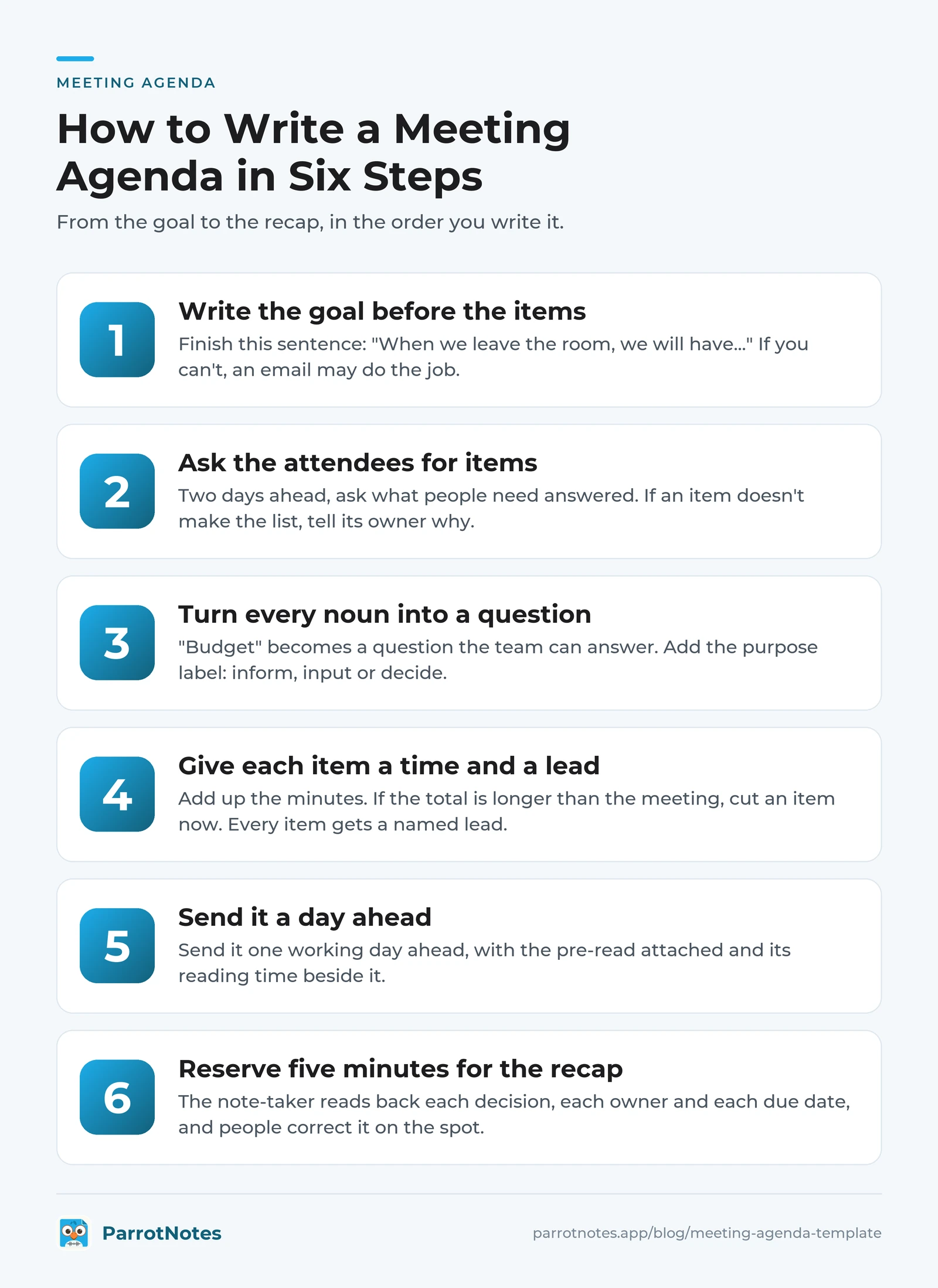
How to write a meeting agenda in six steps
A meeting agenda template gets you most of the way. These six steps cover the rest, and for a routine meeting they take about 10 minutes.
1. Write the goal before the items
Finish this sentence: "When we leave the room, we will have..." If you can't, an email may do the job.
2. Ask the attendees for items
Schwarz's first tip is to seek input from team members. Two days ahead, ask what people need answered. If an item doesn't make the list, tell its owner why.
3. Turn every noun into a question
"Budget" becomes "Can we fund a second intern from the Q4 training budget?" Add the purpose label: inform, input or decide. This step alone would have rescued Priya's Monday.
4. Give each item a realistic time and a lead
Add up the minutes. If the total is longer than the meeting, cut an item now, not at minute 55. Every item gets a named lead who knows they're leading it.
5. Say how to prepare, and send it a day ahead
An agenda that arrives 8 minutes before the meeting can't change how anyone prepares. Send it one working day ahead, with the pre-read attached and its reading time ("10 minutes") beside it.
6. Reserve the last five minutes for the recap
The recap is an agenda item with a time, not something you do if there's time. The note-taker reads back each decision, each owner and each due date, and people correct it on the spot. The weekly review in our productivity hacks post builds on the same habit.
Make your agenda record-ready: let the recording fill it in
Here's the part a meeting agenda template gallery leaves out. An agenda is the outline of the meeting's record. If the agenda is a list of questions, the record is the list of answers.
In a conference room, the person who should capture those answers is busy. Priya was chairing and keeping time. A board secretary is tracking motions.
That's when a recording earns its place, and a well-built agenda makes the recording far more useful.
Before you record, tell the room and ask permission. A line at the top of the agenda works well: "This meeting will be recorded for note-taking. Tell the chair if you object." Recording rules vary by state and country, and this article isn't legal advice. A confidential item can always be taken with the recorder paused.
Then run the meeting so the recording can follow the agenda. This is the record-ready checklist.
- Read each agenda item aloud as you open it. "Item three: do we extend cleaning to five days a week?" The transcript now has headings.
- Use names. "Amara, what do the two quotes say?" tells the record who's speaking.
- Say the decision as a sentence. "So the decision is: five-day cleaning from November 2, on the Brightway quote."
- Say the owner and the date together. "Amara owns the contract, due October 23."
- Park things out loud. "That's going in the parking lot for next month."
- Read the recap. The five-minute recap becomes a clean summary of the whole meeting, in the last minutes of the recording.
Put a phone running ParrotNotes in the middle of the table, and that meeting becomes a transcript, an AI summary and a list of action items. Recording carries on with the screen off, so the phone can sit face down. ParrotNotes can also draft the follow-up email from what was said, so the recap goes out the same day.
Picture Elena, the secretary of that arts nonprofit. Her chair reads each agenda item aloud and states every decision as a sentence. After the October meeting, Elena checks the summary against her agenda headings and has the action list ready in about 10 minutes. When a director later asks what was agreed on the roof quotes, she searches the transcript for "roof".
The free plan includes 100 minutes of recording a month, up to 30 minutes per recording, with an AI summary on every recording. That fits the weekly staff meeting in template 1. For 60-minute team meetings and two-hour board meetings, ParrotNotes Pro records up to 3 hours at a time, with 3,000 minutes a month. Pro costs $19.99 a month, or $14.99 a month billed annually.
Pro also adds AI chat, so you can ask a recording "What did we decide about the copier lease?" It transcribes in 99+ languages with translation, too. If your meeting covers sensitive topics, read how we protect your data first.
New to the app? The guide to getting started with ParrotNotes walks through a first recording. Our post on how to never miss action items was written for sales calls, but the owner-and-date habit works in any conference room.
Pick a meeting agenda template and send it today
The right meeting agenda template is the one that matches what your meeting has to produce. Here's the short version:
- Choose the format by outcome: weekly sync, timed team meeting, decision, kickoff or formal order of business
- Write every agenda item as a question, and label it inform, input or decide
- Give each item a time and a lead, and send the agenda a working day ahead
- Hold the last five minutes for a recap of decisions, owners and due dates
- Say decisions and owners aloud, so the record fills in against the agenda
Think back to Priya's four-word agenda. With template 1 sent on Friday and "Website" moved into its own decision meeting, her Monday ends at 9:30. The agency gets chosen on Wednesday.
Your next meeting is already on the calendar. Copy the meeting agenda template that fits and paste it into the invite. Then download ParrotNotes free, so the next agenda you write comes back with its answers filled in.
Frequently Asked Questions
What should a meeting agenda include?
A meeting agenda should include the meeting's goal in one sentence, the date, time and room, the attendees, and a list of timed agenda items. Each item names who leads it and whether it's there to inform, gather input or reach a decision. Finish with a recap of decisions, owners and due dates.
How far ahead should you send a meeting agenda?
Send it at least one working day before a routine meeting. Allow two to three days when there's a pre-read or a decision to prepare for. For formal boards and committees, check your bylaws, because they can set their own notice periods.
How do you write an agenda for a 30-minute meeting?
Limit it to one goal and no more than three topics. Give the first 5 minutes to last meeting's action items and the last 5 minutes to the recap, which leaves 20 minutes for discussion. The first meeting agenda template above is built for this slot. If a topic needs more than 10 minutes, give it its own meeting.
What's the difference between a meeting agenda and meeting minutes?
The agenda is the plan, written before the meeting: what will be covered, in what order, by whom and for how long. Minutes are the record, written afterwards: what was decided, who's responsible and by when. A well-worded agenda gives the minutes their headings, which is why agenda items written as questions are so useful.
Can you record a meeting instead of taking notes?
Yes, if everyone in the room agrees. Ask permission first, because recording rules vary by location. A transcript, summary and action items free the chair and the note-taker to take part. It works best when the chair reads agenda items, decisions and owners aloud.
Related Posts
Stakeholder Mapping for Complex Sales: Template and Example
Stakeholder mapping for complex sales: a fill-in template, a worked example, and 24 questions that reveal who decides. Copy the template and map your deal.

Sales Tools Every Field Rep Should Carry in 2026
Too many apps and no time between visits? See the sales tools a field rep should carry in 2026, run the four-question carry test, and print the checklist.

Sales Coaching Software: What to Look For
Buying sales coaching software for a field team? Use these 8 criteria, a 100-point scorecard, and 15 demo questions to choose a tool your reps will use.