
Safety Stand-Down Meeting: What It Is and How to Run One

Sarah Johnson
Writes about field sales, meeting notes and voice-first workflows at ParrotNotes. Every article is reviewed by the ParrotNotes product team before it goes live.
Table of Contents
- 1.What is a safety stand-down meeting?
- 2.OSHA's National Safety Stand-Down to Prevent Falls in Construction
- 3.Stand-down vs toolbox talk vs safety committee meeting
- 4.How to run a safety stand-down meeting
- 5.The stand-down record and sign-in sheet (copy and paste)
- 6.Record the stand-down on your phone
- 7.Follow up, then close the record
At 6:40 on a Tuesday, Dana read the night-shift note twice. A forklift carrying a wall-panel form had clipped a racking upright in bay 2. Nobody was hurt. The upright was bent about two inches at the base.
Dana runs a precast concrete plant with 38 people on days. She could have sent a memo. Instead, at 7:00 she stopped both bays and the yard, called everyone to the break room, and held a safety stand-down meeting before a single form moved. (Dana and her plant are composites, not a real manager or company.)
If you run a site or a plant, you already know the toolbox talk. A stand-down is bigger: the work stops, everyone attends, and the meeting ends with fixes that have owners and dates. Here's the short answer, then the detail.
A safety stand-down meeting is a planned pause in work to talk about one safety issue with everyone who does the work. It's usually 30 to 60 minutes, and it's held after an incident or near miss, or for a planned event such as OSHA's National Safety Stand-Down.
Below: what OSHA says about stand-downs (checked November 28, 2026), how a stand-down differs from a toolbox talk, a 45-minute agenda, and a stand-down record with a sign-in sheet you can copy. You'll also see how to record the meeting on your phone so the sign-in and actions get written up the same day. For that part, try ParrotNotes free.
What is a safety stand-down meeting?
OSHA's own definition is short: "A Safety Stand-Down is a voluntary event for employers to talk directly to employees about safety" (OSHA, Stop Falls Stand-Down, read November 28, 2026).
In practice, site and plant managers call two different meetings a stand-down:
- After an incident or near miss. Work stops the same day, often before the next shift starts. The meeting covers what happened, what changes, and when work can restart. This is Dana's kind.
- Planned. You choose a week and a hazard, such as falls, heat, or forklifts, and stop work for an hour to cover it in depth. OSHA's national event in May is the best-known example.
Both kinds share three things. Productive work stops. Everyone exposed to the hazard attends, including subcontractors and temps. And the meeting ends with written actions, not just a talk.
OSHA's National Safety Stand-Down to Prevent Falls in Construction
OSHA runs a National Safety Stand-Down to Prevent Falls in Construction every year. The 13th one ran "May 4th-8th, 2026," according to OSHA's stand-down page. OSHA's May 4, 2026 news release says it "focuses on preventing falls, the leading cause of fatalities in the construction industry," and that it runs in partnership with CPWR, NIOSH and the NORA Construction Sector Council.
The reason is on the same page: falls from elevation accounted for "389 of the 1,034 construction fatalities recorded in 2024 (BLS data)."
Three things to know before you plan for next year (all checked on osha.gov on November 28, 2026):
- 2027 dates weren't posted yet. The page still showed May 4-8, 2026. The event has been held in early May; check the page in the spring before you book a date.
- You don't need to be in construction. OSHA says companies not exposed to fall hazards "can also use this opportunity to have a conversation with employees about the other job hazards they face." A plant can hold one on forklifts or lockout.
- The certificate comes after the event. OSHA's page says employers "were able to provide feedback about their Stand-Down and download a Certificate of Participation," in English and Spanish, after the stand-down. On the day we checked, the page described it in the past tense for 2026, so look for the feedback form on the stand-down page once next year's week ends.
Ray, a site superintendent on a six-story residential job, used the 2026 week for a 40-minute stand-down with his framing and roofing subs. (Ray is a composite.) Each crew inspected its own harnesses and lanyards on the deck, and two lanyards with frayed webbing came out of service that morning. That's the hands-on part OSHA recommends, and it gave Ray something concrete to write down.
Stand-down vs toolbox talk vs safety committee meeting
All three are safety meetings, and people mix them up. The difference is how often, who attends, and what the record has to show.
| Toolbox talk | Safety stand-down | Safety committee meeting | |
|---|---|---|---|
| When | Start of shift, daily or weekly | After an incident, or a planned week | Monthly |
| Length | 5 to 15 minutes | 30 to 60 minutes | 60 minutes |
| Who | One crew | Everyone exposed, including subs and temps | Committee members |
| Work | Keeps going after | Stops until the meeting ends | Not affected |
| Record | Topic and sign-in | Sign-in, what was raised, actions, restart | Minutes and hazard log |
For the daily version, our toolbox talk guide has a ten-minute format and a sign-in sheet. For the monthly meeting that tracks hazards until they're closed, see the safety committee meeting minutes template.
How to run a safety stand-down meeting
OSHA's suggestions page lists eight steps for the national event. Here they are adapted for any stand-down, planned or not.
- Stop the work and name a coordinator. One person owns the meeting. On a multi-site company, name one per site. For an incident stand-down, that's usually the plant or site manager.
- Invite everyone exposed. OSHA suggests asking "your subcontractors, owner, architects, engineers, or others" to take part. On a plant, include maintenance, temps and drivers who load in the yard.
- Prepare one topic. OSHA says the meeting "should provide information to employees about hazards, protective methods, and the company's safety policies, goals and expectations." One hazard, not five. If you need ideas for a planned stand-down, the free safety meeting topics generator has lists by trade.
- Plan something hands-on. "Hands-on exercises (a worksite walkaround, equipment checks, etc.) can increase retention," says OSHA. Walk to the bent upright. Inspect the harnesses.
- Let the crew talk. OSHA's advice is to make it "positive and interactive" and to "let employees talk about their experiences and encourage them to make suggestions." The people who drive the forklift know where the blind corners are.
- Write down every action with an owner and a date. Say each one out loud before you move on.
- Sign in and sign off the restart. Everyone signs. The coordinator signs that work can restart, and under what conditions.
- Follow up. OSHA's last step is "Follow up." Carry every open action to the next meeting until it's closed.
A 45-minute stand-down agenda
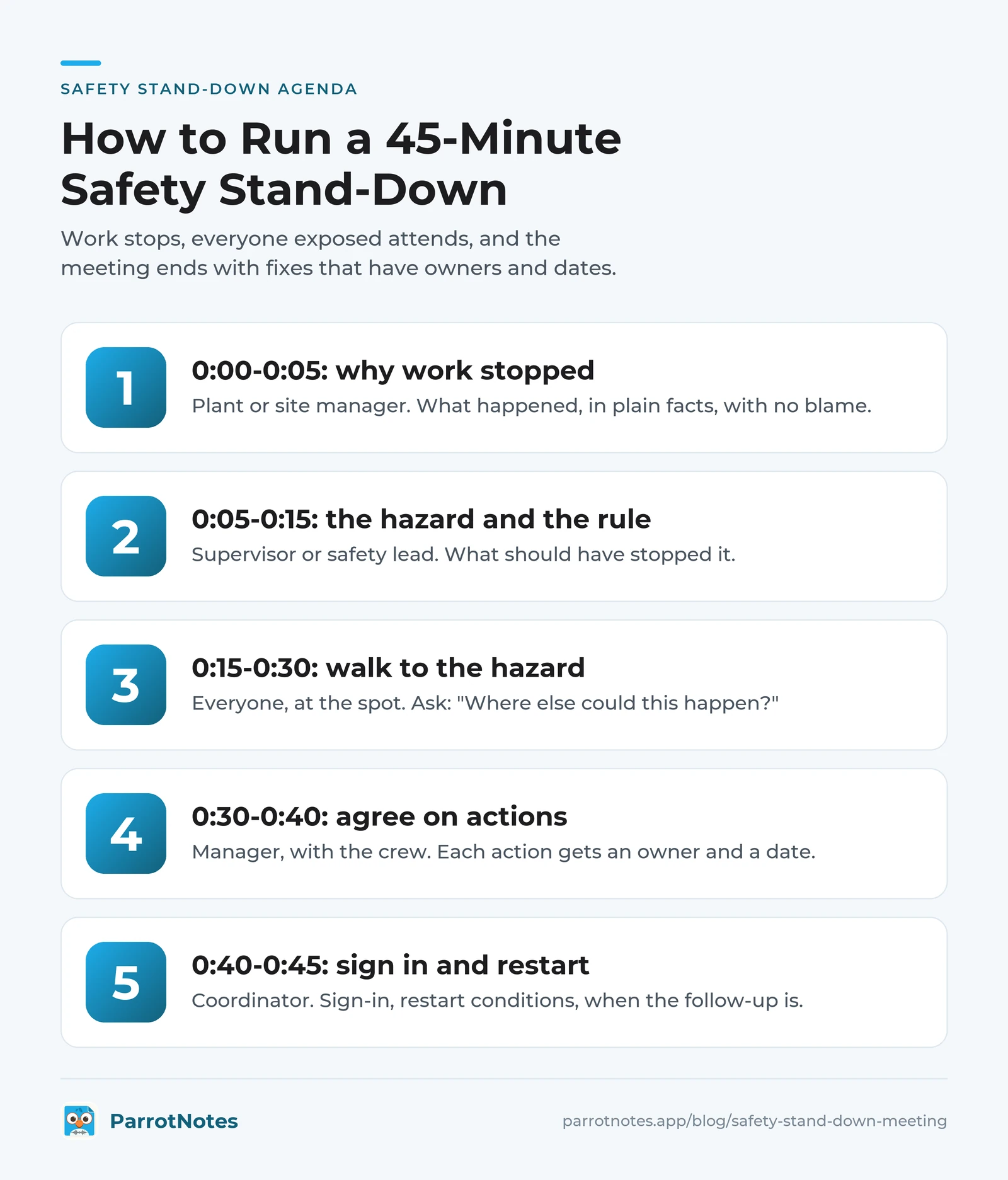
Dana's meeting followed this agenda. Shorten it to 30 minutes for a planned stand-down on a single topic.
| Time | Who speaks | What happens |
|---|---|---|
| 0:00-0:05 | Plant or site manager | Why work stopped. What happened, in plain facts, with no blame |
| 0:05-0:15 | Supervisor or safety lead | The hazard and the rule: what should have stopped it |
| 0:15-0:30 | Everyone, at the hazard | Walk to the spot. Ask: "Where else could this happen?" |
| 0:30-0:40 | Manager, with the crew | Agree on actions: each one gets an owner and a date |
| 0:40-0:45 | Coordinator | Sign-in, restart conditions, when the follow-up is |
If the event itself needs a formal report, keep that separate. The free incident report template covers what happened; the stand-down record covers what the crew heard and what changes.
The stand-down record and sign-in sheet (copy and paste)
A stand-down with no record is a break with a speech. If a client, an insurer or head office asks later what you covered and who was there, this is the page you show.
SAFETY STAND-DOWN RECORD
Company:                         Site / plant / area:
Date:            Work stopped at:          Work restarted at:
Coordinator (name and role):
Type:  [ ] After an incident or near miss   [ ] Planned (topic week)
Topic (one only):
Why today (incident, near miss, planned event):

WHAT WAS COVERED
1.
2.
3.
Hands-on activity (walkaround, inspection, demo):

RAISED BY THE CREW
Item                               Raised by        Action?
................................   ..............   .......

CORRECTIVE ACTIONS
No.  Action                         Owner        Due         Done
1.
2.

RESTART CONDITIONS (what must be true before work resumes):

SIGN-IN: I attended this stand-down
No.   Printed name        Company / crew       Signature
1.
2.
(add lines for everyone)

Absent, to be briefed by:              on:
Coordinator signature:                 Date:
Follow-up meeting:                     Filed in:
Two lines do most of the work. Corrective actions turn a talk into fixes. Restart conditions show nobody went back to work before the fix that mattered was done. For a printable attendance sheet with your own columns, use the free sign-in sheet template.
A filled example
Here's Dana's record, shortened. Northgate Precast is a composite plant, not a real company.
| Field | Northgate Precast, bays 1 and 2 |
|---|---|
| Date and times | Tuesday, November 17, 2026. Work stopped 7:00, restarted 7:52 |
| Coordinator | Dana Whitfield, plant manager |
| Type and topic | After a near miss. Forklift travel in the racking aisles |
| Why today | Night shift: a forklift carrying a wall-panel form clipped a racking upright in bay 2. No injury |
| Hands-on | The whole group walked bay 2 and looked at the bent upright and the aisle width |
| Raised by the crew | Forms stick out past the forks on two products (raised by Luis, forklift operator). The aisle mirror at the bay 2 corner is cracked (raised by Ana, yard lead) |
| Corrective actions | 1. Racking inspection and upright replaced (owner: Mike, maintenance; due Nov 18). 2. Spotter required for oversize forms (owner: Dana; due today). 3. New mirror at bay 2 (owner: Mike; due Nov 20) |
| Restart conditions | Bay 2 aisle taped off until the upright is replaced; oversize forms move only with a spotter |
| Sign-in | 36 of 38 signed. Absent: 2 drivers, briefed by Ana on November 18 |
| Follow-up | Thursday production meeting; open actions carried until closed |
Anyone reading it a year later knows what happened, who was there, and who fixed what by when. The open actions go on the agenda of the next production meeting, where they stay until they're done.
Record the stand-down on your phone
The sign-in sheet shows who attended. It doesn't show what Luis said about the forms sticking out past the forks, or the exact restart condition everyone agreed to. A recording does. It's an addition to the signed record, never a replacement: a recording can't show that each named person attended.
Here's how it works with ParrotNotes on an iPhone or Android phone.
- Tell everyone you're recording, and why. Say it before you press record. Recording rules differ by state; our one-party consent states guide explains them as general information, not legal advice.
- Put the phone on the table, close to whoever is talking. ParrotNotes keeps recording with the screen locked. Recording works without a signal; the transcript and summary need an internet connection.
- Use names when you hand over. "Luis, go ahead." On Pro, speaker identification infers who's talking from name cues like that.
- After the meeting, read the summary and action items. Copy the actions onto the record with owners and dates while everyone is still in the building.
Check the length first. The free plan records up to 30 minutes per recording and 100 minutes a month, with an AI summary on every recording and action items on 5 recordings a month. That covers a 30-minute planned stand-down. A 45-minute stand-down like Dana's runs past the 30-minute limit, so either record it in two parts or use ParrotNotes Pro: $19.99 a month, or $14.99 a month billed annually, with 3,000 minutes a month and recordings up to 3 hours. If you also want to compare apps for recording meetings in a room, our best AI note taker for in-person meetings roundup covers seven options.
Want your next stand-down on record? Download ParrotNotes free and record a short meeting before the next one.
Follow up, then close the record
On Thursday, Dana opened the production meeting with the stand-down record. The upright was replaced on Wednesday. The spotter rule was already working. The mirror was due Friday, so it stayed on the list. When the mirror went up, she wrote "done" and the date on the record and filed it.
That's what separates a stand-down from a talk. Stop the work, keep to one hazard, walk to it, let the crew speak, and write every fix down with a name and a date. Sign everyone in, and don't restart until the restart conditions are met. Then carry the open actions to the next meeting until they're closed. If the incident also damaged product, that part goes to the weekly quality meeting.
Next time work has to stop, get ParrotNotes free, tell the room you're recording, and you'll have the words behind every line on the record.
Frequently Asked Questions
What is a safety stand-down meeting?
A safety stand-down meeting is a planned pause in work so everyone who does the job can talk about one safety issue. It usually lasts 30 to 60 minutes. Managers hold one after an incident or near miss, or for a planned event such as OSHA's National Safety Stand-Down to Prevent Falls in Construction. OSHA calls a stand-down "a voluntary event for employers to talk directly to employees about safety."
When is the next National Safety Stand-Down?
The 13th National Safety Stand-Down to Prevent Falls in Construction ran May 4-8, 2026. When we checked osha.gov on November 28, 2026, OSHA hadn't posted 2027 dates. The event has been held in early May, so check OSHA's stand-down page in the spring.
How do I get an OSHA stand-down certificate?
OSHA's stand-down page says employers could give feedback on their stand-down and download a Certificate of Participation, in English and Spanish, after the event. The certificate comes from the feedback form on OSHA's stand-down page once the national week ends.
How is a safety stand-down different from a toolbox talk?
A toolbox talk is 5 to 15 minutes with one crew at the start of a shift, and work goes on after it. A safety stand-down stops the work for 30 to 60 minutes, brings in everyone exposed to the hazard, including subcontractors and temps, and ends with corrective actions, owners and restart conditions on a signed record.
What should a stand-down record include?
The date, when work stopped and restarted, the coordinator, the topic and why it was chosen, what was covered, what the crew raised, corrective actions with an owner and a due date, restart conditions, and a sign-in with everyone's printed name and signature. Note who was absent and when they'll be briefed.
Related Posts
Quality Meeting Agenda and Minutes for Manufacturing Teams
Run a weekly quality meeting in 45 minutes: an agenda for scrap, NCRs and CAPA status, a minutes template, and two weeks of sample minutes you can copy.

Grant Report Template: Format, Sample and What Funders Check
Copy a grant report template, see a filled-in sample report with a budget table, and check what funders like Mott and Fry ask for. Try ParrotNotes free.
Decision Audit Trail: How to Record Who Agreed What in Meetings
Keep a decision audit trail across meetings: 7 linked records, a decision entry template and one decision traced through three meetings. Try ParrotNotes free.