
Toolbox Talk: How to Run One in Ten Minutes and Keep a Signed Record

Sarah Johnson
Writes about field sales, meeting notes and voice-first workflows at ParrotNotes. Every article is reviewed by the ParrotNotes product team before it goes live.
Table of Contents
- 1.What a toolbox talk is (and what it isn't)
- 2.Who gives the toolbox talk
- 3.How to run a toolbox talk in ten minutes
- 4.The toolbox talk record and sign-in sheet (copy and paste)
- 5.Is there an OSHA toolbox talk rule? What the regulations say
- 6.A toolbox talk for construction crews, plants, and hotels
- 7.Record the toolbox talk on your iPhone or Android phone
- 8.Run tomorrow's toolbox talk from the sheet
Marta gave a toolbox talk every Tuesday at 6:50 am, and she had the sheets to prove it. Then a framer on her four-story apartment job stepped on a loose floor-opening cover on level 3. He caught himself on a stud and walked away.
The client's safety rep asked when she had last covered floor openings with this crew. Marta pulled the folder. Every sheet said "Safety" at the top, with 14 signatures under it and no topic. She had talked about floor openings in October, and she couldn't show it. (Marta is a composite, not a real superintendent.)
If you run a site, a plant floor, or a hotel back-of-house, here's the short answer. Pick one topic that fits today's work, and stand where the hazard is.
Talk for three minutes, ask the crew for three, agree what changes today, and have everyone sign a sheet that names the topic, the date, and you. Ten minutes.
Below: that format minute by minute, a record with a sign-in sheet to copy, a filled example, and what OSHA and two state rules say about keeping it. You'll also see how to record the talk on your phone, so what the crew raised isn't lost by next Tuesday. For that part, try ParrotNotes free.
What a toolbox talk is (and what it isn't)
A toolbox talk is a short, informal safety meeting on one topic, held with the crew at the start of a shift, where the work happens. It usually takes 5 to 15 minutes. You'll also hear it called a tailgate meeting or a safety briefing.
The UK's Health and Safety Executive calls it "a short presentation to the workforce on a single aspect of health and safety." Note the part most people skip: one topic, not six.
It isn't formal training, and it doesn't replace a forklift certification. OSHA's guidance leaves room for it, though: "Effective training and education can be provided outside a formal classroom setting" (OSHA's education and training recommended practices, read November 23, 2026).
It also isn't the safety committee, which meets monthly and tracks hazards until they're closed; our safety committee meeting minutes template covers that record. And it isn't the staff meeting, which covers output, schedules and questions from the floor; our staff meeting minutes sample shows that record for a plant.
Who gives the toolbox talk
The person who assigns the work gives the talk: the foreman, the superintendent, the shift supervisor, or the operations manager. You don't need to be a speaker. You need one page of notes and two questions.
How often matters too. The 2026 ABC Health and Safety Performance Report, as summarized by the association's South Texas chapter, found that "contractors conducting daily toolbox talks achieve a 59% reduction in TRIR and 61% reduction in DART compared to monthly talks" (ABC South Texas, May 5, 2026). That's one association's member data, and it shows a link, not a cause.
How to run a toolbox talk in ten minutes
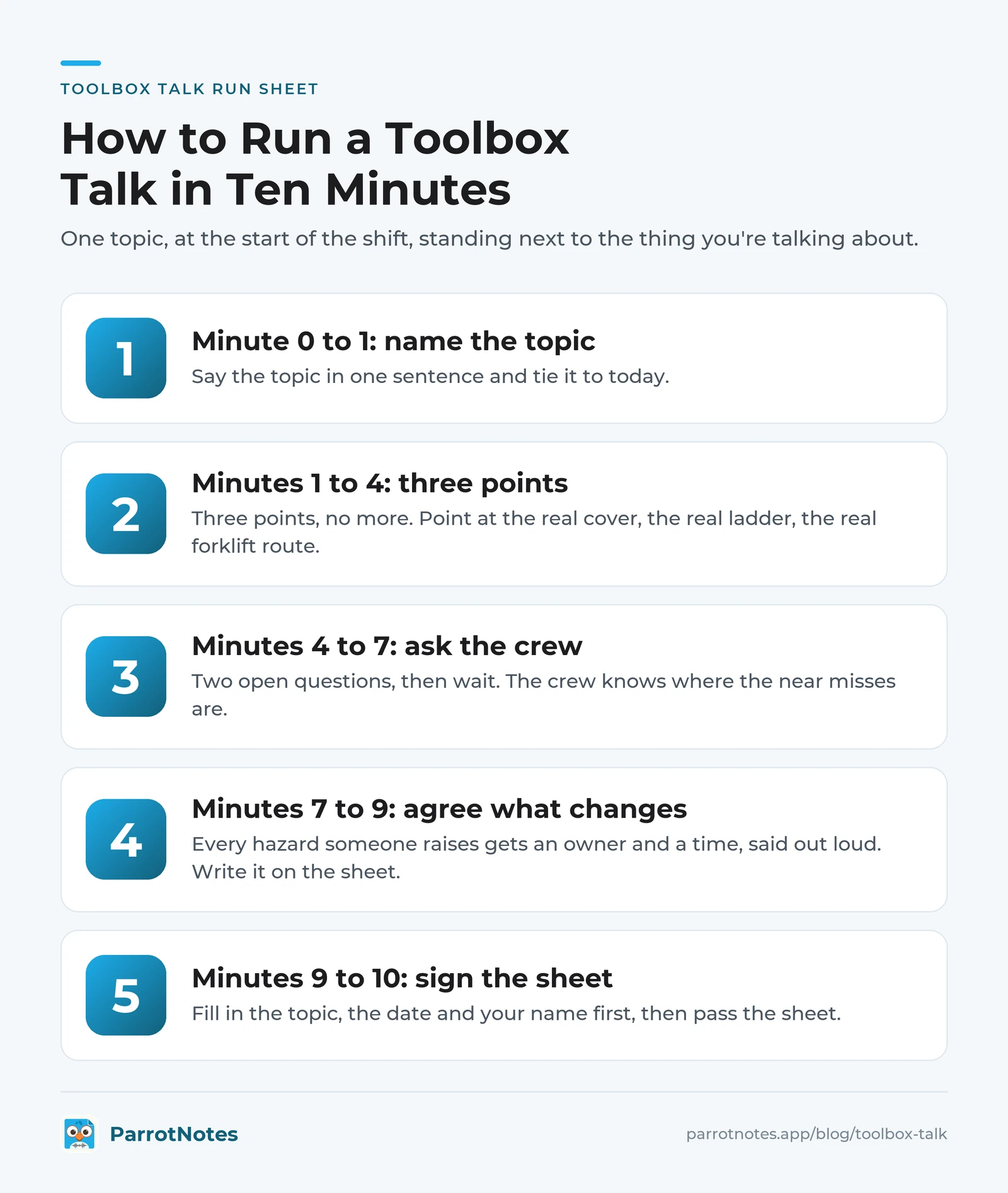
Hold it at the start of the shift, standing, next to the thing you're talking about.
1. Minute 0 to 1: name the topic and why today
Say the topic in one sentence and tie it to today. "Floor-opening covers, because we cut four new openings on level 3 yesterday."
2. Minutes 1 to 4: three points, at the hazard
Give three points, no more. Point at the real cover, the real ladder, the real forklift route. If you read from a prepared talk, put it in your own words.
3. Minutes 4 to 7: ask the crew
Ask two open questions: "Where on this job could that happen today?" and "What have you seen that I haven't?" Then wait. The crew knows where the near misses are.
4. Minutes 7 to 9: agree what changes today
Every hazard someone raises gets an owner and a time, said out loud. "Luis fastens the two covers by the stair core before 9." Write it on the sheet.
5. Minutes 9 to 10: sign the sheet
Fill in the topic, the date, and your name first, then pass the sheet. A blank sheet signed in advance is what left Marta with nothing to show.
That's the whole talk. If you're still going at minute 20, you picked two topics.
Need a topic? Keep it to today's work: ladders in wet weather, a new forklift route, heat on a roof deck. For a full list by trade and season, with talking points and crew questions, use the free safety meeting topics generator.
The toolbox talk record and sign-in sheet (copy and paste)
A signature next to nothing proves nothing. The record needs the topic, the date, the presenter, and what the crew raised.
TOOLBOX TALK RECORD
Company:                         Site / area:
Date:              Start:              End:
Presenter (name and role):
Topic (one only):
Why today (task, weather, incident, near miss):

POINTS COVERED
1.
2.
3.

RAISED BY THE CREW (hazard or question)
Item                               Owner          Due
................................   ............   ..........

Language(s) the talk was given in:

SIGN-IN: I attended this talk and understood it
No.   Printed name        Company / trade      Signature
1.
2.
(add lines for the whole crew)

Absent today, to be briefed by:              on:

Presenter signature:                         Date:
Filed in:                        Keep until:
Three lines do most of the work. Raised by the crew gives every hazard an owner. Language shows people could follow the talk. Absent today covers the two people who weren't there.
Want different columns? Use the free sign-in sheet template. To fill in the whole record on screen and print it with the sign-in sheet attached, use the free toolbox talk template.
A filled example
Harlow Street Apartments is a composite site, not a real project. Its record for one Tuesday looks like this.
| Field | Harlow Street Apartments, level 3 |
|---|---|
| Date and time | Tuesday, November 17, 2026, 6:50 to 7:01 am |
| Presenter | Marta Reyes, superintendent |
| Topic | Floor-opening covers |
| Why today | Four new openings cut on level 3 on Monday; near miss at the stair core |
| Points covered | 1. Site rule: every cover is fastened and marked before the area reopens. 2. If you lift a cover, you put it back and fasten it. 3. Report a loose cover to the foreman the same hour. |
| Raised by the crew | Two covers by the stair core aren't fastened (owner: Luis, framing foreman; due 9:00 am today). Plumbers lift covers to run risers and leave them loose (owner: Marta to brief the plumbing foreman; due today). |
| Language | English and Spanish; Luis repeated each point in Spanish |
| Sign-in | 14 of 16 signed. Absent: 2 drywall hangers, briefed by Luis on November 18 |
| Keep until | End of project plus the period in the client contract |
A stranger can read it a year later and know what was said, who heard it, and who fixed what by when.
The two raised items also belong in the day's construction daily report, and the weekly construction meeting minutes carry anything that stays open.
Is there an OSHA toolbox talk rule? What the regulations say
Federal OSHA has no standard called "toolbox talk." It has a duty to instruct, plus record rules for specific kinds of training. Some states name the meeting. We read each page below on November 23, 2026. This is general information, not legal advice.
| Rule | What it says | Record it names |
|---|---|---|
| Federal OSHA, 29 CFR 1926.21(b)(2) (construction) | "The employer shall instruct each employee in the recognition and avoidance of unsafe conditions and the regulations applicable to his work environment to control or eliminate any hazards or other exposure to illness or injury." | None. The section doesn't mention toolbox talks, records, or retention. |
| Federal OSHA, 29 CFR 1926.503(b) (fall protection training) | "The employer shall verify compliance with paragraph (a) of this section by preparing a written certification record." | The employee's name or other identity, the training date(s), and the signature of the trainer or the employer. "The latest training certification shall be maintained." |
| California, Title 8 §1509(e) (construction) | "Supervisory employees shall conduct 'toolbox' or 'tailgate' safety meetings, or equivalent, with their crews at least every 10 working days to emphasize safety." | See the next row. |
| California, Title 8 §3203(b)(2) (injury and illness prevention program) | Training documentation includes "employee name or other identifier, training dates, type(s) of training, and training providers." | "This documentation shall be maintained for at least one (1) year." Smaller employers have exceptions. |
| Washington, WAC 296-155-110 (construction) | "You must hold crew leader-crew safety meetings at the beginning of each job, and at least weekly thereafter." | Attendance and subjects discussed, in minutes kept "for at least one year." |
So how long do you keep the sheets? None of the federal pages we read sets a period for these records. California and Washington say at least one year for the records they name.
Practices vary beyond that: a client contract, an insurer, or your company policy may ask for longer. Follow the longest one that applies, and write "keep until" on the sheet.
One more point for bilingual crews. OSHA's Training Standards Policy Statement of April 28, 2010 says "an employer must instruct its employees using both a language and vocabulary that the employees can understand." If half the crew follows Spanish better than English, give the points in both, and write that on the record.
A toolbox talk for construction crews, plants, and hotels
The ten minutes are the same everywhere. The place and the trigger change.
- A toolbox talk for construction crews happens at the gang box or the tailgate, and the trigger is the day's task: a pour, a crane pick, a new trade on site. Subcontractor crews sign the same sheet, with their company next to their name.
- In a plant, hold it at the line before startup. The trigger is usually a change: a new product run or a rerouted forklift aisle.
- In a hotel, it's the housekeeping or engineering huddle. The trigger might be a new chemical or a banquet setup with heavy lifting.
Dev runs second shift at a bottling plant. (Dev is a composite, not a real supervisor.) One Thursday he gave a seven-minute talk on a forklift route that had moved two days earlier.
When he asked what he'd missed, a packer said the new route crossed the break room walkway at a blind corner. Dev wrote it on the sheet with the maintenance lead's name and "mirror by Monday." The mirror went up on Friday.
If a talk follows an incident, the incident goes in its own file; the free incident report template keeps that format consistent.
Record the toolbox talk on your iPhone or Android phone
The sign-in sheet shows who was there. It doesn't show what the packer said about the blind corner. A recording does. It's an addition to the signed sheet, never a substitute: it can't show that 14 named people attended and understood.
Here's how it works with ParrotNotes on an iPhone or an Android phone.
- Tell the crew you're recording, and why. Say it before you press record, every time. Consent rules differ by state; our one-party consent states guide explains them as general information, not legal advice.
- Press record and put the phone in your shirt pocket or on the tailgate. ParrotNotes keeps recording with the screen locked. Recording works without a signal; the transcript and summary need an internet connection.
- Stand away from running equipment. Speech recognition works in moderate noise, not next to a generator.
- Use names. "Go ahead, Luis." On Pro, speaker identification infers who is talking from name cues like that.
- Read the summary and action items afterwards. Copy what the crew raised onto the record, with the owner and the time.
The free plan gives you 100 minutes of recording a month, up to 30 minutes per recording, an AI summary on every recording, and action items and key points on 5 recordings a month. A weekly ten-minute talk fits. A daily one doesn't; a month of working days runs past 200 minutes.
ParrotNotes Pro is $19.99 a month, or $14.99 a month billed annually. It gives you 3,000 minutes a month, recordings up to 3 hours, AI on every recording, speaker identification, and multilingual transcription for talks that aren't in English. The apps come with both plans, and our guide on how to record a meeting on iPhone covers phone placement.
Want next week's talk on record? Download ParrotNotes free and record one talk before you decide.
Run tomorrow's toolbox talk from the sheet
Six weeks after the near miss, the client's safety rep came back to Marta's site and asked the same question. This time she turned to one page: November 17, floor-opening covers, 14 signatures, and two hazards with an owner and a deadline next to each.
A toolbox talk takes ten minutes when you hold it to one topic. Name it, give three points at the hazard, ask the crew, and write down what they raise with an owner. Sign a sheet that already says what the talk was about, and keep it for as long as your state, your client, or your insurer asks.
Then let your phone do the remembering. Get ParrotNotes free, tell the crew you're recording, and you'll have the words behind every line on the sheet.
Frequently Asked Questions
What is a toolbox talk?
A toolbox talk is a short, informal safety meeting on one topic, held with the crew at the start of a shift, where the work happens. It usually takes 5 to 15 minutes. The presenter covers a few points, asks the crew questions, and everyone signs a sheet that names the topic and the date. It's also called a tailgate meeting or a safety briefing.
Does OSHA require toolbox talks?
Federal OSHA has no standard called "toolbox talk." Its construction rule, 29 CFR 1926.21(b)(2), requires employers to instruct each employee in recognizing and avoiding unsafe conditions, and a toolbox talk is one common way to do part of that. Some states name the meeting: California requires toolbox or tailgate meetings at least every 10 working days in construction, and Washington requires crew safety meetings at least weekly on construction sites. Check your state's rules. This is general information, not legal advice.
How long should a toolbox talk be?
About ten minutes: one minute on the topic and why today, three on the points, three for the crew's questions and hazards, two to agree what changes, and one to sign the sheet. Anything from 5 to 15 minutes is normal. If it runs to 20, you've probably covered two topics.
How long should I keep toolbox talk sign-in sheets?
The federal OSHA pages read for this article set no retention period for toolbox talk records. California and Washington require at least one year for the training and meeting records they name. A client contract, an insurer, or your company policy may ask for longer, so follow the longest requirement that applies and write the date on the sheet.
Can I record a toolbox talk instead of using a sign-in sheet?
No. A recording shows what was said and who raised which hazard, which a sheet can't. It doesn't show that each named person attended and understood, which is what the signatures are for. Use both: tell the crew you're recording, keep the signed sheet, and write the recording's name on it.
Related Posts
User Interview Platforms Compared: Panels, Recording and Transcripts
User interview platforms compared by job: recruiting panels, session recording and transcripts, with prices checked in November 2026. Try ParrotNotes free.
Transcription Software for Qualitative Research: Options Compared
Qualitative research transcription software compared: NVivo, ATLAS.ti, MAXQDA, Otter, Rev, Sonix, offline apps and a phone app. Prices checked November 2026.
Staff Meeting Minutes: Sample, Template and What to Leave Out
Copy a staff meeting minutes sample from a hotel staff meeting, a one-page template and a list of what to leave out, then draft yours from a recording.