
Production Meeting Agenda and Minutes for Manufacturing Plants

Sarah Johnson
Writes about field sales, meeting notes and voice-first workflows at ParrotNotes. Every article is reviewed by the ParrotNotes product team before it goes live.
Table of Contents
- 1.What a production meeting is, and who attends
- 2.The 15-minute production meeting agenda
- 3.Tier meetings and the SQDC board: what the sources say
- 4.Production meeting minutes template (copy and paste)
- 5.Sample production meeting minutes: two days at a molding plant
- 6.How open actions carry to the next production meeting
- 7.Record the production meeting on your iPhone or Android phone
- 8.Run tomorrow's production meeting from the open actions
On Tuesday at 7:30 am, Dana's production meeting agreed that the worn heater band on press 4 would be swapped before Thursday. Six people heard it, at the board by the presses. Nobody wrote it down.
On Thursday at 10:40, press 4 stopped mid-run. The band had failed, and the replacement was still on the shelf in the maintenance crib. The maintenance tech thought second shift had it. Second shift had never heard of it. The press lost three hours and a customer order slipped a day. (Dana is a composite operations manager, not a real person.)
If you run the daily production meeting at your plant, here's the short answer. Stand at the board at the same time every day and spend 15 minutes on seven items: safety, yesterday's open actions, output against plan, quality, maintenance, staffing and materials, then read back the actions.
Every action gets a number, one owner and a due shift. Tomorrow's meeting starts by reading those numbers out loud.
Below you'll find the timed agenda, a minutes template to copy, and filled-in minutes from two days at one plant, showing what happens to each action the next morning. There's also a way to record the meeting on your phone so you aren't writing at the board; try ParrotNotes free if you want to test that part.
What a production meeting is, and who attends
A production meeting is a short daily meeting where the people running a plant's shifts review yesterday against plan, deal with today's problems and agree who does what before the next shift. Proaction International describes it as "a short meeting usually held at the beginning of the day" (Proaction International, May 7, 2024). In film and theatre, "production meeting" means something else entirely; this guide is about plants.
The plant or operations manager usually chairs it. Around the board you'll find the shift supervisors or team leads, the quality lead, the maintenance lead, and whoever plans materials and the schedule. Five to eight people is common. More than ten, and the meeting turns into a briefing.
It's easy to confuse with three other short meetings. Here's how they differ:
| Meeting | Who and when | What it decides |
|---|---|---|
| Production meeting | Plant manager, supervisors, quality, maintenance; daily at the board | Output against plan, problems, actions with owners by shift |
| Toolbox talk | A supervisor and the crew; start of shift, at the hazard | One safety topic, with a signed sheet |
| Daily standup | A project or software team; daily | Progress toward a sprint goal |
| Staff meeting | The whole team; weekly or monthly | Announcements, policies, bigger decisions |
If your monthly meeting is the staff kind, use our staff meeting agenda template for it and keep the daily production meeting short. For its record, see our staff meeting minutes sample.
The 15-minute production meeting agenda
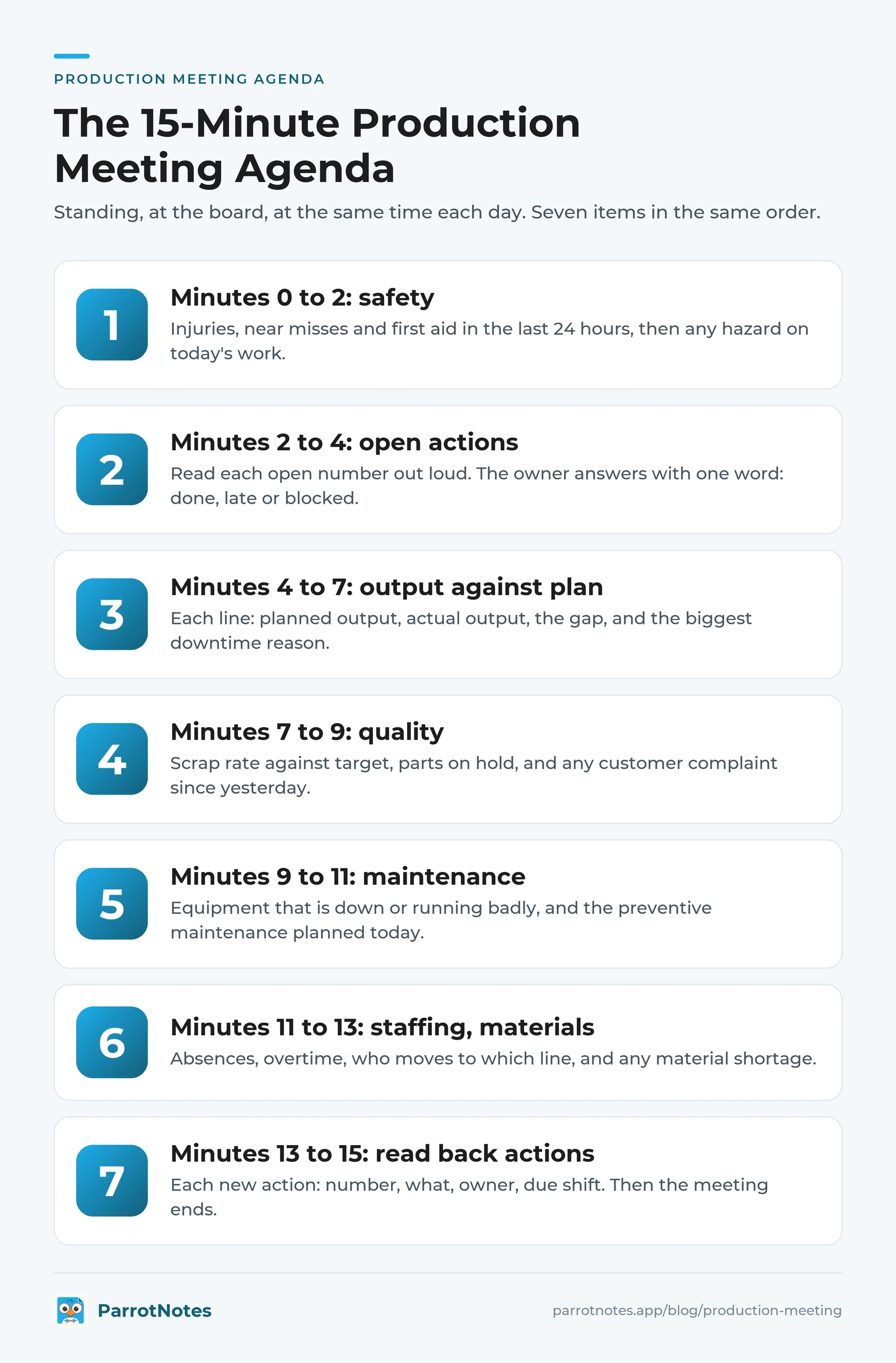
Hold it standing, at the board, at the same time each day. Early in day shift works for most plants, once supervisors have the overnight numbers. Shoplogix puts it plainly: "Most production meetings do not need more than 15–20 minutes if they stay focused" (Shoplogix).
1. Safety (minutes 0 to 2)
Injuries, near misses and first aid in the last 24 hours, then any hazard on today's work. If an item needs a crew briefing, it goes into tomorrow's toolbox talk, not this meeting.
2. Yesterday's open actions (minutes 2 to 4)
Read each open number out loud. The owner answers with one word: done, late or blocked. Late items get one new due shift. No discussion here.
3. Output against plan (minutes 4 to 7)
Each line or area: planned output, actual output, the gap, and the biggest downtime reason. Supervisors write their numbers on the board before the meeting, so nobody reads from a phone.
4. Quality (minutes 7 to 9)
Scrap rate against target, parts on hold, and any customer complaint since yesterday. A quality escape with a root cause to find gets its own meeting; the free corrective action plan template helps there.
5. Maintenance (minutes 9 to 11)
Equipment that is down or running badly, and the preventive maintenance planned today. This is where Dana's heater band should have been written down.
6. Staffing and materials (minutes 11 to 13)
Absences, overtime, who moves to which line, and any material shortage that will stop a line before the next meeting.
7. Read back the actions (minutes 13 to 15)
The note-taker reads each new action: number, what, owner, due shift. If someone hears their name and disagrees, it gets fixed now, in front of everyone. Then the meeting ends.
Anything that needs more than two minutes of discussion leaves the board as an action: "Dana and Priya to meet at 10:00 about the resin lot." The production meeting decides who handles a problem; it doesn't solve it.
Tier meetings and the SQDC board: what the sources say
Plants that run lean daily management often call this a tier meeting. The Kaizen Institute describes a chain of daily meetings: "Tier 1: Frontline teams meet first. They review yesterday's results against target, today's plan and new problems." Supervisors meet next and take the problems tier 1 couldn't solve, then department managers, then plant leadership.
The same page says "each meeting runs on a visual board, such as an SQDC board (safety, quality, delivery, cost)," and that a problem that can't be solved at one tier "moves up to the next tier the same day, with a named owner" (Kaizen Institute, read November 24, 2026).
You don't need four tiers to use the idea. If your plant has one daily meeting, the meeting above does the supervisors' job in that chain: it takes what the lines couldn't solve and gives each problem an owner. The agenda follows the same order as the board, so the minutes follow it too.
Production meeting minutes template (copy and paste)
Production meeting minutes don't need prose. They need the numbers, the problems and the actions, on one page, in the order of the agenda.
PRODUCTION MEETING MINUTES
Plant / area:                         Date:
Start:          End:          Chair:              Minutes:
Present:

1. SAFETY (last 24 hours)
   Injuries / near misses / first aid:
   Hazards for today:

2. OPEN ACTIONS FROM PREVIOUS MEETINGS
   No.   Action                    Owner      Due          Status
   ...   .......................   ........   ..........   Done / Late (new due) / Blocked

3. OUTPUT AGAINST PLAN (yesterday)
   Line / area   Plan    Actual   Gap    Top downtime reason

4. QUALITY
   Scrap % vs target:      Parts on hold:      Complaints:

5. MAINTENANCE
   Down or degraded:
   PM planned today:

6. STAFFING AND MATERIALS
   Absences / moves / overtime:
   Shortages:

7. NEW ACTIONS
   No.   Action                    Owner      Due (shift / time)

ESCALATED TO:                           By:
Next meeting:
Three rules make it work. Numbers never restart: action 41 stays action 41 until it's closed, even across weeks. Due is a shift or a time, never "ASAP". One owner per action, by name, not "maintenance".
For the reasoning behind each field, our action items template walks through them.
Sample production meeting minutes: two days at a molding plant
Cedar Valley Molding is a composite plant, not a real company: six injection presses, two shifts. Here are its minutes for two days in a row, so you can see what happens to each action.
Wednesday's minutes
CEDAR VALLEY MOLDING: PRODUCTION MEETING MINUTES
Date: Wednesday, November 18, 2026   7:30 to 7:44 am, production board
Chair: Dana Whitfield (operations manager)   Minutes: Priya Shah (quality)
Present: Dana, Priya, Luis (day shift supervisor),
         Ken (maintenance), Ana (materials)

1. SAFETY
   Near miss, 2nd shift: pallet jack left in the aisle by press 2.
   Hazards today: mold change on press 5 at 1 pm (overhead lift).

2. OPEN ACTIONS
   #38 Re-label resin bins, zone B | Ana | Tue 2nd shift | Done
   #39 Guard sensor, press 2       | Ken | Tue day      | Done

3. OUTPUT AGAINST PLAN (Tuesday)
   Presses 1-3: plan 9,600, actual 9,350, gap -250, mold change ran long
   Presses 4-6: plan 8,400, actual 7,900, gap -500, press 4 heater
                zone alarms (12 min)

4. QUALITY
   Scrap 2.8% against 2.0% target, mostly short shots on press 4.
   1,200 housings on hold (lot 1117) pending dimensional check.

5. MAINTENANCE
   Press 4 heater band worn: spare in the crib.
   PM today: press 6 hydraulic filter.

6. STAFFING AND MATERIALS
   Day shift one operator short; Luis covers press 6 from the floater.
   Resin for press 5 arrives Thursday 6 am.

7. NEW ACTIONS
   #40 Replace heater band, press 4        | Ken   | Wed 3 pm
   #41 Dimensional check, lot 1117         | Priya | Wed 12:00
   #42 Aisle marking by press 2, refresh   | Luis  | Fri day
   #43 Floater for day shift next week     | Luis  | Thu meeting

ESCALATED TO: none
Next meeting: Thursday, November 19, 7:30 am
The heater band now has a number, one owner and a time. Nobody can assume the other shift has it.
Thursday: what happened to Wednesday's actions
2. OPEN ACTIONS (Thursday, November 19)
   #40 Replace heater band, press 4  | Ken   | Wed 3 pm      | Done 3:40 pm
   #41 Dimensional check, lot 1117   | Priya | Wed 12:00     | Done; 1,180 released,
                                                               20 scrapped
   #42 Aisle marking by press 2      | Luis  | Fri day       | Open, on time
   #43 Floater for day shift         | Luis  | Thu meeting   | Blocked: needs HR
                                                               approval for overtime
   ESCALATED: #43 to the weekly plant review, Friday 2 pm, owner Dana
Four lines, two minutes. Two actions closed, one still inside its due date, and one escalated with a named owner instead of drifting.
How open actions carry to the next production meeting
The daily rhythm makes this easier than in a weekly meeting, as long as you keep five rules.
- Read open actions second, right after safety. If they wait until the end, they get skipped when the meeting runs over.
- An action keeps its number until it's closed. Copy every open item into the next day's minutes, not just the late ones.
- Late twice means escalate. A second missed due shift goes up a level: the weekly plant review, or the next tier if you run them, with a named owner.
- Closed means the person who needed it confirms. Ken says the band is in; the second-shift supervisor says press 4 ran clean all shift.
- Friday rolls the week up. Items still open on Friday go on the weekly review list, so nothing sits on the board for a month.
For a longer-running log with statuses and a weekly health check, see our action items tracking guide.
The shift change is where actions get lost. Marco, Cedar Valley's second-shift supervisor (also a composite), used to hear about day-shift actions second-hand at 2:45 pm.
Now Priya posts a photo of the minutes to the supervisors' group chat by 8 am. Marco reads the actions that touch his shift to his crew at their start-of-shift huddle, and confirms them in the chat before he leaves. Action 40, the heater band, was the first one he confirmed that way: press 4 ran its whole second shift without a heater alarm.
Record the production meeting on your iPhone or Android phone
Writing minutes standing at a board, while also chairing, is how actions like Dana's heater band get lost. A recording means the chair talks and the minutes get written afterward from what was actually said.
Here's how it works with ParrotNotes on an iPhone or an Android phone:
- Tell everyone you're recording, every time. Consent rules vary by state and by country; our one-party consent states guide explains them as general information, not legal advice. Your company or a union agreement may have its own rule, so check it first.
- Stand away from running presses. Speech recognition copes with moderate noise, not with a press cycling a meter away. If the board is next to the line, hold the phone between you and the group, or move the meeting a few steps.
- Press record and keep it in your hand or shirt pocket. ParrotNotes keeps recording with the screen locked. Recording works without a signal; the transcript and summary need an internet connection.
- Say names and numbers out loud. "Ken, that's action 40, second shift." On Pro, speaker identification infers who is talking from name cues like that.
- Copy the action items into the minutes. Check each owner and due shift against the read-back before you send them.
The free plan gives you 100 minutes of recording a month, up to 30 minutes per recording, an AI summary on every recording, and action items and key points on 5 recordings a month. That's about six 15-minute meetings: enough to try it for a week, not for every day.
ParrotNotes Pro is $19.99 a month, or $14.99 a month billed annually, with 3,000 minutes a month, recordings up to 3 hours, AI on every recording, speaker identification, and multilingual transcription for meetings held partly in Spanish or another language. The iPhone, Android and Mac apps come with both plans. Our guide on how to record a meeting on iPhone covers where to put the phone.
Want tomorrow's production meeting on record? Download ParrotNotes free and record one meeting before you decide.
Run tomorrow's production meeting from the open actions
Two weeks after press 4 went down, Dana's Thursday meeting ran 14 minutes. The open actions took two of them: five numbers, four done, one escalated to Friday with her name next to it. Nobody asked who had the heater band.
That's the whole system. A production meeting needs fifteen minutes at the board, seven items in the same order every day, and actions with a number, one owner and a due shift. Copy the open ones into tomorrow's minutes and read them second. When an item misses twice, it goes up a level with a name on it.
If customers visit the floor, the same board is a good stop on a manufacturing plant tour. And if you want the minutes written for you, get ParrotNotes free, tell the team you're recording, and let tomorrow's meeting produce its own first draft.
Frequently Asked Questions
What is a production meeting?
A production meeting is a short daily meeting in a manufacturing plant where the plant or operations manager, the shift supervisors, quality, maintenance and materials review yesterday's output against plan, raise today's problems and agree actions with owners. It usually runs 15 minutes, standing at the production board, at the start of the day.
What should be on a production meeting agenda?
Seven items in a fixed order: safety in the last 24 hours, yesterday's open actions, output against plan by line, quality (scrap, holds, complaints), maintenance, staffing and materials, and a read-back of the new actions with owner and due shift. Give each item two or three minutes and move anything longer to a separate meeting.
How long should a daily production meeting be?
About 15 minutes. Shoplogix says most production meetings don't need more than 15 to 20 minutes if they stay focused. If yours runs longer, problem-solving is happening at the board; turn those discussions into actions and hold them afterward with the people involved.
What goes in production meeting minutes?
The date, time, chair and attendees; the safety items; the status of every open action; output against plan per line; quality, maintenance and staffing notes; and the new actions, each with a number, one named owner and a due shift or time. Note anything escalated and to whom. One page is enough.
What is a tier meeting in manufacturing?
A tier meeting is one level in a chain of short daily meetings. The Kaizen Institute describes frontline teams meeting first, then supervisors, then department managers, then plant leadership, each at a visual board such as an SQDC board (safety, quality, delivery, cost). A problem one tier can't solve moves up to the next tier the same day, with a named owner.
Related Posts
RFQ Email Format: How to Request a Quote and Answer One
RFQ email format for buyers and suppliers: subject lines, a request to copy, and the supplier's acknowledgment, clarifying email and quote reply, with samples.

Open-Ended Questions in Qualitative Research: 40 Examples
40 open-ended questions in qualitative research, grouped by type, with weak-to-strong rewrites and an interview order. Record and quote the answers free.
Governance Meeting Agenda and Minutes Template
Run a governance meeting with a terms of reference template, a 60-minute agenda, filled-in minutes, and a table that sends every decision to the right log.