
Quality Meeting Agenda and Minutes for Manufacturing Teams

Sarah Johnson
Writes about field sales, meeting notes and voice-first workflows at ParrotNotes. Every article is reviewed by the ParrotNotes product team before it goes live.
Table of Contents
- 1.What a quality meeting is, and how it differs from your other meetings
- 2.Who attends a weekly quality meeting
- 3.The 45-minute quality meeting agenda
- 4.Quality terms your minutes will use
- 5.Quality meeting minutes template (copy and paste)
- 6.Sample quality meeting minutes: two weeks at a window plant
- 7.How actions and CAPAs carry to next week's quality assurance meeting
- 8.Record the quality meeting on your iPhone or Android phone
- 9.Run next week's quality meeting from the open list
For three Tuesdays in a row, Rosa's quality meeting agreed to "look into" the sash seal complaint. Six people sat around the conference room table off the floor. Everyone nodded. Nobody's name went next to it.
On the fourth Tuesday, the distributor's quality contact emailed. She wanted the corrective action, the root cause and the date it took effect, before her audit visit in two weeks. Rosa had a whiteboard photo and three sets of handwritten notes that didn't agree. (Rosa is a composite plant manager at a sample window plant, not a real person.)
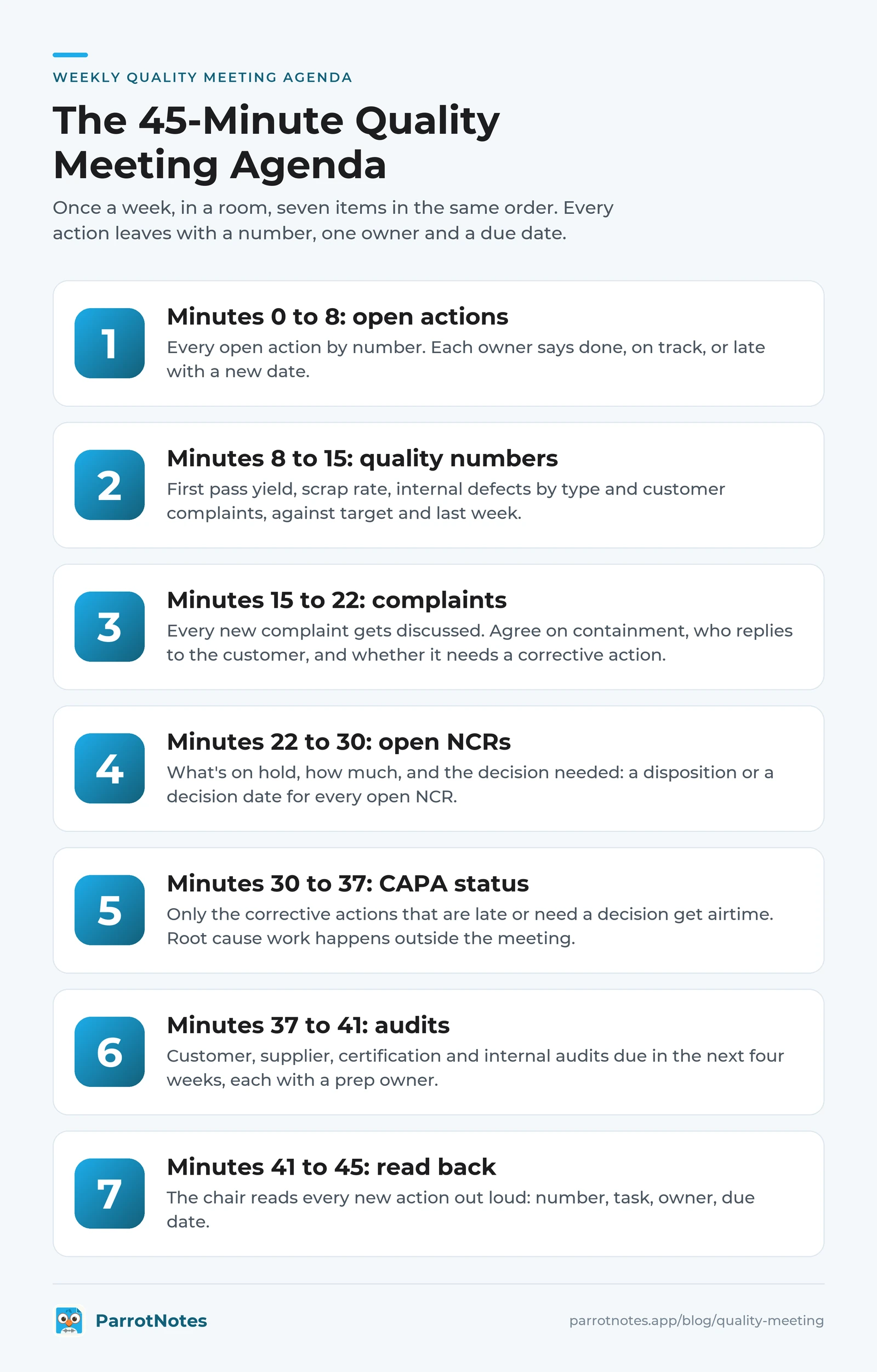
If you run the weekly quality meeting at your plant, here's the short answer. Meet once a week for 45 minutes, in a room, with the same seven items in the same order: open actions, the week's quality numbers, customer complaints, open NCRs, CAPA status, audits, then a read-back of new actions. Every action leaves with a number, one owner and a due date.
What usually breaks is the record between one week and the next. Below you'll find the timed agenda, the terms your minutes will use, a minutes template to copy, and filled sample minutes from two weeks at one plant. There's also a way to record the meeting on your phone so the minutes write themselves afterward; try ParrotNotes free if you want to test that part.
What a quality meeting is, and how it differs from your other meetings
A quality meeting is a regular review where a plant's managers look at the week's quality results, decide what happens to nonconforming product, check corrective actions and assign the next steps. In a plant it usually runs weekly. Some teams call it the quality assurance meeting or the quality review.
It sits between three other meetings, and mixing them up is why many quality meetings run long:
| Meeting | How often | What it decides |
|---|---|---|
| Daily production meeting | Daily, 15 minutes at the board | Output against plan, today's problems, actions by shift |
| Weekly quality meeting | Weekly, about 45 minutes in a room | Quality trends, complaints, NCR status, CAPA progress, audit prep |
| NCR disposition review | As needed, often after the quality meeting | What happens to each held lot: rework, scrap, use as is, return to supplier |
| ISO 9001 management review | At planned intervals, often once or twice a year | Whether the quality system as a whole works, with the standard's required inputs |
The daily meeting catches problems the same shift; the weekly one looks at patterns and checks that fixes happen. If your plant is ISO 9001 certified, the management review is its own formal meeting (SafetyCulture's agenda and minutes template shows its inputs), and the weekly minutes become evidence for it.
Who attends a weekly quality meeting
Keep it to five to eight people who can commit their own department:
- Plant or operations manager: chairs it and owns the escalations.
- Quality manager or quality engineer: brings the numbers and the NCR and CAPA lists.
- Production supervisors: one per area or shift, because most actions land on them.
- Maintenance lead: many defects trace back to a machine.
- Purchasing or supplier quality: when a supplier part is in the NCR list.
Invite others for one item, like a process engineer for the CAPA they own, and let them leave after it.
The 45-minute quality meeting agenda
Hold it the same day and time each week. Early in the week works well: the previous week's numbers are in, and there's time to act before Friday. Send the numbers and the open lists the day before, so the meeting decides instead of reads.
1. Open actions from last week (minutes 0 to 8)
Go through every open action by number. Each owner says done, on track, or late with a new date.
Output: an updated status on every open action.
2. The week's quality numbers (minutes 8 to 15)
Show the same few numbers every week, against target and last week: first pass yield, scrap rate, internal defects by type and customer complaints received. Look at trends, not single days.
Output: one or two items that need an owner, or "on target, no action".
3. Customer complaints (minutes 15 to 22)
Every new complaint gets discussed, whatever it costs. Agree on containment (what's held, sorted or checked), who replies to the customer, and whether it needs a corrective action.
Output: an owner and a reply date for each complaint.
4. Open NCRs (minutes 22 to 30)
Review each open nonconformance report: what's on hold, how much, and the decision needed. If a disposition needs a long discussion, schedule a separate disposition review. MangoApps' NCR review template puts the goal well: "The discussion should end with a clear decision and named follow-up owners" (MangoApps).
Output: a disposition or a decision date for every open NCR.
5. CAPA status (minutes 30 to 37)
Only the corrective actions that are late or need a decision get airtime. The rest are listed in the minutes with their status. Root cause work happens outside the meeting. As iFactory puts it: "The meeting finds, ranks and assigns. Root cause work happens afterwards" (iFactory, October 31, 2026).
Output: a step and a date for each CAPA discussed.
6. Audits and upcoming visits (minutes 37 to 41)
Customer audits, supplier audits, certification audits and internal audits due in the next four weeks. Agree who prepares what.
Output: a prep owner for each audit.
7. Read back the new actions (minutes 41 to 45)
The chair reads every new action out loud: number, task, owner, due date.
Output: the action list for the minutes.
Quality terms your minutes will use
Use the same definitions every week, so the minutes mean the same thing to an auditor.
- Nonconformity and NCR. A nonconformity is the "nonfulfillment of a requirement", the definition from ISO 9000 quoted by Quality Digest. An NCR (nonconformance report) is the record of one: what was found, how much, and what was done with it.
- Corrective and preventive action (CAPA). The ASQ quality glossary describes corrective action as a solution meant to reduce or eliminate an identified problem, and preventive action as action taken to prevent nonconformances from happening. CAPA is the process that covers both.
- 8D. A structured problem-solving method that came from Ford and is used mainly for customer complaints and recurring problems. ASQ lists its steps as D1 to D8, with D0 for planning.
- First pass yield (FPY). The share of units that get through a process the first time without rework or repair (Manufacturing.net).
If you need a form for the corrective action itself, our corrective action plan template has the fields and a tracker. The quality meeting minutes only point to it by number.
Quality meeting minutes template (copy and paste)
WEEKLY QUALITY MEETING MINUTES
Date:            Time:            Location:
Chair:           Minutes by:
Attendees:
Absent:

1. OPEN ACTIONS FROM LAST WEEK
#  | Action | Owner | Due | Status (Done / On track / Late) | New date

2. QUALITY NUMBERS (week / target / last week)
First pass yield:
Scrap rate:
Top internal defects:
Customer complaints received:
Notes:

3. CUSTOMER COMPLAINTS
Complaint # | Customer | Issue | Containment | Reply owner | Reply due | CAPA needed?

4. OPEN NCRs
NCR # | Part / lot | Qty on hold | Disposition or decision date | Owner

5. CAPA STATUS
CAPA # | Problem | Current step | Owner | Due | On track?

6. AUDITS (next 4 weeks)
Date | Type | Prep owner | What's needed

7. NEW ACTIONS
#  | Action | Owner | Due

Escalated to:            Next meeting:
Number actions in one running sequence for the year, not per meeting. Action 57 stays action 57 until it's closed. For a longer-running log, our action items template has a format you can keep in a shared sheet.
Sample quality meeting minutes: two weeks at a window plant
This sample is invented for illustration. Northline Windows is a sample vinyl window plant, and every name and number below is made up.
Week 1: Tuesday, November 17, 2026
Chair: Rosa (plant manager). Minutes: Tom (quality manager). Attendees: Rosa, Tom, Luis (assembly supervisor), Jen (extrusion supervisor), Dave (maintenance lead), Priya (purchasing).
- Open actions: Action 51, gauge recalibration on the welder, done (Dave). Action 52, revised packing instruction, on track for Nov 20 (Jen).
- Numbers: FPY 94.1% (target 96%, last week 95.0%). Scrap 2.8% (target 2.0%). Top defect: sash seal gaps on the 3000 series, 41 units. One customer complaint.
- Complaint C-26-014: distributor reports seal gaps on 12 sashes. Containment: Luis sorts all 3000-series stock in the warehouse by Nov 18. Reply to customer: Tom, by Nov 19. CAPA needed: yes.
- NCRs: NCR-118, seal gap sashes, 41 units on hold, rework decision by Nov 19 (Tom). NCR-121, glass spacers from a supplier out of tolerance, 300 pieces on hold, return to supplier (Priya).
- CAPA: CAPA-031 opened for C-26-014, 8D, team Tom, Luis, Dave. D4 root cause due Nov 24.
- Audits: distributor audit Dec 8. Prep owner: Tom.
- New actions: 53, sort 3000-series stock (Luis, Nov 18). 54, customer reply (Tom, Nov 19). 55, check seal roller pressure on line 2 (Dave, Nov 20). 56, supplier corrective action request for spacers (Priya, Nov 20).
Week 2: Tuesday, November 24, 2026
- Open actions: 52 done. 53 done, 9 more defective sashes found and added to NCR-118. 54 done. 55 late, new date Nov 25 (part on order). 56 done, supplier replied.
- Numbers: FPY 95.2%. Scrap 2.3%. Seal gaps down to 17 units. No new complaints.
- Complaints: none new. C-26-014 stays open until CAPA-031 closes.
- NCRs: NCR-118, 50 units, reworked and passed, closed. NCR-121, credit received, closed.
- CAPA-031: D4 done. Root cause: worn seal roller on line 2 plus no pressure check at changeover. D5 fix agreed: replace roller, add the check to the changeover sheet. Due Dec 1 (Dave, Jen).
- Audits: Dec 8 prep list drafted. The distributor wants the CAPA-031 record; Tom attaches both weeks' minutes.
- New actions: 57, add roller pressure check to changeover sheet (Jen, Nov 27). 58, send CAPA-031 progress to the distributor (Tom, Nov 26).
Notice what carried over: action 55 kept its number, the complaint stayed open until its CAPA closed, and both NCRs closed with a disposition on record. That trail is what the distributor's quality contact asked Rosa for.
How actions and CAPAs carry to next week's quality assurance meeting
The weekly rhythm gives problems seven days to drift. Five rules keep them from it:
- Open actions go first. At the end, they get skipped when the meeting runs over.
- Copy every open item into the new minutes. Not just the late ones. A clean list each week is the record.
- Late twice means escalate. If action 55 misses its second date, it moves to Rosa with the reason written down.
- A complaint closes only when its CAPA closes. Otherwise it looks solved while the cause is still in the line.
- Closed means confirmed. The person who needed it says it's done, ideally with evidence: the changeover sheet, the passing sample.
For a running tracker with statuses across meetings, see our guide to action item tracking.
Record the quality meeting on your iPhone or Android phone
Chairing and writing minutes at once is how "look into it" ends up with no owner. A recording lets you chair now and write the minutes afterward from what was said.
Here's how it works with ParrotNotes on an iPhone or an Android phone:
- Tell everyone you're recording, every time. Consent rules vary by state and by country; our one-party consent states guide explains them as general information, not legal advice. Your company or a works agreement may have its own rule, so check it first.
- Put the phone in the middle of the table. A conference room is easier than the floor. Our guide on how to record a meeting on iPhone covers placement.
- Say numbers and names out loud. "Dave, that's action 55, Wednesday." On Pro, speaker identification infers who is talking from name cues like that.
- Check the action items against the read-back. ParrotNotes pulls out action items from the transcript; check each owner and date against item 7 before you send the minutes.
Recording works without a signal; the transcript and summary need an internet connection.
The free plan gives you 100 minutes of recording a month, up to 30 minutes per recording, an AI summary on every recording, and action items and key points on 5 recordings a month. A 45-minute meeting is longer than one free recording, so you'd split it in two.
ParrotNotes Pro is $19.99 a month, or $14.99 a month billed annually (prices as of November 2026), with 3,000 minutes a month, recordings up to 3 hours, AI on every recording, speaker identification, and multilingual transcription for meetings held partly in Spanish or another language. The iPhone, Android and Mac apps come with both plans.
Want next week's quality meeting on record? Download ParrotNotes free and record one meeting before you decide.
Run next week's quality meeting from the open list
Four weeks after the distributor's email, Rosa's quality meeting ran 42 minutes. Open actions took six of them. CAPA-031 was closed with the changeover sheet attached, and the distributor's audit took the two weeks of minutes as its evidence. Nobody asked who had the seal roller.
That's the system: 45 minutes, seven items in the same order, and actions with a number, one owner and a due date. Open actions go first, every open item is copied forward, and anything late twice goes up with a name on it.
Keep the daily problems in your production meeting and the patterns in this one. And if you want the minutes drafted for you, tell the team you're recording and let next Tuesday's meeting produce its own first draft.
Frequently Asked Questions
What is a quality meeting?
A quality meeting is a regular meeting, usually weekly in a plant, where the plant manager, the quality manager and the production, maintenance and purchasing leads review the week's quality results, customer complaints, open NCRs and corrective actions, then agree actions with one owner and a due date each.
What should be on a quality meeting agenda?
Seven items in a fixed order: open actions from last week, the week's quality numbers (first pass yield, scrap, top defects), customer complaints, open NCRs, CAPA status, upcoming audits, and a read-back of new actions. About 45 minutes in total.
How often should a quality meeting be held?
Weekly works for most plants, with a short daily production meeting for same-shift problems. The weekly meeting looks at trends and checks that corrective actions actually get done.
What is the difference between a quality meeting and a management review?
The weekly quality meeting handles this week's complaints, NCRs and actions. An ISO 9001 management review is a formal, less frequent meeting where top management checks whether the quality system as a whole works. Weekly minutes are useful evidence for it.
Who should take quality meeting minutes?
Someone other than the chair, often the quality manager or a quality engineer. Or record the meeting with the group's knowledge and write the minutes afterward from the transcript, so the chair can run the meeting.
Related Posts

Safety Stand-Down Meeting: What It Is and How to Run One
What a safety stand-down meeting is, a 45-minute agenda, and a stand-down record with sign-in and actions to copy. OSHA dates checked. Try ParrotNotes free.

Grant Report Template: Format, Sample and What Funders Check
Copy a grant report template, see a filled-in sample report with a budget table, and check what funders like Mott and Fry ask for. Try ParrotNotes free.
Decision Audit Trail: How to Record Who Agreed What in Meetings
Keep a decision audit trail across meetings: 7 linked records, a decision entry template and one decision traced through three meetings. Try ParrotNotes free.