
How to Write an RFP Response That Wins

Sarah Johnson
Writes about field sales, meeting notes and voice-first workflows at ParrotNotes. Every article is reviewed by the ParrotNotes product team before it goes live.
Table of Contents
Renee's team spent 11 days on a pump station proposal: 46 pages, a site survey, and a price they were proud of. The buyer rejected it before anyone scored it, because the signed acknowledgement for Addendum 2 wasn't in the package. (Renee is fictional, but the failure is common.)
You already know a good RFP response takes real work. What's less obvious is that most of what wins it is decided before anyone writes a paragraph: whether to bid, what the buyer will score, and what you learned on site.
This guide takes those in order, with the sections to include, a go/no-go scorecard, the writing steps, and an RFP response template you can copy. It's written for manufacturers, sales engineers, and reps, not software vendors. If your best facts come from plant walks, try ParrotNotes free so they're on the record when the document lands.
Not sure it's an RFP at all? Run the triage test in our RFQ vs RFP guide first. A fixed spec with a price form needs a quote instead, and our RFQ template has the format.
What goes in an RFP response
An RFP response is a written offer that shows a buyer how you'd solve their problem, what it costs, and why they should believe you. Most responses have the eight sections below. The buyer's own format always comes first: if the RFP names its sections, use its names and its order.
| Section | What it answers | Who usually writes it |
|---|---|---|
| Cover letter | Who's offering, and is this package complete? | Rep or account owner |
| Executive summary | What's your answer, in one page? | Rep, with the sales engineer |
| Compliance matrix | Where do you meet each requirement? | Proposal lead |
| Technical approach | How will you solve it, to what spec? | Sales engineer |
| Project plan and team | Who does what, by when? | Project manager |
| Past performance | Have you done this before? | Rep, with the customer's permission |
| Price and terms | What does it cost, and on what terms? | Pricing lead, sales manager |
| Required forms and exceptions | Is everything signed, and what won't you accept? | Proposal lead, legal |
U.S. federal RFPs make this easy to find. Instructions for the response sit in Section L and evaluation factors in Section M (FAR 15.204-5). Commercial and state RFPs use their own headings, but the same two questions are in there somewhere.
A capability statement doesn't replace any of this. It introduces your company before a job exists, though it's a useful source for the past performance section.
Should you respond? A go/no-go test
A full RFP response is expensive. Loopio, which sells RFP software, reports that teams spend 33 hours per RFP and nine people contribute, and that 75% of teams use a go/no-go process. Those are a vendor's survey averages, as read in November 2026, and an engineered bid can take far longer.
So decide first. Give it 30 minutes, with one named person making the call.
Five hard stops
One "no" here ends the bid, unless you can fix it before the deadline.
- Mandatory requirements: do you hold every required certification, registration, bond, and insurance level?
- The spec: can you meet it without an exception the buyer has ruled out?
- The date: can your plant deliver by the required date, at current lead times?
- The terms: can you live with the contract terms, or does the RFP allow exceptions?
- The people: are the engineer and pricing lead free before the due date?
Six scored factors
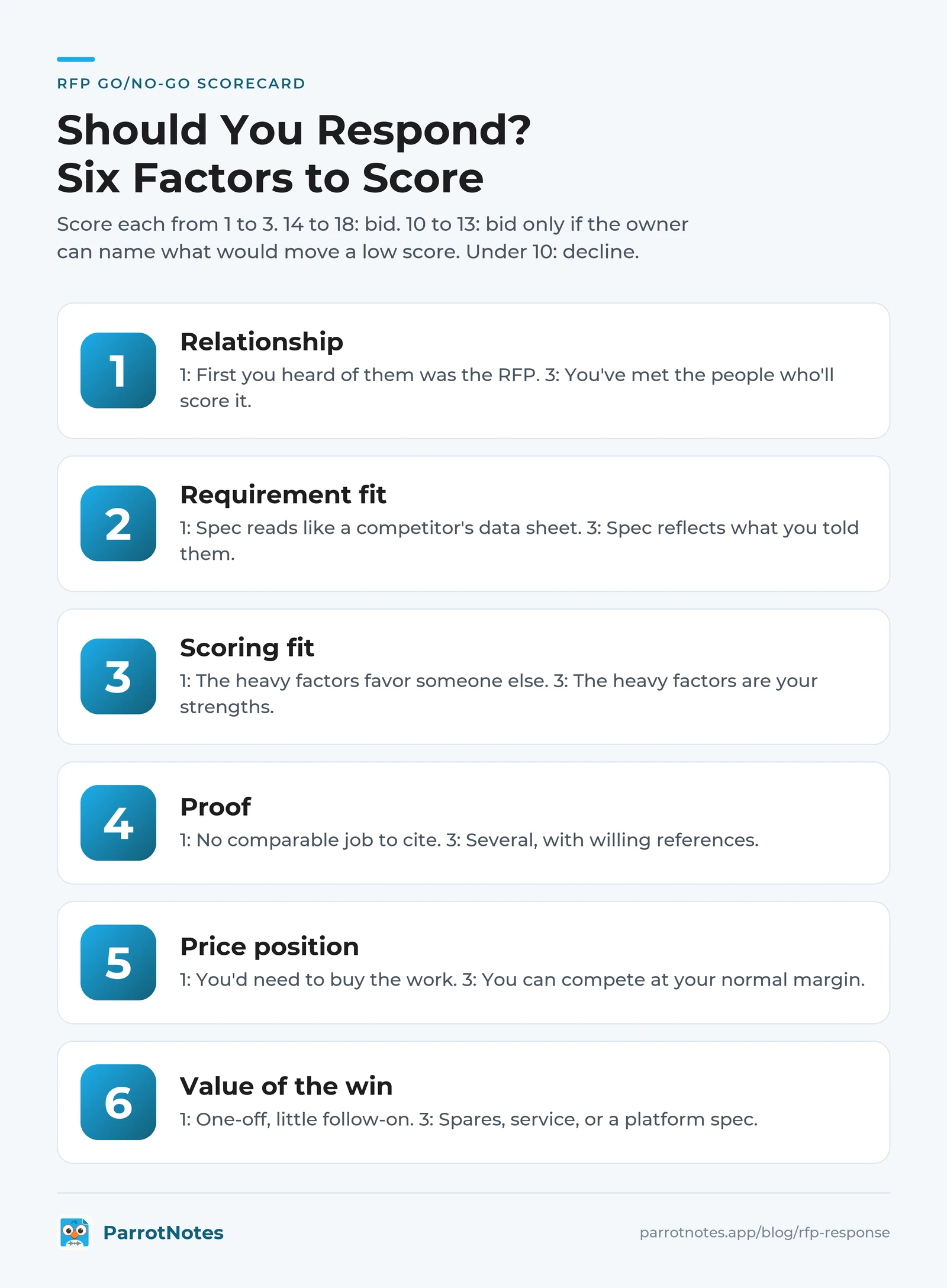
Score each from 1 (weak) to 3 (strong), then add them up.
| Factor | 1 | 3 |
|---|---|---|
| Relationship | First you heard of them was the RFP | You've met the people who'll score it |
| Requirement fit | Spec reads like a competitor's data sheet | Spec reflects what you told them |
| Scoring fit | The heavy factors favor someone else | The heavy factors are your strengths |
| Proof | No comparable job to cite | Several, with willing references |
| Price position | You'd need to buy the work | You can compete at your normal margin |
| Value of the win | One-off, little follow-on | Spares, service, or a platform spec |
14 to 18: bid. 10 to 13: bid only if the owner can name what would move a low score. Under 10: decline. These cut-offs are our suggested starting point, not research, so adjust them after your first ten decisions.
Check the break-even
Then compare what the bid costs with what winning pays. Say a response takes 120 hours at a loaded rate of $75: that's $9,000. If the job's expected margin is $60,000, you need better than a 15% chance of winning to come out ahead ($9,000 ÷ $60,000). These numbers are only an illustration, so plug in your own.
Compare that with your real win rate on similar bids, not someone else's. Loopio's own page gives two averages, 39% this year and 45% across 2019 to 2026, and neither tells you about bids like yours. Our free win rate calculator gives you your own number.
Picture Omar, a fictional manufacturers' rep, holding an RFP whose flow-rate table matches one competitor's catalog line for line. He'd never met the buyer. He scored it 8, sent a polite two-line decline, and his principal spent those 120 hours on a bid they'd helped shape.
How to write an RFP response, step by step
1. Read how you'll be scored first
Skip to the evaluation section before anything else. In U.S. federal buying, factors and "their relative importance shall be stated clearly in the solicitation" (FAR 15.304). Proposals are then judged "solely on the factors and subfactors specified in the solicitation" (FAR 15.305). Whatever doesn't touch a factor earns nothing.
2. Build a compliance matrix
List every "shall" and "must" before anyone drafts. Add every addendum, because that's where Renee's bid died. Here's a fictional example from a pump station RFP:
| Ref | Requirement | Type | Owner | Our section | Status |
|---|---|---|---|---|---|
| 3.2 | Duty point 1,200 gpm at 85 ft head | Must | Engineer | 4.1 | Draft |
| 3.7 | NEMA premium efficient motors | Must | Engineer | 4.3 | Done |
| 5.1 | Factory acceptance test, buyer present | Must | Project manager | 5.2 | Draft |
| 6.4 | Three references from the last 5 years | Must | Rep | 6 | Asking |
| A2 | Signed Addendum 2 acknowledgement | Must | Proposal lead | Forms | Open |
An evaluator should find every answer without hunting. Nothing goes out while a row says "Open."
3. Ask your questions early
Send them to the named contact before the deadline. Many RFPs bar contact with anyone else, so don't call your friend in maintenance. Answers often go to every bidder, so don't hand a competitor your angle.
4. Budget pages by points
Teams tend to write most about what they know best. Give space by points instead. Hawaii's State Procurement Office publishes a sample split of 1,000 points. Here's what it would mean for a 40-page limit, with the cost volume on its own form:
| Factor | Points | Share of non-price | Pages of 40 |
|---|---|---|---|
| Technical approach | 400 | 67% | 27 |
| Qualifications, experience, references | 150 | 25% | 10 |
| Managerial approach | 50 | 8% | 3 |
| Cost | 400 | Separate form | n/a |
Company history isn't on that list, so cut it to a paragraph. The same split works for hours.
5. Answer each requirement the same way
Use four beats: state that you meet it, say how, show proof, and say what it means for them.
- Weak: "We are an industry leader with decades of experience in high-efficiency pumping solutions."
- Strong: "We meet the 1,200 gpm duty point at 85 ft head with Model X. The attached curve shows the duty point at 78% efficiency. You'll witness the test at our plant before shipment, so the number is proven before the pump reaches your site."
Our sales engineer guide has a read-back script for getting them right in the room.
6. Make the price match the plan
If the plan promises a technician on site for 12 weeks and the price assumes four, an evaluator will catch it. List your assumptions and exclusions plainly.
Write only what your plant can deliver. Under FAR 2.101, a response to a federal RFP is an offer that, "if accepted, would bind the offeror to perform the resultant contract." Commercial terms and local law decide the details elsewhere. This isn't legal advice, so have counsel read any exceptions.
7. Score your own draft, then send it early
Hand the draft and the evaluation section to someone who didn't write it, and have them score it as a buyer. Then send it well before the deadline. A federal proposal that arrives after the exact time is "late" and generally won't be considered (FAR 15.208).
RFP response template
Copy this RFP response outline into your document. Keep the buyer's section names where they differ, and delete the prompts as you fill them in.
COVER LETTER (one page) RFP number and title: [ ] Due date: [ ] Named contact: [ ] Our offer in one sentence: [ ] Addenda acknowledged: [numbers] Offer valid until: [date] Signed by someone who can bind the company: [name, title]
1. EXECUTIVE SUMMARY (one page) What you told us you need: [the problem, in their words and numbers] What we propose: [solution in two sentences] Why it fits your top scoring factors: [one line each, in their order] Total price: [only if the RFP allows price outside the cost volume]
2. COMPLIANCE MATRIX [Ref | Requirement | Must or should | Meets, partly, or exception | Our section]
3. TECHNICAL APPROACH (most of your pages if it's the top factor) Understanding of the site or application: [baseline numbers, from your visit] Proposed solution: [models, drawings, data sheets] Requirement by requirement: [meets it, how, proof, what it means for them] Alternates: [only if the RFP allows them, priced separately]
4. PROJECT PLAN AND TEAM Schedule: [milestones, lead times, and what starts each clock] Testing and acceptance: [factory test, site test, who witnesses] Installation, training, and handover: [ ] Named team: [role, name, one line of relevant experience] What we need from you: [site access, utilities, approvals]
5. PAST PERFORMANCE For each of [number] jobs: customer, contact (with permission), dates, value, what we delivered, and the result. Choose jobs most like this one.
6. SERVICE AND SUPPORT Warranty: [terms] Spares: [list, lead times] Response time: [ ]
7. PRICE AND TERMS (separate file if the RFP says so) [Use the buyer's price form exactly] Assumptions and exclusions: [ ] Freight and delivery terms: [ ] Payment terms: [ ] Validity: [ ]
8. FORMS AND EXCEPTIONS Required forms, signed: [list] Registrations and certificates: [list] Exceptions: [clause number | what we propose instead | why]
Before you send it, check three things: every matrix row has a section, every addendum is acknowledged, and file names and format match the instructions.
What happens after you submit
The buyer may ask clarifying questions, or invite the top bidders to discussions or oral presentations. In federal buying, discussions take place with offerors in the "competitive range" (FAR 15.306). Bring the engineer who wrote the technical section to any orals.
Win or lose, ask for a debrief. Federal bidders must request one in writing "within 3 days" after they're notified of the award, and it covers your flaws, the winner's price and technical rating, and why the award was made (FAR 15.506). Commercial buyers don't have to agree, but it's worth asking. Put what you hear into your next scorecard.
Win the RFP response before the RFP lands
The strongest line in a technical section usually comes from a site visit. Imagine Renee's next bid. Months before the RFP, she walked the pump station with the operators and heard that night callouts were what they hated most. Her debrief recorded the callout count and who said it. Her executive summary opened with that problem, in their words.
ParrotNotes keeps those conversations usable. Record your debrief in the car after a plant tour or site walk, and you get a transcript, an AI summary, and action items. When the RFP arrives months later, search the pump station's name and the operator's words are there.
ParrotNotes Pro adds custom insight templates, so a debrief can come back sorted into the fields your proposal needs. If you're recording a meeting rather than yourself, ask everyone first, and check site rules on phones. Download ParrotNotes free and talk through your next site visit before you start the car.
Bid less, and answer what's scored
A winning RFP response is rarely the longest one. It's the one that should have been bid, answers what's scored, and misses nothing.
- Run the hard stops and the scorecard before writing
- Build the compliance matrix first, addenda included
- Give pages and hours by points
- Ask for a debrief, win or lose
Start with the template, then add the site notes that make it specific. Get ParrotNotes free and capture them while you still remember who said what.
Frequently Asked Questions
What is an RFP response?
An RFP response is the proposal a supplier sends to answer a request for proposal. It explains how you'd solve the buyer's problem, what it costs, and why you're credible, usually with a technical approach, project plan, past performance, price, and any required forms. In U.S. federal buying, it's a legally binding offer if accepted.
What should an RFP response include?
Include a cover letter, executive summary, compliance matrix, technical approach, project plan and team, past performance, price and terms, and required forms with any exceptions. If the RFP sets its own format, follow that format exactly, because evaluators score against their own structure.
How do you decide whether to respond to an RFP?
Check for hard stops first: mandatory requirements, spec, delivery date, contract terms, and available people. Then score relationship, requirement fit, scoring fit, proof, price position, and value of the win. Finally, compare what the bid costs with the margin at stake, using your own win rate on similar bids.
How long does an RFP response take?
It depends on the job. Loopio's survey puts the average at 33 hours and nine contributors per RFP, but that's across industries, and an engineered bid with drawings and a site survey can take much longer. Track your own hours for each bid, so the next go/no-go uses real numbers.
What is a good RFP win rate?
There's no reliable universal figure. Loopio's page reports both 39% for this year and 45% across 2019 to 2026, from teams in its own survey, and its mix of industries won't match yours. Your own win rate on similar bids, tracked over time, is the useful number.
What if you have no past performance?
Federal rules say a bidder with no relevant record "may not be evaluated favorably or unfavorably on past performance" (FAR 15.305). Elsewhere, cite similar commercial jobs or your people's earlier projects, and check what the RFP accepts.
Can you take exceptions in an RFP response?
Only where the RFP allows it. Some buyers treat exceptions as non-responsive, so read the instructions first, ask the named contact if they're unclear, and list each exception by clause with your proposed alternative. Have counsel review them. This is general information, not legal advice.
Related Posts

Best Talk to Text App for iPhone and Android
The best talk to text app for your phone: Apple Dictation and Siri on iPhone, Gboard and Gemini on Android, with free plans compared and a voice phrase sheet.

How to Use Speech to Text on iPhone
Turn on speech to text on iPhone in 3 steps, dictate in any app, switch languages, turn it off, and record when the mic stops. Checked on iOS 27, Nov 2026.

How to Record Calls on Samsung
Samsung call recording, step by step: record or auto record calls, find the files, get Galaxy AI transcripts, or turn it all off. Checked November 2026.